

Few birds capture the imagination like owls. Their ability to glide through forests almost without making a sound has fascinated people for centuries. What once seemed like a mysterious hunting advantage is now understood as an extraordinary feat of evolutionary engineering. The secret lies in owl silent flight feathers, which combine specialized structures that reduce turbulence, soften airflow, and minimize the sounds normally created during flight.
Scientists have spent decades studying these remarkable feathers, not only to understand how owls hunt so effectively but also to improve human technology. Engineers designing quieter aircraft, wind turbines, drones, and industrial fans have drawn inspiration from owl wings, making these nocturnal predators a leading example of biomimicry—the practice of solving engineering problems by learning from nature.
Table of Contents
- Why Owls Need Silent Flight
- How Flying Normally Creates Noise
- The Three Feather Adaptations Behind Silent Flight
- The Physics of Turbulence and Noise Reduction
- Why Silent Flight Makes Owls Better Hunters
- How Engineers Copied Owl Wings
- Biomimicry in Aviation and Wind Turbines
- Silent Flight Across Different Owl Species
- Common Myths About Owl Flight
- Frequently Asked Questions
- Conclusion
Why Owls Need Silent Flight
Unlike many birds that hunt during daylight, most owls rely heavily on hearing to locate prey at night.
Small mammals moving beneath leaves or snow often produce only faint sounds.
If an owl’s own wings generated loud rushing noises, those delicate sounds could be masked.
Silent flight provides two major advantages.
First, prey are less likely to detect an approaching predator.
Second, the owl can continue hearing its target throughout the final stages of an attack.
Natural selection has refined owl wings over millions of years into one of the quietest flight systems found in birds.
How Flying Normally Creates Noise
Whenever a bird flies, air flows around its wings.
As the wings move, the smooth airflow eventually breaks into chaotic swirling patterns called turbulence.
These turbulent eddies create pressure fluctuations that generate sound.
Most birds produce audible wing noise because air separates sharply from feather edges.
Rapid wingbeats increase turbulence even further.
The faster the airflow changes, the louder the resulting sound.
Owls reduce this problem through highly specialized feather structures that modify airflow before turbulence becomes noisy.
Owl Silent Flight Feathers: Three Extraordinary Adaptations
Scientists have identified three major feather adaptations responsible for the remarkable quietness of owl flight.
Rather than relying on one feature alone, all three work together to suppress aerodynamic noise.
1. The Leading-Edge Comb
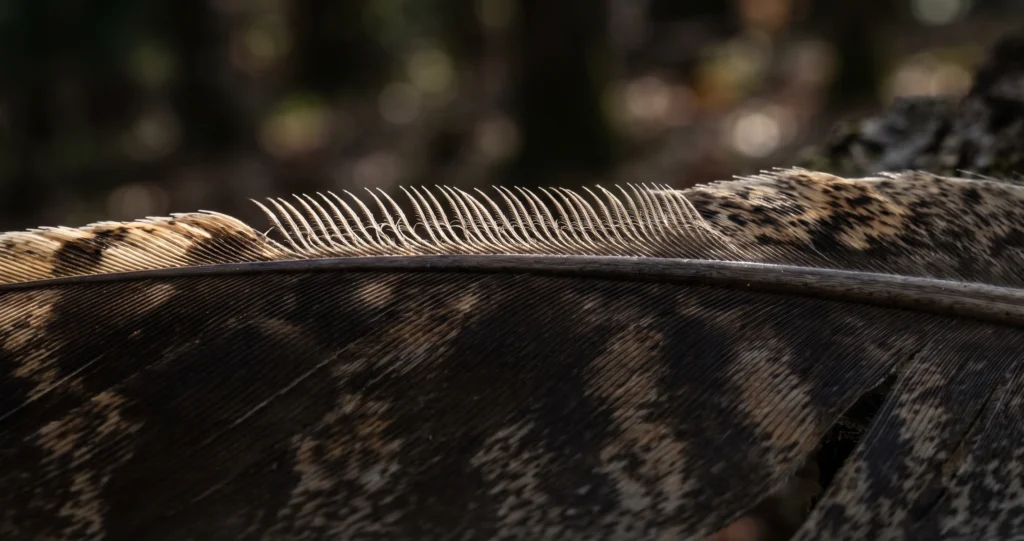
Along the front edge of the primary flight feathers lies a row of stiff, comb-like projections called serrations.
Instead of presenting a smooth edge to incoming air, these tiny structures divide airflow into many smaller streams.
Breaking large turbulent vortices into smaller ones reduces the intensity of pressure fluctuations.
The result is quieter airflow across the wing.
Researchers often compare this process to splitting a large wave into many tiny ripples.
2. The Trailing Fringe
At the back edge of the wing feathers, the feather tips form a soft, flexible fringe.
Instead of ending abruptly like a rigid blade, the feathers gradually blend into the surrounding air.
This smooth transition reduces the sudden turbulence normally generated when airflow leaves a wing.
Less turbulence means less aerodynamic noise.
The trailing fringe acts almost like a built-in sound diffuser.
3. The Velvety Feather Surface
Perhaps the least obvious adaptation is the velvet-like surface covering much of the feather.
Unlike the smoother feathers found on many birds, owl feathers contain tiny hair-like structures that create an exceptionally soft texture.
This velvety covering dampens microscopic airflow disturbances while reducing friction between overlapping feathers.
It also helps eliminate rubbing noises that might occur during wing movement.
Together, these three adaptations make owl wings uniquely effective at suppressing sound.
The Physics of Turbulence and Noise Reduction
Understanding owl flight becomes easier with a simple look at basic aerodynamics.
When air flows smoothly over a surface, engineers call it laminar flow.
Eventually, disturbances develop and transition into turbulence.
Turbulent airflow contains swirling vortices of different sizes.
Large vortices produce stronger pressure fluctuations and therefore louder sound.
The specialized structures of owl silent flight feathers modify airflow before these large vortices fully develop.
The leading-edge comb weakens incoming turbulence.
The velvety surface absorbs small disturbances.
The trailing fringe softens airflow as it leaves the wing.
Instead of producing abrupt bursts of noise, the wing spreads airflow changes over a larger area and longer period.
This dramatically lowers the sound produced during flight.
Why Silent Flight Makes Owls Better Hunters
Silent flight offers far more than simple stealth.
Owls depend heavily on extraordinarily sensitive hearing.
Many species possess asymmetrical ears that help determine the precise location of prey in three dimensions.
If wing noise were too loud, these faint sounds would become difficult to detect.
Silent wings therefore improve both hunting concealment and auditory perception.
This dual advantage allows owls to capture rodents hidden beneath vegetation or even beneath shallow snow.
Combined with excellent night vision and powerful talons, silent flight makes owls highly efficient nocturnal predators.
How Engineers Copied Owl Wings
Nature often provides elegant solutions to difficult engineering problems.
Studying owl silent flight feathers has inspired researchers to redesign many technologies involving moving air.
Rather than attempting to eliminate turbulence completely, engineers increasingly focus on managing airflow in ways similar to owl feathers.
Laboratory experiments using artificial serrated edges have demonstrated measurable reductions in aerodynamic noise under certain operating conditions.
These findings continue influencing multiple industries.
Biomimicry in Aviation
Aircraft wings, propellers, helicopter blades, and drone rotors all generate aerodynamic noise.
Researchers have explored leading-edge and trailing-edge modifications inspired by owl feathers to reduce sound without sacrificing performance.
Although commercial airplanes cannot simply copy owl wings directly, many experimental designs incorporate similar aerodynamic concepts.
Quiet aircraft would benefit airports, nearby communities, and passengers alike.
Several research programs continue evaluating owl-inspired wing modifications for future aviation technologies.
Wind Turbines and Industrial Fans
Perhaps the most successful practical application involves wind turbines.
Large rotating blades generate aerodynamic noise that sometimes concerns nearby residents.
Engineers have developed serrated trailing-edge attachments inspired partly by owl feather structures.
These modifications can reduce certain types of blade noise while maintaining efficient energy production.
Similar concepts have also improved industrial ventilation systems, cooling fans, and some high-performance computer fans.
Biomimicry continues demonstrating how natural evolution can guide modern engineering.
For more information about biomimicry research, the Smithsonian’s National Museum of Natural History offers educational resources on how nature inspires innovation:
https://naturalhistory.si.edu/
Silent Flight Across Different Owl Species
Not every owl hunts in exactly the same way.
Different species show variations in wing shape, size, and hunting strategy.
Barn Owl
Barn owls possess some of the most specialized silent-flight adaptations.
Their exceptional hearing allows them to capture prey in complete darkness using sound alone.
Great Gray Owl
Great gray owls often hunt rodents beneath deep snow.
Silent flight helps them approach unnoticed before plunging through the snow surface.
Snowy Owl
Snowy owls hunt in open Arctic landscapes.
Although their wings retain silent-flight adaptations, they also rely heavily on vision in bright northern environments.
Eagle Owl
Large eagle owls combine powerful flight with remarkable stealth while hunting mammals and birds across varied habitats.
The exact balance between speed, maneuverability, and noise reduction differs among species, reflecting their ecological niches.
Why Evolution Favored Quiet Wings
Developing specialized feathers carries trade-offs.
The soft surfaces that reduce noise may increase aerodynamic drag slightly compared with smoother feathers.
For many birds, maximum speed is more important than silence.
Owls evolved under different pressures.
For nocturnal ambush predators, remaining undetected and preserving sensitive hearing provide greater survival advantages than achieving the highest possible flight speed.
Evolution therefore favored quieter wings over faster ones.
Common Myths About Owl Flight
Myth: Owls make absolutely no sound while flying.
False.
Owls are exceptionally quiet, but they are not completely silent.
Very close observers may still hear faint wing sounds.
Myth: Silent flight comes only from soft feathers.
False.
Three major adaptations—the leading-edge comb, trailing fringe, and velvety feather surface—work together.
Myth: Every owl species is equally silent.
False.
Different species vary depending on habitat, hunting strategy, and wing design.
Myth: Engineers copied owl feathers exactly.
Not exactly.
Most technologies borrow aerodynamic principles rather than replicating feather structures directly.
Myth: Silent flight only benefits hunting.
False.
Reduced wing noise also allows owls to hear prey more accurately during flight.
Frequently Asked Questions
Why are owl wings quieter than those of other birds?
Specialized feather structures reduce turbulence and suppress aerodynamic noise.
What is the leading-edge comb?
It consists of comb-like serrations along the front edge of the wing that divide incoming airflow into smaller streams.
Do all owls have silent-flight adaptations?
Most owls possess these features to varying degrees, although their effectiveness differs among species.
How has owl research influenced engineering?
Scientists have developed quieter wind turbine blades, industrial fans, and experimental aircraft components inspired by owl wing aerodynamics.
Can completely silent aircraft be built?
Probably not. However, studying owl wings continues helping engineers reduce aerodynamic noise in many applications.
Conclusion
The remarkable design of owl silent flight feathers represents one of nature’s finest examples of evolutionary engineering. Through a combination of leading-edge combs, trailing fringes, and velvety feather surfaces, owls manipulate airflow in ways that dramatically reduce turbulence and suppress the sounds normally produced during flight.
These adaptations allow owls to hunt with extraordinary precision while continuing to hear the faint movements of prey beneath leaves, grass, or snow. Beyond their ecological importance, owl wings have inspired engineers developing quieter aircraft, wind turbines, drones, and industrial equipment. As biomimicry continues advancing, the silent flight of owls serves as a powerful reminder that some of the world’s most innovative engineering solutions have already been perfected by nature over millions of years.
If you ever watch an owl glide silently through the evening sky, you are witnessing not only an exceptional predator at work but also one of the most sophisticated aerodynamic systems ever evolved.
2 Internal Link Suggestions:
- https://secretsofthegreengarden.com/how-pollinators-help-your-garden-thrive/
- https://secretsofthegreengarden.com/why-fireflies-are-important-for-healthy-gardens/
3 External Dofollow Authoritative Sources with URLs:
- Smithsonian National Museum of Natural History: https://naturalhistory.si.edu/
- Cornell Lab of Ornithology – All About Birds (Owls): https://www.allaboutbirds.org/
- NASA – Biomimicry and Nature-Inspired Engineering: https://www.nasa.gov/