
Table of Contents
- Introduction
- What Is a Vampire Squid?
- Why It Isn’t Really a Squid—or an Octopus
- Vampire Squid Facts: Surviving in Oxygen-Starved Waters
- A Surprisingly Peaceful Diet: Feeding on Marine Snow
- The Inside-Out Defense Posture
- Bioluminescent Decoys and Other Survival Tricks
- Why the Vampire Squid Matters to Science
- Common Myths About Vampire Squids
- Frequently Asked Questions
- Conclusion
Despite its dramatic name, the vampire squid is one of the most peaceful animals in the deep ocean. In fact, many fascinating vampire squid facts reveal a gentle scavenger that feeds on drifting organic debris rather than hunting living prey. It doesn’t drink blood, it isn’t dangerous to humans, and it survives in one of the harshest environments on Earth—deep ocean regions with almost no oxygen.
Scientists have long been fascinated by this mysterious cephalopod because it doesn’t fit neatly into any familiar category. It shares characteristics with both squid and octopuses while belonging to its own unique taxonomic order. Combined with remarkable adaptations for surviving in oxygen-poor waters, unusual defensive behaviors, and the ability to produce dazzling bioluminescent displays, the vampire squid represents one of evolution’s most distinctive deep-sea success stories.
Understanding this remarkable animal reminds us that appearances can be deceiving, especially in the strange world of the deep ocean.
If you enjoy discovering unusual marine life, you may also like our article on How Giant Tube Worms Survive Without a Mouth, Gut, or Sunlight here on secretsofthegreengarden.com.
What Is a Vampire Squid?
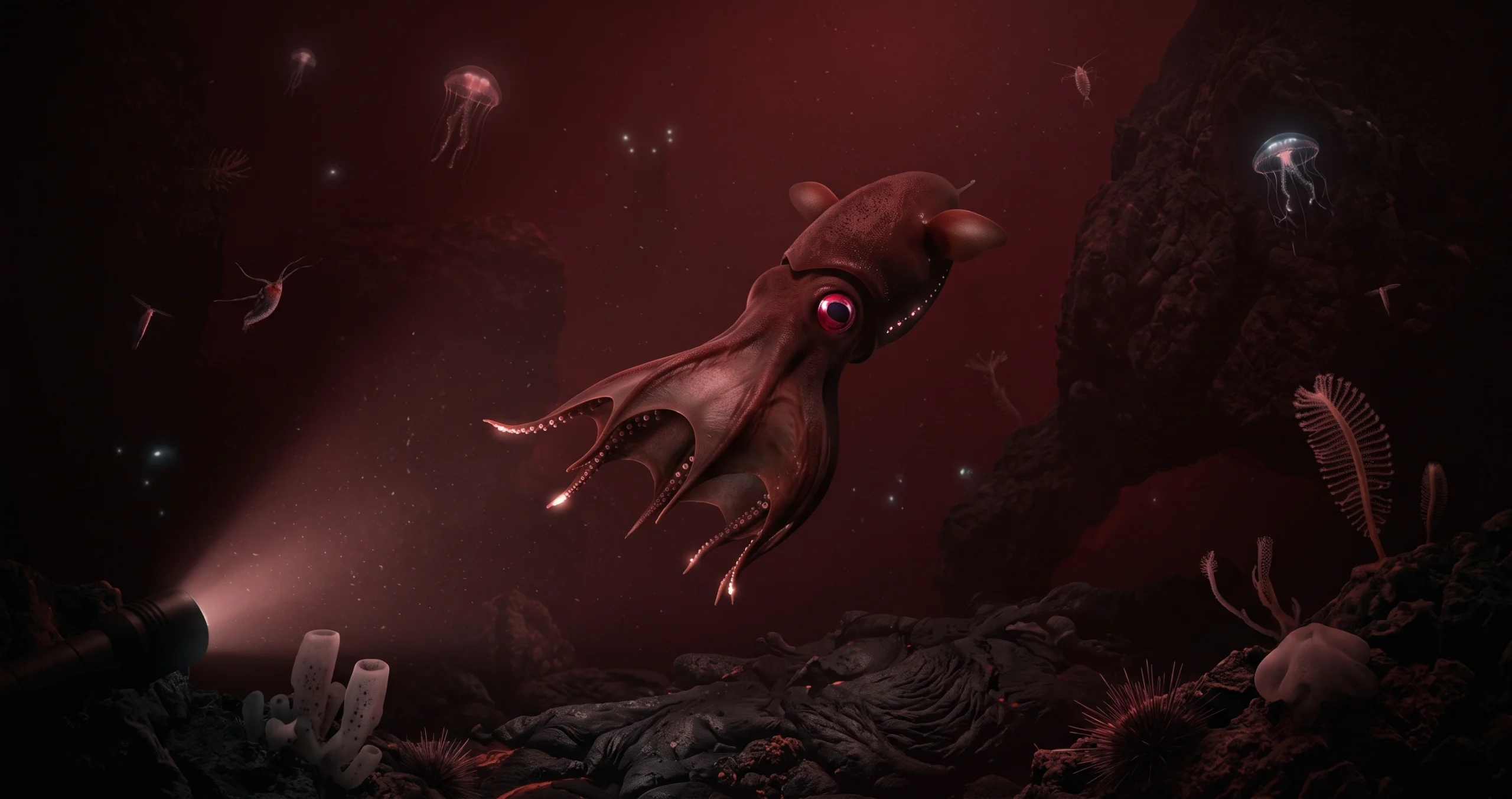
The vampire squid (Vampyroteuthis infernalis) inhabits the deep ocean at depths ranging from roughly 2,000 to 10,000 feet (600–3,000 meters).
Its scientific name translates roughly to “vampire squid from hell,” a reference inspired by its dark coloration, glowing eyes, and cloak-like webbing rather than its actual behavior.
Unlike fast-swimming predatory squid, vampire squid move slowly through the water using gentle fin movements and drifting currents.
They rarely expend unnecessary energy.
This lifestyle perfectly matches the challenging conditions of the deep sea, where food is scarce and oxygen levels remain extremely low.
Far from being aggressive predators, vampire squid are among the least threatening cephalopods known to science.
Why It Isn’t Really a Squid—or an Octopus
One of the most interesting vampire squid facts is that it belongs to neither the true squid order (Teuthida) nor the octopus order (Octopoda).
Instead, it occupies its own unique taxonomic order called Vampyromorphida.
This classification reflects millions of years of independent evolution.
The vampire squid displays a fascinating mixture of squid-like and octopus-like features.
Like octopuses, it possesses eight arms connected by a broad web.
Unlike octopuses, however, it also retains two retractable sensory filaments believed to represent highly modified ancestral tentacles.
It also possesses internal support structures similar to squid rather than the soft bodies typical of octopuses.
Scientists often describe the vampire squid as a living evolutionary bridge between these two familiar cephalopod groups.
Studying its anatomy provides valuable clues about the evolutionary history of modern cephalopods.
Vampire Squid Facts: Surviving in Oxygen-Starved Waters
Perhaps the vampire squid’s greatest achievement is its ability to thrive where most other large animals cannot survive.
It inhabits oxygen minimum zones, regions of the deep ocean containing extremely low dissolved oxygen concentrations.
Many fish and cephalopods avoid these waters because they cannot obtain enough oxygen to support normal metabolism.
The vampire squid has evolved several remarkable adaptations.
Its metabolism ranks among the lowest measured in active marine animals.
Instead of constantly swimming, it conserves energy whenever possible.
Its blood contains highly efficient oxygen-binding pigments.
Large gills maximize oxygen extraction from surrounding seawater.
Its gelatinous body requires relatively little energy to support.
These adaptations allow vampire squid to occupy habitats with few predators and little competition for food.
By specializing in extreme environments, they avoid many ecological pressures faced by shallow-water relatives.
A Surprisingly Peaceful Diet: Feeding on Marine Snow
Contrary to its frightening name, the vampire squid does not hunt fish or large prey.
Instead, it feeds primarily on marine snow.
Marine snow consists of tiny particles drifting slowly through the water column.
This material includes dead plankton, microscopic algae, discarded crustacean shells, fish scales, fecal pellets, mucus aggregates, and countless other organic fragments.
Rather than chasing prey, vampire squid patiently collect these particles using long retractable sensory filaments.
Sticky mucus covering the filaments traps drifting debris.
The collected material is then rolled into small food bundles before being transported toward the mouth.
This feeding strategy requires remarkably little energy.
In nutrient-poor deep oceans, efficiency often matters more than speed.
The vampire squid functions as an important recycler within deep-sea ecosystems by consuming organic matter that would otherwise continue sinking toward the seafloor.
The Inside-Out Defense Posture
Because vampire squid lack the speed of many squid species, they rely on unusual defensive behaviors instead of rapid escape.
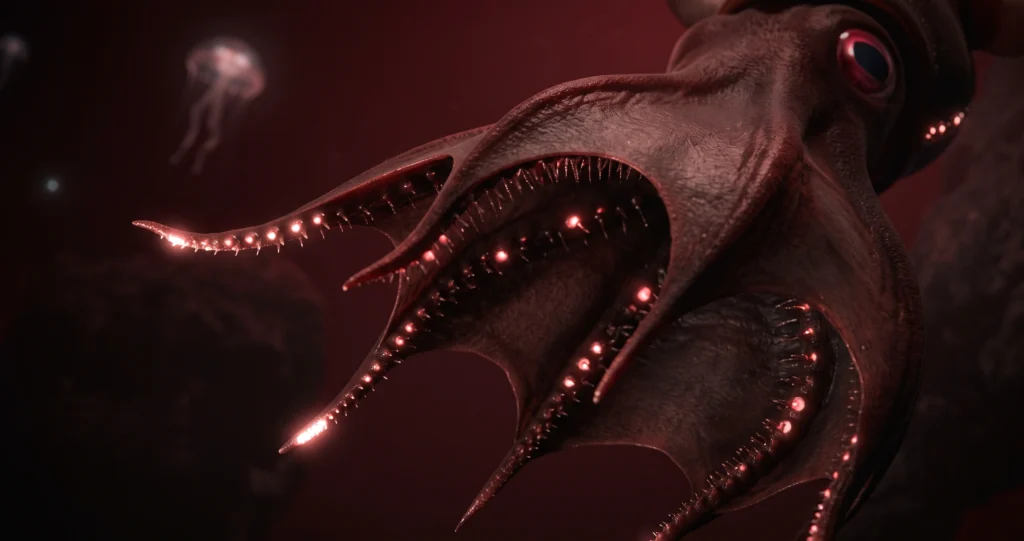
One of the most remarkable is the pumpkin posture, sometimes called the inside-out posture.
When threatened, the vampire squid pulls its arms upward and wraps them over the body.
The webbing connecting the arms flips outward, exposing rows of harmless fleshy projections called cirri.
This dramatic transformation makes the animal appear much larger and more intimidating.
Importantly, these cirri are not hooks, teeth, or venomous spines.
They simply contribute to the startling visual display.
The animal may also partially hide its vulnerable body beneath the protective webbing during this posture.
This behavior represents bluff rather than attack.
Bioluminescent Decoys and Other Survival Tricks
Light is scarce in the deep ocean.
Many animals produce their own illumination through bioluminescence.
The vampire squid is no exception.
Instead of producing continuous light, it generates brief flashes from specialized organs called photophores distributed across its body.
When threatened, these flashes may confuse predators long enough for the squid to drift away.
Unlike many squid that release clouds of ink, vampire squid use something even more unusual.
They eject sticky clouds of glowing mucus filled with bioluminescent particles.
The glowing material may distract predators while the animal escapes into darkness.
Because producing light requires energy, the vampire squid uses these displays sparingly.
This strategy reflects the importance of conserving resources in nutrient-poor deep-sea environments.
Why the Vampire Squid Matters to Science
Scientists continue studying vampire squid because they provide valuable insights into evolution, physiology, and deep-sea ecology.
Their unique taxonomic position helps researchers reconstruct the evolutionary history of cephalopods.
Their ability to survive in oxygen minimum zones offers clues about physiological adaptation under environmental stress.
Marine ecologists investigate how vampire squid contribute to carbon cycling by consuming marine snow.
Their feeding behavior helps recycle nutrients that would otherwise accumulate on the seafloor.
Climate scientists also pay close attention to oxygen minimum zones.
As ocean warming influences dissolved oxygen levels worldwide, understanding animals already adapted to low-oxygen environments becomes increasingly important.
Common Myths About Vampire Squids
Myth 1: Vampire squid drink blood.
Reality:
They do not consume blood. Their diet consists primarily of drifting organic debris known as marine snow.
Myth 2: Vampire squid attack humans.
Reality:
They inhabit deep ocean environments far beyond recreational diving depths and pose no threat to people.
Myth 3: They are true squid.
Reality:
Although related to squid, they belong to their own unique taxonomic order, Vampyromorphida.
Myth 4: The inside-out posture is an attack.
Reality:
It is a defensive bluff designed to appear larger and discourage predators.
Myth 5: They survive because they are powerful hunters.
Reality:
Their success depends largely on energy conservation, efficient oxygen use, and feeding on drifting organic particles.
Why Deep-Sea Discoveries Continue to Surprise Us
The vampire squid demonstrates how little we still know about Earth’s largest habitat.
The deep ocean covers more than half of the planet’s surface yet remains only partially explored.
Every expedition reveals new species, unexpected adaptations, and previously unknown ecosystems.
Animals like the vampire squid challenge assumptions about where life can survive and how evolution solves extreme environmental problems.
Their remarkable biology continues inspiring research in marine science, evolutionary biology, physiology, and environmental change.
Frequently Asked Questions
Is the vampire squid really a squid?
Not exactly. It belongs to its own unique order, Vampyromorphida, sharing characteristics with both squid and octopuses.
Does the vampire squid drink blood?
No. Despite its name, it feeds primarily on marine snow and other drifting organic particles.
Why does it live in low-oxygen waters?
Specialized physiological adaptations allow it to survive where many predators and competitors cannot.
What is the inside-out defense posture?
The squid wraps its webbed arms around its body, creating a larger and more intimidating appearance to discourage predators.
Is the vampire squid dangerous to humans?
No. It lives far below diving depths, feeds on organic debris, and poses no threat to people.
Conclusion
The remarkable collection of vampire squid facts reveals an animal far different from the fearsome creature suggested by its name. Rather than hunting prey or drinking blood, the vampire squid quietly survives by collecting drifting organic matter in some of the most oxygen-poor environments on Earth. Its unique classification, highly efficient metabolism, bioluminescent defenses, and dramatic inside-out posture make it one of the most extraordinary cephalopods known to science.
Far from being a monster of the deep, the vampire squid represents a masterpiece of evolutionary adaptation. By thriving where few other large animals can survive, it continues teaching scientists valuable lessons about deep-sea ecology, cephalopod evolution, and life’s remarkable ability to adapt to even the planet’s most extreme environments.
2 Internal Link Suggestions:
- https://secretsofthegreengarden.com/how-giant-tube-worms-survive-without-a-mouth-gut-or-sunlight/
- https://secretsofthegreengarden.com/sea-otters-keep-personal-tools-for-years-heres-how-and-why/
3 External Dofollow Authoritative Sources:
- Smithsonian National Museum of Natural History: https://naturalhistory.si.edu/
- Monterey Bay Aquarium Research Institute (MBARI): https://www.mbari.org/
- NOAA Ocean Exploration: https://oceanexplorer.noaa.gov/