
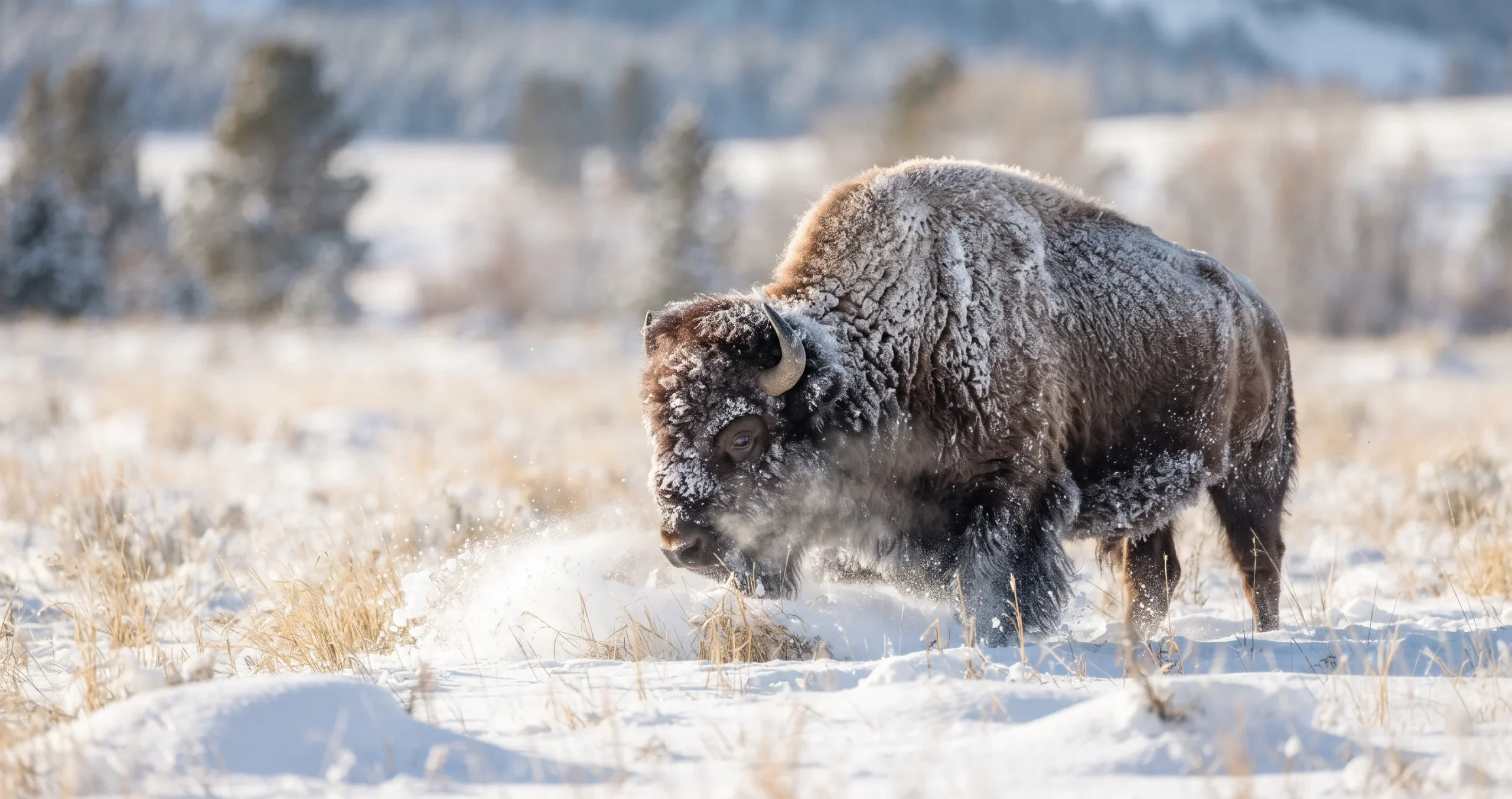
A massive American bison lowers its head into a snowdrift, swings its powerful neck from side to side, and pushes snow away to uncover a patch of frozen grass. What looks like an ordinary feeding movement is actually one of the most fascinating examples of bison winter survival in North America.
While many animals seek shelter or migrate when winter arrives, bison often remain on exposed grasslands where snow, wind, and freezing temperatures dominate the landscape.
Their secret is more than a thick winter coat. These enormous herbivores possess a remarkable combination of physical adaptations, feeding behaviors, and energy-saving strategies that allow them to survive conditions that would challenge many other grazing animals.
Perhaps their most recognizable winter behavior is using their massive heads like natural snowplows.
But how does this technique work, and why has it become such an important part of life on the snowy plains?
Table of Contents
- The Remarkable Winter Life of the American Bison
- How Bison Use Their Heads as Snowplows
- Bison Winter Survival: The Science Behind Their Adaptations
- What Bison Eat Beneath the Snow
- How Bison Conserve Energy During Harsh Winters
- Why Snow Conditions Matter More Than They Appear
- The Ecological Importance of Bison in Winter
- In Your Own Yard: Learning From Bison Winter Survival
- Frequently Asked Questions
- A Winter Survival Strategy Written in Snow
The Remarkable Winter Life of the American Bison
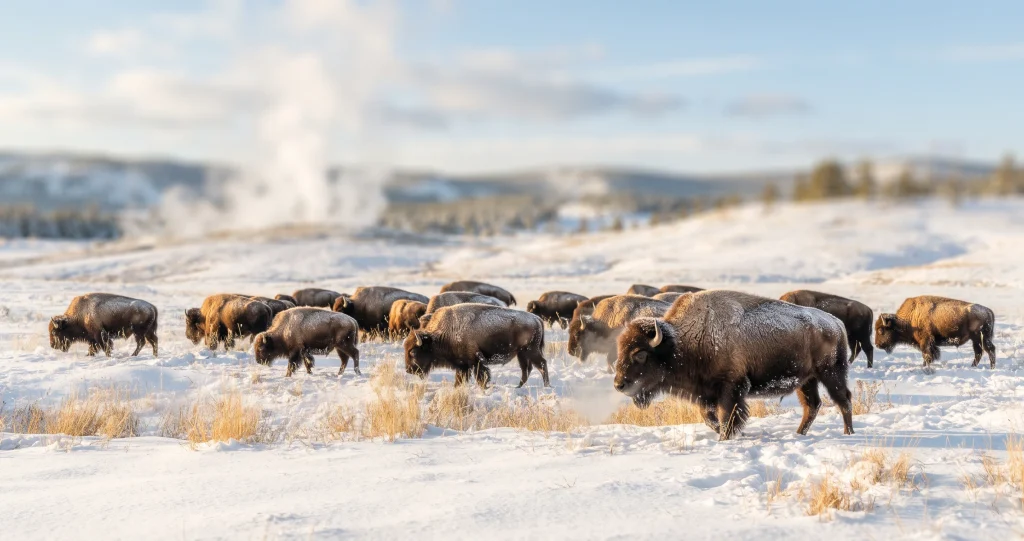
The American bison (Bison bison) is the largest living land mammal native to North America.
Historically, enormous herds moved across grasslands and prairie ecosystems, shaping vegetation and influencing the landscapes around them.
Today, wild and managed conservation herds occupy protected areas and other grassland habitats across parts of North America.
Among the most recognizable populations are the bison of Yellowstone National Park, where long winters provide an extraordinary opportunity to observe their adaptations.
Life on an Exposed Winter Landscape
Unlike forest animals that can find shelter among dense trees, plains bison frequently encounter winter weather across relatively open terrain.
Depending on the region, winter conditions may include strong winds, drifting snow, frozen ground, and periods of limited access to vegetation.
Yet bison are exceptionally well suited to these environments.
Their enormous shoulders, muscular necks, dense coats, and specialized feeding behavior help them remain active when the landscape appears almost completely buried.
These features work together rather than independently.
A thick coat helps preserve body heat, while powerful muscles allow bison to reach food hidden beneath snow.
Their behavior also changes with seasonal conditions, helping them balance food intake against the energy required to obtain it.
How Bison Use Their Heads as Snowplows
One of the most distinctive winter behaviors of American bison is their ability to move snow aside with their heads.
This technique is often described as snowplowing.
It is especially useful when grasses and other low-growing plants remain buried beneath a layer of snow.
The Snowplowing Movement
When a bison encounters a promising feeding area, it may lower its large head toward the snow-covered ground.
Using its muscular neck and shoulders, the animal pushes or sweeps snow sideways, exposing the vegetation underneath.
The movement can create an opening in the snow through which the bison can reach grasses, sedges, and other available forage.
The process generally follows a simple pattern:
- The bison approaches a snow-covered feeding patch.
- It lowers its heavy head toward the surface.
- It moves its head through the snow, pushing material aside.
- It reaches the exposed vegetation with its muzzle.
- It grazes before moving to another suitable patch.
The exact movement varies with snow depth, density, and the accessibility of plants beneath the surface.
Bison may also use their muzzles to search through shallow snow rather than performing a large sweeping motion.
Why Their Massive Shoulders Matter
The distinctive hump above a bison’s shoulders is more than an impressive feature of its silhouette.
It reflects an anatomical structure that supports powerful muscles associated with the neck and forequarters.
These muscles help the animal control and move its heavy head.
During winter feeding, this strength becomes particularly valuable.
A bison can push through snow that might prevent a less powerful grazer from reaching the same vegetation.
Its broad forehead, strong neck, and substantial body mass all contribute to this ability.
However, snowplowing is not effortless.
Moving snow requires energy, and the benefits depend on whether enough food becomes available to justify the effort.
Why Snowplowing Is Not Always Enough
Although bison are powerful animals, they cannot clear every type of snow.
Deep, compacted, or icy snow can make feeding much more difficult.
In some circumstances, bison may move toward areas with shallower snow, wind-exposed vegetation, or more accessible forage.
This flexibility is essential.
Snowplowing is an important feeding technique, but successful winter survival depends on combining it with movement, habitat selection, and efficient energy use.
Bison Winter Survival: The Science Behind Their Adaptations
The ability to uncover buried grass is only one part of the larger biological story.
Bison winter survival involves several interconnected adaptations that influence how these animals manage cold temperatures, obtain food, and conserve energy.
A Thick Coat That Traps Warmth
Bison develop a dense winter coat that provides insulation against cold conditions.
Their shaggy hair is especially noticeable around the head, neck, and shoulders.
This coat helps reduce heat loss by trapping air near the body.
Air held within the fur acts as an insulating layer, slowing the transfer of body heat to the surrounding environment.
The insulating effect depends on factors such as coat condition, moisture, wind, and temperature.
Bison also shed much of their thick winter hair as warmer weather returns.
This seasonal change helps them adapt to different environmental conditions throughout the year.
A Large Body That Helps Retain Heat
Body size plays an important role in how mammals exchange heat with their surroundings.
Larger animals generally have a lower surface-area-to-volume ratio than smaller animals of similar shape.
This means they have proportionally less external surface through which heat can escape.
For an adult bison, substantial body mass can therefore help reduce relative heat loss.
However, size alone does not guarantee survival.
Large animals also require significant amounts of food, making reliable access to winter forage essential.
Specialized Digestion for Tough Vegetation
Bison are ruminants, meaning they possess a complex digestive system that relies on microorganisms to break down fibrous plant material.
Their stomach contains several compartments, including the rumen, where microbial fermentation helps process cellulose-rich vegetation.
This allows bison to obtain nutrients from grasses and other plants that many nonruminant animals cannot digest efficiently.
During winter, the available forage is often mature, dry, and relatively low in nutritional quality.
Their digestive system helps them make use of this material, although food quality and availability still influence their physical condition.
Seasonal Changes in Energy Use
Winter survival is partly a matter of managing energy.
Bison must obtain enough nourishment to support essential bodily functions while coping with cold weather and difficult feeding conditions.
Their activity patterns and habitat choices can help reduce unnecessary energy expenditure.
In many cases, they spend substantial time feeding, resting, and ruminating.
By limiting avoidable movement and using accessible feeding areas, they may reduce the energy required to survive.
The balance changes with weather, snow conditions, age, body condition, and food availability.
What Bison Eat Beneath the Snow
At first glance, a snow-covered prairie can appear almost lifeless.
But beneath the white surface, many perennial plants remain rooted in the soil.
Bison are primarily grazers, feeding on grasses, sedges, and other herbaceous vegetation.
During winter, they often rely on the standing or partially buried plant material left from the previous growing season.
Dormant Grass Still Provides Food
Although winter grasses may look brown and dry, they can still contain usable energy and nutrients.
Their nutritional quality is often lower than that of fresh spring growth.
Nevertheless, dormant vegetation can remain an important food source.
Bison use their grazing adaptations and digestive systems to process this coarse forage.
The value of a feeding patch depends on plant species, growing-season conditions, snow cover, and how much vegetation remains accessible.
Wind-Exposed Areas Can Become Feeding Opportunities
Strong winter winds create uneven snow distribution across the landscape.
Some locations accumulate deep drifts, while exposed ridges and slopes may retain relatively little snow.
Bison can take advantage of these differences.
Areas where wind has removed snow may offer easier access to vegetation, reducing the need for extensive snowplowing.
This helps explain why bison sometimes concentrate in particular winter habitats rather than distributing themselves evenly across a snowy landscape.
How Bison Conserve Energy During Harsh Winters
Surviving winter is not simply about finding food.
It also involves using that food efficiently.
Choosing the Right Places to Feed
Bison may move between feeding areas as conditions change.
A location that provides accessible forage early in winter may become difficult to use after repeated snowfall or the formation of hard snow layers.
Animals can respond by seeking alternative patches where food remains easier to reach.
In Yellowstone, seasonal movements are influenced by several factors, including snow conditions, terrain, forage availability, and local environmental conditions.
Some areas with geothermal activity can also have distinctive snow and vegetation patterns, although these habitats represent only part of the larger winter landscape.
Resting and Ruminating
After feeding, bison spend time resting and chewing cud.
Rumination allows previously swallowed plant material to be processed further, supporting microbial digestion.
Resting also helps limit energy expenditure.
During severe weather, avoiding unnecessary activity can be valuable, particularly when forage is difficult to obtain.
These behaviors are part of a broader winter strategy rather than isolated responses to individual snowstorms.
Why Snow Conditions Matter More Than They Appear
Not all snow presents the same challenge.
A relatively shallow layer of loose powder may be easier for a bison to move than a thinner layer containing dense ice crust.
Snow characteristics influence both movement and feeding.
Powdery Snow Versus Hardened Snow
Fresh, loose snow can often be displaced through head movements.
Compacted snow requires greater force.
Ice crusts may create particularly difficult conditions because they can form resistant layers between the animal and the vegetation below.
Repeated thawing and freezing can change the structure of the snowpack.
As a result, winter severity cannot be measured by temperature or snow depth alone.
The physical condition of the snow also matters.
Why Changing Winters Create Complicated Effects
Changes in winter weather can affect bison habitats in different ways.
In some regions, reduced snow cover may make vegetation easier to reach.
Elsewhere, more frequent rain-on-snow events or freeze-thaw cycles may contribute to hard surface layers that complicate feeding.
The effects depend on local climate, terrain, vegetation, and seasonal weather patterns.
For this reason, researchers must consider multiple environmental factors when evaluating how changing winters influence bison populations.
The Ecological Importance of Bison in Winter
Bison are more than remarkable winter survivors.
They are also important ecological participants in North American grassland systems.
Their grazing, movement, and other behaviors influence vegetation and habitat structure throughout the year.
Grazing Shapes Grassland Vegetation
By consuming grasses and other plants, bison influence patterns of plant growth and competition.
Their grazing can create variation in vegetation height and structure.
These differences may affect habitat conditions for insects, birds, and other wildlife.
The ecological outcomes vary with grazing intensity, season, plant communities, and landscape conditions.
Winter grazing is one part of this broader relationship between bison and grassland ecosystems.
Movement Connects Different Habitats
As bison move through the landscape, they transport nutrients through their feeding and waste deposition.
Their presence can contribute to ecological processes across different areas of grassland.
Bison also interact with predators, scavengers, microorganisms, and numerous other organisms.
These relationships help explain why bison conservation is closely connected to broader efforts to restore and maintain functioning prairie ecosystems.
Protecting bison means considering not only the animals themselves but also the habitats and ecological processes that support them.
In Your Own Yard: Learning From Bison Winter Survival
Most home gardeners will never encounter a bison clearing snow from their lawn.
Still, observing how these animals survive winter offers a useful way to think about seasonal wildlife habitat.
The central lesson is that winter landscapes are not necessarily empty or inactive.
Leave Some Natural Vegetation Standing
In a wildlife-friendly garden, leaving selected native grasses and seed-bearing plants standing through winter can provide resources for birds and other small animals.
Dry stems and plant litter may also create shelter for overwintering insects.
Choose plants suited to your region and consider local wildlife needs.
The goal is to maintain useful habitat rather than imitate the feeding behavior of bison directly.
Observe How Snow Changes Your Garden
After a snowfall, look at where snow collects and where wind exposes the ground.
Notice how fences, shrubs, slopes, and garden structures influence snow distribution.
These patterns can affect soil insulation, moisture, and the exposure of plants to winter weather.
Understanding them can help you make better planting and garden-design decisions.
Support Wildlife With Native Plants
Native plant communities often provide seasonal resources for local wildlife.
A garden containing a diversity of regionally appropriate plants can offer food, shelter, and habitat structure across the year.
Leaving some natural cover in place through winter may support species that rely on stems, seeds, leaf litter, or protected ground-level spaces.
For larger wildlife, responsible observation is essential.
Wild bison should always be viewed from a safe distance in designated habitats. The National Park Service advises visitors to remain at least 25 yards from bison in Yellowstone, and greater distance may be necessary depending on their behavior.
Frequently Asked Questions
1. Do bison really use their heads to move snow?
Yes. American bison can lower and sweep their powerful heads through snow to expose grasses and other vegetation beneath it. This behavior is commonly described as snowplowing. Its effectiveness depends on snow depth, density, and the availability of buried forage.
2. How do bison stay warm during extremely cold winters?
Bison rely on a combination of dense insulating fur, large body size, and behavioral adaptations. Their thick winter coats help reduce heat loss, while feeding and resting strategies support energy conservation. Their ability to withstand cold does not eliminate the challenges of severe winter weather or food shortages.
3. Do bison migrate when winter arrives?
Some bison populations make seasonal movements between habitats, while others remain within relatively limited areas. Their movements depend on geography, forage availability, snow conditions, habitat connectivity, and other environmental factors. In Yellowstone, seasonal movement is an important part of how bison respond to changing conditions.
A Winter Survival Strategy Written in Snow
Imagine returning to that first snowy grassland scene.
A massive bison lowers its head, pushes through the white surface, and reveals a small patch of dry vegetation hidden beneath the snow.
What initially looks like a simple movement is the result of an extraordinary combination of anatomy, behavior, and ecological adaptation.
The bison’s powerful shoulders make snowplowing possible. Its thick coat helps retain warmth. Its digestive system extracts nourishment from coarse winter vegetation, while its movements help it find accessible feeding areas.
Together, these adaptations make bison winter survival one of North America’s most compelling examples of wildlife resilience.
And perhaps the most fascinating detail is that the bison does not need to escape winter to survive it.
Instead, it has evolved ways to live within the season, transforming a snow-covered landscape into a place where food can still be found.
The next time you see a photograph of a bison standing in deep snow, look closely at its lowered head.
You may be witnessing one of nature’s most impressive living snowplows.
Conclusion
In the heart of a frozen North American grassland, a bison lowers its massive head and pushes through the snow, revealing the dry grasses hidden beneath. This simple movement represents millions of years of adaptation to challenging environments.
From their powerful shoulder muscles and thick insulating coats to their efficient digestion and remarkable snowplowing behavior, bison winter survival demonstrates how wildlife can adapt to extreme seasonal conditions.
These magnificent animals remind us that survival in nature often depends on a combination of strength, specialized anatomy, and intelligent use of available resources. Even when the prairie appears buried and lifeless, opportunities for nourishment remain beneath the surface.
And as the winter wind sweeps across the plains, the American bison continues its ancient routine, using its head as a natural snowplow and revealing one of the most extraordinary survival strategies in the animal kingdom.
External Sources
Explains how the bison’s muscular shoulder hump helps it swing its head sideways to clear snow and uncover food. Includes a public-domain wildlife photograph. U.S. Geological Survey
2. National Park Service — Yellowstone’s Geothermal Winter Habitat
Reveals how bison use Yellowstone’s geothermal areas, where warmer ground can reduce snow accumulation and improve access to vegetation. National Park Service
3. Scientific Research — Winter Foraging Strategies of Wood Bison
A 2024 peer-reviewed study examining how snow conditions, food accessibility, and predation risk influence winter feeding decisions in wood bison.