
A beautiful blanket of fresh snow can transform an ordinary evergreen into a winter masterpiece. But beneath that peaceful white covering, something surprising may be happening: branches are bending under a weight they were never designed to carry.
In some cases, a single heavy snowfall can leave an evergreen shrub permanently misshapen or cause major limbs to split. Fortunately, preventing snow damage on evergreens often comes down to understanding when snow should be removed, how to handle fragile branches, and when leaving the tree alone is actually the safest choice.
Evergreens are remarkably adapted to winter, yet their year-round foliage can make them vulnerable to accumulating snow and ice. Whether you have arborvitae along a driveway, a towering spruce in the backyard, or a decorative juniper near your front porch, knowing how to respond after a snowstorm can make a meaningful difference.
The secret is surprisingly simple: gentle movements, careful observation, and respect for the natural flexibility of branches.
Table of Contents
- Why Snow Can Be Dangerous for Evergreen Trees and Shrubs
- Snow Damage on Evergreens: The Science Behind Bent and Broken Branches
- When to Remove Snow From Evergreens
- How to Remove Snow Without Breaking Branches
- Common Winter Mistakes That Can Damage Evergreens
- What to Do When Evergreen Branches Are Already Bent
- How to Prevent Snow Damage Before Winter
- Which Evergreens Are Most Vulnerable to Heavy Snow
- In Your Own Yard: A Practical Winter Inspection
- Frequently Asked Questions
Why Snow Can Be Dangerous for Evergreen Trees and Shrubs
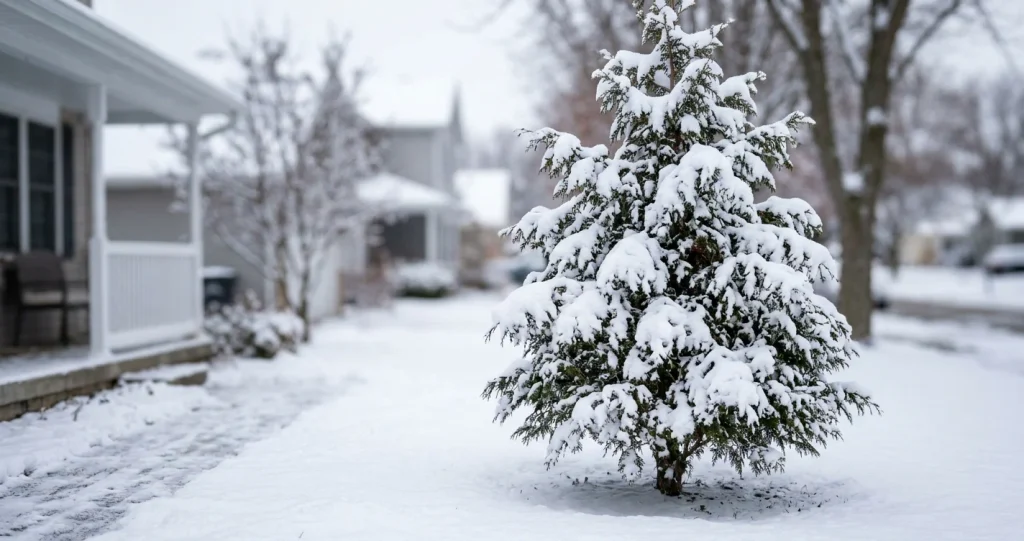
Evergreen trees and shrubs bring structure, color, and life to winter landscapes. Unlike deciduous trees, which shed most of their leaves before winter, many evergreens retain needles or broad leaves throughout the cold season.
This creates an important difference in how they interact with snow.
Needles, scales, and dense branching patterns can catch falling snow, allowing it to accumulate across the canopy. When snowfall is light and powdery, branches may support it without difficulty.
However, wet snow can be much heavier.
As snow accumulates, its weight places downward pressure on branches. Flexible stems may bend temporarily, while weaker branches can crack, split, or separate from the trunk.
Why Wet Snow Creates Greater Risks
The amount of water contained in snow varies considerably.
Dry, fluffy snow generally contains more air and less water per unit of volume than dense, wet snow.
When temperatures hover near freezing, snow can become sticky and accumulate in thick layers on evergreen foliage.
This additional weight may cause branches to droop dramatically.
Wind can increase the problem by redistributing snow or adding mechanical stress to already loaded branches.
Why Evergreen Shape Matters
The structure of an evergreen also influences its vulnerability.
Trees with strong central leaders and well-spaced branches may distribute snow loads more effectively than plants with multiple upright stems or weak branch attachments.
Columnar shrubs, including some arborvitae and junipers, can be especially vulnerable to stems spreading apart under heavy snow.
Dense, rounded shrubs may collect substantial snow across their upper surfaces.
The exact risk depends on species, cultivar, age, pruning history, and local weather conditions.
Snow Damage on Evergreens: The Science Behind Bent and Broken Branches
To understand why some evergreens recover from snow while others break, it helps to look at the mechanics of branches.
A branch behaves somewhat like a flexible beam.
Its ability to support weight depends on its thickness, length, wood properties, attachment to the trunk, and the location of the load.
How Snow Weight Creates Bending Stress
When snow collects on a branch, gravity pulls the accumulated mass downward.
The branch must resist that force.
Long branches often experience substantial bending stress because weight located farther from the trunk creates greater leverage.
As the branch bends, different portions of the wood experience tension and compression.
Healthy, flexible branches can sometimes accommodate this movement and return toward their original positions after the snow disappears.
However, when the load exceeds the strength of the wood or its attachment, cracking or breakage may occur.
Why Frozen Branches Can Be More Vulnerable
Cold weather changes the mechanical behavior of plant tissues.
The response varies among species, temperatures, and tissue conditions, but branches may become less tolerant of sudden movement during freezing conditions.
This is one reason forcefully shaking a frozen evergreen can cause damage.
A branch that bends gradually under accumulating snow may respond poorly to an abrupt upward push or sharp impact.
Gentle snow removal, when appropriate, reduces the chance of adding unnecessary stress.
Why Ice Is Different From Snow
Snow and ice create different challenges.
Loose snow may fall away with a light movement.
Ice, however, can adhere tightly to needles, leaves, and branches.
Trying to break or chip ice away can tear foliage, damage bark, or snap small branches.
For this reason, allowing ice to melt naturally is generally safer than attempting to remove it mechanically.
If ice-covered branches threaten buildings, vehicles, walkways, or electrical lines, professional assistance may be necessary.
Why Some Branches Recover Naturally
Evergreen branches possess varying degrees of elasticity.
When the weight of snow disappears, healthy branches may gradually return toward their previous positions.
Recovery is not always immediate.
Some branches take time to straighten, while others remain permanently displaced because their tissues or attachments were damaged.
Understanding this difference helps gardeners avoid unnecessary pruning or aggressive repositioning immediately after a storm.
When to Remove Snow From Evergreens
One of the most important winter gardening decisions is knowing when intervention is helpful.
Snow accumulation does not automatically mean a plant is in danger.
Many evergreens tolerate ordinary snowfall quite well.
Light, Fluffy Snow
A modest covering of dry snow is often harmless.
In many situations, leaving this snow in place is preferable to disturbing branches unnecessarily.
Snow can also provide insulation for low-growing vegetation and the soil beneath it.
If branches remain in their natural positions and show little strain, immediate action may offer limited benefit.
Heavy, Wet Snow
Dense snow deserves closer attention.
If an evergreen shrub is visibly spreading apart or its branches are bending severely, careful removal of loose snow may help reduce the load.
The safest opportunity is often while snow remains soft and can be dislodged with minimal contact.
However, safety comes first.
Avoid approaching trees with cracking limbs, unstable trunks, or large branches suspended overhead.
Ice-Covered Branches
When snow has frozen into a hard crust or become coated with ice, mechanical removal is much riskier.
Waiting for natural melting is usually the better option.
Never climb an icy tree or stand beneath heavily loaded branches.
If the tree presents an immediate hazard, keep the area clear and contact a qualified arborist.
How to Remove Snow Without Breaking Branches
When snow removal is necessary, the goal is to reduce weight without forcing branches into unnatural positions.
A gentle approach is especially important for ornamental evergreens with delicate foliage or multiple stems.
Step 1: Inspect the Plant From a Safe Position
Before touching the evergreen, look at its overall shape.
Identify branches that are bending significantly and areas where snow has accumulated.
Check for broken limbs, hanging branches, or signs of structural instability.
Only work on small shrubs or branches that can be reached comfortably from the ground.
For larger trees, professional evaluation is safer.
Step 2: Choose a Soft Tool
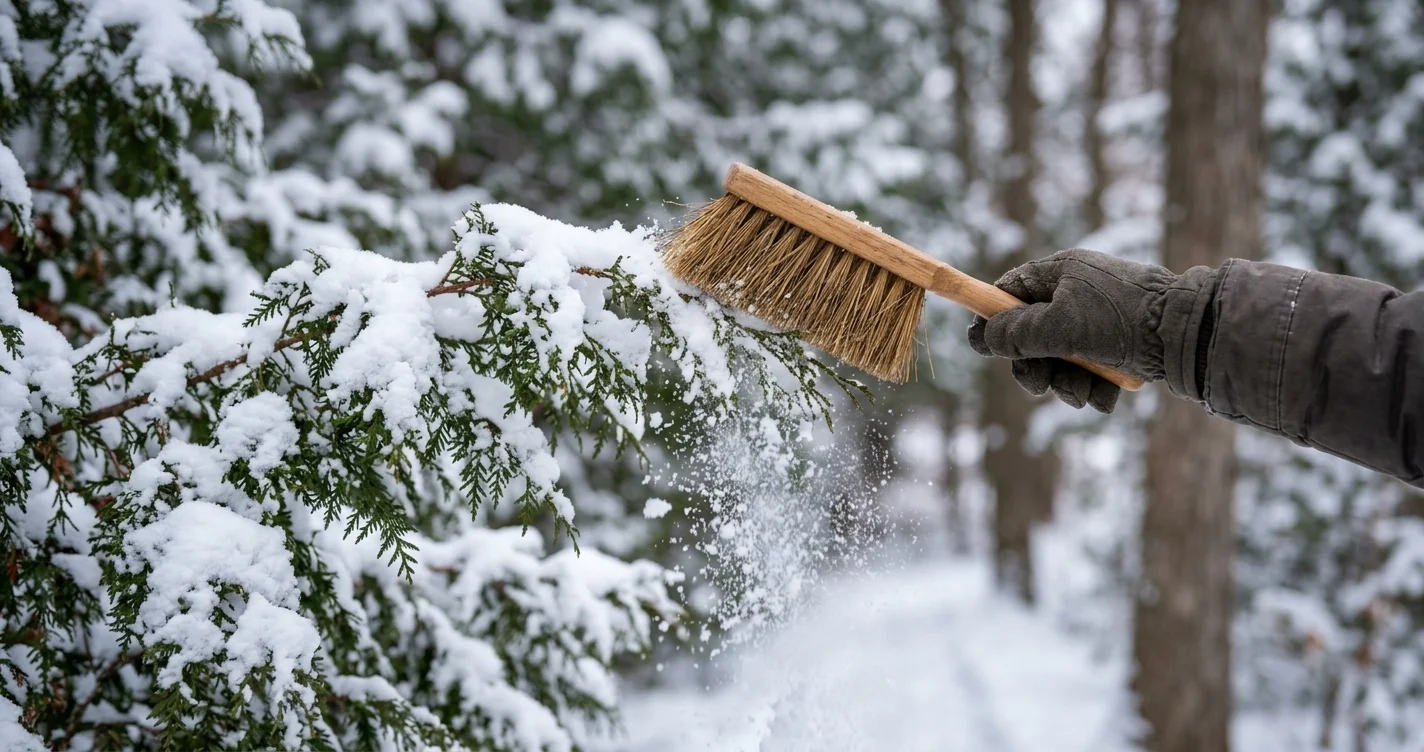
A soft broom can be useful for removing loose snow from reachable branches.
A gloved hand may be sufficient for smaller shrubs.
Avoid hard tools that could scrape bark, crush foliage, or strike branches.
The objective is to dislodge snow rather than manipulate the branch itself.
Step 3: Work From the Bottom Up
For many small evergreen shrubs, starting with the lower branches is a practical approach.
Clearing lower branches first helps prevent snow falling from above from adding extra weight to branches that are already heavily loaded.
Use light upward motions beneath accessible branches to release loose snow.
Allow the snow to fall naturally.
Avoid vigorous shaking, downward pulling, or forceful lifting.
If a branch resists movement or feels frozen in place, stop.
Step 4: Continue Gradually
Move around the shrub and remove snow in small amounts.
Avoid striking the trunk or repeatedly pushing the same branch.
If snow is packed tightly or frozen onto foliage, leave it to melt naturally.
For tall trees, branches beyond comfortable ground-level reach should remain untouched.
Step 5: Recheck the Plant After Snowfall
Once the snow has fallen away, observe the plant’s shape.
Some branches may begin returning to their normal positions relatively quickly.
Others may recover gradually as temperatures change.
Avoid forcing bent branches back into place.
If a branch is cracked, split, or dangerously unstable, seek appropriate pruning or professional assistance.
Common Winter Mistakes That Can Damage Evergreens
Even well-intentioned winter maintenance can create additional problems.
The following practices are especially worth avoiding.
Shaking Branches Aggressively
Vigorous shaking can place sudden stress on branches already weakened by snow.
Frozen or brittle twigs may snap, and partially damaged limbs may break completely.
Gentle movements are preferable whenever loose snow can be safely removed.
Knocking Off Ice
Ice can bond tightly to foliage and bark.
Striking frozen branches to remove it may cause more damage than the ice itself.
Natural melting is generally the safest solution.
Pouring Hot Water Over Frozen Branches
Hot water is not a recommended method for clearing ice from evergreens.
It can expose plant tissues to abrupt temperature changes, and the water may refreeze on branches or nearby walking surfaces.
Allowing ice to melt naturally avoids these unnecessary risks.
Using a Ladder During Snowy Conditions
Snow-covered ground and icy ladders create serious fall hazards.
Reaching overhead into snow-loaded branches adds another danger.
Large trees and elevated branches should be assessed by trained professionals rather than handled as routine home maintenance.
What to Do When Evergreen Branches Are Already Bent
After a major snowstorm, some evergreens may look flattened or distorted.
This appearance can be alarming, but it does not always mean permanent damage has occurred.
Allow Time for Natural Recovery
If the branches are intact and the plant is stable, patience is often the best first response.
As snow and ice disappear, flexible branches may gradually regain their original positions.
The recovery period varies with plant species, branch structure, and the severity of bending.
Inspect for Cracks and Splits
Look for visible fractures, torn bark, and branches separated from their normal attachments.
Damaged branches may require pruning to prevent further tearing.
For small, safely reachable branches, use clean, sharp pruning tools and make appropriate cuts outside the branch collar.
Avoid flush cuts against the trunk.
Large broken limbs, damaged leaders, and split trunks are best evaluated by a certified arborist.
Support Vulnerable Shrubs Carefully
Some upright, multi-stemmed evergreen shrubs can benefit from seasonal support.
For example, appropriately installed soft ties may help keep the stems of certain arborvitae or junipers together during winter.
Support materials should be positioned to avoid girdling or damaging the plant.
They should also be checked regularly and adjusted or removed when appropriate.
How to Prevent Snow Damage Before Winter
Prevention often begins long before the first snowflake falls.
Healthy plant structure and suitable placement can reduce the likelihood of serious damage.
Choose Evergreens Suited to Your Climate
Different evergreen species and cultivars vary in their tolerance of snow, ice, and winter wind.
When selecting plants, consider local winter conditions, mature size, growth habit, and site exposure.
Regional Cooperative Extension recommendations can help identify suitable choices.
Maintain Healthy Branch Structure
Proper pruning can improve plant structure and remove damaged or poorly attached branches.
However, heavy pruning immediately before winter is not always appropriate.
Pruning schedules should reflect the species and its growth habits.
For most evergreens, careful selective pruning is preferable to aggressive cutting.
Prepare Upright Shrubs Before Heavy Snow
Narrow, multi-stemmed shrubs sometimes benefit from loosely applied seasonal support designed to reduce spreading.
Use soft, plant-safe materials and allow room for natural movement.
Avoid wrapping stems so tightly that they are compressed.
For valuable or unusually large specimens, seek advice from a local horticultural professional.
Avoid Creating Additional Snow Loads
Snow pushed from driveways, sidewalks, and roofs can place considerable weight on nearby shrubs.
Whenever possible, direct shoveled or plowed snow away from ornamental evergreens.
Also consider the location of roof snow slides when planting near buildings.
These concentrated snow loads can be much greater than ordinary snowfall.
Which Evergreens Are Most Vulnerable to Heavy Snow
Evergreen vulnerability varies with growth habit, branch structure, and local weather.
Several commonly planted groups deserve particular attention.
Arborvitae
Arborvitae (Thuja species and cultivars) are widely used for privacy screens and hedges.
Some upright, multi-stemmed varieties may spread apart under heavy wet snow.
Preventive support and gentle removal of loose snow can be helpful in suitable situations.
Junipers
Junipers (Juniperus species) include upright, spreading, and low-growing forms.
Certain columnar varieties may experience stem separation, while spreading forms can suffer bent or broken branches under heavy accumulation.
The degree of vulnerability depends strongly on cultivar and plant structure.
Spruce and Pine
Many spruce and pine trees have branching patterns that help them tolerate typical winter snowfall.
However, heavy wet snow, ice storms, and structural weaknesses can still cause damage.
Large limbs and tall trees should never be treated as simple do-it-yourself snow-removal projects.
Broadleaf Evergreens
Broadleaf evergreens such as rhododendrons and hollies can also accumulate snow.
Their leaves and branching structures may retain heavy deposits, particularly during wet snowfall.
Gentle handling is important because frozen leaves and twigs can be damaged by rough contact.
In Your Own Yard: A Practical Winter Inspection
Winter storms offer an opportunity to observe how different plants respond to snow.
A simple inspection routine can help identify problems before they become more serious.
Before the Storm
Walk through your garden and identify shrubs with multiple upright stems, long branches, or previous structural damage.
Check whether snow from roofs, driveways, or sidewalks is likely to accumulate on vulnerable plants.
Make sure any seasonal supports are properly positioned and are not restricting stems.
During and Immediately After Snowfall
Observe evergreens from a safe distance.
Pay particular attention to small shrubs bending under fresh, wet snow.
Where conditions are safe, gently remove loose snow from accessible branches.
Leave frozen deposits and hazardous overhead limbs undisturbed.
After the Snow Melts
Inspect plants for cracks, broken branches, and changes in shape.
Allow undamaged branches time to recover naturally.
Plan appropriate pruning for damaged growth and consider whether structural support or improved planting choices could reduce future problems.
For a wildlife-friendly garden, remember that evergreens also provide valuable winter cover for birds and other small animals.
Maintaining healthy evergreen vegetation supports both garden appearance and habitat quality.
Frequently Asked Questions
1. Should snow always be removed from evergreen trees?
Snow removal is not always necessary. Light, fluffy snow generally causes little harm to healthy evergreens. Heavy, wet snow may require gentle removal from small, safely accessible shrubs if branches are bending severely. Ice-covered branches are usually best left to thaw naturally.
2. Can evergreen branches recover after being bent by snow?
Yes, many evergreen branches can recover after the snow load disappears. Flexible, undamaged branches may gradually return toward their original positions. However, cracked wood, torn bark, or severe stem separation can result in permanent damage and may require pruning or professional evaluation.
3. What is the safest tool for removing snow from evergreen shrubs?
A soft broom or gloved hand can be suitable for gently removing loose snow from small, reachable shrubs. Light upward movements help release snow without pulling branches downward. Avoid hard tools, aggressive shaking, frozen branches, and any work requiring ladders or reaching beneath unstable limbs.
Conclusion
A snow-covered evergreen can look peaceful and beautiful, even while its branches carry a surprisingly heavy load.
Understanding snow damage on evergreens helps gardeners recognize when a plant needs assistance and when natural recovery is the better choice.
The most effective approach is usually simple: observe the weight of accumulated snow, remove loose deposits gently when it is safe, avoid disturbing frozen branches, and give healthy plants time to regain their shape.
Good pruning practices, suitable plant selection, and thoughtful winter preparation can also reduce the risk of future damage.
And the next time your garden disappears beneath a blanket of snow, remember that the most important winter gardening tool may not be a shovel or broom.
It may simply be a careful eye and a gentle hand.
External Sources
1. University of Minnesota Extension — Protecting Trees and Shrubs in Winter
Explains how heavy snow and ice can bend, split, or break tree branches, particularly on vulnerable evergreens. It also covers preventive winter care and protection methods.
2. Illinois Extension — The Weight of Winter
Bent branches often recover naturally without intervention. Forcefully removing frozen snow or ice can cause more damage than allowing it to melt. Il