
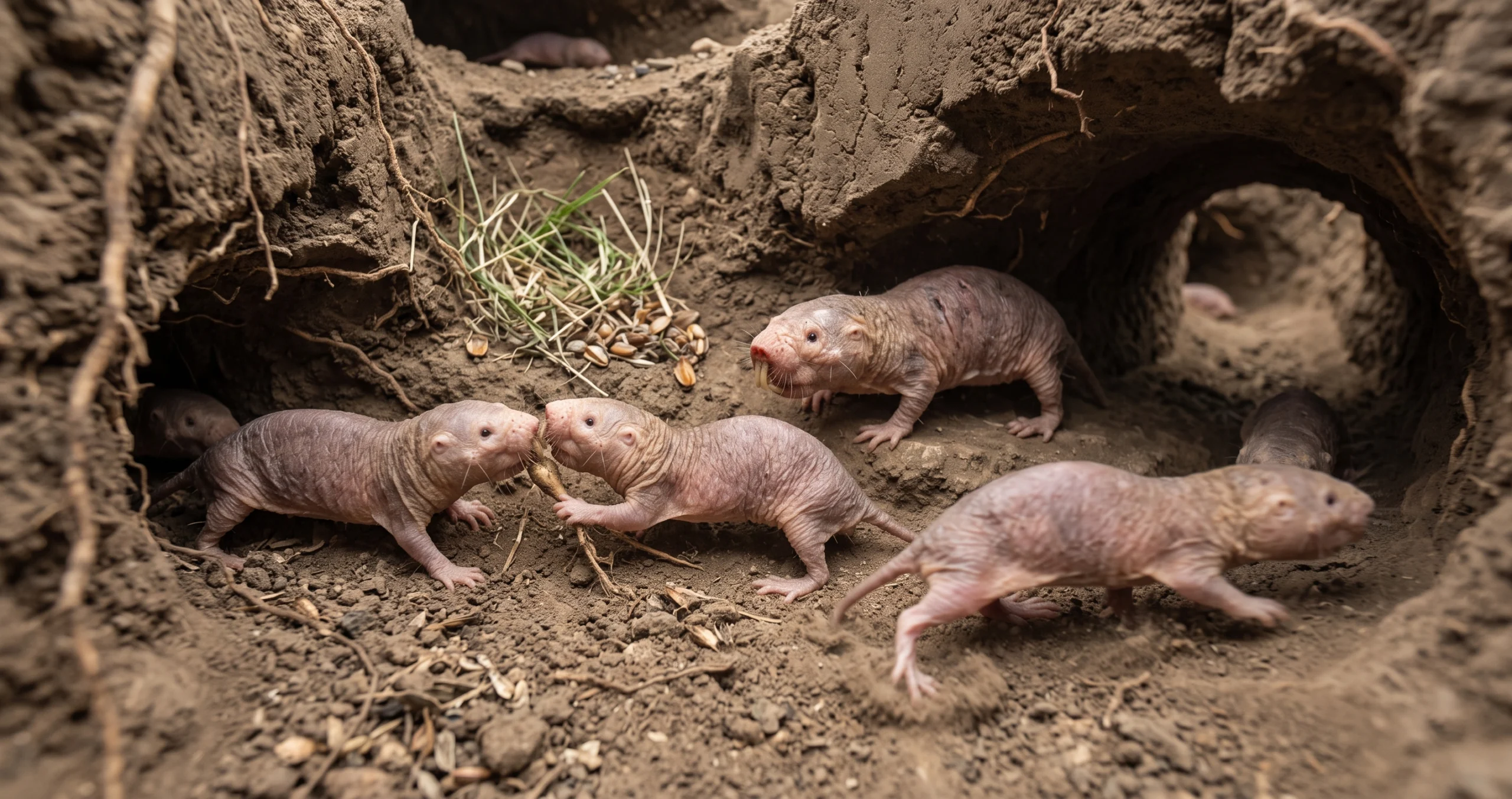
Naked mole-rat colony structure is unlike almost anything else found among mammals. Deep beneath the dry soils of eastern Africa, these unusual rodents live in highly organized underground societies where individuals cooperate, divide labor, and even limit reproduction to a single breeding female. Their way of life has fascinated zoologists for decades because it resembles the social systems of ants, bees, and termites far more than those of typical mammals.
Despite their unusual appearance, naked mole-rats are remarkable examples of evolutionary adaptation. Their nearly hairless bodies, specialized teeth, and cooperative behavior allow entire colonies to survive in harsh environments where food and water are limited. Rather than competing with one another, colony members work together to dig tunnels, defend their home, and care for the next generation.
This article explores how naked mole-rat colony structure functions, why it evolved, and what it reveals about cooperation in the animal kingdom.
Table of Contents
- What Is a Naked Mole-Rat?
- Where Naked Mole-Rats Live
- Anatomy Built for Underground Life
- Understanding Naked Mole-Rat Colony Structure
- Communication and Cooperation
- Reproduction and the Queen
- Daily Life Inside the Colony
- Ecological Importance
- Conservation Status and Future Challenges
- What People Often Get Wrong
- How You Can Support Underground Wildlife
- Frequently Asked Questions
- Conclusion
What Is a Naked Mole-Rat?
The naked mole-rat (Heterocephalus glaber) is a small burrowing rodent native to parts of Ethiopia, Kenya, and Somalia. Although its name includes “mole,” it is not closely related to true moles. Instead, it belongs to the African mole-rat family.
Adults typically measure around 3 to 4 inches long, although breeding females become noticeably larger. Their wrinkled pinkish skin, tiny eyes, sparse hair, and oversized front teeth may seem unusual, but every feature serves a purpose underground.
Unlike many rodents, naked mole-rats spend almost their entire lives below the surface. Colonies may occupy tunnel systems stretching for several miles, rarely emerging into daylight.
Where Naked Mole-Rats Live
Naked mole-rats inhabit dry grasslands and semi-arid regions of East Africa. These landscapes receive limited rainfall, and food can be difficult to find.
Their underground tunnel systems protect them from:
- Predators
- Extreme daytime heat
- Nighttime cooling
- Dry surface conditions
The tunnels connect sleeping chambers, nesting areas, waste chambers, and feeding sites where the animals locate underground roots and tubers.
Living below ground also creates unique environmental challenges. Oxygen levels are often lower than at the surface, while carbon dioxide concentrations can become much higher. Naked mole-rats possess remarkable physiological adaptations that allow them to tolerate these conditions better than most mammals.
Anatomy Built for Underground Life
Everything about a naked mole-rat’s body reflects its underground lifestyle.
Powerful Incisors
Their large front teeth protrude outside the lips. This unusual arrangement allows them to dig through compact soil without filling their mouths with dirt.
The incisors can move independently, giving the animals excellent control while excavating tunnels.
Wrinkled, Nearly Hairless Skin
The lack of dense fur reduces friction while moving through narrow tunnels.
Loose, wrinkled skin also lets individuals move forward or backward with ease inside confined spaces.
Sensitive Whiskers
Although their eyesight is limited, naked mole-rats rely heavily on touch.
Specialized whiskers scattered across the body help them navigate dark tunnels and maintain contact with colony members.
Reduced Vision
Since sunlight rarely reaches their underground world, large eyes provide little advantage.
Instead, the brain invests more resources in senses useful for life underground.
Efficient Metabolism
Their bodies use energy slowly, an important adaptation when food supplies are unpredictable.
Combined with tolerance for low oxygen, this helps colonies survive challenging environmental conditions.
Understanding Naked Mole-Rat Colony Structure
The most fascinating aspect of these animals is the naked mole-rat colony structure itself.
Very few mammals display eusociality, a form of social organization defined by cooperative care of offspring, overlapping generations, and reproductive specialization.
Naked mole-rats meet all three criteria.
The Queen
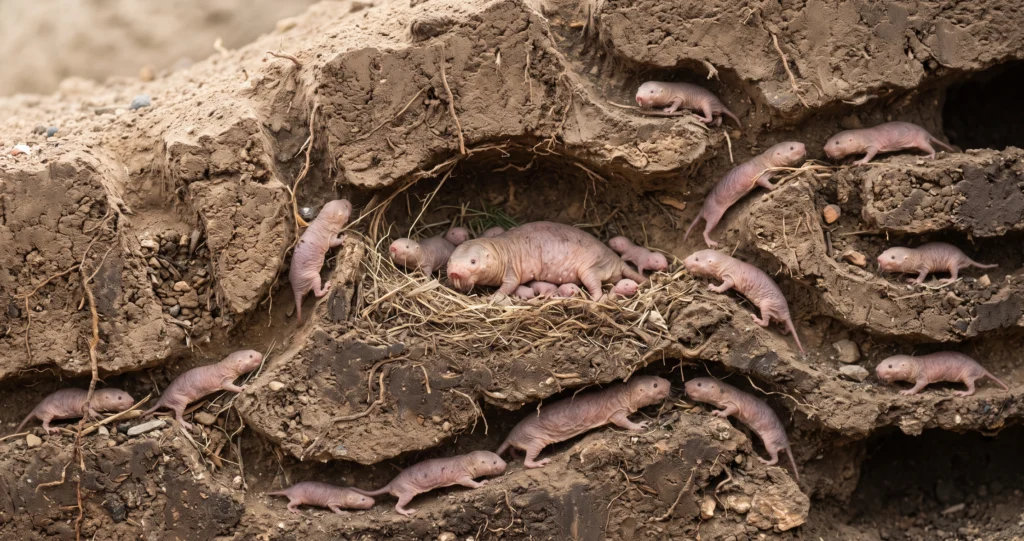
Each colony usually contains one breeding female known as the queen.
She is the only female that regularly produces offspring. Rather than simply being born different, she becomes physically larger after assuming the breeding role, with an elongated body that allows her to carry large litters.
The queen also maintains social dominance through behavioral interactions that discourage reproduction by other females.
Breeding Males
Only a few males mate with the queen.
Most males never reproduce, instead contributing to the survival of the colony through cooperative work.
Workers
Most colony members serve as workers.
Their responsibilities include:
- Digging tunnels
- Searching for food
- Caring for pups
- Cleaning nesting chambers
- Maintaining tunnel systems
- Transporting food
- Grooming other individuals
Workers are not assigned permanent jobs. Many shift responsibilities throughout their lives depending on age, size, and colony needs.
Defenders
Some larger individuals specialize in colony defense.
When snakes or other tunnel-invading predators enter the burrow, these animals confront the threat while other members retreat with vulnerable pups.
Communication and Cooperation
Life underground requires constant coordination.
Naked mole-rats communicate using a combination of vocalizations, touch, scent, and physical contact.
Researchers have identified numerous distinct calls used during everyday colony life.
These sounds help coordinate movement, maintain group cohesion, and identify familiar colony members.
Scent also plays a major role.
Individuals recognize members of their own colony through chemical cues, helping prevent conflicts with neighboring groups.
Touch is equally important.
Animals frequently move in close physical contact while traveling through tunnels, reinforcing social bonds and sharing information about movement direction.
Reproduction and the Queen
One of the most unusual features of naked mole-rat colony structure is reproductive division of labor.
Most females remain reproductively inactive throughout their lives while the queen is healthy and socially dominant.
This is largely maintained through social interactions rather than permanent physical differences.
When a queen dies, several females may compete to replace her.
These contests can involve repeated pushing and physical encounters before one female establishes dominance and eventually becomes the new breeding queen.
The successful female undergoes hormonal and physical changes associated with reproduction.
Litters can be relatively large, and all colony members participate in raising the young.
This cooperative care allows pups to receive protection, grooming, warmth, and food from multiple adults instead of relying solely on their mother.
Daily Life Inside the Colony
Daily activities revolve around maintaining the underground network.
Digging is continuous because expanding tunnels increases opportunities to locate underground roots and tubers.
Colonies often discover food accidentally while excavating.
Instead of consuming an entire underground plant immediately, naked mole-rats sometimes eat portions while leaving enough tissue for the plant to survive and regenerate. This strategy allows the colony to revisit the same food source later.
Inside nesting chambers, individuals often sleep together in tightly packed groups.
Huddling conserves body heat because naked mole-rats have limited ability to regulate their own temperature compared with many mammals.
This social behavior reduces energy demands while maintaining comfortable conditions.
Waste is deposited in designated toilet chambers, helping keep nesting areas relatively clean.
Ecological Importance
Although hidden from view, naked mole-rats influence their environment in several important ways.
Tunnel construction aerates soil and improves water movement through underground layers.
Burrowing also mixes soil, redistributing nutrients over time.
Their feeding habits affect underground plant communities by influencing the growth and regeneration of roots and tubers.
In turn, naked mole-rats serve as prey for specialized underground predators, particularly certain snake species capable of entering burrow systems.
Their colonies therefore contribute to both plant dynamics and food webs within East African ecosystems.
Conservation Status and Future Challenges
Naked mole-rats are currently not considered globally threatened, but that does not mean their future is guaranteed.
Like many wildlife species, they may face increasing pressures from:
- Habitat alteration
- Agricultural expansion
- Infrastructure development
- Changing climate patterns that affect vegetation and soil conditions
Because these animals spend nearly their entire lives underground, population changes can be difficult to monitor accurately.
Protecting healthy native grasslands and maintaining natural ecosystems benefits not only naked mole-rats but many other species that depend on underground habitats.
Long-term ecological research also remains valuable for understanding how environmental changes influence these highly specialized mammals.
What People Often Get Wrong
They Are Not Blind
Their eyesight is poor, but they can still detect light and some visual cues.
They Are Not True Moles
Despite the name, naked mole-rats are rodents rather than members of the mole family.
Every Female Does Not Breed
A healthy colony usually has only one regularly breeding female.
Workers Are Not Mindless
Individuals respond flexibly to changing colony needs, and job roles often shift over time.
Their Appearance Does Not Reflect Poor Health
Their wrinkled skin and sparse hair are normal adaptations for underground living rather than signs of illness.
How You Can Support Underground Wildlife
Most people will never encounter a naked mole-rat in the wild, but supporting habitat conservation still makes a difference.
Practical actions include:
- Supporting organizations that protect African ecosystems.
- Learning about lesser-known mammals, not just charismatic species.
- Visiting accredited zoos that participate in conservation education and scientific research.
- Sharing scientifically accurate wildlife information to reduce misconceptions.
- Encouraging protection of natural habitats that support entire underground ecosystems.
Even small educational efforts help build appreciation for species that are often overlooked.
Frequently Asked Questions
Why do naked mole-rats have a queen?
Having one primary breeding female allows the colony to concentrate resources on raising offspring while other members contribute through digging, defense, and care.
How many naked mole-rats live together?
Colony size varies considerably. Some contain only a few dozen individuals, while larger colonies may include well over one hundred members.
Why are naked mole-rats hairless?
Sparse hair reduces friction in narrow tunnels and suits their warm underground environment. They still possess specialized sensory hairs that aid navigation.
What do naked mole-rats eat?
Their diet consists mainly of underground roots, tubers, bulbs, and other plant storage organs.
Do naked mole-rats ever leave their tunnels?
They rarely emerge above ground. Nearly every aspect of their lives, including feeding, breeding, and raising young, occurs underground.
Conclusion
The remarkable naked mole-rat colony structure demonstrates that cooperation can be just as successful as competition. From the queen and breeding males to hardworking tunnel diggers and dedicated defenders, every colony member contributes to the survival of the group.
Their anatomy, communication, reproductive strategy, and underground engineering make naked mole-rats one of the most extraordinary mammals on Earth. As researchers continue to study these unusual rodents, they provide valuable insights into evolution, social behavior, physiology, and adaptation to extreme environments.
Protecting the habitats where these colonies thrive helps preserve not only a fascinating species but also the ecological processes that unfold beneath the soil, often unnoticed yet critically important.
Suggested Internal Link Opportunities
When related articles are available on SecretsoftheGreenGarden.com, consider linking naturally to:
- An article about bar-tailed godwit migration (bird adaptation and survival).
- An article explaining animal fur patterns and camouflage.
- An article exploring how animal noses evolve for specialized functions.
Recommended Authoritative External Sources
- Smithsonian’s National Zoo & Conservation Biology Institute (naked mole-rat biology)
- International Union for Conservation of Nature (IUCN Red List)
- University of Illinois or Cornell University wildlife and animal behavior resources
- National Institutes of Health (research on naked mole-rat physiology)
- Peer-reviewed journals such as Nature, Science, Proceedings of the Royal Society B, and the Journal of Experimental Biology