
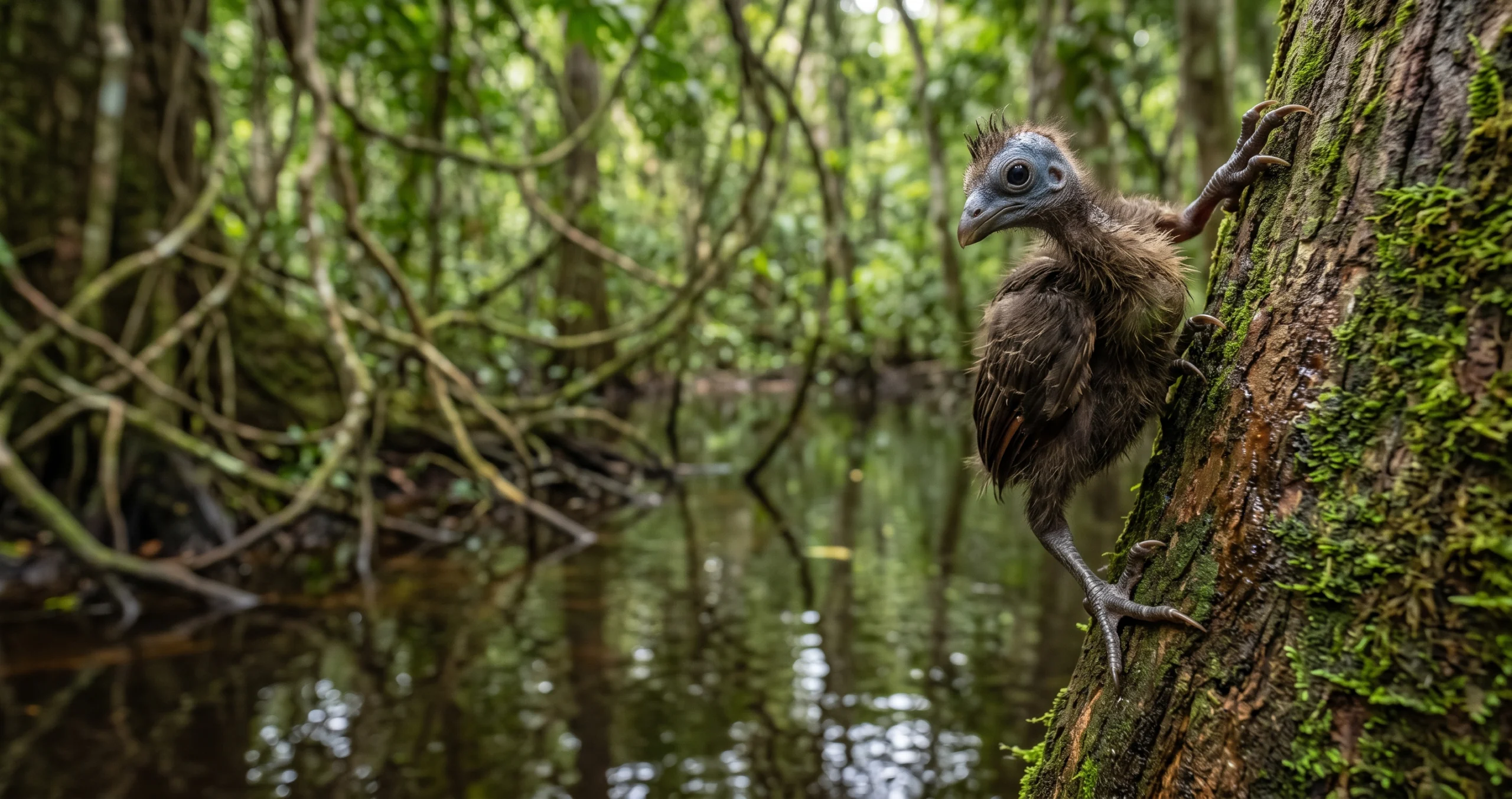
Few birds look as unusual as the hoatzin, but even fewer surprise scientists as much as its chicks. The hoatzin chick wing claws are one of the most remarkable survival adaptations found in modern birds. Hidden among the flooded forests of northern South America, young hoatzins hatch with two functional claws on each wing. These temporary structures allow them to climb through branches, escape predators, and return safely to their nests after danger has passed.
Although wing claws might sound like something from the age of dinosaurs, they are very much a part of the hoatzin’s life today. These unusual appendages have fascinated ornithologists for generations because they offer a rare glimpse into how specialized adaptations can evolve to meet very specific environmental challenges.
In this article, we’ll explore why hoatzin chicks have wing claws, how they use them, what happens as they mature, and why this extraordinary bird continues to puzzle scientists.
Table of Contents
- Meet the Hoatzin
- Where Hoatzins Live
- Anatomy of a Hoatzin Chick
- Why Hoatzin Chick Wing Claws Matter
- How Chicks Escape Predators
- Growing Up: Losing the Claws
- Adult Hoatzin Adaptations
- Ecological Importance
- Conservation Status
- What People Often Get Wrong
- How Birdwatchers Can Observe Hoatzins Responsibly
- Frequently Asked Questions
- Conclusion
Meet the Hoatzin
The hoatzin (Opisthocomus hoazin) is one of the world’s most distinctive birds. It inhabits slow-moving rivers, swamps, oxbow lakes, and flooded forests across the Amazon and Orinoco basins.
Adults are immediately recognizable by their:
- Long crest
- Blue facial skin
- Red eyes
- Chestnut-colored plumage
- Long tail
Their appearance is striking, but their biology is even more unusual.
Unlike most birds, hoatzins rely heavily on fermentation to digest leaves, making them one of the few primarily folivorous birds alive today. Their enlarged crop functions somewhat like the rumen of grazing mammals, allowing microbes to break down tough plant material before digestion continues.
This unusual digestive system gives the species its well-known nickname: the “stinkbird,” because fermentation can produce a distinctive odor.
Where Hoatzins Live
Hoatzins are found throughout parts of:
- Brazil
- Venezuela
- Colombia
- Ecuador
- Peru
- Bolivia
- Guyana
- Suriname
- French Guiana
They rarely venture far from freshwater.
Their preferred habitat includes:
- Flooded forests
- River edges
- Mangrove-like wetlands
- Dense riverside vegetation
- Quiet backwaters
Nests are usually built directly above water in shrubs or overhanging branches.
This location plays a major role in the survival strategy of young chicks.
Anatomy of a Hoatzin Chick
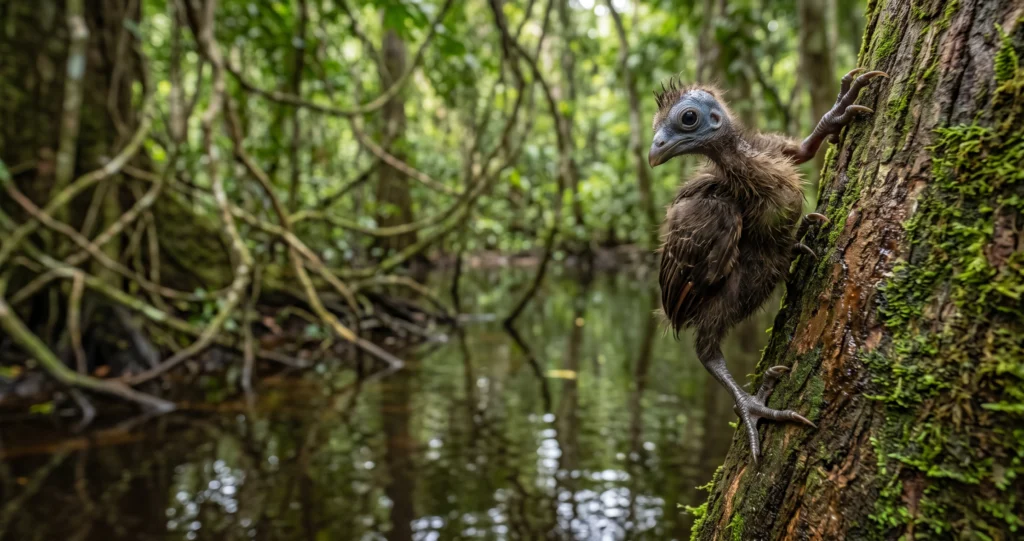
Newly hatched hoatzins are very different from adults.
Besides their fluffy down, they possess two small but functional claws on each wing. These claws grow from the first and second digits of the wing skeleton.
Unlike decorative vestiges, these claws serve an important mechanical purpose.
The chicks also have:
- Strong grasping feet
- Flexible joints
- Excellent climbing ability
- Lightweight bodies
- Well-developed balance
Together, these characteristics allow them to move through vegetation long before they are capable of true flight.
Why Hoatzin Chick Wing Claws Matter
The primary purpose of hoatzin chick wing claws is survival.
Hoatzin nests are vulnerable to predators such as monkeys, snakes, birds of prey, and other nest raiders.
Unlike many nestlings that remain defenseless, hoatzin chicks have an unusual escape strategy.
When threatened, they leap from the nest into the water below.
At first glance, this seems risky.
However, the chicks are capable swimmers. They paddle toward nearby vegetation using both their feet and partially developed wings.
Once they reach branches, the wing claws become invaluable.
The claws hook onto bark and stems, allowing the chicks to climb steadily upward until they return to the nest or reach safer cover.
Without these specialized structures, climbing vertical branches would be far more difficult before the wings become strong enough for flight.
How Chicks Escape Predators
The escape sequence is one of the most fascinating examples of behavioral adaptation among birds.
Jumping Into the Water
Instead of freezing when danger approaches, chicks often dive directly into nearby water.
This rapid response can reduce the chance of being captured by predators climbing toward the nest.
Swimming to Safety
Young hoatzins are capable swimmers despite being birds.
They propel themselves using coordinated movements of their legs and partially developed wings.
Climbing Back
After reaching shoreline vegetation, they begin climbing.
The wing claws grip branches while the feet provide additional support.
This coordinated climbing resembles the movements of small mammals more than those of most birds.
Eventually the chicks make their way back into shrubs and toward the nesting area.
Parents typically continue caring for them after these escape events.
Growing Up: Losing the Claws
One of the most interesting aspects of hoatzin development is that the wing claws are temporary.
As chicks mature:
- Wings lengthen.
- Flight feathers develop.
- Muscles strengthen.
- Climbing becomes less important.
- Flight becomes more efficient.
Eventually, the claws become greatly reduced and lose their functional role.
Adult hoatzins retain tiny remnants of these structures, but they no longer use them for climbing.
The transition reflects a change in lifestyle.
Young birds need climbing ability before flight develops, while adults depend almost entirely on flying between riverside trees.
Adult Hoatzin Adaptations
The wing claws are only one part of the hoatzin’s remarkable biology.
Specialized Digestive System
Adults feed primarily on leaves, shoots, and buds.
An enlarged crop houses microbes that ferment plant material before digestion continues.
This digestive strategy is extremely unusual among birds.
Reduced Flight Ability
Because the digestive system occupies considerable space within the chest, hoatzins are relatively weak fliers.
Their flights are generally short and involve gliding between nearby trees.
Social Behavior
Hoatzins often live in small family groups.
Adults cooperate in defending nesting territories, and older offspring may help care for younger chicks during the breeding season.
Are Wing Claws a Living Dinosaur Trait?
The appearance of wing claws naturally raises questions about dinosaur evolution.
Early birds such as Archaeopteryx possessed clawed fingers on their wings, and several extinct feathered dinosaurs also retained clawed forelimbs.
However, scientists caution against describing modern hoatzins as “living fossils.”
The presence of wing claws does not mean hoatzins are unchanged descendants of prehistoric birds.
Instead, the claws represent a specialized adaptation that serves a clear purpose during the chick stage.
Modern birds and extinct dinosaurs share ancient evolutionary ancestry, but hoatzins have followed their own unique evolutionary path.
Ecological Importance
Hoatzins contribute to wetland ecosystems in several ways.
As leaf-eating birds, they influence vegetation by browsing on young plant growth.
They also disperse some plant material through movement between feeding sites.
Because they occupy healthy river-edge forests, their presence can indicate intact wetland habitats with abundant vegetation.
These ecosystems also support fish, reptiles, amphibians, insects, and countless other bird species.
Protecting hoatzins therefore helps conserve entire freshwater communities.
Conservation Status
The hoatzin is currently classified as Least Concern on the IUCN Red List.
Its range is extensive, but healthy populations still depend on intact wetlands and riverine forests.
Potential pressures include:
- Wetland drainage
- Deforestation
- River modification
- Agricultural expansion
- Human disturbance near breeding habitats
Conserving flooded forests benefits not only hoatzins but also many other specialized wildlife species that depend on these ecosystems.
Protected areas throughout the Amazon and Orinoco basins play an important role in maintaining suitable habitat.
What People Often Get Wrong
Hoatzins Do Not Keep Functional Wing Claws for Life
The claws are most useful during the chick stage and become greatly reduced as the birds mature.
Wing Claws Are Not Used for Hunting
Hoatzins are primarily herbivorous and do not use their claws to capture prey.
They Are Not Direct Descendants of Dinosaurs
Like all modern birds, hoatzins share ancient ancestry with dinosaurs, but they are modern birds with their own specialized evolutionary history.
They Are Not Strong Fliers
Despite their large wings, hoatzins usually make short flights through dense riverside vegetation.
Swimming Is a Normal Survival Behavior
Young hoatzins intentionally enter the water when escaping predators. This is a natural part of their development rather than an accident.
How Birdwatchers Can Observe Hoatzins Responsibly
Seeing a hoatzin in the wild is a memorable experience, especially during the breeding season.
If you visit Amazonian wetlands:
- Watch from established boats or observation areas.
- Avoid approaching active nests.
- Use binoculars or a telephoto lens instead of moving closer.
- Minimize noise around breeding colonies.
- Support ecotourism operators that follow wildlife-viewing guidelines.
Giving nesting birds enough space reduces stress and helps ensure chicks can develop naturally.
Frequently Asked Questions
Why do hoatzin chicks have claws on their wings?
They use them to climb branches after escaping predators by jumping into the water below their nests.
Can adult hoatzins still use wing claws?
Adults retain only tiny remnants of the claws, which no longer function for climbing.
Are hoatzins good fliers?
Not particularly. They usually make short flights between nearby trees because their enlarged digestive system limits flight performance.
Where can hoatzins be found?
They inhabit flooded forests and wetlands throughout much of the Amazon and Orinoco river basins in northern South America.
Are hoatzins endangered?
No. The species is currently listed as Least Concern by the IUCN, although habitat conservation remains important for long-term population health.
Conclusion
The remarkable hoatzin chick wing claws demonstrate how evolution can produce highly specialized adaptations for survival. These temporary claws allow vulnerable chicks to escape predators, climb back through riverside vegetation, and survive the dangerous weeks before they become capable fliers.
Combined with their leaf-based diet, fermentation-powered digestion, and life in flooded forests, hoatzins remain one of the most extraordinary birds alive today. Their unusual biology reminds us that nature often solves challenges in unexpected ways, creating adaptations perfectly suited to specific environments rather than following familiar patterns.
Protecting tropical wetlands ensures that future generations can continue studying—and marveling at—this truly unique bird.
Suggested Internal Link Opportunities
When related articles are available on SecretsoftheGreenGarden.com, consider linking naturally to:
- How Bar-Tailed Godwits Complete Nonstop Trans-Pacific Flights
- Inside the Complex Colonies of Naked Mole-Rats
- A future article about bird nesting strategies or rainforest bird adaptations
Recommended Authoritative External Sources
- Smithsonian’s National Zoo & Conservation Biology Institute
- International Union for Conservation of Nature (IUCN) Red List
- Cornell Lab of Ornithology (Bird Academy and Birds of the World resources)
- The Auk / Ornithology and Journal of Avian Biology (peer-reviewed research)
- Encyclopaedia Britannica and university ornithology departments for background taxonomy