
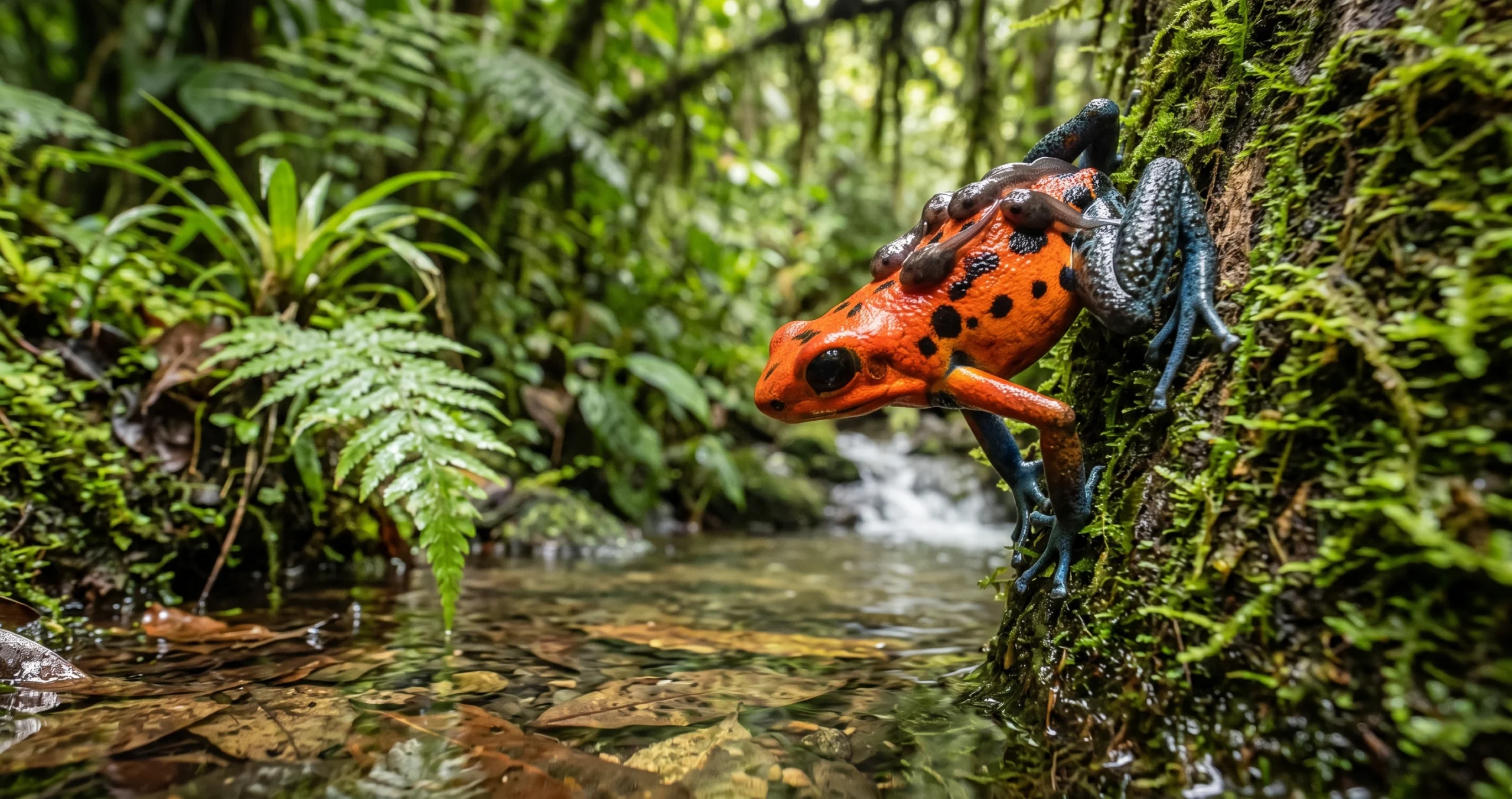
Poison frogs are famous for their brilliant colors, but one of their most remarkable traits is something many people never see. Poison frog tadpole transport is an extraordinary form of parental care in which an adult carefully carries newly hatched tadpoles from eggs laid on land to tiny pools of water scattered throughout the rainforest. This demanding journey helps give the next generation a better chance of survival in one of the world’s most competitive ecosystems.
Unlike many amphibians that simply lay eggs in ponds and leave them behind, numerous poison frog species invest significant time and energy into raising their offspring. Some fathers transport each tadpole individually, climbing trees and navigating complex forest terrain. In a few species, mothers later return to feed their developing young with unfertilized eggs, creating one of the most specialized parenting systems found among amphibians.
Understanding poison frog tadpole transport offers a fascinating look at evolution, rainforest ecology, and the delicate balance that supports tropical biodiversity.
Table of Contents
- What Are Poison Frogs?
- Why Eggs Are Laid on Land
- How Poison Frog Tadpole Transport Works
- Anatomy That Helps During the Journey
- Finding Safe Water in the Rainforest
- Specialized Parenting Strategies
- Habitat and Distribution
- Ecological Importance
- Threats to Poison Frogs
- What People Often Get Wrong
- How to Observe Poison Frogs Responsibly
- Frequently Asked Questions
- Conclusion
What Are Poison Frogs?
Poison frogs belong primarily to the family Dendrobatidae, a group of small tropical frogs native to Central and South America. While many species produce skin toxins that discourage predators, toxicity varies greatly between species and populations. In captivity, many poison frogs lose much of their toxicity because they no longer consume the specialized ants, mites, and other arthropods that supply the chemical compounds used to produce defensive alkaloids.
Despite their small size—many measure less than two inches long—poison frogs display remarkable diversity in color, behavior, and reproductive strategies. Their vibrant patterns serve as warning signals in many species, although some less-toxic species mimic the appearance of more dangerous relatives.
Their breeding behavior, however, may be even more impressive than their colors.
Why Eggs Are Laid on Land
Unlike many frogs that deposit eggs directly in ponds or streams, numerous poison frog species lay their eggs on moist leaf litter, under fallen logs, inside bromeliads, or on other protected surfaces above water.
This strategy offers several advantages:
- It reduces exposure to aquatic predators like fish and insect larvae.
- Eggs remain in humid environments while avoiding permanent pools filled with predators.
- Parents can guard developing embryos more effectively.
Many male poison frogs stay close to the clutch, keeping the eggs moist by transporting water on their bodies or selecting naturally humid nesting sites. They also defend the area against rival males and may remove infected or damaged eggs.
After several days to a few weeks, depending on the species and environmental conditions, the tadpoles hatch.
That is when one of nature’s most remarkable journeys begins.
Poison Frog Tadpole Transport: One Tiny Passenger at a Time
Fathers Usually Take the Lead
In many poison frog species, the male performs the transport. As the eggs hatch, each tadpole wriggles onto the parent’s back, where a layer of sticky mucus helps it remain attached.
Instead of carrying the entire brood together, many species transport one tadpole at a time. This requires multiple trips through the rainforest, demanding considerable energy and exposing the parent to predators.
Researchers believe this careful approach may reduce competition between siblings by placing them in separate pools.
An Incredible Navigation Challenge
The rainforest presents an enormous challenge for such tiny animals.
A transporting frog may travel across leaf litter, climb vines, scale tree trunks, and navigate dense vegetation before reaching suitable water.
Scientists continue studying exactly how poison frogs remember these locations. Evidence suggests they combine spatial memory, visual landmarks, and environmental cues to relocate breeding sites repeatedly.
Some individuals return to the same tiny pools throughout multiple breeding seasons.
Anatomy That Helps During the Journey
Although poison frogs appear delicate, several anatomical features support their unusual parenting behavior.
Strong Limbs
Their muscular hind legs provide excellent jumping ability while also allowing careful climbing over uneven forest surfaces.
Adhesive Toe Pads
Expanded toe pads help many species grip wet leaves, bark, moss, and vegetation. This climbing ability is especially important for frogs that transport tadpoles into water-filled bromeliads high above the forest floor.
Protective Skin
Their moist skin supports respiration while also containing glands that produce defensive compounds in many species. Bright coloration warns potential predators that attacking the frog may not be worthwhile.
Compact Body
A lightweight body helps adults move efficiently even while carrying one or more tadpoles.
Finding Safe Water in the Rainforest
Not every puddle makes a suitable nursery.
Many poison frogs select extremely small water bodies, including:
- Water-filled bromeliad leaf axils
- Tree holes
- Bamboo cavities
- Fallen palm bracts
- Small rock pools
These miniature pools often contain few predators, giving tadpoles a greater chance of survival.
However, small pools also contain limited food, making parental decisions especially important.
Some species deliberately place siblings into separate pools to reduce competition and cannibalism.
Specialized Parenting Strategies
Poison frogs display remarkable diversity in parental care.
Fathers That Transport
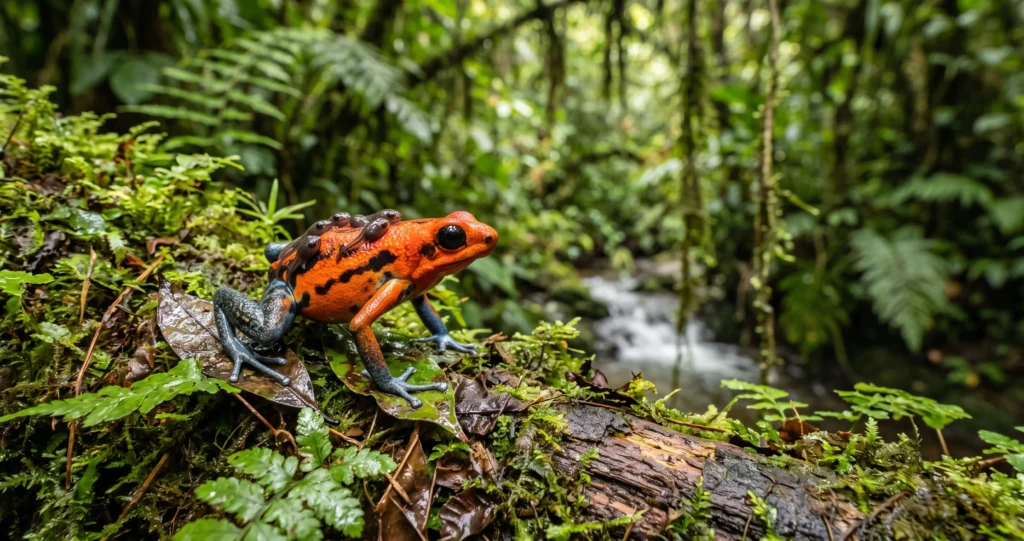
Species such as many Dendrobates and Ameerega frogs rely heavily on males for transporting tadpoles to water.
Mothers That Feed
In several species of Oophaga, mothers repeatedly visit each tadpole after transport.
These pools often lack enough nutrients to support growing larvae. The mother solves this problem by laying unfertilized eggs, which serve as food for her developing offspring.
This behavior requires repeated trips over weeks, demonstrating one of the most advanced forms of parental investment among amphibians.
Shared Parenting
Some poison frog species divide responsibilities between both parents, with each contributing to different stages of reproduction.
This flexibility highlights how parental care has evolved differently across the poison frog family.
Habitat and Distribution
Poison frogs inhabit humid tropical forests from southern Central America through much of northern South America.
Many species live in:
- Lowland rainforests
- Cloud forests
- Foothill forests
- Secondary tropical forests with sufficient moisture
Most remain active during the day, making them unusual among frogs.
High humidity is essential because amphibian skin loses water rapidly. Even slight changes in forest moisture can affect breeding success.
Microhabitats also matter. Moss-covered logs, leaf litter, bromeliads, and shaded vegetation create the stable conditions these frogs need for reproduction.
Ecological Importance
Although small, poison frogs contribute significantly to rainforest ecosystems.
Insect Population Control
Adults consume ants, mites, termites, springtails, flies, and other tiny invertebrates, helping regulate insect populations.
Food Web Connections
Despite their chemical defenses, poison frogs remain prey for certain predators that have evolved resistance or avoidance strategies.
Indicators of Forest Health
Because amphibians are highly sensitive to pollution, moisture changes, and habitat degradation, healthy poison frog populations often indicate relatively intact ecosystems.
Scientists frequently monitor amphibian communities when assessing rainforest health.
Threats to Poison Frogs
Many poison frog populations face growing pressures.
Habitat Loss
Deforestation removes breeding sites, reduces humidity, and fragments populations.
Climate Change
Changing rainfall patterns may dry the tiny pools required for tadpole development.
Disease
The fungal disease chytridiomycosis has affected amphibians worldwide, although impacts vary among poison frog species.
Illegal Wildlife Trade
Some colorful species have been collected illegally for the pet trade, increasing pressure on vulnerable wild populations.
Conservation efforts increasingly focus on habitat protection, sustainable forest management, disease monitoring, captive breeding programs for threatened species, and stronger enforcement against illegal collection.
What People Often Get Wrong
Several misconceptions continue to circulate about poison frogs.
Every Poison Frog Is Extremely Toxic
Toxicity varies widely between species, and captive individuals often lose much of their toxicity because of dietary differences.
Mothers Always Carry the Tadpoles
In many species, the father performs most or all transport duties.
Tadpoles Are Placed in Large Ponds
Many species deliberately choose tiny water-filled plants or tree cavities instead of large bodies of water.
Bright Colors Always Mean Maximum Danger
Warning coloration generally signals chemical defenses, but the strength of those defenses differs considerably among species.
All Poison Frogs Use the Same Parenting Strategy
Parental care varies greatly across the poison frog family, ranging from simple egg guarding to repeated feeding of tadpoles with unfertilized eggs.
How to Observe Poison Frogs Responsibly
Watching poison frogs in the wild can be rewarding when done carefully.
- Stay on established trails whenever possible.
- Never handle wild frogs. Human skin oils, sunscreen, and chemicals may harm amphibians.
- Observe quietly from a respectful distance.
- Avoid disturbing breeding sites or moving bromeliads.
- Support protected rainforest areas and responsible ecotourism programs.
Photographers should prioritize animal welfare over obtaining close-up images.
Frequently Asked Questions
Why do poison frogs carry tadpoles?
Transporting tadpoles allows parents to place them in safer water sources with fewer predators, increasing the likelihood that young frogs survive.
Do all poison frogs transport their young?
No. Many species perform tadpole transport, but parental behaviors differ across the poison frog family.
Why are tadpoles placed in tiny pools?
Small pools often contain fewer predators than larger ponds, although they may require additional parental care because food is limited.
Are poison frogs poisonous from birth?
Young frogs gradually develop chemical defenses through diet after metamorphosis. Wild frogs acquire defensive alkaloids from specific prey, while captive frogs typically have greatly reduced toxicity.
Can poison frogs recognize their offspring?
Researchers continue studying this question. Many species reliably return to known breeding sites and care for their own developing tadpoles, although recognition mechanisms likely vary among species.
Conclusion
The story of poison frog tadpole transport reveals that some of the rainforest’s smallest animals display surprisingly sophisticated parental care. By guarding eggs, carrying tadpoles across challenging terrain, selecting carefully chosen nursery pools, and in some species even feeding their young with unfertilized eggs, poison frogs demonstrate how evolution can produce highly specialized reproductive strategies.
These remarkable behaviors also remind us how closely amphibian survival depends on healthy tropical forests. Every bromeliad, tree hole, and shaded patch of leaf litter may serve as an essential nursery for the next generation. Protecting these habitats helps preserve not only colorful frogs but also one of nature’s most extraordinary examples of parental dedication.
Suggested Internal Link Opportunities
Search your existing wildlife content for related articles covering:
- Dragonfly hunting accuracy and predator-prey behavior.
- Bar-tailed godwit migration and animal navigation.
- Other amphibian, rainforest, or animal parental care articles.
- Conservation-focused wildlife features relevant to tropical ecosystems.
Recommended Authoritative External Sources
- IUCN Red List species assessments
- Smithsonian’s National Zoo & Conservation Biology Institute
- AmphibiaWeb (University of California, Berkeley)
- American Museum of Natural History research on poison frogs
- Peer-reviewed journals such as Behavioral Ecology and Sociobiology, Journal of Herpetology, and Herpetologica