
Table of Contents
- Introduction
- What Is a Slow Loris?
- Slow Loris Venom: The Only Venomous Primate
- How the Brachial Gland Venom Mechanism Works
- Why Did Slow Lorises Evolve Venom?
- A Secretive Life in the Forest Canopy
- The Illegal Pet Trade Crisis
- Conservation Status and Ongoing Threats
- Common Myths About Slow Lorises
- Frequently Asked Questions
- Conclusion
The remarkable phenomenon of slow loris venom makes this small nocturnal mammal unlike any other primate on Earth. At first glance, slow lorises appear harmless, with their enormous eyes, fluffy fur, and slow, deliberate movements. Yet beneath that gentle appearance lies one of the most unusual defensive adaptations found in mammals: a venomous bite created by mixing secretions from a specialized gland with saliva.
Scientists have spent decades studying how this venom works and why it evolved. Evidence suggests it plays several important roles, including predator defense, territorial conflicts, and even competition between young lorises. At the same time, the popularity of misleading internet videos has fueled an illegal pet trade that threatens wild populations throughout Southeast Asia.
Understanding the biology of slow loris venom reveals not only a remarkable evolutionary adaptation but also why these animals belong in protected forests—not in living rooms.
If you enjoy learning about extraordinary animal adaptations, you may also enjoy our article on Atlantic Puffins Return to the Same Burrow and Mate Every Year here on secretsofthegreengarden.com.
What Is a Slow Loris?
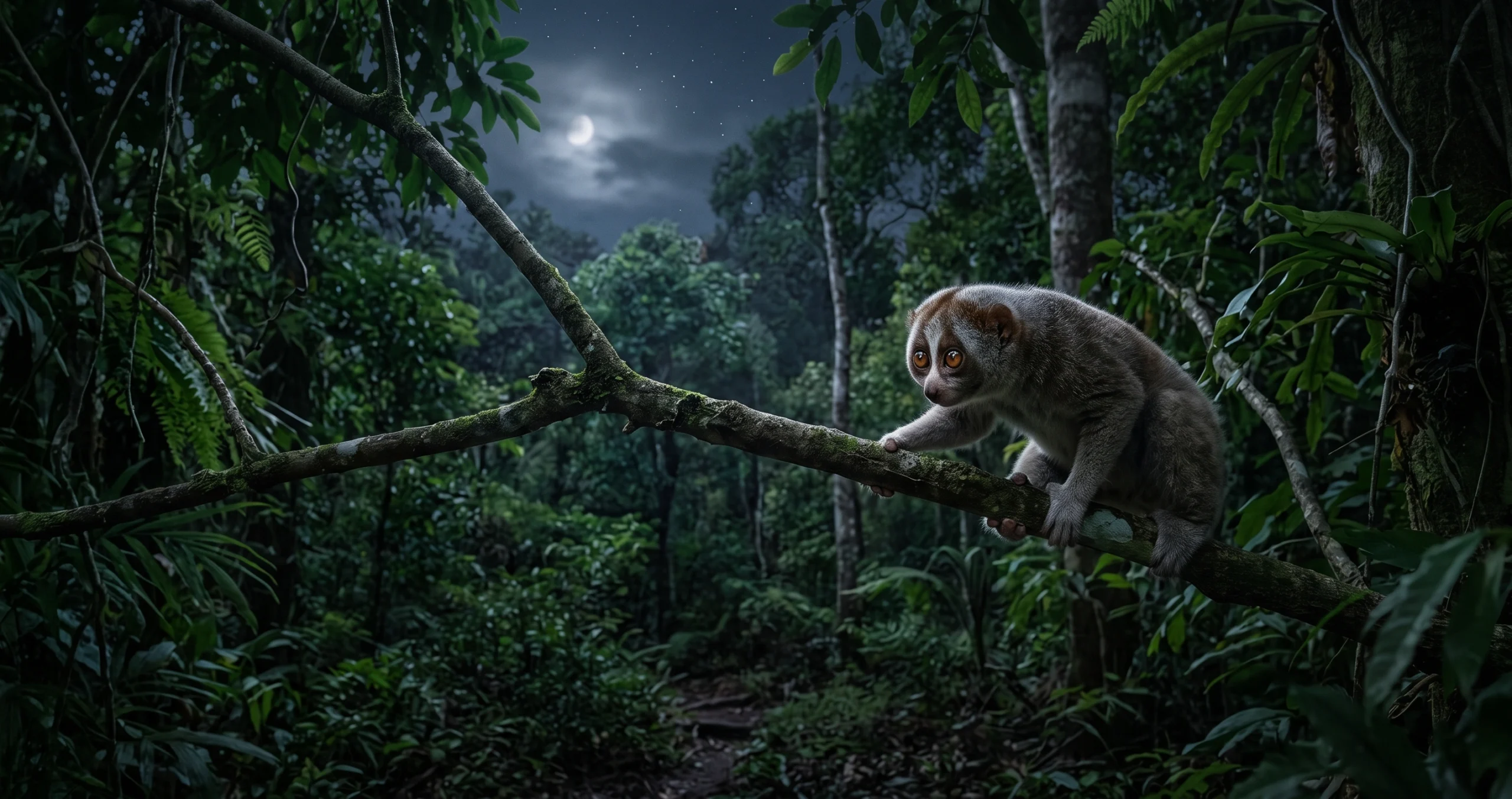
Slow lorises belong to the genus Nycticebus, a group of small nocturnal primates native to South and Southeast Asia.
They inhabit tropical forests in countries including Indonesia, Malaysia, Thailand, Vietnam, Cambodia, Laos, Bangladesh, and parts of India.
Several recognized species exist, including the Sunda slow loris, Bengal slow loris, pygmy slow loris, Javan slow loris, and others.
Unlike monkeys, slow lorises move cautiously through tree branches using an exceptionally strong grip.
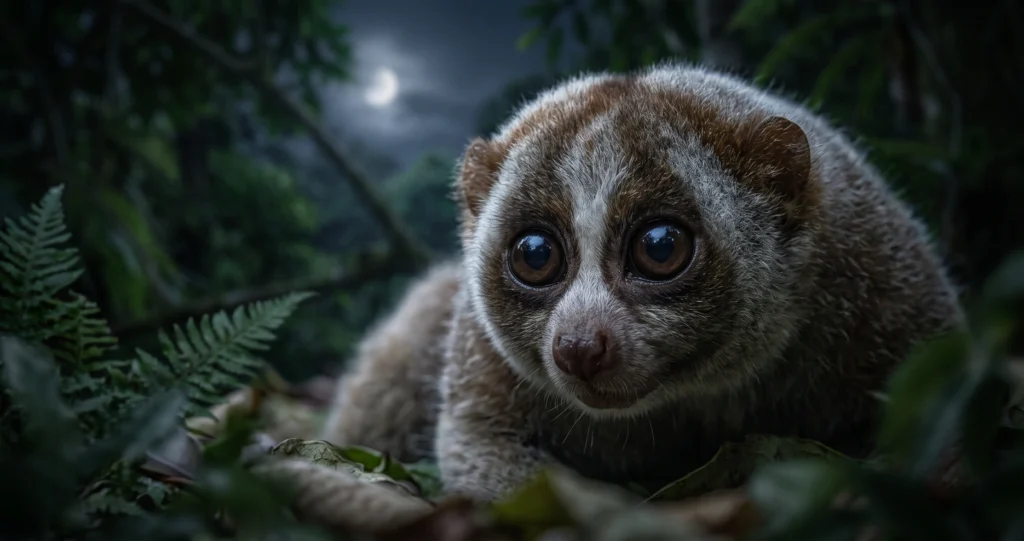
Their large forward-facing eyes provide excellent night vision, while specialized blood vessels in their limbs allow them to remain motionless for extended periods without muscle fatigue.
This slow, deliberate movement helps them avoid detection by predators.
Despite their peaceful appearance, however, slow lorises possess one biological feature unmatched among primates.
Slow Loris Venom: The Only Venomous Primate
Slow Loris Venom Is Unlike Any Other Primate Defense
Among all known primates, only slow lorises produce a venomous secretion capable of being delivered through a bite.
The venom does not come directly from specialized fangs like those of venomous snakes.
Instead, it results from a unique two-part system.
A gland located on the inside of each upper arm—called the brachial gland—produces an oily secretion.
When threatened or preparing to defend itself, the loris raises its arms over its head and licks this gland.
The secretion mixes with saliva inside the mouth.
Once activated, the loris can deliver the venom through a bite using specialized tooth structures.
Although most bites affect predators or rival lorises, humans have also experienced medically significant reactions.
In rare cases, severe allergic responses, including anaphylactic shock, have been documented.
Because venom composition varies and research continues, scientists are still working to understand every component involved.
How the Brachial Gland Venom Mechanism Works
The brachial gland sits near the elbow on the inner upper arm.
When the loris feels threatened, it assumes a distinctive defensive posture by lifting both arms above its head.
This behavior serves two purposes.
First, it allows the animal to access the gland easily with its tongue.
Second, the raised posture itself may intimidate predators.
After licking the gland, secretions combine with saliva before the loris bites.
Researchers believe certain proteins in the brachial secretion resemble proteins found in cat allergens, possibly contributing to strong immune reactions in bitten animals.
The lower front teeth of slow lorises form a tightly packed structure known as a toothcomb.
Although primarily used for grooming, this specialized arrangement may also help deliver venom efficiently during defensive bites.
Scientists continue studying the chemistry of the venom because its exact composition remains only partially understood.
Why Did Slow Lorises Evolve Venom?
Unlike snakes, which primarily use venom to capture prey, slow lorises likely evolved venom for several different purposes.
Predator Defense
Slow lorises cannot leap rapidly between trees or flee quickly from predators.
Instead, they rely on camouflage, stealth, and defensive biting.
A venomous bite provides an effective deterrent against predators capable of reaching them in the forest canopy.
Some researchers believe the venom may also discourage repeated attacks by causing pain or illness.
Competition Between Adults
Slow lorises are generally solitary.
Territorial disputes occasionally lead to aggressive encounters.
Serious bite wounds observed in wild populations suggest venom may help establish dominance or defend valuable territories.
Sibling Rivalry
One particularly intriguing hypothesis involves competition between young lorises.
Researchers have observed bite wounds among juveniles and propose that venom may influence sibling competition under certain circumstances.
Evidence remains limited, and scientists continue investigating this possibility.
Rather than viewing venom as serving only one purpose, many researchers now believe it likely evolved through multiple selective pressures acting simultaneously.
A Secretive Life in the Forest Canopy
Slow lorises spend nearly their entire lives in trees.
Their diet includes tree gums, nectar, fruit, insects, spiders, bird eggs, and small vertebrates.
Unlike many primates, they move with exceptional caution.
Each limb grips securely before the next moves forward.
This deliberate locomotion minimizes noise and helps avoid attracting predators.
Large eyes maximize light gathering during nighttime activity.
A reflective layer behind the retina improves vision under dim conditions.
Although their facial expressions often appear gentle or smiling to humans, these interpretations reflect human emotions rather than loris behavior.
Understanding their natural ecology helps explain why they adapt poorly to captivity.
The Illegal Pet Trade Crisis
Perhaps no issue threatens slow lorises more than the illegal wildlife trade.
Videos circulating online often portray lorises being tickled, cuddled, or held like domestic pets.
Unfortunately, these clips rarely show the suffering behind the scenes.
Many captured lorises have their front teeth painfully cut or removed without anesthesia to reduce the risk of venomous bites.
This mutilation often leads to infection, chronic pain, and death.
Without their toothcomb, lorises struggle to feed naturally.
Others die during transport because of stress, dehydration, poor nutrition, and improper handling.
Even survivors frequently suffer severe psychological stress.
Slow lorises have highly specialized dietary, social, and environmental needs that cannot easily be replicated in homes.
The illegal pet trade also removes breeding adults from already vulnerable wild populations.
Conservation organizations consistently emphasize that slow lorises should never be purchased or kept as pets.
Conservation Status and Ongoing Threats
Every slow loris species faces conservation challenges.
Habitat destruction caused by logging, agriculture, and infrastructure development continues reducing available forest habitat.
Illegal capture for the pet trade remains widespread throughout much of Southeast Asia.
Traditional medicine markets also contribute to population declines in some regions.
Although conservation status varies among species, many are listed as Vulnerable, Endangered, or Critically Endangered on the IUCN Red List.
International trade is regulated under the Convention on International Trade in Endangered Species (CITES), yet illegal trafficking persists.
Protecting remaining forests, strengthening law enforcement, reducing consumer demand, and supporting rescue centers remain essential conservation priorities.
Why Slow Loris Research Matters
Slow lorises continue surprising scientists.
Their venom represents one of the rarest defensive adaptations among mammals.
Studying its chemistry may improve understanding of allergy-related proteins and venom evolution.
Behavioral studies reveal complex social interactions previously overlooked.
Conservation research also provides valuable insights into wildlife trafficking, habitat fragmentation, and sustainable forest management.
Because slow lorises occupy important ecological roles as pollinators, insect predators, and seed dispersers, protecting them benefits entire forest ecosystems.
Common Myths About Slow Lorises
Myth 1: Slow lorises are harmless pets.
Reality:
They possess venomous bites, specialized dietary needs, and should never be kept as pets.
Myth 2: Their venom comes directly from their teeth.
Reality:
Venom originates from brachial gland secretions mixed with saliva before delivery through a bite.
Myth 3: They enjoy being tickled.
Reality:
The raised-arm posture seen in many viral videos often represents defensive behavior rather than enjoyment.
Myth 4: Slow lorises are lazy.
Reality:
Their slow movement is a highly specialized adaptation that reduces detection by predators.
Myth 5: Removing their teeth solves the danger.
Reality:
Tooth removal causes severe suffering, often leads to infection, and prevents normal feeding and grooming.
Frequently Asked Questions
Are slow lorises really venomous?
Yes. They are the only known primates capable of producing a venomous bite through brachial gland secretions mixed with saliva.
Can a slow loris bite humans?
Yes. Bites may cause pain, swelling, allergic reactions, and, in rare cases, severe anaphylaxis.
Why do slow lorises raise their arms?
This defensive posture allows them to lick the brachial glands before preparing to bite.
Why are slow lorises illegal pets?
International trade restrictions exist because wild populations face serious threats from habitat loss and illegal capture, and these animals have complex care requirements unsuitable for captivity.
What do slow lorises eat?
Their diet includes tree gums, nectar, fruit, insects, spiders, and occasionally small vertebrates or bird eggs.
Conclusion
The remarkable biology of slow loris venom demonstrates that even seemingly gentle animals can possess extraordinary evolutionary adaptations. Through a unique combination of brachial gland secretions and saliva, slow lorises have evolved the only known venomous bite among primates—a defense likely shaped by predator pressure, territorial competition, and other ecological challenges.
Equally important is the conservation message these animals represent. Viral internet videos often hide the devastating consequences of the illegal pet trade, including painful tooth removal, stress, and declining wild populations. Slow lorises belong in the forests of Southeast Asia, where their specialized behaviors, ecological roles, and remarkable adaptations have evolved over millions of years. Protecting these unique primates helps preserve not only one extraordinary species but also the rich biodiversity of the forests they call home.
2 Internal Link Suggestions:
- https://secretsofthegreengarden.com/atlantic-puffins-return-to-the-same-burrow-and-mate-every-year/
- https://secretsofthegreengarden.com/how-giant-tube-worms-survive-without-a-mouth-gut-or-sunlight/
3 External Dofollow Authoritative Sources:
- International Union for Conservation of Nature (IUCN): https://www.iucn.org/
- Little Fireface Project: https://www.nocturama.org/en/little-fireface-project
- Smithsonian’s National Zoo: https://nationalzoo.si.edu/