
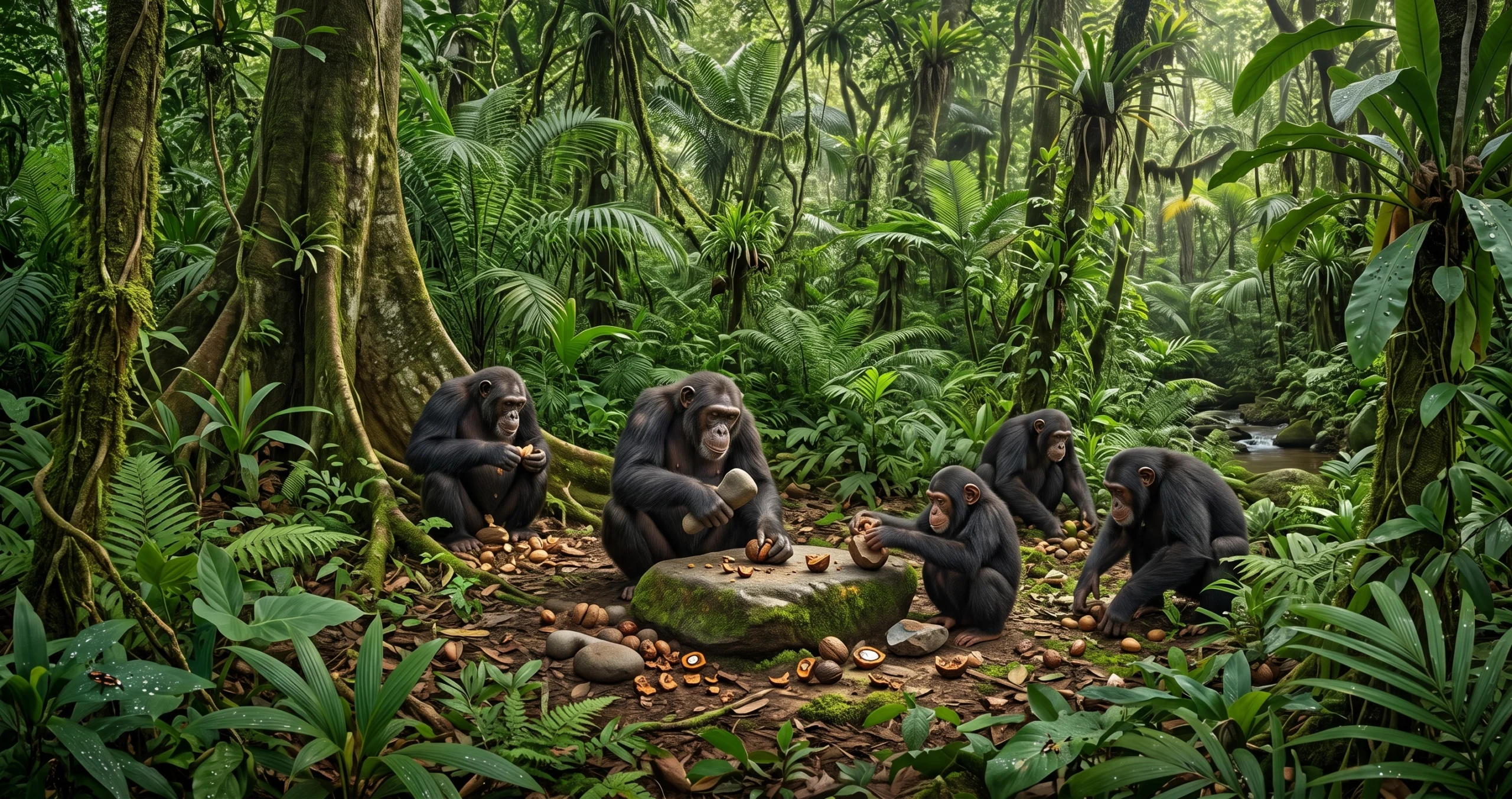
For decades, scientists believed that culture was uniquely human. Today, decades of field research tell a different story. One of the strongest examples comes from wild chimpanzees, whose communities display distinct traditions that are learned rather than inherited. The study of chimpanzee tool use culture has transformed our understanding of animal intelligence, revealing that neighboring chimpanzee groups can solve the same problems in completely different ways—and pass those solutions from one generation to the next.
From cracking nuts with stone hammers to crafting fishing tools for termites, chimpanzees demonstrate behaviors that spread through observation and practice instead of instinct alone. These traditions vary between populations even when habitats are similar, suggesting that social learning plays a major role. Understanding chimpanzee tool use culture not only sheds light on our own evolutionary history but also highlights why protecting experienced individuals is essential for conserving wildlife knowledge.
Table of Contents
- What Scientists Mean by Animal Culture
- Why Chimpanzees Became the Best Example
- Chimpanzee Tool Use Culture Across Africa
- How Young Chimpanzees Learn Traditions
- Social Learning vs. Instinct
- Famous Examples of Regional Tool Use
- Why Losing Older Chimpanzees Matters
- What Chimpanzee Culture Teaches Us About Human Evolution
- Conservation Implications
- Common Myths About Chimpanzee Culture
- Frequently Asked Questions
- Conclusion
What Scientists Mean by Animal Culture
When people hear the word “culture,” they often think of language, art, music, or written history.
In biology, the definition is broader.
Researchers generally define animal culture as behaviors that are learned socially and transmitted from one individual to another rather than being determined solely by genetics or the environment.
For a behavior to qualify as culture, young individuals must acquire it through observation, imitation, or repeated interaction with experienced group members.
The behavior must also persist within a community across generations.
Chimpanzees meet these criteria remarkably well.
Why Chimpanzees Became the Best Example
Chimpanzees (Pan troglodytes) share approximately 98–99% of their DNA with humans, making them our closest living relatives alongside bonobos.
Their intelligence, dexterous hands, and long childhoods provide ideal conditions for learning complex behaviors.
Beginning with pioneering observations by Jane Goodall in the 1960s, researchers documented chimpanzees using sticks to extract termites from underground nests.
This discovery overturned the long-held belief that only humans made and used tools.
Since then, decades of field studies across Africa have revealed dozens of culturally transmitted behaviors that differ from one community to another.
Chimpanzee Tool Use Culture Across Africa
One of the strongest pieces of evidence for chimpanzee culture is that different populations use different techniques despite facing similar environmental challenges.
Scientists have identified numerous behavioral traditions across Africa.
Some communities crack hard nuts using heavy stones or wooden hammers placed on natural anvils.
Others living in comparable habitats never perform this behavior at all.
Certain chimpanzees carefully strip leaves from twigs before using them as termite-fishing tools.
Elsewhere, chimpanzees modify sticks differently depending on the insect species they target.
These regional traditions resemble human cultural differences.
The tools serve similar purposes, but each community develops its own preferred methods.
Famous Examples of Regional Tool Use
Termite Fishing
Perhaps the best-known example involves termite fishing.
Chimpanzees select suitable branches, remove leaves, adjust length, and insert the finished tool into termite mounds.
When termites bite the stick, the chimpanzee slowly withdraws it and eats the insects.
Different populations manufacture these tools in noticeably different ways.
Nut Cracking
West African chimpanzees famously crack hard nuts using carefully selected hammer stones.
Young chimpanzees require years of practice before mastering this difficult skill.
Researchers have observed juveniles watching experienced adults closely before attempting the technique themselves.
Leaf Sponges
Some chimpanzees create absorbent leaf sponges by chewing or folding leaves into compact bundles.
These simple tools soak up drinking water from tree holes that would otherwise be difficult to reach.
Other communities rarely use this method despite similar opportunities.
Spear Hunting
In certain populations, chimpanzees sharpen sticks with their teeth before using them to probe tree cavities where small mammals may hide.
Although less common than other tool use, this behavior demonstrates impressive planning and modification of natural materials.
How Young Chimpanzees Learn Traditions
Chimpanzee childhood lasts much longer than that of most mammals.
This extended developmental period provides time to observe experienced adults repeatedly.
Young chimpanzees spend years watching mothers and other skilled individuals.
Learning occurs gradually.
Juveniles often begin by handling tools incorrectly.
Repeated observation, practice, and experience eventually produce adult-level competence.
Unlike instinctive behaviors that appear automatically, many chimpanzee traditions require prolonged learning and refinement.
Scientists have documented youngsters carefully positioning themselves where they can closely watch successful adults.
This active observation strongly supports the role of social learning.
Social Learning vs. Instinct
Understanding the difference between instinct and social learning is central to studying chimpanzee tool use culture.
Instinctive behaviors emerge without teaching.
A spider spinning its first web provides a familiar example.
Chimpanzee tool traditions do not work this way.
Young chimpanzees are not born knowing how to crack nuts or prepare termite-fishing sticks.
Instead, they acquire these behaviors by watching experienced individuals, experimenting, making mistakes, and gradually improving.
Researchers distinguish several forms of social learning.
Observation
Young chimpanzees closely watch skilled adults performing complex tasks.
Emulation
Rather than copying every movement exactly, they learn the general goal and develop their own successful techniques.
Practice
Years of repetition refine coordination and efficiency.
This combination of observation and experience allows traditions to persist across generations.
What Chimpanzee Culture Teaches Us About Human Evolution
Chimpanzee cultural traditions provide important clues about our own evolutionary history.
The earliest human ancestors likely relied on similar processes of observation, experimentation, and teaching before language became highly developed.
Studying chimpanzees helps researchers explore questions such as:
- How did tool traditions first emerge?
- Why do different communities develop different techniques?
- How does knowledge accumulate over generations?
- What role do experienced elders play in preserving survival skills?
Although human culture has become vastly more complex, the foundations of social learning may extend far back into our shared evolutionary past.
Why Losing Older Chimpanzees Matters
Cultural knowledge does not exist independently of individuals.
It lives within experienced members of the community.
Older chimpanzees often possess decades of accumulated knowledge about food sources, seasonal resources, tool manufacture, and social relationships.
When these individuals disappear through poaching, disease, or habitat loss, entire communities may lose important traditions.
Unlike genetic information, cultural knowledge cannot simply reappear once lost.
Researchers increasingly recognize that protecting older animals may preserve unique behavioral diversity alongside genetic diversity.
This concept has become an important part of modern wildlife conservation.
Conservation Implications
Protecting chimpanzees means conserving more than individual animals.
It also means protecting populations with unique cultural traditions.
Different chimpanzee communities represent living libraries of learned behaviors developed over countless generations.
Habitat fragmentation threatens these cultural differences by isolating populations or eliminating knowledgeable individuals.
Conservation organizations increasingly emphasize long-term protection of entire social groups rather than focusing solely on population numbers.
Healthy forests also support countless other species that contribute to balanced ecosystems.
If you enjoy learning about remarkable wildlife adaptations and ecosystem relationships, you may also enjoy our guide to beneficial pollinators and biodiversity at secretsofthegreengarden.com.
For additional information about chimpanzee conservation and behavior, the Jane Goodall Institute provides science-based educational resources:
https://janegoodall.org/
Image Placement Suggestion
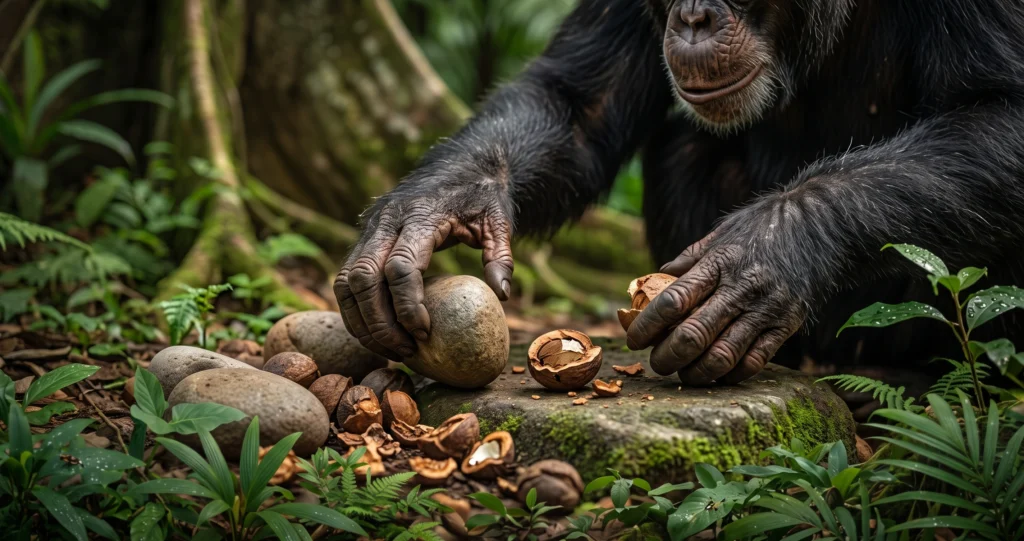
“chimpanzee tool use culture showing termite fishing passed from adult to juvenile.”
How Researchers Study Chimpanzee Culture
Scientists rely primarily on long-term field observations.
Many famous research sites have monitored the same chimpanzee communities for decades.
Researchers record:
- Tool manufacture
- Feeding behavior
- Grooming customs
- Communication patterns
- Social relationships
- Juvenile learning
Comparing multiple populations allows scientists to distinguish behaviors influenced by habitat from those transmitted socially.
This long-term approach has produced some of the strongest evidence for animal culture anywhere in the natural world.
Common Myths About Chimpanzee Culture
Myth: Only humans have culture.
False.
Chimpanzees demonstrate socially learned traditions that meet scientific definitions of culture.
Myth: Every chimpanzee behaves the same.
False.
Different communities display distinct traditions that may persist for generations.
Myth: Tool use is entirely instinctive.
False.
Young chimpanzees spend years learning complex techniques through observation and practice.
Myth: Animal culture is identical to human culture.
Not exactly.
Chimpanzee culture lacks language, writing, and many symbolic traditions, but it clearly involves socially transmitted knowledge.
Myth: Protecting habitat alone preserves culture.
Not always.
Losing experienced individuals can eliminate valuable knowledge even if suitable habitat remains.
Frequently Asked Questions
What is chimpanzee culture?
It refers to behaviors learned socially and passed between individuals rather than inherited genetically.
Why do different chimpanzee groups use different tools?
Communities develop traditions independently, and young chimpanzees learn the local techniques practiced by experienced adults.
Who first documented chimpanzee tool use?
Jane Goodall’s pioneering observations in Gombe National Park revealed chimpanzees making and using termite-fishing tools.
Can chimpanzees invent new tools?
Yes. Researchers have documented innovation, although successful techniques spread mainly through social learning.
Why is chimpanzee culture important?
It improves our understanding of animal intelligence, human evolution, and the importance of protecting knowledgeable individuals within wildlife populations.
Conclusion
Chimpanzee tool use culture has fundamentally changed how scientists understand intelligence in the animal kingdom. Different communities maintain distinct traditions, teach younger generations through observation and practice, and preserve knowledge that can endure for decades. These discoveries demonstrate that culture is not exclusively human but exists along a continuum of social learning across species.
As habitat loss and other threats continue to affect wild chimpanzees, conserving these remarkable primates means preserving not only their populations but also their accumulated knowledge. Every experienced individual represents a living repository of traditions that cannot easily be replaced. By protecting chimpanzee communities, we safeguard one of nature’s most compelling examples of cultural inheritance and gain deeper insight into the evolutionary roots of our own capacity to learn, teach, and innovate.
2 Internal Link Suggestions:
- https://secretsofthegreengarden.com/how-pollinators-help-your-garden-thrive/
- https://secretsofthegreengarden.com/why-fireflies-are-important-for-healthy-gardens/
3 External Dofollow Authoritative Sources with URLs:
- Jane Goodall Institute: https://janegoodall.org/
- Smithsonian National Zoo – Chimpanzees: https://nationalzoo.si.edu/animals/chimpanzee
- International Union for Conservation of Nature (IUCN) – Chimpanzee: https://www.iucnredlist.org/species/15933/17964308