
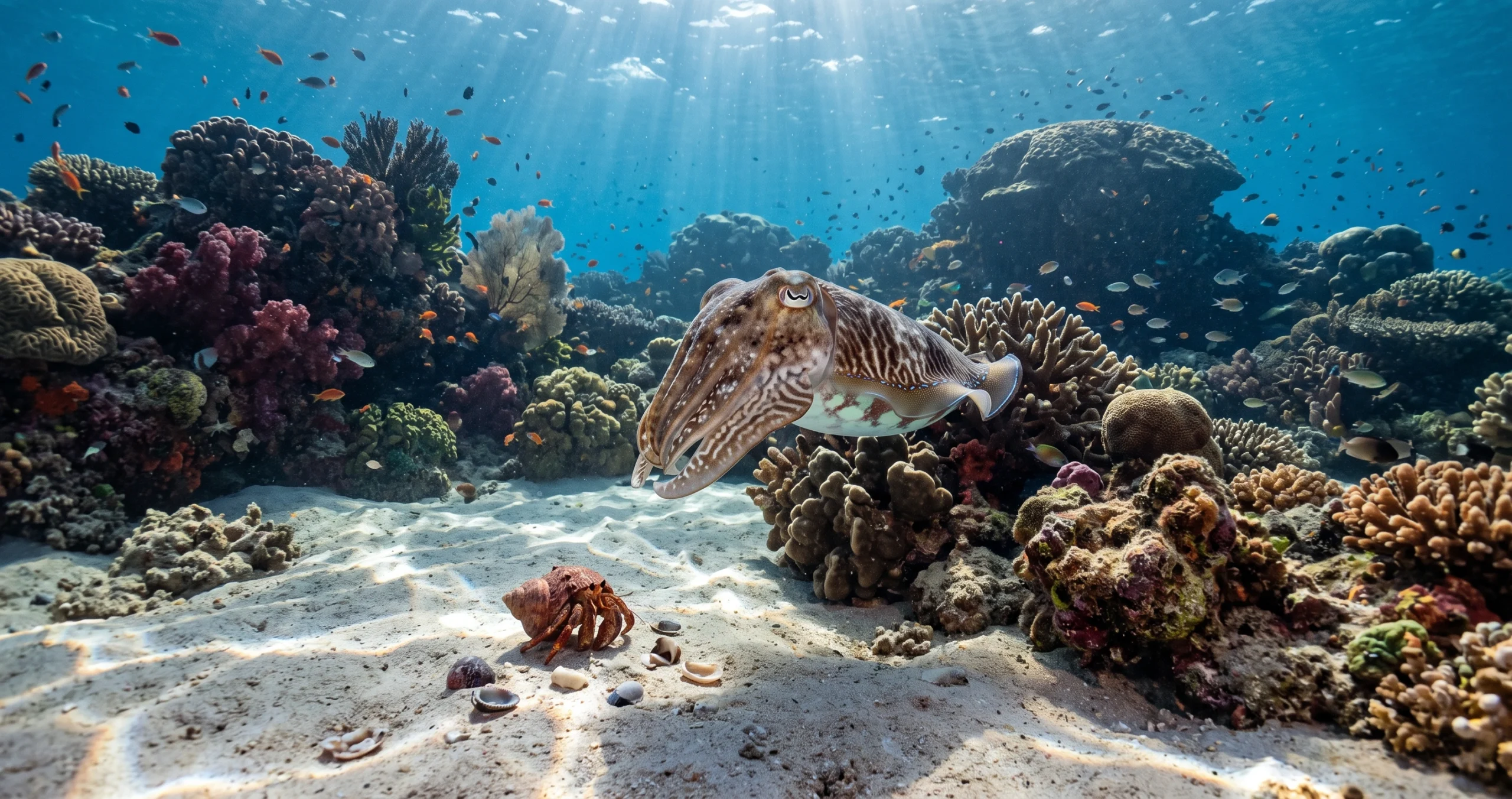
Among the ocean’s most remarkable predators, cuttlefish stand out not because of speed or size, but because of their extraordinary ability to manipulate light and color across their skin. One of their most fascinating behaviors is the cuttlefish hunting display, a rapidly moving wave of dark and light bands that sweeps across the body as they approach prey. Often called the “passing-cloud display,” this dramatic visual pattern has sometimes been described as a form of hypnosis—but the real science is even more intriguing.
Rather than relying on supernatural powers, cuttlefish use sophisticated skin structures, lightning-fast neural control, and carefully timed movements to influence the behavior of nearby prey. Scientists continue investigating exactly how these displays affect fish and crustaceans, and while many questions remain, the evidence suggests that dynamic skin patterns may briefly confuse, distract, or alter prey responses just long enough for a successful strike.
Table of Contents
- Meet the Remarkable Cuttlefish
- What Is the Passing-Cloud Display?
- Cuttlefish Hunting Display: Skin as a Hunting Tool
- The Amazing Biology of Chromatophores
- Beyond Chromatophores: Other Skin Structures
- How the Nervous System Controls Color
- Camouflage vs. Hunting Displays
- Does the Display Really “Hypnotize” Prey?
- Other Hunting Strategies Used by Cuttlefish
- Why Scientists Study Dynamic Skin Patterns
- Common Myths About Cuttlefish Displays
- Frequently Asked Questions
- Conclusion
Meet the Remarkable Cuttlefish
Cuttlefish belong to the cephalopod group, making them close relatives of octopuses and squid.
Although they are often mistaken for fish, they are actually highly intelligent marine mollusks.
Their large brains, excellent eyesight, flexible bodies, and remarkable skin allow them to communicate, camouflage themselves, and hunt with exceptional precision.
More than 120 cuttlefish species inhabit coastal waters throughout Europe, Africa, Asia, and Australia.
Many live on sandy or rocky seabeds where blending into the environment can mean the difference between eating and being eaten.
What Is the Passing-Cloud Display?
The passing-cloud display is one of the most visually striking behaviors in the marine world.
As a cuttlefish slowly approaches prey, broad dark bands appear to travel rhythmically across its body.
These moving waves resemble shadows cast by drifting clouds.
The pattern often continues while the animal carefully positions itself within striking distance.
Unlike ordinary camouflage, the display is highly dynamic.
Instead of disappearing into the background, the cuttlefish deliberately creates moving visual signals that appear directed toward nearby prey.
Exactly why this works remains an active area of scientific research.
Cuttlefish Hunting Display: Skin as a Hunting Tool
The cuttlefish hunting display differs fundamentally from traditional camouflage.
Rather than hiding, the animal actively manipulates the visual environment surrounding its prey.
Researchers believe the moving bands may interfere with how prey perceive approaching motion.
Small fish and crustaceans rely heavily on vision to detect predators.
Rapidly changing patterns moving across the predator’s body could reduce their ability to judge speed, direction, or distance.
The display may also draw attention toward the moving bands instead of the approaching arms and tentacles.
Although the term “hypnosis” is popular in documentaries and online videos, scientists generally avoid it because it suggests a neurological process that has not been demonstrated experimentally.
Current evidence supports the idea that the display influences prey behavior through visual processing rather than true hypnosis.
The Amazing Biology of Chromatophores
The extraordinary abilities of cuttlefish begin with specialized skin cells called chromatophores.
Chromatophores are tiny pigment-containing organs distributed across the skin.
Each chromatophore contains a small elastic pigment sac surrounded by radial muscles.
When these muscles contract, the pigment sac expands and becomes visible.
When the muscles relax, the pigment retracts and nearly disappears.
Thousands of chromatophores work together simultaneously.
The result is an astonishing range of colors and patterns that can change within fractions of a second.
This rapid control allows cuttlefish to switch instantly between camouflage, communication, and hunting displays.
Beyond Chromatophores: More Than Just Pigment
Chromatophores represent only one layer of the cuttlefish’s sophisticated skin.
Beneath them lie reflective cells called iridophores.
These cells reflect light using microscopic structures that create shimmering blues, greens, and metallic colors.
Even deeper are leucophores.
Unlike chromatophores or iridophores, leucophores scatter incoming light broadly, helping match the brightness of surrounding environments.
Together, these three systems create one of the most advanced biological displays found anywhere in the animal kingdom.
The interaction between pigments, structural colors, and reflected light gives cuttlefish extraordinary visual flexibility.
How the Nervous System Controls Color
Unlike many animals that change color slowly through hormones, cuttlefish rely primarily on direct neural control.
Each chromatophore receives signals from the nervous system.
This arrangement allows precise coordination across thousands of pigment organs simultaneously.
The brain processes visual information from the environment and immediately sends commands that alter skin appearance.
Researchers often compare this process to a living digital display.
Rather than individual pixels turning on and off electronically, chromatophores expand and contract under muscular control.
This direct connection explains why cuttlefish can generate rapidly moving waves such as the passing-cloud display.
Camouflage vs. Hunting Displays
Cuttlefish are famous for camouflage, but hunting displays serve a different purpose.
Background Matching
When avoiding predators, cuttlefish often match nearby rocks, sand, coral, or seaweed.
The goal is to remain undetected.
Disruptive Coloration
Some patterns break up the animal’s outline, making it harder for predators to recognize its shape.
Mimicry
Certain species imitate toxic or dangerous organisms to discourage attacks.
Hunting Displays
The passing-cloud display does not conceal the animal.
Instead, it actively manipulates visual perception during prey capture.
This distinction highlights the remarkable versatility of cephalopod skin.
The same biological system supports defense, communication, courtship, and hunting.
Does the Display Really “Hypnotize” Prey?
The word “hypnosis” has become popular because prey sometimes appear unusually still before the cuttlefish strikes.
However, scientists urge caution.
Current research has not demonstrated that prey enter a hypnotic state comparable to human hypnosis.
Several alternative explanations remain under investigation.
Visual Distraction
Moving patterns may temporarily capture the prey’s attention.
Motion Confusion
Dynamic skin waves could interfere with accurate motion detection.
Delayed Escape Responses
Complex visual stimuli might slow the timing of defensive reactions by fractions of a second.
For an ambush predator, even a tiny delay can dramatically improve hunting success.
Researchers continue studying prey responses under controlled laboratory conditions to better understand these mechanisms.
The exact neurological processes remain an active area of investigation rather than settled scientific fact.
Other Hunting Strategies Used by Cuttlefish
The passing-cloud display is only one part of a sophisticated hunting toolkit.
Cuttlefish also employ:
- Slow stalking movements
- Rapid tentacle projection
- Excellent depth perception
- Independent eye movements
- Flexible body positioning
- Instant camouflage before and after attacks
Their two specialized feeding tentacles can extend with remarkable speed, capturing prey before it has time to escape.
The hunting display likely works together with these other adaptations rather than replacing them.
Why Scientists Study Dynamic Skin Patterns
Cuttlefish skin has inspired research far beyond marine biology.
Engineers study chromatophore systems while developing adaptive camouflage materials.
Roboticists investigate flexible skin capable of changing appearance.
Neuroscientists explore how complex visual information is processed and controlled so rapidly.
Understanding cephalopod skin may eventually influence future technologies involving smart materials, soft robotics, and adaptive optical surfaces.
For reliable information about ongoing cephalopod research, the Smithsonian Ocean educational resources provide science-based explanations of cephalopod biology:
https://ocean.si.edu/
If you enjoy learning how remarkable animal adaptations inspire science and technology, you may also enjoy our article on extraordinary wildlife survival strategies at secretsofthegreengarden.com.
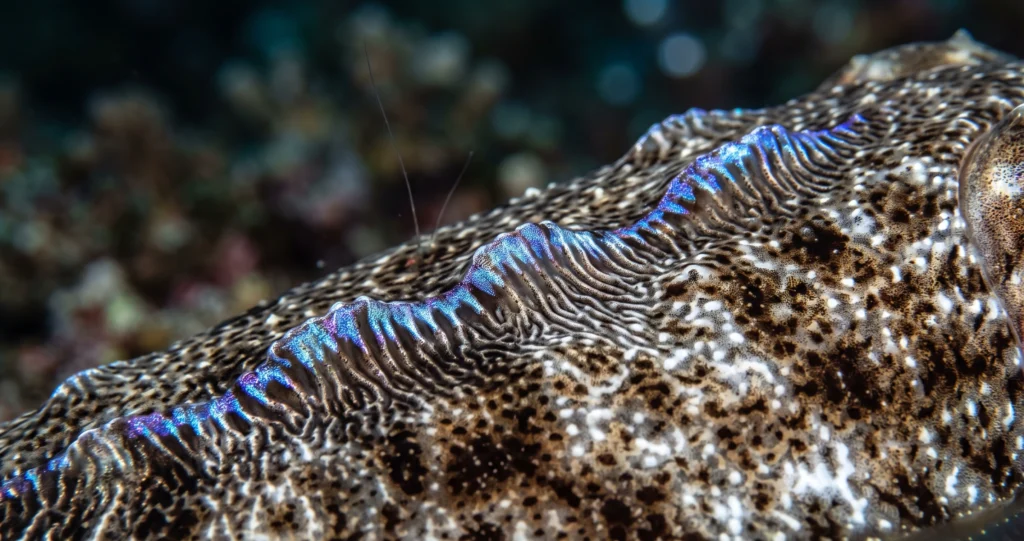
“cuttlefish hunting display showing the passing-cloud pattern during prey approach.”
Common Myths About Cuttlefish Displays
Myth: Cuttlefish truly hypnotize prey.
False.
Current evidence supports visual distraction or altered prey responses rather than true hypnosis.
Myth: Chromatophores create every color.
Not entirely.
Iridophores and leucophores also contribute significantly to the final appearance.
Myth: Cuttlefish always use the passing-cloud display.
False.
The behavior depends on species, hunting conditions, prey type, and environmental context.
Myth: Color changes happen through hormones alone.
False.
Most rapid color changes occur through direct neural control of chromatophores.
Myth: Camouflage and hunting displays are identical.
False.
Camouflage aims to avoid detection, while hunting displays appear designed to influence prey behavior during capture.
Frequently Asked Questions
What is the passing-cloud display?
It is a moving wave of light and dark skin patterns that travels across the body of hunting cuttlefish.
Do cuttlefish really hypnotize fish?
There is no scientific evidence for true hypnosis. Researchers believe the display may distract or confuse prey visually.
What are chromatophores?
They are specialized pigment-containing organs that expand and contract to produce rapid color changes.
Why do scientists study cuttlefish skin?
Their remarkable color-changing abilities inspire research into adaptive materials, robotics, camouflage, and neuroscience.
Are cuttlefish dangerous to humans?
No. Most species are harmless to people and generally avoid human contact.
Conclusion
The cuttlefish hunting display demonstrates how evolution can transform skin into one of the most sophisticated hunting tools in nature. By combining chromatophores, iridophores, leucophores, and precise neural control, cuttlefish generate moving visual patterns that may subtly influence the behavior of nearby prey during the critical moments before capture.
Although the popular description of “hypnosis” captures the imagination, current research points toward more nuanced explanations involving visual distraction, motion processing, and delayed escape responses. As scientists continue uncovering the secrets behind these remarkable cephalopods, their discoveries are not only expanding our understanding of animal behavior but also inspiring new technologies in engineering, robotics, and adaptive materials.
The next time you watch a cuttlefish glide across the seafloor while waves of color ripple over its body, you are witnessing one of the ocean’s most sophisticated demonstrations of biological innovation.
2 Internal Link Suggestions:
- https://secretsofthegreengarden.com/how-pollinators-help-your-garden-thrive/
- https://secretsofthegreengarden.com/why-fireflies-are-important-for-healthy-gardens/
3 External Dofollow Authoritative Sources with URLs:
- Smithsonian Ocean – Cephalopods: https://ocean.si.edu/
- Monterey Bay Aquarium – Cuttlefish: https://www.montereybayaquarium.org/
- Animal Diversity Web – Cephalopoda: https://animaldiversity.org/accounts/Cephalopoda/