
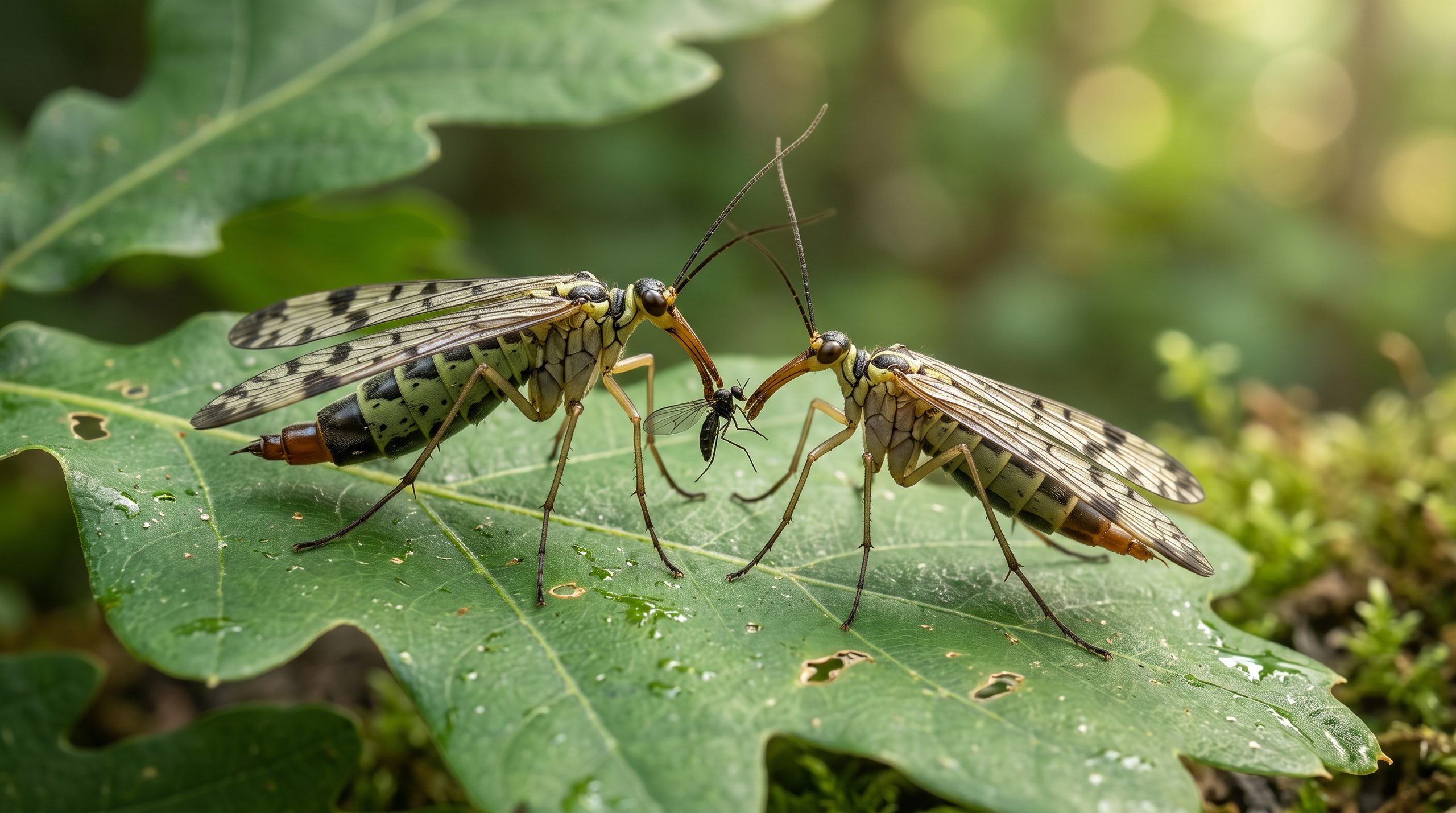
At first glance, a scorpionfly looks slightly alarming. Its elongated face, patterned wings, and—in males of many species—a bulbous, upturned genital structure can create the impression of an insect armed with a scorpion-like stinger.
But scorpionflies are not scorpions, and that conspicuous male abdomen is not a venomous tail.
Their reproductive behavior is considerably more interesting.
In several well-studied scorpionflies, particularly species in the genus Panorpa, males provide females with an edible nuptial gift associated with mating. Depending on the species and circumstances, that gift may be a captured arthropod or a nutrient-rich mass of saliva produced by the male.
The female feeds while mating proceeds.
Far from being a charming insect version of giving a present, this behavior is part of a complex reproductive strategy involving nutrition, female choice, male condition, mating duration, sperm transfer, competition between males, and sometimes alternative mating tactics. Research on species such as Panorpa cognata and Panorpa vulgaris has made scorpionflies important model organisms for understanding the evolution of nuptial gifts.
What Exactly Is a Scorpionfly?
Scorpionflies are insects belonging to the order Mecoptera.
They are generally recognizable by their:
- Elongated, downward-pointing mouthparts
- Two pairs of membranous wings in most species
- Long antennae
- Slender bodies
- Distinctive reproductive structures in males of many species
Despite their common name, they are not closely related to true scorpions, which are arachnids rather than insects.
The “scorpion” appearance comes mainly from the enlarged genital structure at the end of the abdomen in male Panorpa.
It cannot sting like a scorpion’s tail.
What Is a Nuptial Gift?
In animal behavior, a nuptial gift is a resource transferred from one mating partner—usually the male—to another during courtship or mating.
Such gifts occur in several groups of insects and spiders.
They can take very different forms. Some males provide captured prey, while others produce edible secretions from their own bodies.
Scorpionflies provide particularly interesting examples because different species—and sometimes individuals within a species—can employ different strategies.
Studies of Panorpa have shown that edible gifts can influence mating success and reproductive investment, making them much more than incidental snacks.
Two Very Different Kinds of Scorpionfly Gifts
The image of a male scorpionfly arriving with a dead insect is accurate for some scorpionflies, but it should not be generalized to every species.
Captured Prey
In some scorpionflies, a male obtains another arthropod and presents it to a female.
The female begins eating the prey, and mating can take place while she feeds.
Obtaining such a gift has obvious costs. The male must find or capture a suitable food item and may face competition from other insects.
There can even be theft.
Research on the hangingfly Hylobittacus apicalis, another member of Mecoptera, documented males mimicking female behavior to obtain prey from gift-bearing males. The stolen prey could subsequently be used by the thief during his own mating attempt.
Salivary Gifts
Other scorpionflies manufacture the gift themselves.
Male Panorpa cognata, for example, produce a substantial salivary mass before copulation. The female consumes this secretion during mating.
The gift is therefore not captured prey at all.
It is a biological investment manufactured by the male.
In Panorpa vulgaris, research has similarly shown that males produce salivary secretions consumed by females during copulation. The ability to manufacture these gifts depends partly on the male’s nutritional condition and salivary-gland development.
How Scorpionfly Courtship Works
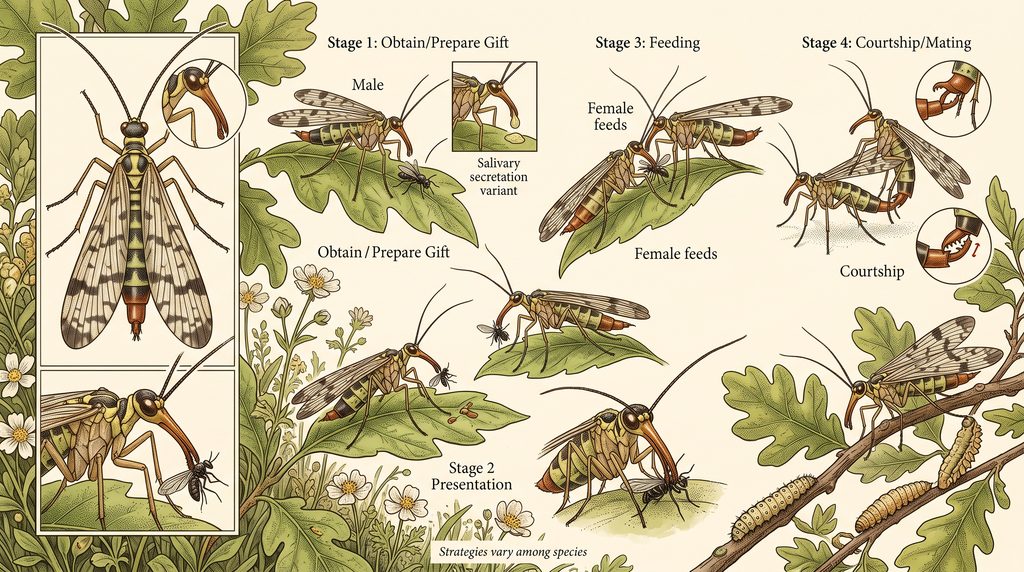
Courtship varies among species, so there is no single sequence applicable to every scorpionfly.
In Panorpa, chemical communication can be important before the gift exchange even begins.
Classic experiments showed that female Panorpa responded to odors released by sexually active males, demonstrating a role for male-produced pheromones in bringing potential partners together.
Once a female approaches, the interaction may involve a nuptial gift.
In gift-giving species, the simplified sequence can look something like this:
- A male attracts or encounters a receptive female.
- He presents prey or produces a salivary secretion.
- The female begins feeding.
- Copulation occurs while she consumes the gift.
- Mating duration can be influenced by the amount of food available.
That final point is particularly important.
The gift isn’t merely a way to convince a female to begin mating. It can affect what happens after copulation starts.
A Larger Gift Can Mean a Longer Mating
Experiments with Panorpa cognata have found that males producing larger salivary masses achieve longer copulations.
This matters because mating duration can influence how much sperm a male transfers.
Research on P. vulgaris similarly found that the number of salivary gifts influences copulation duration, which in turn affects reproductive success.
The evolutionary relationship therefore becomes clearer.
From the female’s perspective, the gift provides nutrition.
From the male’s perspective, keeping the female feeding can increase the time available for sperm transfer.
Both participants can potentially gain benefits, although their reproductive interests are not necessarily identical.
The Gift Is Expensive for the Male
Producing saliva might sound inexpensive compared with capturing prey.
It isn’t necessarily so.
Experiments with Panorpa vulgaris found that males in better nutritional condition produced more salivary gifts than males with poorer nutrition.
Researchers also found that gift production declined across successive matings, demonstrating that males have a limited supply of resources available for this reproductive investment.
This makes the gift biologically informative.
A male cannot necessarily produce an unlimited number of large gifts.
The amount he invests may reflect his condition and the resources available to him.
Males Can Adjust Their Investment
Scorpionfly reproductive behavior becomes even more sophisticated when males are given choices about how much to invest.
Research with Panorpa cognata has demonstrated strategic allocation of salivary gifts.
Males can alter their reproductive investment according to circumstances, including female reproductive potential, their own condition, and their expected future mating opportunities.
This creates an evolutionary trade-off.
A male investing heavily in one female may increase his reproductive success from that mating, but he also consumes resources that could have been used for future mates.
Saving resources could therefore be advantageous early in life when many future mating opportunities remain.
Later, when fewer opportunities are expected, conserving those resources may become less valuable.
Studies have found evidence consistent with precisely this shift in male investment across the reproductive season.
Females Gain More Than Something to Eat
The food itself can matter to females.
A broad review of nuptial gifts in insects concluded that edible prey and glandular products commonly provide direct nutritional benefits, although the consequences vary greatly among species.
Scorpionfly research has also examined how nuptial feeding influences female reproductive output.
The gift should therefore not be dismissed as a meaningless distraction.
It represents actual nutritional material transferred between reproductive partners.
That makes courtship partly an exchange of resources.
Nuptial Gifts and Sperm Competition
There is another layer to the story.
Female scorpionflies can mate with multiple males.
That means sperm from different males may compete for fertilization opportunities.
Research on Panorpa cognata found evidence that males can adjust mating investment in relation to sperm previously transferred to a female by another male.
That is an extraordinary degree of reproductive fine-tuning for an insect.
A male’s decision is therefore not simply:
“Do I offer food?”
It can effectively become:
“How much of my limited reproductive resources should I invest in this particular mating?”
Evolution has turned an apparently simple meal into part of a complex reproductive economy.
Why Did Food Gifts Evolve?
There probably isn’t one explanation applicable to every gift-giving insect.
In scorpionflies, several evolutionary benefits can operate simultaneously.
For females, edible gifts can provide nutrition.
For males, gifts may:
- Increase the likelihood of successful mating
- Extend copulation
- Increase sperm transfer
- Affect competitive reproductive success
The behavior is therefore best understood as a product of both cooperation and competing reproductive interests.
This complexity is precisely why scorpionflies have become useful organisms for studying sexual selection and sexual conflict. Modern reviews describe the group as displaying a particularly diverse range of mating practices, including nuptial provisioning and other reproductive tactics.
Not Every Scorpionfly Behaves the Same Way
This distinction is essential.
“Scorpionfly” describes a diverse group, not a single species with one fixed mating strategy.
Even within Panorpa, courtship tactics vary.
Some males provide prey.
Some manufacture salivary masses.
Some species use particular anatomical structures during mating.
And the reproductive strategies available to males can change with ecological and competitive conditions.
One study of Cerapanorpa dubia, for example, documented males providing a solid salivary mass before copulation. Once the female began feeding, specialized male structures helped establish and maintain the mating position.
The most scientifically accurate statement is therefore:
Some male scorpionflies provide edible nuptial gifts associated with courtship and mating.
It should not be presented as universal behavior across every scorpionfly species.
Why Scorpionflies Matter to Evolutionary Biology
Scorpionflies may not receive the attention given to butterflies or bees, but their reproductive behavior allows scientists to investigate major evolutionary questions.
Researchers can examine how:
- Females choose mates
- Males allocate limited resources
- Nutrition affects reproductive success
- Multiple mating changes behavior
- Sperm competition influences investment
- Sexual conflict shapes anatomy and behavior
A small insect offering a droplet of saliva can therefore reveal fundamental principles about how reproductive strategies evolve.
Practical Tips for Observing Scorpionflies
Scorpionflies are generally associated with moist, vegetated habitats. Depending on the species and region, adults can be encountered among low vegetation, forest edges, gardens, and other shaded or humid environments.
If you find one, observe rather than handle it.
A camera with macro capability can reveal the characteristic elongated face, wing pattern, and reproductive structures far more clearly than the naked eye.
And remember that the curved structure of a male Panorpa is not a stinger. Despite the intimidating silhouette, scorpionflies are not tiny flying scorpions.
Common Mistakes When Talking About Scorpionflies
Calling Them Scorpions
Scorpionflies are insects belonging to Mecoptera. Scorpions are arachnids.
Saying the Male Always Brings Captured Prey
Some species use prey gifts, while others produce salivary secretions.
Describing the Gift as Purely Romantic
The behavior has measurable reproductive consequences involving female nutrition, mating duration, sperm transfer, and male reproductive investment.
Assuming the Gift Costs the Male Nothing
Producing salivary masses requires resources. Experimental studies show that nutrition and male condition affect gift production.
Assuming Every Scorpionfly Uses the Same Courtship Strategy
Mating behavior varies substantially across Mecoptera and even among closely related species.
Frequently Asked Questions
Do male scorpionflies really give females food before mating?
Yes, in several studied species. The gift may be captured prey or a male-produced salivary secretion, depending on the species.
Why does the female eat during mating?
The gift provides food while also influencing the mating interaction. In studied Panorpa, larger or more numerous salivary gifts can be associated with longer copulation.
Is a scorpionfly dangerous?
The scorpion-like structure visible on male Panorpa is part of the reproductive anatomy rather than a venomous stinger.
Do all scorpionflies offer nuptial gifts?
No. Reproductive behavior differs among species, and the form of the gift also varies.
Why do scientists study scorpionfly courtship?
Their reproductive system provides an excellent model for studying sexual selection, nuptial feeding, resource allocation, sperm competition, and sexual conflict.
Conclusion
Scorpionfly courtship is far more sophisticated than its simple sequence—find food, present gift, mate—might suggest.
In some species, males capture prey and offer it to females. In others, they manufacture edible salivary masses from their own limited resources. The female consumes the gift while mating, and the quantity or quality of that gift can influence how long copulation continues.
Experiments have revealed an even deeper strategy. Male condition influences the ability to produce gifts, males can adjust how much they invest, and mating investment interacts with sperm competition and future reproductive opportunities.
What looks like an insect offering a simple meal is therefore the visible part of a remarkably complex evolutionary negotiation.
And the animal performing it isn’t a scorpion at all.
Internal Linking
Explore another remarkable insect predator hiding in plain sight:
https://secretsofthegreengarden.com/ambush-bug-flower-predator/
Discover how specialized animal noses evolved for survival:
https://secretsofthegreengarden.com/animal-nose-adaptations/
Learn how different bird beaks reveal what species eat:
https://secretsofthegreengarden.com/bird-beak-adaptations/
Explore how animal fur patterns function as camouflage and communication:
https://secretsofthegreengarden.com/animal-fur-patterns-explained/
Authoritative External Sources
Research published in Behavioral Ecology documents how male Panorpa cognata produce salivary nuptial gifts and how gift size relates to mating duration and reproductive investment.
Behavioral Ecology — Oxford Academic
A peer-reviewed review indexed by the U.S. National Library of Medicine examines the evolutionary role of edible nuptial gifts across insects.
PubMed — Sexual Conflict Over Nuptial Gifts in Insects
Research indexed by PubMed documents salivary-gift production and strategic reproductive investment in Panorpa cognata.