
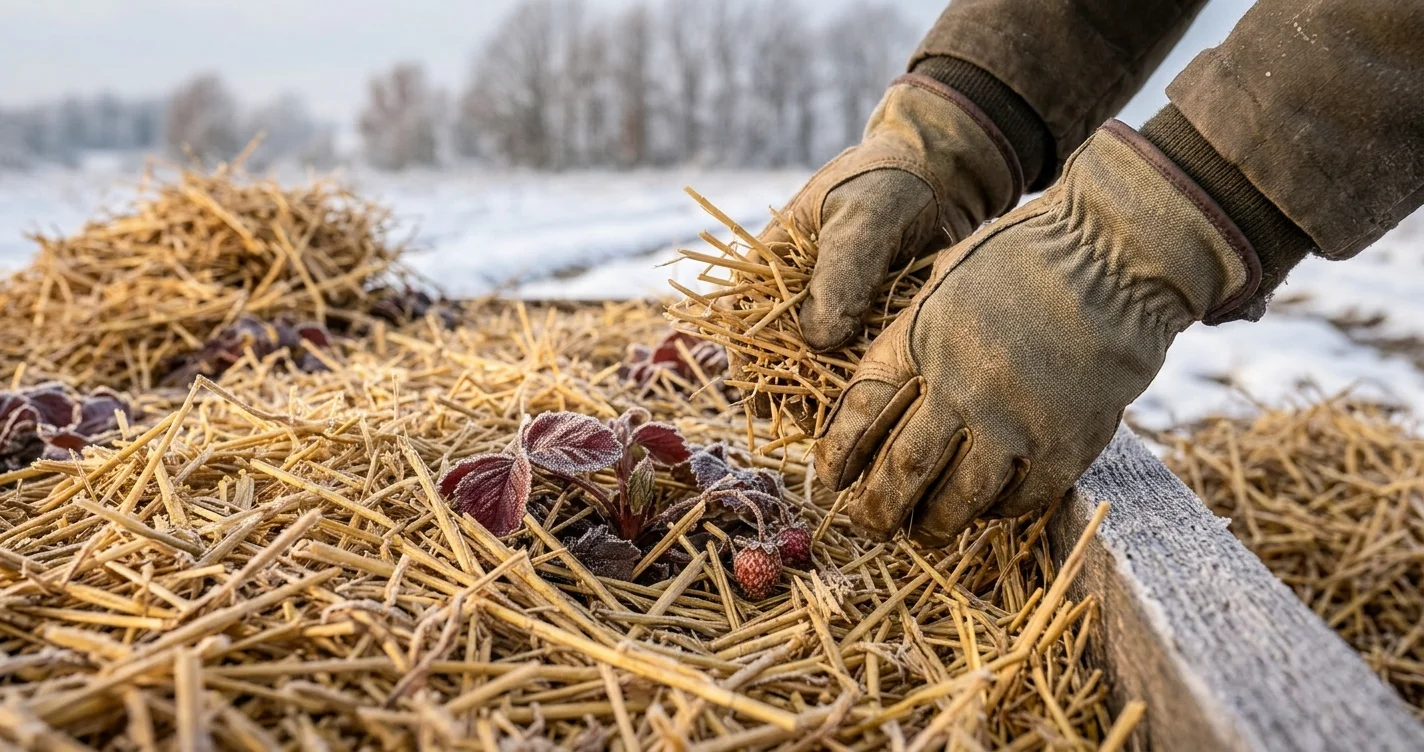
A strawberry plant can survive a bitter winter beneath a blanket of straw, yet the same plant may suffer damage if that blanket goes on too early. The surprising part is that winter protection is not simply about keeping strawberries warm. It is about keeping their crowns and roots protected from damaging temperature changes.
Learning how to mulch strawberries for winter can make a real difference in colder parts of the United States. The right material, applied at the right time and at the right depth, helps strawberry plants enter spring with healthier crowns and a better chance of producing a strong crop.
But there is a catch: winter mulching is not equally necessary everywhere. A strawberry bed in Minnesota faces different challenges from one in coastal California or the Deep South.
This guide explains when to mulch, which materials work best, how much to apply, and when to uncover your plants in spring.
Table of Contents
- Why Strawberry Plants Need Winter Mulch
- When to Mulch Strawberries for Winter
- The Best Mulching Materials for Strawberries
- How Deep Should Strawberry Mulch Be?
- How to Mulch Strawberries for Winter: Step by Step
- Common Winter Mulching Mistakes
- When to Remove Strawberry Mulch in Spring
- In Your Own Yard: Adapting Mulch to Your Climate
- Frequently Asked Questions
Why Strawberry Plants Need Winter Mulch
Strawberries are perennial plants, but their ability to withstand winter depends on the variety, local climate, snow cover, soil conditions, and the plant’s stage of dormancy.
The most vulnerable part is often the crown, the compact growing point located near the soil surface. This is where new leaves, flowers, and runners originate.
When severe cold reaches the crown, the tissues responsible for future growth can be injured.
Roots are also vulnerable because soil temperatures may fall to damaging levels during prolonged cold spells, particularly when snow cover is absent.
The Crown Is the Heart of the Plant
Unlike many woody perennials, strawberries do not have thick protective bark around their growing points.
Their crowns sit close to the ground, exposed to changing weather.
A well-established strawberry plant may tolerate freezing temperatures after it has properly hardened off. However, sudden severe cold, repeated freezing and thawing, and exposed soil can increase the risk of damage.
Winter mulch provides a protective layer over these sensitive growing points.
Mulch Helps Stabilize Soil Temperature
One of the most important functions of winter mulch is insulation.
Loose straw traps air, slowing heat movement between the soil and the surrounding atmosphere.
This helps moderate abrupt temperature changes and can reduce the frequency of freezing and thawing near the crown.
Mulch does not generate heat. Instead, it reduces how quickly the soil gains or loses it.
Mulch Can Reduce Frost Heaving
Frost heaving occurs when freezing soil expands and ice formation pushes plants upward.
Repeated freezing and thawing can leave roots exposed or damage their connection to the surrounding soil.
Strawberries with shallow root systems can be particularly vulnerable.
A protective mulch layer helps moderate soil temperature changes, reducing conditions that contribute to heaving.
When to Mulch Strawberries for Winter
Timing matters just as much as the material.
Applying mulch too early can interfere with the plant’s natural preparation for winter. Applying it too late may leave crowns exposed during a damaging cold spell.
Wait Until Plants Have Hardened Off
In cold climates, strawberries gradually become more cold-tolerant as autumn temperatures decline and day length shortens.
This process is called cold acclimation or hardening.
Gardeners generally wait until plants have experienced several hard frosts and growth has largely stopped before applying winter mulch.
A commonly used guideline is to mulch after repeated temperatures near 20°F, although exact recommendations vary among university extension services.
The goal is to allow the plants to enter dormancy while protecting them before prolonged severe cold arrives.
Watch the Weather, Not Just the Calendar
A fixed calendar date is less reliable than local conditions.
In northern states, winter mulching may take place during November or early December. In some regions, it may happen earlier or later.
An unusually warm fall can delay dormancy, while an early cold outbreak may require faster preparation.
Local extension guidance is particularly valuable because it accounts for regional weather patterns.
Avoid Mulching Too Early
Covering actively growing plants with a thick layer of straw can retain excess moisture and create favorable conditions for some diseases.
It may also delay natural cold acclimation.
The best approach is to monitor plant growth, recent frost events, and the forecast rather than covering the bed at the first cool night.
The Best Mulching Materials for Strawberries
Not every garden mulch is equally suitable for winter protection.
The best materials are lightweight, insulating, and relatively easy to remove or reposition in spring.
Clean Straw: The Traditional Favorite
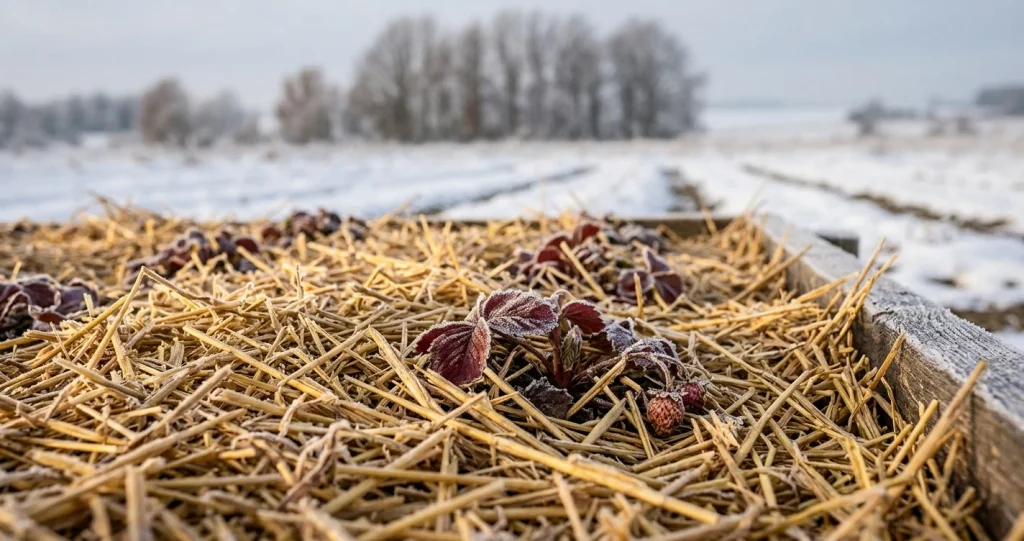
Clean straw is one of the most widely recommended materials for winter strawberry beds.
Wheat, oat, or similar grain straw can provide an airy insulating layer.
It is relatively lightweight, allows air movement, and can be pulled away from the crowns as spring growth resumes.
Choose straw that is dry, clean, and free from excessive weed seeds.
Avoid straw with a known history of persistent herbicide contamination.
Pine Needles: A Regional Alternative
Pine needles can also provide winter protection in some situations.
They form a loose layer and may be readily available in gardens with mature pine trees.
However, their performance depends on how densely they settle, how much material is available, and local conditions.
A very thin layer may not provide the same protection as a sufficiently deep layer of loose straw.
Pine needles do not automatically make garden soil dangerously acidic. Their effect on established soil pH is usually much smaller than gardeners sometimes assume.
Chopped Leaves: Use With Care
Dry, shredded leaves can be useful as mulch, but they are less predictable when used as a thick winter covering over strawberry crowns.
Whole leaves may mat together after rain or snow.
A dense, wet layer can restrict air circulation and make spring removal difficult.
If using leaves, shred them first and keep the layer loose rather than compressed.
For reliably cold climates, clean straw is often the simpler choice.
Materials to Avoid
Fresh grass clippings are generally unsuitable as a thick winter blanket because they can compact and become wet.
Heavy applications of dense compost or fine-textured mulch may also behave differently from loose straw.
Wood chips are valuable in many garden situations, but they are less convenient for covering strawberry crowns because they are heavier and harder to remove cleanly in spring.
For winter protection, prioritize loose insulation over a dense covering.
How Deep Should Strawberry Mulch Be?
For many cold-climate strawberry beds, university extension recommendations commonly fall around 3–5 inches of loose straw, with some recommending approximately 4–6 inches depending on the material and conditions.
The important detail is that this is the depth of the loose mulch after application, not a tightly packed layer.
Why a Thin Layer May Fail
An inch of scattered straw may offer limited insulation during severe cold.
Wind can move the material, leaving some crowns exposed.
Snow may provide additional insulation, but gardeners cannot always depend on consistent snow cover.
A deeper, evenly distributed straw layer offers more reliable protection in regions with cold winters.
Why More Is Not Always Better
An excessively thick layer can be difficult to manage.
It may stay wet, delay spring warming, and make it harder to uncover plants at the appropriate time.
The ideal depth depends on the local climate, strawberry variety, mulch material, and expected winter conditions.
A practical starting point for cold-winter gardens is approximately 4 inches of loose straw, adjusted according to local extension recommendations.
Cover the Entire Strawberry Bed
Winter mulch should generally cover the plants and the surrounding soil evenly.
This protects the crowns and helps stabilize temperatures throughout the root zone.
Avoid leaving large exposed patches between plants.
Check the bed after strong winds and replace displaced straw where needed.
How to Mulch Strawberries for Winter: Step by Step
A good winter mulching routine is straightforward. The key is preparing the bed carefully and applying the material at the correct stage.
Step 1: Inspect the Strawberry Plants
Before winter protection, walk through the bed and look for obvious problems.
Remove severely diseased plant debris where appropriate, following local disease-management guidance.
Avoid aggressively cutting healthy foliage immediately before winter. Leaves contribute to plant growth and cold acclimation during the preceding season.
Check that crowns remain at the proper soil level and that roots are not exposed.
Step 2: Remove Problem Weeds
Large weeds can compete with strawberries and complicate mulching.
Remove established weeds carefully, avoiding unnecessary disturbance around shallow strawberry roots.
This is also a good opportunity to inspect irrigation lines and bed edges.
Step 3: Wait for the Right Cold Weather
Allow the plants to experience natural autumn cooling and hardening.
Look for repeated hard frosts and a clear slowdown in growth.
Consult your local extension service if early winter temperatures are unpredictable.
Step 4: Spread Loose Straw Evenly
Place clean, dry straw over the strawberry plants and surrounding soil.
Aim for roughly 3–5 inches of loose coverage in many cold-climate gardens, adjusting to local recommendations.
Gently distribute the material without compressing it.
The straw should form an insulating blanket rather than a heavy mat.
Step 5: Check After Wind and Storms
Winter weather can shift loose mulch.
Inspect the bed occasionally when conditions permit.
If strong winds expose crowns, redistribute the straw.
Avoid unnecessary foot traffic on frozen or waterlogged soil.
Step 6: Prepare for Spring Removal
As temperatures begin to rise, monitor the plants for signs of renewed growth.
Spring mulch management is as important as winter application.
Removing or moving the straw at the correct time allows plants to receive light and resume normal growth.
Common Winter Mulching Mistakes
Even experienced gardeners sometimes make small mistakes that reduce the effectiveness of winter protection.
Covering Plants Before Dormancy
Mulching during warm autumn weather can keep plants too insulated while they are still actively growing.
Wait until cold acclimation has progressed and local conditions indicate that winter protection is appropriate.
Using Wet, Compacted Material
Dense mulch can trap moisture around the crowns.
Loose straw is preferred because it provides insulation without forming a heavy, compressed layer.
Leaving Crowns Exposed
Uneven application can leave individual plants vulnerable.
Distribute straw across the entire bed, especially around edges where wind may remove it.
Forgetting About Spring
Mulch that remains over actively growing strawberry plants for too long can delay growth and flowering.
It may also create unfavorable conditions around developing leaves.
Plan to check the bed regularly as spring approaches.
When to Remove Strawberry Mulch in Spring
Winter mulch is temporary protection, not a covering that should remain over the crowns indefinitely.
The right removal time depends on weather and plant development.
Look for New Growth
As spring arrives, strawberry leaves begin to emerge and expand.
When new growth starts beneath the straw, gradually move the mulch away from the crowns.
In many regions, this happens after the most severe winter weather has passed, but the calendar varies widely.
Keep Some Straw Between Rows
You do not need to remove every piece of straw from the garden.
Clean material can often be repositioned between rows.
This may help keep developing berries away from bare soil, suppress some weeds, and reduce soil splash.
Keep the crowns uncovered so new leaves and flowers can develop normally.
Be Ready for Late Frosts
Early spring warmth does not guarantee that freezing weather has ended.
Strawberry blossoms are more vulnerable to frost injury than dormant crowns.
If plants are flowering and a frost is forecast, appropriate frost protection may be needed.
Breathable row covers can be useful when installed and managed correctly. The protection they provide depends on their weight, installation, and the severity of the cold.
In Your Own Yard: Adapting Mulch to Your Climate
Winter strawberry care should reflect the conditions in your own garden rather than a single nationwide schedule.
Northern Gardens With Severe Winters
In areas with prolonged freezing temperatures, winter mulch can be especially valuable.
Strawberry crowns may face severe cold during periods with little insulating snow.
Use a sufficiently deep layer of loose straw after dormancy begins, and inspect the bed for wind exposure.
Milder Southern Gardens
In many mild-winter areas, thick winter mulch may be unnecessary.
Some southern strawberry production systems use different planting schedules and management methods, including annual plantings.
A heavy blanket of straw can be counterproductive when plants continue growing through winter.
Follow regional strawberry-growing recommendations instead of automatically applying northern winter practices.
Raised Beds and Containers
Raised beds and containers may experience more rapid temperature changes than plants growing in the ground.
Containers are particularly vulnerable because their roots are exposed to cold from multiple directions.
Mulching the surface may help, but it may not adequately protect a small pot during severe freezing conditions.
Moving containers to a protected location or insulating the container itself may be necessary in colder climates.
Build a Wildlife-Friendly Garden
Strawberry beds can be part of a garden that also supports pollinators, birds, and beneficial insects.
Native flowers, shrubs, and undisturbed habitat areas can provide resources for wildlife throughout the year.
Keep wildlife habitat features separate from strawberry crowns when dense organic material could interfere with crop management.
A garden can support biodiversity while still giving cultivated plants the seasonal care they need.
Frequently Asked Questions
1. Can I Use Hay Instead of Straw to Mulch Strawberries?
Hay can provide insulation, but it often contains more weed seeds than clean straw.
Those seeds may germinate in the strawberry bed during spring.
Clean grain straw is generally the more convenient choice for winter protection.
2. Should I Mulch Strawberry Plants Before the First Frost?
In cold climates, winter mulch is usually applied after plants have experienced repeated frosts and begun dormancy.
Covering them too early can interfere with hardening and retain excess moisture.
The exact timing depends on local weather and regional extension recommendations.
3. Can I Leave Straw Mulch on Strawberries All Summer?
Yes, some straw can remain between plants and rows during the growing season.
It may help keep berries cleaner and reduce soil splash.
However, move heavy winter mulch away from crowns when spring growth begins. Avoid allowing dense, wet material to accumulate around the growing points.
Conclusion
The surprising secret of winter strawberry care is that protection is not simply about piling on more mulch.
To mulch strawberries for winter successfully, gardeners need to understand dormancy, temperature changes, material choice, and spring timing.
In many cold-climate gardens, a loose layer of clean straw applied after hardening can protect vulnerable crowns and help reduce frost heaving.
Just as importantly, that protective blanket needs to be moved away when growth resumes.
A little attention in late fall and early spring can help strawberry plants move through winter and return to productive growth when warmer weather arrives.
Internal Sources
1.How to Grow Strawberries in Pots on Your Balcony: learn how to successfully grow strawberries in containers, what tools and materials you’ll need, and the best practices to ensure a healthy harvest. https://secretsofthegreengarden.com/how-to-grow-strawberries-in-pots-on-your-balcony/?utm_source=chatgpt.com
External Sources
1. Growing Strawberries in the Home Garden: Explains crown cold sensitivity, winter protection, recommended straw depth, and spring removal.
University of Minnesota Extension, Read Minnesota Extension guidance.
2. Growing Fruit: Strawberries: Recommends loose organic mulch, discusses straw alternatives, and explains spring management.
University of New Hampshire Extension, Read New Hampshire Extension fact sheet
3. Growing Strawberries: Covers fall timing, frost heaving, straw depth, and reuse of mulch between rows.
University of Illinois Extension, Read Illinois Extension recommendations
4. Adding and Removing Straw Mulch for Strawberries: Detailed guidance on soil temperatures, dormancy, and avoiding early or late mulch removal. Its commercial recommendations may differ from home-garden depths.
University of Minnesota Extension ,Read detailed mulching guidance
5. Growing Strawberries: Supports the use of clean grain straw, winter protection, and timely spring removal.