
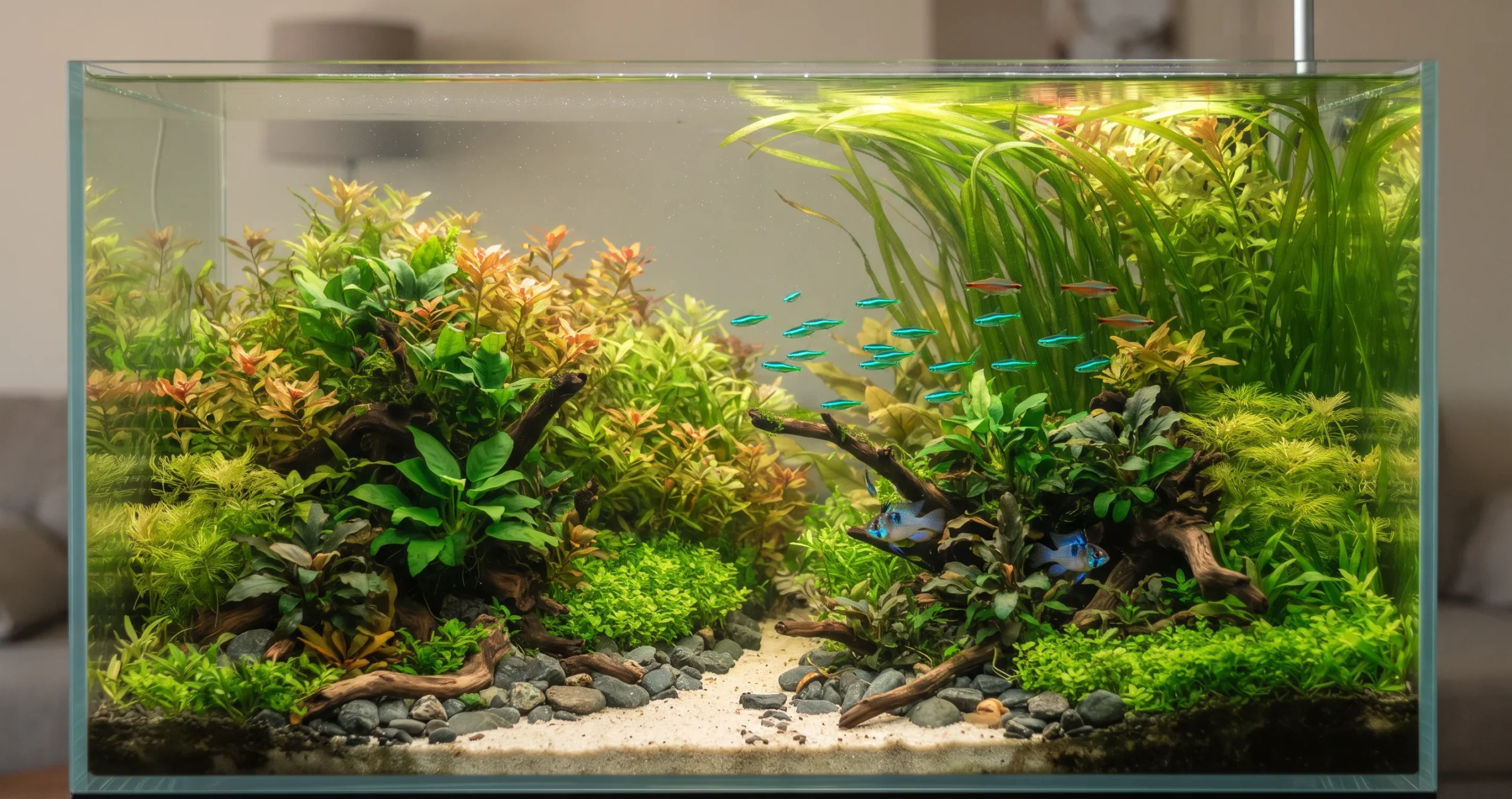
Adding living greenery to a freshwater aquarium is one of the most rewarding ways to create a natural underwater environment. Aquatic plants provide shelter, contribute to nutrient cycling, and make an aquarium more visually interesting.
Learning how to plant live aquarium plants correctly is essential for helping them establish healthy roots and produce new growth. While some species grow directly in gravel or aquarium soil, others thrive when attached to rocks or driftwood.
Fortunately, beginners do not need expensive equipment or advanced aquascaping experience. Choosing suitable plants, using the correct planting technique, and maintaining balanced lighting and nutrients can make a considerable difference.
Table of Contents
- Benefits of Live Aquarium Plants
- Essential Tools and Materials
- How to Prepare Aquarium Plants Before Planting
- How to Plant Live Aquarium Plants Step by Step
- Why the Plant Crown Must Stay Above the Substrate
- Attaching Java Fern and Anubias to Rocks or Wood
- Best Live Aquarium Plants for Beginners
- Aquarium Lighting and Fertilizer Basics
- How to Avoid Aquarium Plant Pests
- Common Planting Mistakes and Maintenance Tips
- Frequently Asked Questions
Benefits of Live Aquarium Plants
Living plants contribute more than attractive greenery to a freshwater aquarium. They interact with their surroundings through photosynthesis, nutrient absorption, and natural growth.
Understanding these benefits can help you choose plants that complement the needs of your fish and the characteristics of your aquarium.
Supporting water quality
Aquatic plants absorb nutrients from their surroundings, including nitrogen compounds that become available through fish waste and decomposing organic material.
Healthy plant growth can help manage nutrient accumulation. However, plants cannot replace biological filtration, water testing, or appropriate water changes.
Providing natural shelter
Aquatic vegetation creates hiding places for smaller fish, shrimp, and other aquarium inhabitants.
Dense foliage can provide sheltered resting areas, while taller plants help divide open swimming spaces. These features may reduce unwanted interactions between compatible but territorial fish.
Contributing to oxygen production
During photosynthesis, aquatic plants use light energy to produce carbohydrates and release oxygen.
Plants also consume oxygen through respiration, including at night when photosynthesis stops. Adequate water circulation and gas exchange therefore remain important in planted aquariums.
Creating a natural underwater landscape
When you plant live aquarium plants, you can create different levels of vegetation, textures, and colors.
Combining taller background plants with compact foreground varieties produces an attractive underwater landscape while maintaining sufficient swimming space.
Essential Tools and Materials
Before planting, gather the materials needed to prepare your aquarium and position each plant correctly.
Basic equipment includes:
- Healthy freshwater aquarium plants
- Aquarium-safe gravel, sand, or planted-tank substrate
- Long planting tweezers
- Clean aquarium scissors
- Aquarium-safe rocks or driftwood
- Water conditioner
- Aquarium plant fertilizer, if needed
- Suitable aquarium lighting
- A clean container for rinsing plants
You do not need every specialized aquascaping accessory to plant live aquarium plants successfully. For a simple beginner aquarium, appropriate substrate, suitable lighting, and healthy plants are more important than elaborate equipment.
How to Prepare Aquarium Plants Before Planting
Preparing plants properly helps prevent unnecessary damage and reduces the likelihood of introducing unwanted organisms into your aquarium.
Remove packaging and growing material
Many aquarium plants are sold in small plastic baskets containing mineral wool around their roots.
Carefully remove the basket and gently separate the growing material from the roots. Use your fingers or tweezers to loosen stubborn pieces without tearing healthy tissue.
For tissue-cultured plants, rinse away the nutrient gel using clean, conditioned water.
Inspect leaves and roots
Examine each plant for damaged leaves, decaying roots, unusual growths, and unwanted hitchhiking organisms.
Remove dead or badly damaged material using clean scissors. Avoid trimming healthy roots excessively, particularly on small plants that are still establishing themselves.
Keep plants moist
Aquarium plants can dry out quickly when exposed to air during planting.
Keep them in a container of conditioned water or mist them periodically while arranging the aquarium.
These simple preparations make it easier to plant live aquarium plants without subjecting them to unnecessary environmental stress.
How to Plant Live Aquarium Plants Step by Step
Different aquarium plants require different planting methods. Identifying whether you are working with a stem plant, rosette plant, or rhizome plant is the most important first step.
The following method is suitable for establishing a basic freshwater planted aquarium.
Step 1: Prepare the substrate
Choose a substrate appropriate for your plants and aquarium inhabitants.
Aquarium soil can provide nutrients for rooted plants, while inert gravel or sand can also work when combined with suitable fertilization.
For many common rooted plants, a substrate depth of roughly two to three inches provides a useful starting point. Adjust the depth according to root size and aquarium design.
Step 2: Add a small amount of water
If you are setting up an empty aquarium, add enough conditioned water to moisten the substrate and make planting easier.
Working in shallow water allows better visibility and reduces the tendency of plants to float away before their roots become established.
If your aquarium already contains fish, plant carefully with the tank filled or during a normal partial water change.
Step 3: Plant rooted species
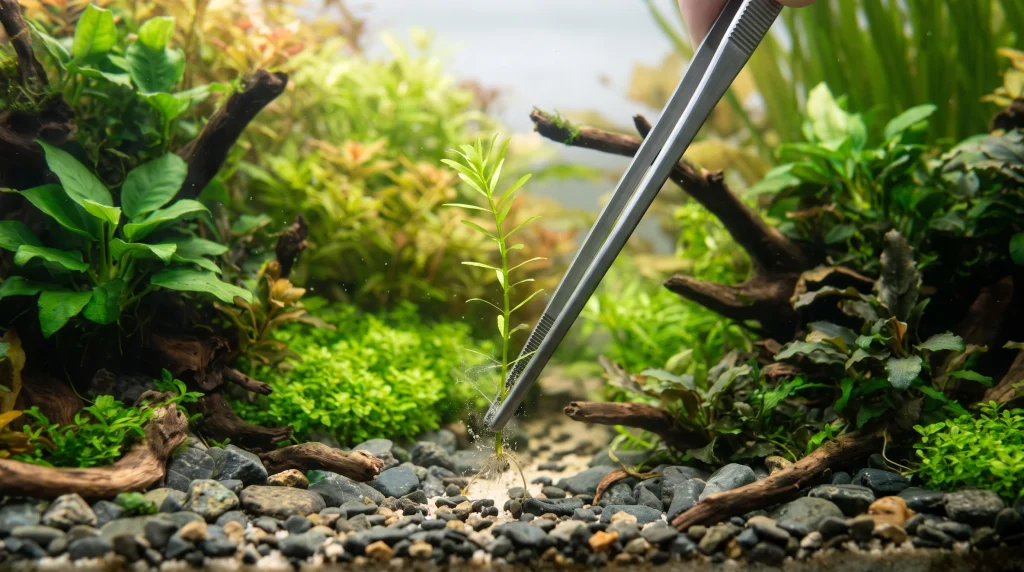
Hold the roots gently with planting tweezers and guide them into the substrate.
Position the plant so that its roots are covered while its crown or growing point remains exposed.
Release the tweezers slowly and adjust the surrounding substrate if necessary.
Step 4: Plant stem species
Separate bundled stem plants into individual stems or manageable groups.
Remove leaves that would otherwise become buried, then insert the lower section of each stem into the substrate.
Leave sufficient space between stems so that light can reach their lower foliage.
Step 5: Position plants according to their mature size
Place taller plants toward the back or sides of the aquarium. Smaller species work well near the front, while medium-sized plants can connect different areas of the layout.
Remember that newly purchased plants may look much smaller than their eventual mature size.
Step 6: Fill the aquarium carefully
Pour conditioned water slowly onto a clean plate or similar surface to avoid disturbing the substrate and uprooting plants.
Once the aquarium is filled, check that each plant remains correctly positioned.
Install or restart the filtration and other necessary equipment, and ensure that water conditions are appropriate for the intended inhabitants.
Why the Plant Crown Must Stay Above the Substrate
One of the most common mistakes beginners make when they plant live aquarium plants is burying them too deeply.
For rosette plants, the crown is the central growing area where the leaves emerge and connect to the roots. This part must generally remain at or just above the substrate surface.
What happens when the crown is buried?
Burying the crown can encourage tissue deterioration and interfere with healthy new growth.
Plants such as Amazon swords and many Cryptocoryne varieties may struggle to establish themselves when their growing points are covered.
Over time, affected plants may develop deteriorating leaves, weakened growth, or rotting tissue.
Correct planting depth
Insert the roots into the substrate, then gently pull the plant upward until its crown is visible.
The roots should remain securely anchored while the growing point stays exposed to the surrounding water.
Remember that the crown and rhizome are different structures. Both require careful positioning, but their planting requirements depend on the type of plant.
Attaching Java Fern and Anubias to Rocks or Wood
Not every aquatic plant belongs in the substrate. Some of the easiest beginner species grow particularly well when attached to solid surfaces.
Java fern and Anubias are popular examples because they tolerate relatively modest lighting and do not generally require supplemental carbon dioxide.
Understanding the rhizome
A rhizome is a thickened stem from which roots and leaves develop.
If the rhizome is completely buried in gravel or sand, it may begin to rot. The roots themselves can extend into the substrate, provided the rhizome remains exposed.
This distinction is essential when you plant live aquarium plants belonging to these groups.
How to attach rhizome plants
Choose a stable piece of aquarium-safe driftwood or rock.
Position the plant with its roots touching the surface. Secure it gently using suitable aquarium-safe thread or a small amount of aquarium-safe cyanoacrylate gel.
Avoid covering the growing point or coating large sections of the plant with adhesive.
Over time, new roots can attach themselves to the surface, helping the plant become established naturally.
Best Live Aquarium Plants for Beginners
Choosing forgiving species makes it easier to establish a successful planted aquarium without complicated equipment.
The following freshwater plants are generally suitable starting points, provided their environmental requirements are met.
| Aquarium plant | Planting method | Light requirements | Growth rate |
|---|---|---|---|
| Anubias nana | Attach to rock or wood | Low | Slow |
| Java fern | Attach to rock or wood | Low to moderate | Slow |
| Amazon sword | Root in substrate | Moderate | Moderate |
| Cryptocoryne wendtii | Root in substrate | Low to moderate | Slow to moderate |
| Water wisteria | Plant stems in substrate | Moderate | Fast |
| Java moss | Attach to rock or wood | Low to moderate | Variable |
| Vallisneria | Root in substrate | Low to moderate | Moderate to fast |
Growth rates depend on lighting, nutrients, water chemistry, temperature, and other environmental conditions.
Choosing plants for a small aquarium
Anubias nana, compact Cryptocoryne varieties, and Java moss are useful options for smaller aquariums.
Amazon swords and Vallisneria can eventually become quite large, so check their mature dimensions before purchasing them.
Combining slow-growing plants with suitable faster-growing species can help create a visually balanced aquarium.
Aquarium Lighting and Fertilizer Basics
Knowing how to plant live aquarium plants is only the beginning. Their long-term development depends on suitable light, nutrients, and environmental stability.
How much light do aquarium plants need?
For a newly planted aquarium, about six hours of artificial lighting per day is a reasonable starting point.
As plants establish themselves, the lighting period can gradually be adjusted toward seven or eight hours, depending on their requirements and the development of algae.
An automatic timer helps maintain a consistent day-and-night cycle.
Avoid placing the aquarium in strong direct sunlight, which can encourage excessive algae growth and contribute to temperature fluctuations.
Liquid fertilizer and root tabs
Aquarium plants obtain nutrients through their leaves, roots, or a combination of both.
Liquid aquarium fertilizers supply nutrients directly to the water. Root tabs provide localized nutrition beneath the substrate and can be particularly useful for established root-feeding plants such as Amazon swords.
Choose aquarium-specific products and follow their dosing instructions. Ordinary garden fertilizers may contain unsuitable concentrations or ingredients.
Is supplemental CO2 necessary?
Many beginner aquarium plants can grow without supplemental carbon dioxide injection.
A low-tech aquarium containing Java fern, Anubias, and suitable Cryptocoryne varieties can develop successfully with appropriate lighting and nutrition.
More demanding plants may benefit from controlled CO2 supplementation, but beginners should prioritize stable conditions before introducing additional equipment.
How to Avoid Aquarium Plant Pests
New aquarium plants can carry unwanted snails, eggs, algae, and other organisms.
Although some aquarium snails are harmless or beneficial, introducing unidentified organisms can create management problems and environmental risks.
Inspect and isolate new plants
Examine the undersides of leaves, roots, and stems carefully.
Rinse plants in conditioned water and consider keeping new purchases in a separate observation container before introducing them to an established aquarium.
Laboratory-grown tissue-culture plants can reduce the likelihood of introducing unwanted hitchhikers, although careful handling remains important.
Avoid unnecessary chemical treatments
Chemical dips may damage sensitive aquatic plants or leave residues that affect aquarium inhabitants.
Do not use household pesticides, detergents, or unverified cleaning treatments on aquarium vegetation.
Never release aquarium plants into nature
Unwanted aquarium plants should never be introduced into rivers, lakes, streams, or other natural waterways.
Common Planting Mistakes and Maintenance Tips
Even when you plant live aquarium plants correctly, changes during the establishment period are normal.
Common problems include:
- Burying the crown or rhizome.
- Providing excessive lighting too early.
- Overdosing fertilizer.
- Selecting plants unsuitable for the aquarium.
- Allowing decaying leaves to accumulate.
- Adding fish before biological filtration is established.
Some plants lose older leaves while adapting from above-water cultivation to submerged conditions. This transition is commonly called plant melt.
Remove deteriorating material and monitor the plant for healthy new growth.
Test ammonia, nitrite, and nitrate regularly, particularly in newly established aquariums. Before introducing fish, confirm that the biological filter can process waste and maintain undetectable ammonia and nitrite levels under the intended conditions.
Frequently Asked Questions
Can I plant live aquarium plants in ordinary gravel?
Yes. Many rooted aquarium plants can grow in aquarium-safe gravel when provided with suitable nutrients.
Root tabs may be useful when the substrate contains little available nutrition.
Can I add live plants to an aquarium that already contains fish?
Yes. Introduce properly prepared plants carefully, avoid disturbing the biological filter, and minimize sudden changes in water conditions.
Why are my aquarium plants turning brown?
Possible causes include environmental adjustment, insufficient nutrients, unsuitable lighting, or deteriorating plant tissue.
Examine growing conditions and look for healthy new leaves before deciding whether a plant has failed.
Should aquarium plant roots be completely buried?
For most common rooted plants, the roots should be anchored beneath the substrate while the crown remains exposed.
Rhizome plants require different placement because their thickened stems should not be buried.
How long does it take aquarium plants to establish?
Some plants begin producing new growth within a few weeks, while slower-growing species may require considerably longer.
Establishment time depends on plant health and environmental conditions.
Do live aquarium plants replace the need for a filter?
No. Plants contribute to nutrient cycling, but they do not reliably replace appropriate biological filtration, oxygenation, water testing, and routine maintenance.
Conclusion
Learning to plant live aquarium plants correctly allows beginners to create attractive, functional underwater habitats.
The most important principles are choosing suitable species, keeping crowns and rhizomes exposed where necessary, providing balanced lighting and nutrition, and maintaining appropriate water quality.
Start with forgiving plants such as Java fern, Anubias, or Cryptocoryne. Allow them time to establish before introducing more demanding species.
With patience and consistent maintenance, a freshwater planted aquarium can become a beautiful environment that supports both aquatic vegetation and its animal inhabitants.
External Sources
1. Planting
Provide specialist guidance on preparing and planting aquatic stem plants, rosette plants, carpeting plants, and rhizome species. Tropica Aquarium Plants. https://tropica.com/blogs/getting-started/planting?utm_source.
2. The Right Start With Your Aquarium
Explain aquarium preparation, plant establishment, lighting schedules, and basic planted aquarium maintenance. Tropica Aquarium Plants. https://tropica.com/en/guide/get-the-right-start?utm_source
3. Invasive Hitchhiking Organisms on Aquarium Plants: An Emerging Pathway of Introduction
Provide scientific evidence about unwanted organisms transported through the aquarium plant trade and the importance of preventing invasive species introductions. U.S. Geological Survey (USGS). https://www.usgs.gov/publications/invasive-hitchhiking-organisms-aquarium-plants-emerging-pathway-introduction?utm_source