
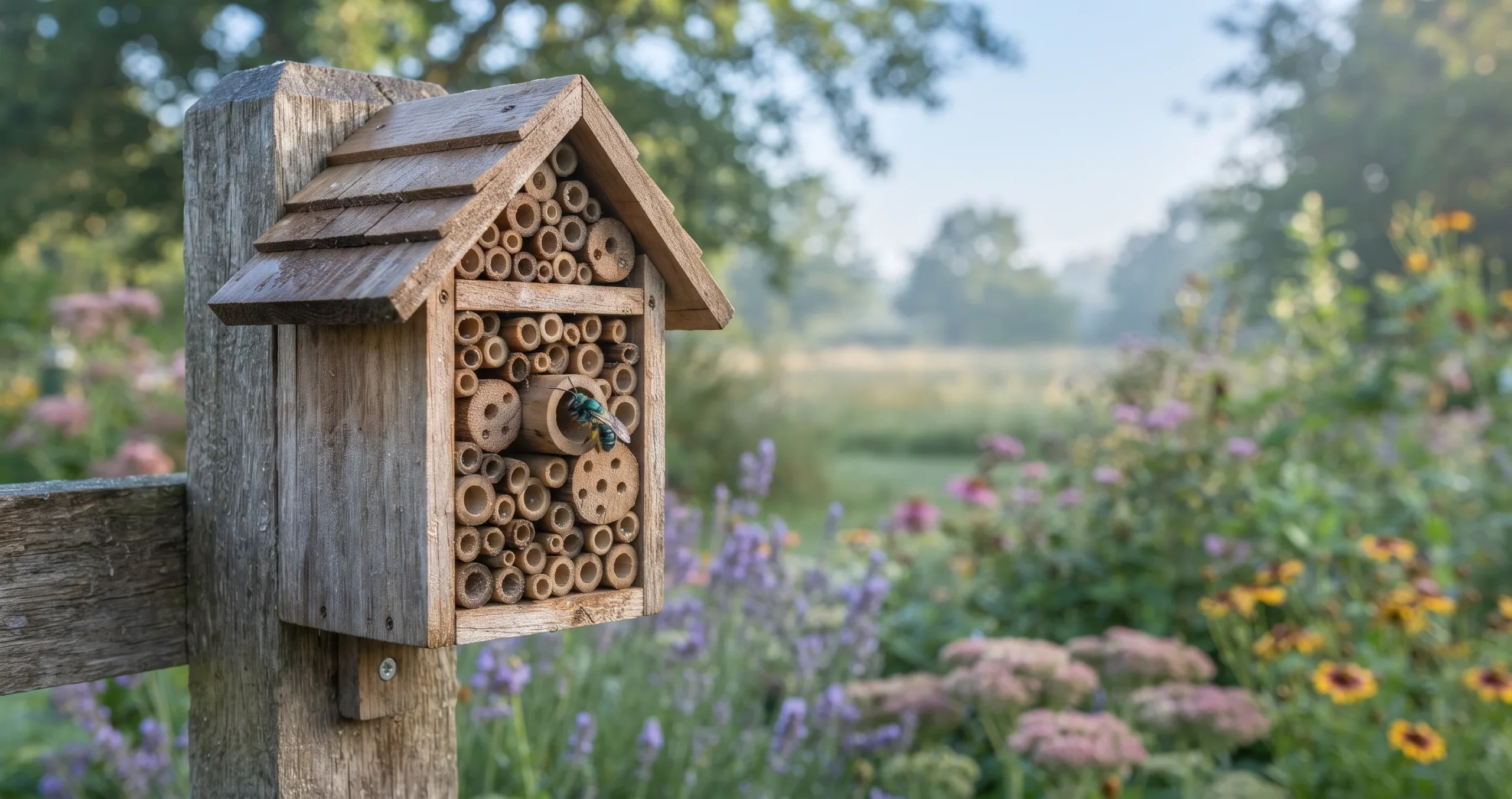
A small bee house can make an interesting and useful addition to a pollinator-friendly garden. Unlike honey bee hives, these structures provide individual nesting tunnels for solitary bees that naturally seek cavities in wood and plant stems.
Understanding how to set up a bee house native bees can safely occupy involves choosing suitable nesting materials, finding the right location, and maintaining the shelter throughout the year.
Although bee houses can support certain pollinators, they require more attention than ordinary garden decorations. This guide explains how to create a practical nesting shelter while supporting the wider diversity of native bees in your garden.
Table of Contents
- Which Native Bees Use Bee Houses?
- How Native Bees Use Nesting Tunnels
- Choosing the Correct Tube Size and Length
- Why Removable Nesting Liners Are Important
- How to Set Up a Bee House Native Bees Can Use
- Choosing Flowers and Natural Nesting Materials
- How to Clean and Maintain a Bee House
- Problems With Solid Wooden Nesting Blocks
- Alternative Nesting Habitats for Native Bees
- Common Bee House Mistakes
- Frequently Asked Questions
Which Native Bees Use Bee Houses?
North America is home to a remarkable diversity of native bees, but only certain species use artificial nesting tunnels.
About 70 percent of native bee species nest underground. Many others nest in hollow stems, abandoned insect tunnels, and other aboveground cavities.
Traditional bee houses are intended primarily for these cavity-nesting species rather than honey bees or bumble bees.
Mason bees
Mason bees (Osmia species) are among the most familiar inhabitants of backyard bee houses. Many species are active during spring and visit flowering fruit trees, shrubs, and wildflowers.
They commonly use mud to construct partitions between their developing offspring inside nesting tunnels.
Leafcutter bees
Leafcutter bees (Megachile species) use small pieces of leaves or petals to construct protective nesting chambers.
They are frequently active during summer. The rounded cutouts they leave on garden foliage generally cause cosmetic rather than serious damage to established plants.
Other solitary insects
Small resin bees and certain solitary wasps may also occupy suitable nesting tunnels.
Their presence is not necessarily a problem. Many solitary wasps contribute to garden biodiversity and naturally hunt other insects.
How Native Bees Use Nesting Tunnels
Unlike honey bees living in large colonies, most solitary bees establish individual nests.
A female bee selects a suitable cavity and collects pollen and nectar to provide food for her offspring. She deposits an egg alongside these provisions and creates a protective partition.
This process is repeated along the tunnel, producing a series of individual brood chambers. After completing the nest, the female typically seals the entrance.
Depending on the species, developing bees may remain inside for several weeks, months, or through winter.
A sealed nesting tube should therefore be treated as occupied until its inhabitants have emerged.
Choosing the Correct Tube Size and Length
Selecting appropriate nesting tunnels is essential when establishing a bee house. Decorative designs sometimes contain materials that look attractive but provide unsuitable nesting conditions.
Different native bee species require different entrance diameters. Providing several sizes can accommodate a wider variety of locally occurring bees.
Recommended nesting tube dimensions
| Internal diameter | Approximate length |
|---|---|
| 1/8 inch (3 mm) | 3–4 inches |
| 3/16 inch (5 mm) | 3–4 inches |
| 1/4 inch (6 mm) | 5–6 inches |
| 5/16 inch (8 mm) | 5–6 inches |
| 3/8 inch (10 mm) | 5–6 inches |
These are general construction recommendations rather than universal requirements for every bee species.
Smaller tunnels accommodate smaller bees, while larger diameters may be suitable for certain mason and leafcutter bees.
Choose smooth, protected tunnels
Every nesting tunnel should have a closed rear end and an unobstructed front entrance.
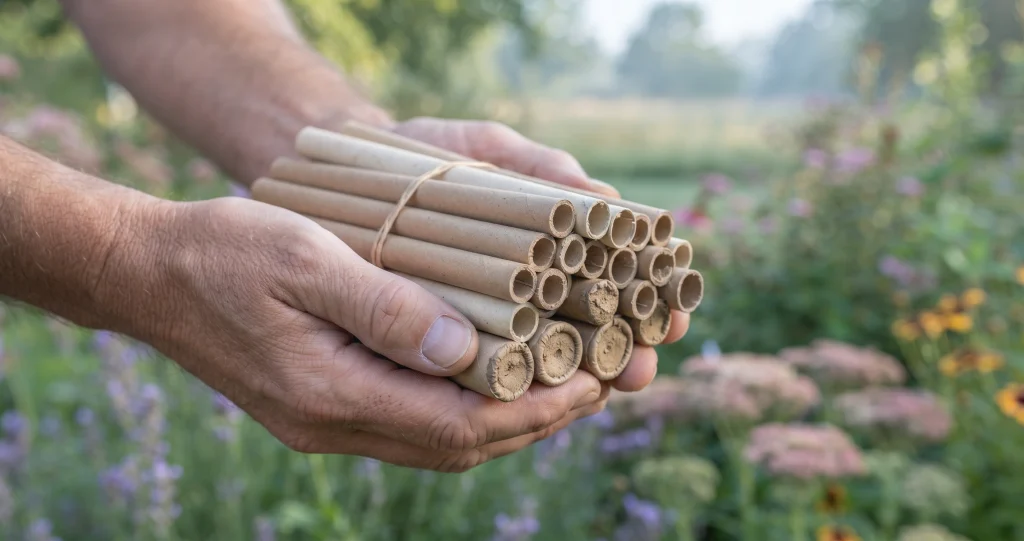
Suitable materials include purpose-made paper nesting tubes, removable wooden nesting trays, and carefully prepared natural reeds.
Avoid splintered entrances, crushed tubes, and materials that remain persistently damp. The nesting chambers should protect developing bees without trapping excessive moisture.
Why Removable Nesting Liners Are Important
A bee house should be designed for maintenance from the beginning.
Over time, nesting materials can accumulate pollen residues, mites, parasites, and fungal pathogens. Repeatedly using contaminated tunnels may increase the risks to developing bees.
Removable liners make it easier to retire old nesting materials and introduce fresh ones.
Choosing a manageable design
For a beginner, a small wooden shelter containing replaceable paper tubes is often more practical than a large decorative insect hotel.
The nesting materials should fit securely inside the shelter while remaining removable when maintenance becomes necessary.
How to Set Up a Bee House Native Bees Can Use
Installing a bee house correctly involves several simple but important decisions. Sunlight, moisture protection, mounting height, and stability all influence the suitability of the nesting environment.
Step 1: Find a location with morning sunlight
Choose a position that receives sunlight during the earlier part of the day.
An east-facing or southeast-facing location is often suitable. In particularly hot climates, afternoon shade can help reduce excessive heating.
Step 2: Provide protection from rain
Choose a shelter with a projecting roof that protects the nesting entrances from rainfall.
Mounting the house beneath an appropriate overhang can provide additional protection. Avoid locations where roof runoff or irrigation regularly wets the structure.
Step 3: Mount the house at a suitable height
A height of roughly three to six feet above ground is a practical starting point for a backyard bee house.
This keeps nesting materials away from direct ground moisture while allowing convenient observation and maintenance.
Step 4: Secure the house firmly
Attach the structure to a sturdy wooden fence, post, or garden shed.
The shelter should remain stable rather than swinging freely during windy weather.
Step 5: Maintain a clear entrance
Avoid placing the house behind dense foliage or other objects that obstruct access.
Bees should be able to approach and leave the nesting tunnels easily.
Choosing Flowers and Natural Nesting Materials
Installing a bee house without providing suitable flowering plants is unlikely to create a complete pollinator habitat.
Native bees need reliable sources of pollen and nectar during their active periods. Growing locally native flowers with overlapping blooming seasons helps provide these resources.
Suitable flowers for each season
| Season | Suggested flowering plants |
|---|---|
| Early spring | Native willows, serviceberry, redbud |
| Late spring | Penstemon, native columbine |
| Summer | Bee balm, coneflowers, mountain mint |
| Late summer | Black-eyed Susan, native sunflowers |
| Fall | Native asters and goldenrods |
Select species naturally suited to your region rather than assuming every plant is appropriate throughout North America.
For additional planting ideas, read our guide to native fall flowers for pollinators, which explores ways to extend the garden’s flowering season.
Provide mud and suitable leaves
Many mason bees require moist soil to construct their nesting partitions. Leafcutter bees need access to suitable foliage for lining their brood chambers.
Providing these natural materials near flowering plants helps create a more complete nesting environment.
Avoid unnecessary pesticide applications, particularly around flowering plants and active nesting sites.
How to Clean and Maintain a Bee House
Annual maintenance is an essential responsibility when providing artificial nesting habitat. Unlike naturally scattered cavities, bee houses concentrate numerous nests in a relatively small area.
This concentration can increase opportunities for parasites and diseases to spread.
During spring and summer
Observe nesting activity periodically without opening occupied tunnels.
Check that the shelter remains securely mounted and protected from rainfall. Replace damaged exterior components carefully without disturbing active nests.
During fall and winter
Remember that sealed nesting tubes may contain developing bees throughout winter.
Protect occupied materials from excessive moisture and physical damage. Do not bring overwintering bees into a heated home, where unsuitable temperatures could interfere with their seasonal development.
Before the following nesting season
Provide fresh nesting tubes and place retired occupied materials in a suitable emergence box near their original location.
An emergence box allows adult insects to leave while discouraging the reuse of old nesting tunnels.
Some native bee species require more than one winter before emerging, so unidentified occupied materials should not be discarded prematurely. Utah State University Extension recommends allowing up to two years for emergence when hosting unidentified species.
Clean empty nesting materials
Once all occupants have emerged, replace disposable paper tubes and clean reusable nesting trays according to their material-specific maintenance instructions.
Allow reusable components to dry completely before reinstalling them.
Problems With Solid Wooden Nesting Blocks
Solid wooden blocks containing permanently drilled holes are common in commercially available bee houses.
Although bees may occupy these tunnels, their enclosed construction makes thorough maintenance difficult.
Nesting debris and potentially harmful organisms can accumulate inside the cavities. Cracking wood can also expose developing bees to unfavorable conditions.
When purchasing a bee house, prioritize replaceable tubes, removable liners, or wooden trays that can be separated for cleaning.
The objective is not simply to attract nesting bees but to provide conditions that remain suitable across successive generations.
Alternative Nesting Habitats for Native Bees
Knowing how to set up a bee house native bees can use is only one part of responsible pollinator gardening.
Because most native bee species do not use artificial nesting tunnels, preserving natural habitats remains especially important.
Leave some exposed soil
Maintain small patches of undisturbed, well-drained soil where ground-nesting bees can establish burrows.
Avoid covering every garden surface with landscape fabric, paving, or thick mulch.
Preserve standing plant stems
Leave some hollow or soft-centered perennial stems standing after the growing season.
These natural structures can provide nesting opportunities for small bees without concentrating them inside an artificial shelter.
Retain natural garden materials
Where appropriate, preserve fallen branches, dead wood, and some leaf litter.
Common Bee House Mistakes
Avoid these frequently encountered problems when establishing a bee house:
- Selecting permanently enclosed nesting materials that cannot be cleaned or replaced.
- Using tunnels with rough entrances or open rear ends.
- Installing the shelter in persistently damp locations.
- Allowing the structure to swing in the wind.
- Discarding occupied nesting tubes too early.
- Providing insufficient nearby flowering plants.
- Using insecticides near active nesting areas.
- Installing oversized insect hotels that are difficult to maintain.
A small, carefully managed bee house is generally a more practical starting point than a large decorative structure.
Frequently Asked Questions
When should I put out a bee house?
Late winter or early spring is a convenient time to install an empty bee house before spring-active solitary bees begin nesting. Summer-active species may occupy suitable tunnels later in the year.
Which direction should a bee house face?
East or southeast is often appropriate because these orientations receive morning sunlight. Consider local weather, afternoon temperatures, and exposure to rainfall.
Can native bees sting near a bee house?
Female solitary bees can sting, but they generally do not defend their nesting areas like large social bee colonies. Avoid handling bees or disturbing occupied tunnels.
How often should nesting tubes be replaced?
Provide fresh nesting materials annually and retire used disposable tubes after their occupants have emerged. Never discard sealed tubes simply because the nesting season has ended.
Why are bees not using my bee house?
Unsuitable tunnel dimensions, insufficient flowering plants, unfavorable placement, and seasonal inactivity are possible explanations. Even a correctly installed bee house is not guaranteed to attract occupants.
Are bamboo tubes suitable for bee houses?
Bamboo can provide nesting cavities when correctly prepared, but permanent rigid tunnels are difficult to clean. Use removable sections with smooth entrances and closed rear ends.
Should I buy mason bees for my bee house?
Providing suitable habitat for locally occurring bees is generally preferable for backyard conservation. Purchasing and transporting bees can introduce diseases or species inappropriate for the local environment.
Conclusion
Learning how to set up a bee house for native bees involves much more than filling a wooden box with hollow tubes.
Appropriate tunnel dimensions, replaceable nesting materials, morning sunlight, secure mounting, and annual maintenance all contribute to a suitable nesting environment.
However, artificial shelters support only a portion of native bee diversity. Locally native flowering plants, exposed soil, standing stems, and undisturbed natural habitats remain essential.
By combining a responsibly managed bee house with thoughtful gardening practices, you can support native pollinators while appreciating their remarkable nesting behavior throughout the seasons.
External Sources
1. Making and Managing Wild Bee Hotels
Provide research-based guidance on nesting tube dimensions, bee house construction, seasonal maintenance, emergence boxes, and disease prevention.
Utah State University Extension. https://extension.usu.edu/planthealth/research/making-and-managing-wild-bee-hotels?utm_source
2. Nests for Pollinators
Explain appropriate bee house placement, sunlight requirements, nesting protection, and alternative natural habitats for native pollinators.
University of Minnesota Extension. https://extension.umn.edu/garden-and-home/yard-and-garden/lawns-and-landscapes-in-minnesota/pollinator-nests?utm_source