
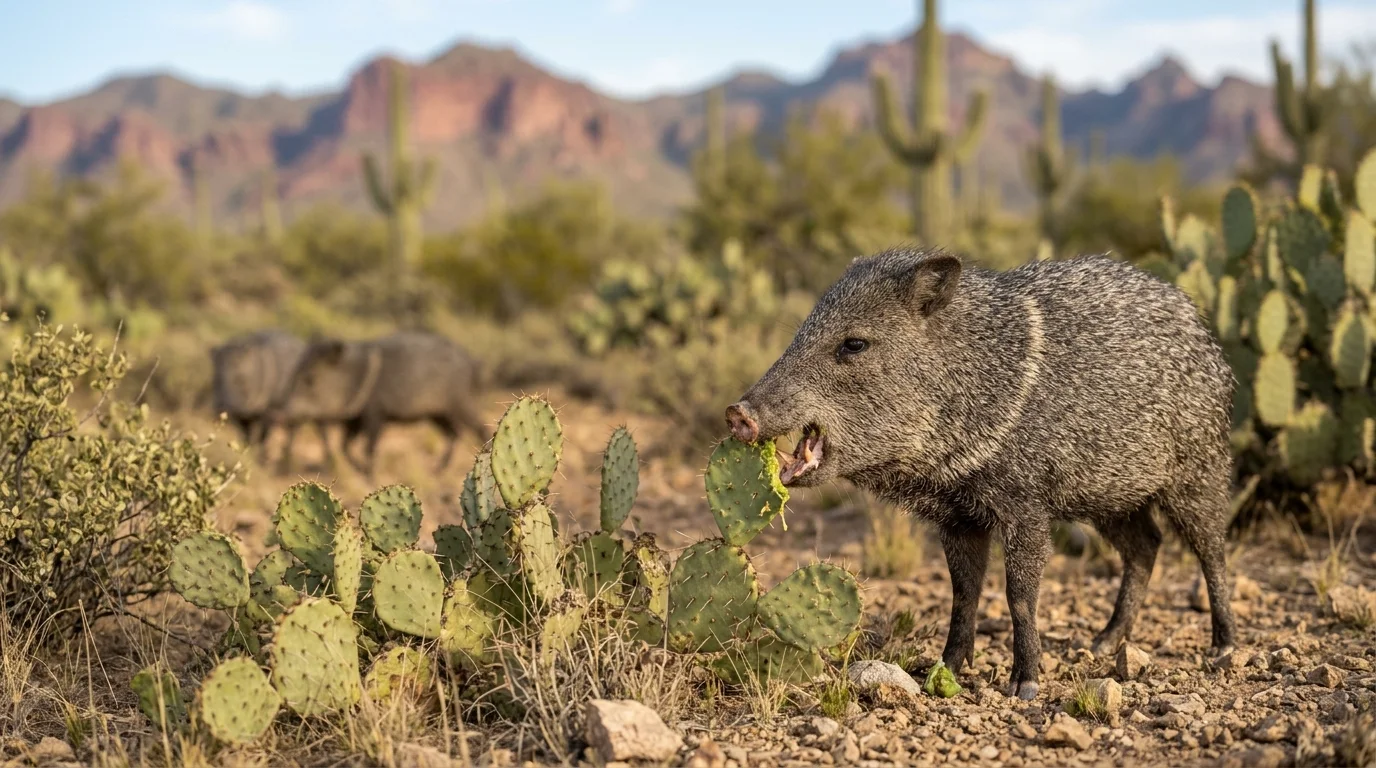
Imagine walking along a quiet desert trail in Arizona when a stocky, gray animal emerges from behind a prickly pear cactus. It has a pig-like snout, short legs, and a rounded body covered in coarse bristles. A moment later, several more animals appear, moving together through the brush.
At first glance, you might think you’ve encountered wild pigs. But these animals are something different.
Meet the javelina, also known as the collared peccary (Pecari tajacu). Although it resembles a pig, it belongs to the family Tayassuidae, while true pigs belong to the family Suidae.
The differences go far beyond scientific classification. Javelinas have unusual teeth, specialized digestive systems, strong social bonds, and an impressive ability to feed on prickly desert plants.
Understanding these animals reveals a fascinating side of life in the American Southwest.
Table of Contents
- Meet the Javelina: A Desert Mammal With a Pig-Like Appearance
- Javelina vs. Wild Pig: What Makes Them Different?
- How Javelinas Eat Prickly Pear Cactus
- Why Javelinas Travel in Herds
- The Science Behind Javelina Adaptations
- Where Javelinas Live
- Breeding and Raising Young
- Javelinas in Desert Ecosystems
- In Your Own Yard: Living Safely Around Javelinas
- Frequently Asked Questions
Meet the Javelina: A Desert Mammal With a Pig-Like Appearance
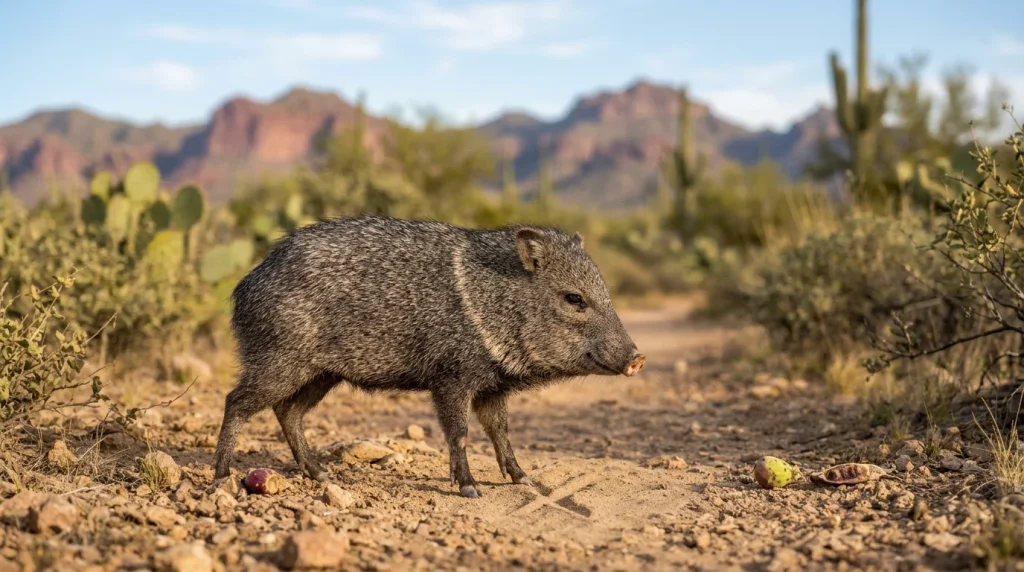
The javelina is a medium-sized hoofed mammal native to the Americas. Its scientific name is Pecari tajacu, and it is commonly called the collared peccary because of the pale band of fur extending across its shoulders and around its neck.
Javelinas belong to the order Artiodactyla, a group of even-toed hoofed mammals that also includes deer, cattle, and true pigs.
Despite their similar appearance, peccaries and pigs represent distinct evolutionary lineages.
What Does a Javelina Look Like?
Adult javelinas commonly stand about 18–24 inches tall at the shoulder and weigh approximately 35–60 pounds, although size varies with age, sex, and habitat.
Their bodies are compact and muscular, supported by relatively short legs.
The coat consists of coarse gray, brown, and black bristles that create a salt-and-pepper appearance.
A lighter band across the shoulders gives the species its common name.
Javelinas also have small ears, dark eyes, a blunt snout, and a very short tail that is usually difficult to see.
Their appearance is well suited to moving through thorny vegetation and rocky desert terrain.
Where Are Javelinas Found?
In the United States, javelinas are most closely associated with Arizona, New Mexico, and Texas.
They also occur across Mexico and parts of Central and South America.
Their geographic range extends well beyond the Sonoran Desert, encompassing several kinds of tropical, subtropical, and dry habitats.
Within the American Southwest, they are especially familiar in desert scrub, wooded washes, thorny brush, and neighborhoods bordering natural habitat.
Javelina vs. Wild Pig: What Makes Them Different?
Javelinas and true pigs share a general body shape, but several anatomical differences help distinguish them.
Their resemblance reflects a shared evolutionary history and broadly similar feeding lifestyles, not membership in the same family.
Different Biological Families
True pigs, including domestic pigs and wild boars, belong to Suidae.
Javelinas belong to Tayassuidae.
Both families are part of the broader pig-like mammal group known as Suina, but they have evolved along separate branches.
This distinction is why a javelina is not simply a small wild boar.
Their Tusks Point Differently
One of the clearest differences involves the canine teeth.
Javelinas have relatively short, sharp canine teeth that point mostly downward from the upper jaw.
These teeth interlock with the lower canines and can produce a characteristic clicking or clacking sound.
In many wild boars, the canine teeth grow into more prominent tusks that curve upward or outward.
However, tusk appearance varies among pig species, sexes, and ages.
The distinction is best understood as a general anatomical difference rather than an absolute rule for every animal.
Body Shape and Tail Length
Javelinas typically have compact bodies and very short tails.
Many true pigs have longer, more visible tails, although tail length varies among species and breeds.
The pale collar on a collared peccary is another useful identification feature.
A Distinctive Scent Gland
Javelinas possess a prominent scent gland on the upper back near the rump.
They use its secretions in social communication, particularly when rubbing against other members of their group.
True pigs also communicate through scent, but their scent-gland anatomy and social signaling differ.
| Feature | Javelina | True pig or wild boar |
|---|---|---|
| Family | Tayassuidae | Suidae |
| Tail | Very short, often hidden | Usually more visible |
| Upper canine teeth | Relatively short, directed mostly downward | Often more outward- or upward-curving |
| Coat | Coarse bristles with a pale shoulder collar | Varies considerably |
| Social behavior | Commonly lives in cohesive herds | Many species also form social groups |
| Geographic origins | Native to the Americas | Native pig species originated in Eurasia and Africa |
How Javelinas Eat Prickly Pear Cactus
One of the most surprising aspects of javelina behavior is their ability to feed on prickly pear cactus.
For many animals, a cactus covered in sharp spines would seem like an unappealing meal.
For javelinas, however, prickly pear can be an important food source.
Cactus Pads and Fruits
Javelinas eat both the fleshy pads and fruits of prickly pear cacti.
These plants provide moisture as well as nutrients, making them particularly useful in dry environments.
A javelina may bite into a cactus pad, tear off a section, and chew it with powerful jaws.
The animal can handle spiny vegetation, although that does not mean its mouth is completely immune to injury.
How Do They Manage the Spines?
Javelinas have strong jaws and teeth suited to processing tough plant material.
Their feeding behavior allows them to consume cactus despite the presence of spines.
However, the popular claim that cactus spines can never harm them is an exaggeration.
The animal’s success comes from its feeding adaptations and behavior, not from a magical resistance to sharp objects.
More Than Just Cactus
Although prickly pear is a familiar part of their diet, javelinas are not exclusive cactus eaters.
They also consume roots, bulbs, fruits, seeds, and other plant materials.
Occasionally, they may eat insects or other animal matter.
Their flexible diet helps them survive in habitats where available food changes with rainfall and season.
Why Javelinas Travel in Herds
Unlike solitary animals that spend most of their time alone, collared peccaries commonly live in social groups.
These groups are often called herds or squadrons.
Safety Through Social Living
Herd living can provide several advantages.
Multiple animals may detect threats more effectively than a single individual.
Group members can also maintain contact while moving through dense vegetation.
Herd size varies depending on habitat, food availability, and local conditions.
In some places, groups contain only a few animals, while elsewhere they may be considerably larger.
Scent Marking and Communication
Javelinas rely heavily on smell.
Members of a herd often rub their bodies together, transferring scent from their dorsal glands.
This behavior helps maintain a shared group scent and may support social recognition.
They also communicate through vocalizations, body posture, and other signals.
Staying Together
Herd members may rest, travel, and forage together.
Young animals often remain close to adults while learning to navigate their environment.
Social relationships are an important part of javelina life, although group membership and interactions can change over time.
The Science Behind Javelina Adaptations
The javelina’s survival in desert habitats depends on more than its ability to eat cactus.
Its teeth, digestion, senses, and behavior work together to help it exploit environments where heat, food, and water availability can change dramatically.
Specialized Teeth and Powerful Jaws
Javelinas possess sharp canine teeth and cheek teeth suited to processing a varied diet.
Their canine teeth can serve defensive and social functions, while the molars and premolars help break down plant material.
Their jaws are strong enough to handle fibrous vegetation.
However, they do not chew food in exactly the same way as grazing cattle or other ruminants.
A Complex Digestive System
Collared peccaries have a specialized stomach with multiple compartments.
This digestive anatomy supports microbial fermentation of plant material.
Microorganisms help break down some of the fibrous components of the animal’s diet.
Although their stomach is complex, peccaries are not true ruminants like cattle.
They do not use the same four-chambered digestive arrangement or typical rumination process.
Their digestive specialization helps them make use of vegetation that can be difficult for other mammals to process.
An Excellent Sense of Smell
Javelinas have a well-developed sense of smell that helps them locate food and communicate.
Their snouts are useful for investigating soil, vegetation, and potential food sources.
Smell also plays an important role in recognizing other animals.
Because their eyesight is generally considered less acute than that of many visually oriented mammals, scent and hearing are especially important.
Managing Desert Heat
Javelinas are adapted to warm environments, but they can still experience heat stress.
During hot weather, they often seek shade beneath shrubs, trees, or rocky overhangs.
They may become more active during cooler periods of the day.
Activity patterns vary with season, temperature, and human disturbance.
Water and Moisture
Prickly pear and other succulent foods provide moisture.
Nevertheless, javelinas also use available drinking water.
Their ability to survive in dry landscapes should not be confused with an ability to live indefinitely without water.
Seasonal Flexibility
During cooler months, javelinas may forage more openly during daylight.
In hotter periods, activity may shift toward mornings, evenings, or nighttime.
These changes help animals balance feeding opportunities with environmental conditions.
Where Javelinas Live
The American Southwest provides a mixture of habitats suitable for collared peccaries.
Sonoran Desert Scrub
In southern Arizona, javelinas are familiar inhabitants of desert scrub.
Prickly pear, mesquite, palo verde, and other native plants provide food and cover.
Dense vegetation can offer important shelter during hot weather.
Desert Washes and Woodlands
Dry washes often support relatively lush vegetation compared with surrounding slopes.
These corridors can provide shade, food, and travel routes.
Javelinas also occur in oak woodlands and other habitats beyond the hottest desert valleys.
Urban-Edge Habitats
As communities expand into desert landscapes, encounters between people and javelinas can become more frequent.
Neighborhood gardens, unsecured garbage, pet food, and ornamental plants may attract animals.
Understanding these attractants is important for reducing conflict.
Breeding and Raising Young
Javelinas reproduce within their social groups, and young animals are integrated into herd life.
Courtship and Reproduction
Breeding can occur during different parts of the year, depending on environmental conditions.
Food availability and rainfall may influence reproductive patterns.
After a gestation period of several months, females give birth to young that are noticeably smaller and often reddish or tan compared with adults.
Caring for the Young
Newborn javelinas remain close to their mothers.
They depend on milk initially and gradually begin consuming solid foods as they develop.
Other herd members may remain nearby, providing the young with opportunities for social interaction.
Learning Herd Behavior
Young javelinas grow up surrounded by adults and other group members.
They gradually learn feeding locations, social signals, and responses to danger.
Keeping young animals undisturbed is especially important when observing herds in the wild.
Javelinas in Desert Ecosystems
Javelinas are active participants in desert food webs.
Their feeding and movement can influence vegetation, soil, and other wildlife.
Consumers of Desert Plants
By eating cactus pads, fruits, roots, and other vegetation, javelinas affect the plants growing in their habitats.
They may also disperse some seeds after consuming fruits.
The ecological importance of these interactions varies among plant species and habitats.
Prey for Larger Predators
Mountain lions and coyotes may prey on javelinas.
Young animals can be particularly vulnerable to predators.
These relationships help connect plant resources, herbivores, and carnivores within desert ecosystems.
Habitat Fragmentation and Human Conflict
Road construction, urban development, and changes in native vegetation can divide habitat.
Javelinas may then move through residential areas while searching for food and shelter.
Conflicts are more likely when animals become accustomed to human food sources or are approached too closely.
Responsible coexistence benefits both people and wildlife.
In Your Own Yard: Living Safely Around Javelinas
For homeowners in Arizona, New Mexico, and Texas, javelinas can be occasional visitors.
Their presence does not automatically indicate a problem, but some precautions can help prevent unwanted encounters.
Secure Garbage and Food
Use sturdy garbage containers with secure lids.
Avoid leaving pet food outdoors, especially overnight.
Clean up fallen fruit and other accessible food sources where practical.
Never intentionally feed javelinas.
Protect Vulnerable Garden Plants
Javelinas may browse ornamental plants and damage gardens while searching for food.
Appropriate fencing can help protect vegetable beds and vulnerable landscaping.
Choose designs recommended by local wildlife agencies and avoid creating hazards for animals.
Keep Pets Under Control
Dogs can provoke defensive behavior, particularly when they chase or corner javelinas.
Keep dogs leashed near wildlife and supervise pets outdoors.
Bring pets inside when a herd is passing through.
Give Javelinas Space
Observe from a distance and allow animals a clear route away.
Never approach young javelinas or position yourself between herd members.
Avoid cornering animals against walls, fences, or buildings.
If a javelina appears defensive, retreat calmly and give it room.
Follow Local Wildlife Guidance
Wildlife agencies provide regional recommendations for managing encounters.
In Arizona, the Arizona Game and Fish Department offers practical advice on preventing conflicts with javelinas.
If an animal is injured, trapped, or behaving unusually, contact the appropriate local wildlife authority rather than attempting to handle it yourself.
Frequently Asked Questions
1. Are Javelinas Actually Pigs?
No. Javelinas are collared peccaries belonging to the family Tayassuidae.
True pigs belong to the family Suidae.
Although both groups share some physical characteristics and evolutionary ancestry, they are biologically distinct.
2. Can Javelinas Really Eat Cactus With Spines?
Yes. Javelinas regularly consume prickly pear cactus pads and fruits, even when spines are present.
Their strong jaws and feeding behavior allow them to handle this challenging food source.
However, they are not completely immune to injury from cactus spines.
3. Are Javelinas Dangerous to People and Pets?
Javelinas generally avoid direct conflict with people when given sufficient space.
However, they may defend themselves if threatened, cornered, or pursued by dogs.
Their sharp canine teeth can cause injuries.
The safest approach is to observe from a distance, secure attractants, and keep pets under control.
Conclusion
Return to that quiet desert trail where a gray, bristly animal emerges from the cactus.
Its snout and stocky body may suggest a wild pig, but the javelina has a biological identity and lifestyle all its own.
From its downward-pointing canine teeth and specialized digestive system to its social herds and ability to consume prickly pear, the collared peccary is remarkably suited to life in the Americas.
It also plays an important role in desert ecosystems as a plant consumer, potential seed disperser, and prey for larger predators.
Understanding the javelina helps us appreciate the extraordinary wildlife living in the American Southwest—and reminds us that appearances rarely tell the whole story.
External Sources
1. Living With Javelina : Guidance on herd behavior, feeding, scent communication, residential attractants, and avoiding dangerous encounters.
Arizona Game and Fish Department , Read Arizona’s javelina coexistence guide
2. Animal Diversity Web: Pecari tajacu : Species biology, digestive adaptations, geographic range, reproduction, and feeding ecology.
University of Michigan , Read the collared peccary species account
3. Javelina Species Profile : Adult size, appearance, habitat preferences, and natural history.
Arizona Game and Fish Department, Read Arizona’s javelina species profile