
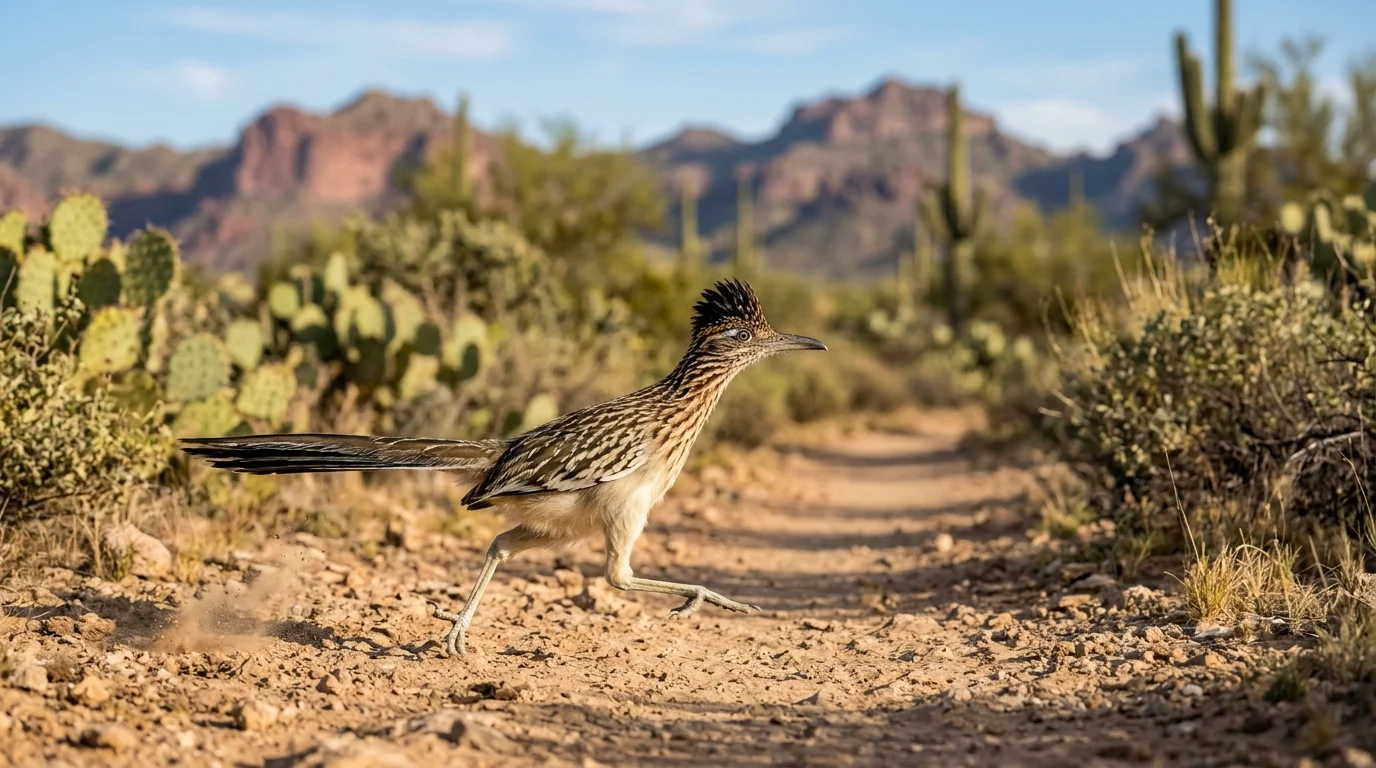
Imagine a bird with strong wings that spends much of its day racing across the desert instead of flying above it. It darts between shrubs, pauses to inspect the ground, and suddenly accelerates after a fleeing lizard.
Meet the greater roadrunner (Geococcyx californianus), one of the American Southwest’s most recognizable and fascinating birds.
Although capable of flight, this remarkable species spends much of its time on the ground, using its long legs, alert senses, and quick movements to search for food. It can reportedly reach speeds of about 20 miles per hour in short bursts, making it an impressive terrestrial hunter.
But speed is only part of its story.
From its unusual X-shaped footprints to its clever responses to desert temperatures, the greater roadrunner offers a fascinating example of how animals adapt to challenging environments.
Table of Contents
- Meet the Greater Roadrunner
- Why the Greater Roadrunner Prefers Running
- How Roadrunners Hunt Their Prey
- The Science Behind Their Desert Adaptations
- Surviving Desert Heat and Seasonal Changes
- Breeding, Nesting, and Communication
- The Greater Roadrunner’s Role in Desert Ecosystems
- In Your Own Yard: Supporting Roadrunners
- Frequently Asked Questions
Meet the Greater Roadrunner: A Bird Built for the Ground
The greater roadrunner belongs to the cuckoo family, Cuculidae. Unlike many cuckoos associated with trees and dense vegetation, it is highly adapted to moving across open ground.
Its scientific name is Geococcyx californianus, and its appearance is unmistakable once you know what to look for.
What Does a Greater Roadrunner Look Like?
An adult greater roadrunner generally measures around 20–24 inches from bill to tail tip, with its long tail contributing substantially to its overall length.
Its plumage combines streaks of brown, black, cream, and white, providing camouflage among desert vegetation.
Other recognizable features include a shaggy crest, a long slightly downcurved bill, powerful legs, and a dark tail marked with pale tips.
A patch of bare skin behind the eye may show blue and reddish-orange coloration, although its visibility varies.
Its body is slender and streamlined, giving the bird a distinctive appearance when running.
Where Greater Roadrunners Live
Greater roadrunners inhabit the southwestern United States and Mexico.
They are especially familiar in Arizona, New Mexico, Texas, and parts of California, although their distribution extends into additional areas.
Typical habitats include desert scrub, thorny brush, open woodlands, grasslands, and dry landscapes with scattered vegetation.
Roadrunners may also appear around rural homes, ranches, parks, and neighborhoods where suitable habitat remains.
They generally favor environments that provide both open ground for hunting and vegetation for shelter.
Why the Greater Roadrunner Prefers Running
A bird capable of flight might seem better equipped to escape danger or search for food from above.
Yet the greater roadrunner has developed a lifestyle in which running is especially useful.
Running Helps It Hunt Ground-Dwelling Prey
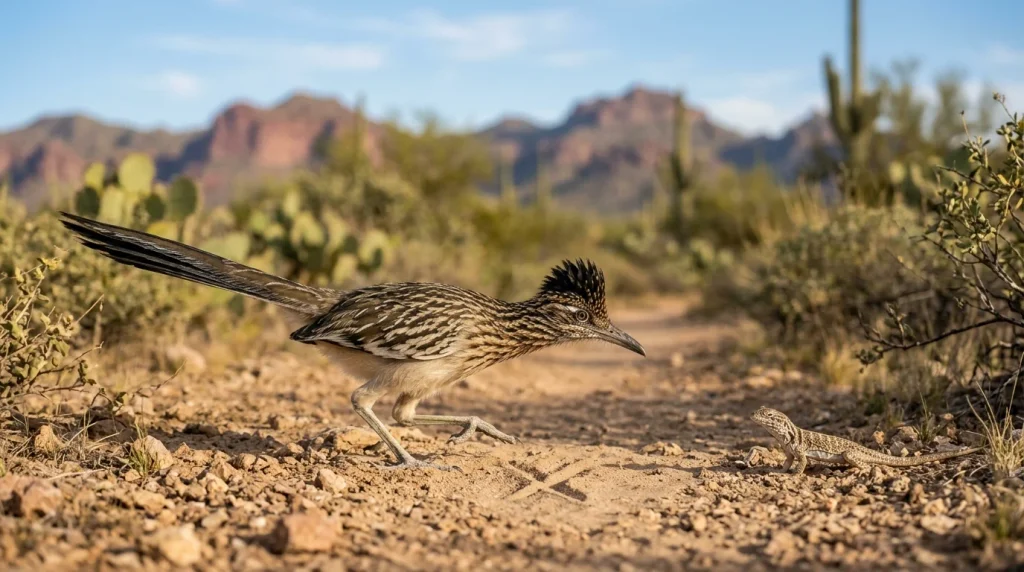
Many of the animals roadrunners eat live on or near the ground.
Lizards move between rocks, insects crawl through vegetation, and small mammals shelter beneath shrubs.
Running allows the bird to investigate these habitats directly.
It can stop abruptly, change direction, and accelerate toward prey without needing to take off.
This ground-based hunting strategy is especially effective in landscapes with scattered vegetation and open patches.
How Fast Can a Roadrunner Run?
Greater roadrunners are commonly described as capable of reaching approximately 20 miles per hour.
This figure is best understood as a reported upper speed rather than the pace they maintain throughout the day.
During ordinary foraging, they often move more slowly, alternating between walking, running, and brief pauses.
Their rapid acceleration becomes especially useful when pursuing prey or escaping a threat.
The Long Tail Helps With Balance
The roadrunner’s long tail is one of its most striking features.
During quick movements, the bird may raise, lower, or shift its tail while turning and changing posture.
These movements can contribute to balance and maneuvering.
It is tempting to describe the tail as a steering rudder, but that comparison is a simplification. A bird running on land does not steer in exactly the same way as an aircraft or boat.
Its tail works together with body position, legs, and changes in momentum.
Why Flying Is Still Important
Roadrunners are capable of flight, even though they often prefer traveling on foot.
They may fly short distances to reach elevated perches, escape danger, cross obstacles, or move between locations.
Their wings are functional, and flight remains an important part of their behavioral repertoire.
The greater roadrunner is therefore not a flightless bird. It is a flying bird whose everyday lifestyle strongly favors running.
How Roadrunners Hunt Their Prey
The greater roadrunner is an opportunistic predator.
Rather than specializing in a single food source, it eats a variety of animals depending on habitat, season, and availability.
Lizards: A Common Desert Meal
Lizards are familiar prey in many roadrunner habitats.
A hunting roadrunner may move slowly through brush, watching for movement.
When a lizard appears, the bird can rush forward and seize it with its bill.
Smaller prey may be swallowed relatively quickly, while larger animals may require additional handling.
Insects and Spiders
Roadrunners also consume insects such as grasshoppers, beetles, and other arthropods.
Spiders and scorpions may also be taken.
These prey provide food in habitats where insects are seasonally abundant.
The bird’s varied diet helps it exploit different opportunities throughout the year.
Small Rodents and Other Animals
Greater roadrunners may capture mice and other small vertebrates.
They also occasionally eat small birds, eggs, and other available food.
Their feeding behavior reflects the flexibility of a predator adapted to unpredictable desert environments.
Do Roadrunners Really Eat Snakes?
Yes. Roadrunners sometimes capture and eat snakes, including small individuals.
They may use rapid movements and repeated strikes with the bill to subdue difficult prey.
However, popular stories can exaggerate their ability to handle dangerous snakes.
Not every snake is suitable prey, and attempting to capture a large or venomous animal involves risk.
Roadrunners are capable hunters, not invulnerable snake-fighting specialists.
The Science Behind the Greater Roadrunner’s Desert Adaptations
The roadrunner’s unusual anatomy and behavior are closely connected to its ground-based lifestyle.
Several features help explain why it is so effective in dry, open environments.
X-Shaped Footprints and Unusual Toes
Roadrunner Tracks In Desert
Roadrunners have zygodactyl feet, meaning two toes point forward and two point backward.
This arrangement differs from the three-forward, one-backward configuration common among many other birds.
Their footprints can therefore appear X-shaped.
Interestingly, an isolated roadrunner track may not clearly reveal which direction the bird was traveling.
The toe arrangement is well established, although explaining its exact advantages requires care.
Zygodactyl feet occur in several bird groups with very different lifestyles, so they should not be described as an adaptation unique to desert running.
Long Legs and Efficient Ground Movement
The greater roadrunner has relatively long, strong legs suited to walking and running.
Its body position changes as it accelerates, allowing it to move quickly across uneven terrain.
The bird frequently uses short bursts of speed rather than continuous high-speed running.
These movements are particularly useful when pursuing prey among rocks and shrubs.
Sharp Vision and Rapid Reactions
Roadrunners rely heavily on vision while hunting.
Their alert posture and frequent pauses allow them to examine nearby vegetation for movement.
Once prey is detected, the bird can respond rapidly.
Its success comes from combining visual detection, quick movement, and precise strikes with the bill.
Sunbathing to Warm the Body
One of the most fascinating roadrunner behaviors occurs during cool mornings.
A roadrunner may turn its back toward the sun, spread or lower its wings, and expose dark skin beneath its back feathers.
This posture allows sunlight to reach the dark surface more directly, helping the bird absorb solar heat.
The behavior is especially useful after a cool night.
It is an example of behavioral thermoregulation: controlling body temperature partly through posture and environmental conditions.
Conserving Energy During Cool Nights
Roadrunners can reduce their body temperature during periods of rest, particularly overnight.
This controlled reduction in body temperature can lower energy demands.
Morning sunbathing may help them warm up afterward.
The process is sometimes described as shallow torpor or nighttime hypothermia, although the terminology and degree of cooling depend on the scientific context.
The important point is that roadrunners combine physiological and behavioral responses to manage energy in a variable desert climate.
How Roadrunners Survive Desert Heat and Seasonal Changes
Deserts are not consistently hot.
Temperatures can change dramatically between day and night, and some southwestern habitats experience freezing winter weather.
Roadrunners must respond to both heat and cold.
Finding Shade During Hot Weather
During particularly hot periods, roadrunners may seek shade beneath shrubs or other vegetation.
They can adjust activity patterns to avoid the most demanding conditions.
Their habitat often provides a mixture of open hunting areas and sheltered resting locations.
Obtaining Moisture From Food
Roadrunners receive some of their water from the animals they eat.
This can reduce their dependence on frequent visits to open water sources.
However, they may drink when water is available.
Their ability to survive in dry environments reflects multiple adaptations rather than complete independence from water.
Adjusting to Seasonal Food Availability
The abundance of insects, reptiles, and small mammals changes throughout the year.
Roadrunners respond by taking different prey as opportunities arise.
In colder weather, reptiles may be less active, while other food sources remain available.
A flexible diet is especially valuable in environments where rainfall and temperature strongly influence animal activity.
Breeding, Nesting, and Communication
Roadrunners are not only remarkable hunters. Their family behavior is equally interesting.
Courtship and Pair Bonds
Greater roadrunners often maintain territories and may form long-lasting pair bonds.
Courtship can involve vocalizations, displays, and food offerings.
Males may present prey to females during courtship.
These behaviors help coordinate reproduction and reinforce interactions between mates.
Building a Nest
Roadrunners usually build platform-like nests of sticks and other plant material.
Nests are commonly placed in shrubs, cacti, or small trees, where vegetation provides support and some concealment.
Both adults may participate in nest construction and caring for young.
Breeding timing varies with location and environmental conditions.
Raising the Young
Females lay a clutch of eggs, and the parents share responsibilities during incubation and chick-rearing.
After hatching, young roadrunners depend on adults for food and protection.
Their development is relatively rapid, as is common among many birds living in exposed environments.
More Than One Kind of Call
Roadrunners communicate through several vocalizations, including low cooing sounds and other calls.
They may also produce bill-clattering sounds during certain interactions.
These signals can play roles in territory defense, pair communication, and other social behaviors.
The Greater Roadrunner’s Role in Desert Ecosystems
As a predator, the greater roadrunner participates in the complex food webs of southwestern habitats.
A Versatile Hunter
By eating insects, reptiles, rodents, and other animals, roadrunners connect several levels of the desert food web.
Their diet changes according to what is available.
They may influence local prey populations, although their effects depend on habitat and the abundance of other predators.
Roadrunners Have Predators Too
Despite their speed, roadrunners are vulnerable to larger predators.
Some hawks, mammals, and other animals may prey on roadrunners or their nests.
Their quick running, camouflage, and use of vegetation can help reduce exposure.
Conservation and Habitat Protection
The greater roadrunner is not generally considered globally threatened, but local habitat conditions still matter.
Urban expansion, vegetation removal, roads, and changes in native habitat can affect where birds live and hunt.
Maintaining healthy desert ecosystems supports roadrunners along with the many other species that share their environment.
In Your Own Yard: Supporting Roadrunners in the Southwest
If you live in the American Southwest, your property may occasionally attract a greater roadrunner, particularly where natural desert habitat remains nearby.
Supporting these birds begins with responsible landscaping.
Preserve Native Vegetation
Native shrubs, cacti, and grasses provide shelter, nesting opportunities, and habitat for the small animals roadrunners eat.
Avoid clearing every patch of natural vegetation simply to create an open landscape.
A mixture of cover and accessible ground can be valuable.
Reduce Unnecessary Pesticide Use
Broad pesticide applications can reduce insects and potentially expose wildlife to harmful substances.
Use integrated pest management practices, including monitoring, prevention, and targeted interventions when necessary.
Choose methods that minimize effects on non-target species.
Keep Pets From Disturbing Wildlife
Free-roaming cats and uncontrolled dogs can disturb birds and other native animals.
Supervise pets outdoors and use appropriate containment measures.
This protects both wildlife and domestic animals.
Observe Without Feeding
Roadrunners are best appreciated through natural behavior.
Avoid offering food, attempting to lure them closer, or approaching nests.
Feeding wildlife can alter behavior and create unnecessary risks.
Binoculars or a camera with a zoom lens allow observation from a respectful distance.
Create a Wildlife-Friendly Landscape
A garden featuring regionally native plants, natural ground cover, and limited disturbance can support many species.
Even if roadrunners never visit, these practices may benefit native insects, reptiles, and birds.
The goal is not to attract a predator artificially, but to maintain a healthier local ecosystem.
Frequently Asked Questions
1. Can Greater Roadrunners Fly?
Yes. Greater roadrunners are fully capable of flight.
They often prefer running when moving through their habitat or pursuing prey, but they can fly to escape threats, reach perches, and cross obstacles.
Their ground-based lifestyle does not make them flightless.
2. How Fast Can a Greater Roadrunner Run?
Greater roadrunners are commonly reported to reach speeds of approximately 20 miles per hour during short bursts.
Their normal movements are generally slower.
They often alternate between walking, pausing, and sudden acceleration while searching for food.
3. Do Greater Roadrunners Really Eat Snakes?
Yes. Greater roadrunners sometimes eat snakes, including small individuals.
They also consume lizards, insects, spiders, rodents, and other prey.
Their ability to handle snakes depends on the size and species of the animal, and encounters with venomous snakes can be dangerous.
Conclusion
Picture that bird racing across the desert again, its long tail shifting as it turns and its powerful legs carrying it between rocks and shrubs.
The greater roadrunner is not simply a bird that runs fast.
It is a highly adaptable predator whose anatomy, behavior, and energy-saving strategies reflect life in the American Southwest.
Its unusual feet, sharp vision, flexible diet, and ability to manage changing temperatures make it one of the region’s most distinctive birds.
And while it can take to the sky whenever necessary, much of its extraordinary life unfolds on the ground, one rapid stride at a time.
External Sources
1. Greater Roadrunner : Desert temperature regulation, X-shaped tracks, diet, seasonal behavior, and habitat.
Arizona-Sonora Desert Museum, Read the Desert Museum fact sheet
2. Greater Roadrunner Natural History : Hunting techniques, long-tail maneuvering, nesting, and morning sunbathing.
Arizona-Sonora Desert Museum , Read the natural history profile
3. Greater Roadrunner : Diet, reproduction, threats, and wildlife conservation.
National Wildlife Federation, Read the wildlife profile