
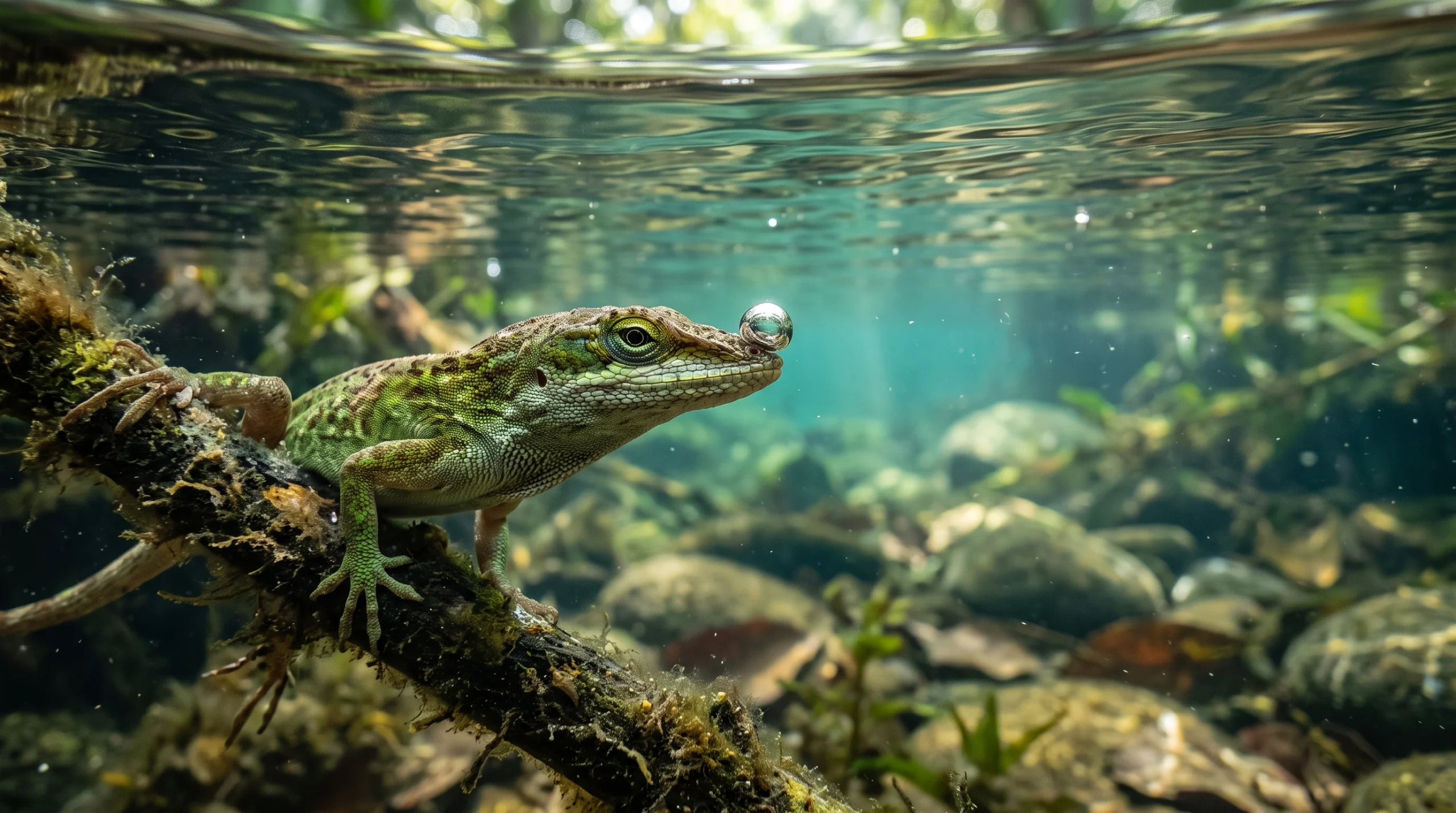
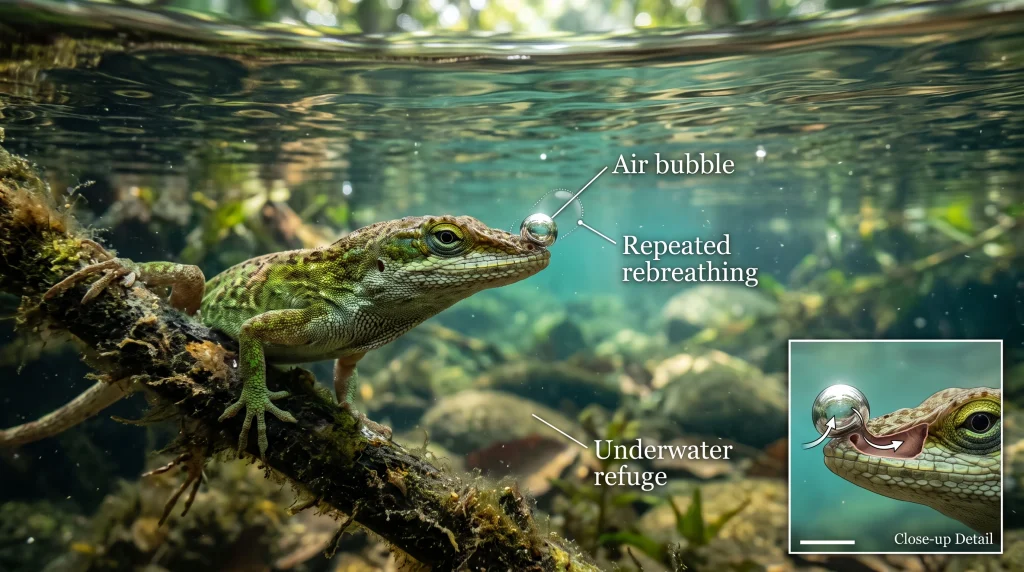
A small tropical lizard dives beneath the surface of a stream. Instead of immediately swimming back toward air, it settles underwater. Then something unusual appears around its snout: a silvery bubble. The bubble expands as the lizard exhales and contracts again as the air is drawn back through its nostrils.
This is not simply air accidentally stuck to the animal.
Researchers call the behavior underwater rebreathing, and experiments have demonstrated that several semi-aquatic anoles repeatedly exhale into and reinspire air from a bubble while submerged. Oxygen measurements show that the bubble participates in respiration, and newer experiments with the water anole (Anolis aquaticus) demonstrate that normal rebreathing can significantly extend the amount of time the animal remains underwater.
The discovery is especially remarkable because these are fundamentally air-breathing reptiles. They have not evolved gills. Instead, their water-repellent skin, trapped air, lungs, and behavior work together to create an unusual respiratory system that scientists are still investigating.
The popular description that these lizards carry a miniature “scuba tank” is useful as an analogy, but it is incomplete. The bubble is not an unlimited oxygen supply, and exactly how it supports respiration appears more complicated than simply carrying extra air underwater.
What Is a Semi-Aquatic Anole?
Anoles are small lizards of the genus Anolis, an extraordinarily diverse group native to the Americas.
Most are terrestrial or arboreal, but several independently evolved lineages specialize in habitats around streams and rivers. These semi-aquatic anoles commonly perch on rocks, branches, and vegetation immediately above or beside water.
When threatened, diving provides an effective escape route.
Instead of running through vegetation where a predator may follow, a lizard can disappear beneath the surface and remain hidden.
Some semi-aquatic anoles have been documented staying underwater for remarkably long periods. The 2021 research describing rebreathing reported dives lasting up to about 18 minutes.
That raised an obvious physiological question: how does a small air-breathing lizard remain submerged for so long?
Part of the answer was visible on its face.
The Bubble That Appears Underwater
When certain anoles enter water, air becomes trapped against their highly water-repellent skin.
Instead of water immediately contacting every surface, a very thin layer of air remains associated with the skin. Researchers describe this layer as a plastron.
Around the head, this trapped air can form a conspicuous bubble over the nostrils.
The lizard then performs a repeating cycle.
It exhales air into the bubble, causing it to expand.
It subsequently draws air back through its nostrils, making the bubble contract.
The process can happen repeatedly during a single dive.
Researchers studying 20 focal Anolis species observed some rebreathing in many of them, but sustained rebreathing was particularly associated with semi-aquatic specialists. All five semi-aquatic species in that focal comparison routinely displayed the behavior.
That pattern strongly suggested that rebreathing had become particularly important in anoles that regularly use underwater refuges.
Why Doesn’t the Bubble Simply Float Away?
Ordinarily, an air bubble released underwater rises rapidly toward the surface.
The anole’s skin changes what happens.
Anole skin is hydrophobic, meaning it resists wetting. Its microscopic structure helps retain a thin layer of air when the animal becomes submerged.
The air surrounding the head can therefore remain connected to the bubble over the nostrils instead of immediately escaping.
Researchers found that non-anole lizards tested in the original experiments did not maintain the same plastron. Their exhaled air tended to break into bubbles and escape toward the surface.
The anole effectively carries a temporary air-water interface with it.
Is the Anole Actually Breathing the Bubble?
This was one of the most important questions researchers needed to answer.
Seeing a bubble expand and contract was intriguing, but movement alone could not prove that the air was being used for respiration.
Scientists therefore measured oxygen levels inside the bubbles.
If the bubble were simply moving back and forth without contributing to respiration, its oxygen concentration should remain relatively stable.
Instead, oxygen partial pressure declined over the course of experimental submersion in living anoles. The same decline did not occur in mechanical controls.
That provided strong evidence that the lizards were consuming oxygen from the rebreathed air.
The bubble is therefore genuinely involved in underwater respiration.
What “Rebreathing” Actually Means
It is easy to imagine the bubble as a tiny oxygen tank carried underwater.
That description needs an important correction.
The lizard initially dives with air already contained within its respiratory system and air retained against its hydrophobic skin. During rebreathing, some exhaled air is transferred into the external bubble and then reinhaled.
So the animal is repeatedly cycling air rather than simply taking fresh breaths from an independent reservoir.
That distinction matters because every respiratory cycle changes the composition of the air.
Oxygen is consumed.
Carbon dioxide is produced.
Eventually, simply breathing the same isolated pocket of air would cease to provide sufficient usable oxygen.
Researchers have therefore investigated several ways in which moving air through the external bubble could improve underwater respiration.
Three Possible Advantages of the Bubble
The original researchers proposed several mechanisms that were not mutually exclusive.
1. Accessing Otherwise Unused Air
Not every bit of inhaled air reaches the gas-exchanging surfaces of the lungs.
Air remains in the mouth, nasal passages, trachea, and other parts of what physiologists call anatomical dead space.
Rebreathing may help redistribute some of this air and make respiratory gases more effectively available during a dive.
2. Removing Carbon Dioxide
Carbon dioxide is highly soluble in water.
When exhaled air enters a bubble surrounded by water, some CO₂ may diffuse from the bubble into the surrounding water.
If this occurs efficiently, reinhaled air could contain less carbon dioxide than it otherwise would.
This could make repeated use of the trapped air more useful than simply holding a breath.
3. Obtaining Oxygen From the Water
The most fascinating possibility is that the bubble may behave partly as a physical gill.
Aquatic insects have long been known to use underwater air bubbles this way.
As an insect consumes oxygen inside its bubble, the oxygen partial pressure falls. Dissolved oxygen in the surrounding water can then diffuse into the bubble.
The bubble therefore becomes more than stored air—it becomes a gas-exchange surface.
The 2021 anole study proposed this possibility but did not establish that it occurred.
More recent research has made the hypothesis considerably more interesting.
New Evidence for a Possible “Physical Gill”
A 2025 study manipulated the amount of dissolved oxygen available in water containing diving Anolis aquaticus.
The reasoning was straightforward.
If oxygen from the water can enter the bubble and become available to the lizard, then anoles should potentially remain underwater longer when the surrounding water contains more dissolved oxygen.
That is what researchers found: dive duration increased significantly under the highest dissolved-oxygen treatment.
The result is consistent with physical-gill functionality.
However, an important scientific distinction remains.
Researchers have described the findings as evidence suggesting physical-gill use, rather than definitive proof that oxygen diffusion from water through the bubble and into the lizard’s respiratory system has been directly demonstrated. Direct measurements of that entire pathway would provide stronger confirmation.
So it would be premature to say that anoles possess functional gills.
They do not.
What they possess is an air bubble that may perform some gas-exchange functions analogous to the physical gills used by certain aquatic invertebrates.
Does Rebreathing Actually Make the Lizard Stay Underwater Longer?
For several years, this remained a logical but incompletely tested assumption.
Then researchers performed an elegant experiment with the water anole, Anolis aquaticus.
The normal formation of the rebreathing bubble was experimentally impaired by applying an emollient to the skin where the bubble forms. The treatment altered the surface properties sufficiently to interfere with normal bubble formation.
Researchers then compared those animals with control lizards capable of rebreathing normally.
The difference was substantial.
Control anoles with normal rebreathing remained submerged for an average of about 212 seconds, compared with approximately 145 seconds in the treatment group.
In other words, normal rebreathing increased average dive duration by roughly 32%.
This provided direct experimental evidence that the bubble is not merely a visual curiosity.
It improves underwater performance.
Why Would Staying Underwater Longer Matter?
For a semi-aquatic anole, water can function as a refuge.
When danger approaches along a stream bank, diving suddenly removes the lizard from the environment in which many terrestrial or aerial predators are searching.
The longer it can remain underwater, the greater the possibility that a predator will move away before the lizard resurfaces.
Rebreathing therefore may provide a meaningful survival advantage.
Interestingly, specialized rebreathing appears to have evolved repeatedly.
Semi-aquatic anoles displaying the behavior are not all members of a single recently evolved aquatic lineage. Instead, different branches of the anole evolutionary tree independently adapted to streamside lifestyles.
Phylogenetic analysis in the original study strongly suggested that specialized rebreathing evolved repeatedly in association with semi-aquatic ecology.
This is an example of convergent evolution: different lineages arriving independently at similar solutions to similar environmental challenges.
The Skin May Have Come Before the Behavior
There is another interesting evolutionary detail.
Hydrophobic skin is not exclusive to semi-aquatic anoles.
Researchers observed water-repellent skin among the terrestrial anoles they examined as well.
That suggests the physical property required to trap air may originally have evolved for another reason.
When some anole lineages began using streams as escape habitats, an already existing characteristic—water-repellent skin—may have created an opportunity for a new behavior.
Evolutionary biologists call this exaptation: an existing trait becomes useful for a new function.
Natural selection could then refine the behavior in lineages that spent increasing amounts of time underwater.
Common Misconceptions About the Anole’s Bubble
“The Bubble Contains Unlimited Oxygen”
It does not.
The original oxygen measurements showed oxygen declining during dives. The lizard is consuming the available oxygen.
“The Bubble Is Just Stored Fresh Air”
Not exactly.
Air is repeatedly exhaled and reinhaled. Gas exchange with the surrounding water may also influence its composition.
“The Lizard Has Gills”
It does not.
Anoles remain air-breathing reptiles with lungs.
The physical-gill hypothesis concerns gas exchange involving an external air bubble, not the evolution of anatomical gills.
“Any Lizard Can Do This”
Some non-aquatic anoles show rudimentary rebreathing, but sustained rebreathing is particularly characteristic of semi-aquatic species. Other lizards tested did not necessarily maintain the same air layer.
“The Bubble Alone Explains Every Long Dive”
Probably not.
Dive duration also depends on physiology, metabolism, lung oxygen stores, behavior, temperature, activity, and potentially other mechanisms.
The bubble is an important part of the system, not the entire explanation.
Practical Tips for Observing Water Anoles
For anyone fortunate enough to encounter semi-aquatic anoles in their natural habitat, observation should be passive.
Look along tropical streams for small lizards perched on rocks, roots, branches, and low vegetation close to water.
Avoid deliberately frightening an animal into diving merely to observe the bubble. Diving is an antipredator response and unnecessarily forcing repeated escapes creates stress.
If an anole enters the water naturally, binoculars, a telephoto lens, or slow-motion video can reveal the bubble’s rhythmic expansion and contraction without disturbing the animal.
Frequently Asked Questions
Can anoles really breathe underwater?
Certain semi-aquatic anoles repeatedly breathe air from a bubble attached to their snouts while submerged. Experiments confirm that oxygen in this air is consumed during respiration. They are still lung-breathing reptiles rather than aquatic animals with anatomical gills.
How long can an anole remain underwater?
Researchers have documented semi-aquatic anoles remaining submerged for up to approximately 18 minutes in the work that first characterized rebreathing, although dive duration varies considerably with circumstances.
Does the same bubble stay there throughout the dive?
The visible bubble repeatedly changes size as air is expired into it and reinspired. It is associated with a broader layer of air held against the hydrophobic skin.
Does the bubble really extend dive time?
Yes. A 2024 experiment found that Anolis aquaticus individuals capable of normal rebreathing stayed underwater approximately 32% longer on average than individuals whose normal bubble formation had been experimentally impaired.
Does the bubble extract oxygen from water?
Recent experiments show that higher dissolved oxygen in the surrounding water can increase dive duration, supporting the hypothesis that the bubble may function partly as a physical gill. Researchers still describe this mechanism cautiously because direct oxygen transfer through the entire pathway has not yet been conclusively demonstrated.
Conclusion
The bubble carried by a diving anole is one of those biological adaptations that looks almost too ingenious to be real.
Yet the evidence has moved far beyond observation.
Scientists have documented repeated expiration and reinspiration of bubble air, measured oxygen declining inside the bubble, and experimentally demonstrated that normal rebreathing extends dive duration in Anolis aquaticus. More recent work has even found that highly oxygenated water allows longer dives, raising the intriguing possibility that the bubble exchanges respiratory gases with the surrounding water.
What makes the discovery particularly compelling is that the bubble is not a simple miniature scuba tank. It is part of a dynamic respiratory system involving the lizard’s lungs, trapped air, hydrophobic skin, and potentially the water itself.
A tiny lizard disappearing beneath a tropical stream has therefore opened an unexpected window into vertebrate respiration—and scientists are still discovering exactly how sophisticated that system may be.