

A small, golden-brown animal slips across a snow-covered log, pauses beneath a towering spruce, and suddenly climbs the trunk with astonishing agility. Within seconds, it disappears into the branches. This elusive forest hunter is the American marten, one of North America’s most fascinating woodland mammals.
With its slender body, bushy tail, sharp claws, and remarkable climbing abilities, the American marten is perfectly suited to life in northern forests. Although it resembles a weasel, its behavior reveals a highly adaptable predator capable of hunting on the ground, navigating fallen trees, and exploring the forest canopy.
Hidden among dense conifers and snowy landscapes, this little carnivore plays an important role in the food web. Understanding its habits offers a fascinating glimpse into the complex ecosystems of North America’s forests.
Table of Contents
- What Is the American Marten?
- Where American Martens Live
- How the American Marten Climbs and Hunts
- What American Martens Eat
- Daily Behavior and Territorial Life
- American Martens in Winter
- Reproduction and Life Cycle
- Predators and Natural Threats
- The American Marten’s Role in Forest Ecosystems
- Conservation and Habitat Protection
- In Your Own Yard: Supporting Forest Wildlife
- Frequently Asked Questions
What Is the American Marten?
The American marten (Martes americana) is a small carnivorous mammal belonging to the family Mustelidae, which also includes weasels, otters, badgers, and wolverines.
Despite its compact size, it is a capable predator with a combination of speed, flexibility, and excellent climbing ability.
Its long, slender body allows it to move through narrow spaces, while its relatively short legs help it maneuver through dense vegetation and fallen timber.
Physical Appearance and Identification
American martens typically have soft, dense fur ranging from pale yellowish brown to rich chocolate brown.
Their throats and chests often display a distinctive orange or cream-colored patch, sometimes called a bib.
Other identifying features include rounded ears, a pointed face, dark eyes, and a long, bushy tail.
Adult martens commonly measure approximately 18–27 inches in total length, including the tail, although body size varies by sex and geographic population.
Males are generally larger than females.
Their thick winter coats make them appear especially fluffy, but underneath that fur is a lean, athletic animal built for movement.
American Marten vs. Fisher
The American marten is sometimes confused with the fisher (Pekania pennanti), another forest-dwelling mustelid.
Fishers are generally larger, heavier, and darker than martens.
American martens usually have more prominent ears and a relatively bright throat patch.
Both species can climb trees, but their habitat preferences, body proportions, and hunting behaviors differ.
In areas where their ranges overlap, accurate identification may require careful observation of size, coloration, and body shape.
Where American Martens Live
American martens inhabit forested regions of northern North America.
Their distribution includes much of Canada and Alaska, along with suitable habitats in parts of the northern and western United States.
In the contiguous United States, populations occur in regions such as the northern Rocky Mountains, northern Great Lakes, and portions of the northeastern forests.
Their distribution is not continuous, and some populations are geographically isolated.
A Preference for Structurally Complex Forests
American martens are strongly associated with forests that provide abundant cover.
Mature coniferous forests, mixed forests, and landscapes containing large fallen logs can offer suitable habitat.
Important features often include dense vegetation, standing dead trees, hollow logs, and complex layers of woody debris.
These structures provide shelter, hunting opportunities, and protection from predators.
Although martens can use younger forests and varied habitats, the availability of cover is often especially important.
Why Fallen Trees Matter
A fallen tree may appear to be little more than decaying wood, but to a marten, it can be a valuable pathway.
Logs provide elevated travel routes, hiding places, and access to prey.
Spaces beneath fallen trunks can also serve as sheltered resting sites.
In snowy regions, logs and branches help create openings beneath the snowpack, allowing martens to move through protected spaces.
This demonstrates why forest structure matters as much as the presence of living trees.
How the American Marten Climbs and Hunts
The American marten is an agile predator that combines tree climbing with ground-level hunting.
Its success depends on physical adaptations, sensory abilities, and an intimate relationship with forest structure.
Sharp Claws and Flexible Movement
Martens possess curved claws that help them grip bark and rough surfaces.
Their flexible bodies and muscular limbs allow them to climb trunks, cross branches, and navigate uneven terrain.
A long tail contributes to balance during rapid movement.
Unlike animals specialized exclusively for life in trees, martens spend substantial time on the ground.
Their climbing ability expands the range of places they can explore, escape danger, and search for food.
Hunting Through Dense Vegetation
American martens frequently hunt small mammals living among roots, logs, and forest-floor vegetation.
They use their senses to investigate potential hiding places and locate prey.
Their slender bodies allow them to enter narrow gaps that larger predators cannot easily access.
A marten may move quietly through dense cover before making a rapid attack.
Although its movements can appear playful, these behaviors are part of an efficient hunting strategy.
The Importance of Scent and Hearing
Martens rely on multiple senses while exploring their environment.
Their hearing helps detect movement, while their sense of smell provides information about prey, other martens, and potential threats.
Scent marking is also important in communication.
Individuals deposit scent in their environment, helping convey information about territory and reproductive status.
Hunting Above and Below the Snow
One of the American marten’s most remarkable adaptations is its ability to exploit winter habitats.
Snow creates a layered environment with different conditions above and below its surface.
Small mammals may remain active beneath the snow in spaces known as the subnivean zone.
Martens can investigate openings around logs and tree roots to reach these sheltered areas.
Their ability to use complex forest structures becomes particularly valuable during harsh winters.
What American Martens Eat
American martens are opportunistic predators whose diets vary with location, season, and prey availability.
Small mammals often form a major part of their food supply.
Small Mammals as Primary Prey
Voles, mice, and other small rodents are common prey in many marten populations.
Depending on the region, martens may also hunt squirrels, shrews, and other small mammals.
The exact composition of their diet changes according to local wildlife communities.
A marten living in a northern conifer forest may encounter different prey than one occupying a mixed mountain woodland.
Birds, Insects, and Other Foods
Martens sometimes consume birds, eggs, insects, and other small animals.
They may also eat carrion when available.
These additional foods can become more important when preferred prey is scarce.
Berries and Seasonal Foods
Although classified as carnivores, American martens occasionally eat plant material.
Berries and other fruits may supplement their diet during suitable seasons.
This dietary flexibility can help them respond to changing food availability.
However, they remain primarily predators rather than fruit-eating specialists.
Daily Behavior and Territorial Life
American martens are generally solitary animals outside breeding periods and interactions between mothers and offspring.
They maintain home ranges that may overlap, depending on sex, population density, and habitat conditions.
When Are Martens Most Active?
Martens can be active during both daylight and darkness.
Their activity patterns vary with season, temperature, prey behavior, and local conditions.
Some individuals show increased activity during particular periods of the day, but they are not strictly nocturnal.
This flexibility allows them to take advantage of hunting opportunities.
Territorial Communication
Scent marking helps martens communicate without meeting directly.
Chemical signals can indicate that an individual has recently occupied an area.
Martens also use body postures and vocalizations during direct encounters.
Their relatively solitary lifestyle reduces the need for constant group communication.
Resting and Denning Sites
Martens use a variety of sheltered locations for resting.
These may include hollow trees, cavities, rock crevices, and spaces within fallen timber.
Suitable resting sites provide protection from weather and predators.
Females require particularly secure locations when raising young.
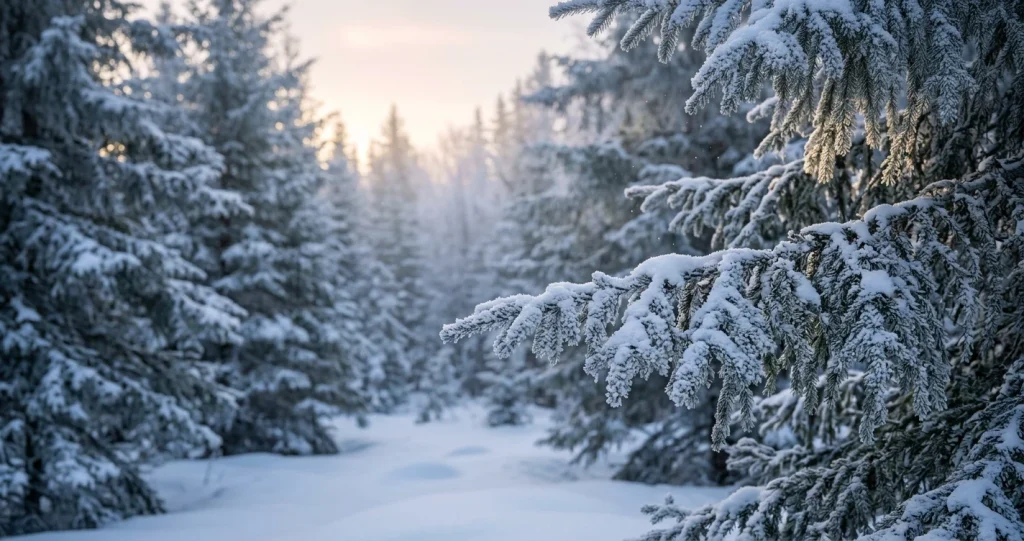
American Martens in Winter
Winter transforms the northern forest into a challenging environment.
Deep snow, low temperatures, and changing prey activity all influence how martens move and hunt.
Yet American martens remain active throughout the cold season.
Thick Fur and Winter Survival
A dense winter coat helps reduce heat loss.
Martens may also use sheltered resting sites to conserve energy during severe weather.
Their relatively small bodies can lose heat quickly, making access to food and protective cover especially important.
Moving Across Snow
Martens travel over snow, along logs, and through openings beneath the snowpack.
Their feet provide some support on snowy surfaces, although they are not as specialized for deep-snow travel as the broad paws of a Canada lynx.
Snow conditions can influence movement efficiency and access to prey.
Crusted snow, deep powder, and thaw-freeze cycles may create different challenges.
The Hidden World Beneath the Snow
The subnivean environment can remain relatively sheltered from extreme surface temperatures.
Small mammals use this space to move, feed, and avoid exposure.
Martens may access it through openings around tree trunks, roots, and fallen logs.
This connection between snow and forest debris illustrates the importance of maintaining structurally diverse habitats.
Reproduction and Life Cycle
American martens have a reproductive system that includes delayed implantation.
This means that development does not proceed immediately after fertilization.
Mating and Delayed Implantation
Mating generally occurs during summer.
After fertilization, the embryo may remain in an early developmental state for several months before implanting in the uterus.
This reproductive adaptation helps synchronize birth with more favorable seasonal conditions.
The precise timing can vary among individuals and populations.
Birth and Early Development
Females generally give birth in spring.
Litters commonly contain a few young, called kits.
Newborn kits are dependent on their mother for warmth, nourishment, and protection.
The female selects a sheltered den, often in a tree cavity or another protected location.
Growing Into Independent Hunters
As kits develop, they gradually become more mobile and begin exploring their surroundings.
Their mother provides care during their early development.
Eventually, young martens disperse and establish their own home ranges.
Survival depends on factors such as food availability, habitat quality, and predation risk.
Predators and Natural Threats
Although American martens are skilled hunters, they are also vulnerable to larger predators.
Potential predators include larger carnivorous mammals and birds of prey.
The specific threats vary by region.
Predation in Forest Ecosystems
Fishers, foxes, coyotes, and large raptors may pose risks under certain circumstances.
Martens often use dense cover and complex vegetation to reduce exposure.
Their climbing ability can provide escape opportunities, but trees do not guarantee safety from every predator.
Habitat Fragmentation
Large areas of open ground can create challenges for an animal strongly associated with forest cover.
Roads, development, and intensive forest disturbance may divide suitable habitats into smaller patches.
The effects depend on landscape structure and the ability of individuals to move between forested areas.
Changes in Snow Conditions
In some regions, changing winter conditions may influence marten habitat and competition with other carnivores.
Snow depth and consistency can affect how different predators move through forests.
Researchers continue to investigate how climate change may alter these relationships.
The American Marten’s Role in Forest Ecosystems
American martens are part of complex food webs connecting predators, prey, vegetation, and habitat structure.
Their ecological importance extends beyond their role as hunters.
Regulating Small-Mammal Populations
By consuming rodents and other small animals, martens contribute to predator-prey relationships.
Their impact depends on prey abundance, the presence of other predators, and local environmental conditions.
They are one component of a larger ecological community rather than a single controlling force.
A Link Between Forest Layers
Martens use the forest floor, fallen timber, tree trunks, and branches.
This ability connects different physical layers of the forest.
Their movements demonstrate how a habitat’s vertical and horizontal complexity can support wildlife.
Indicators of Forest Conditions
Because martens often depend on structural cover, their presence can provide information about habitat characteristics.
However, finding martens in an area does not automatically prove that a forest is healthy.
Scientists assess habitat quality using multiple measures, including vegetation structure, connectivity, prey availability, and population trends.
Conservation and Habitat Protection
The conservation status of American martens varies across their geographic range.
Some populations are relatively widespread, while others face local pressures from habitat loss, fragmentation, or historical overharvesting.
Management decisions must account for regional conditions.
Protecting Forest Structure
Maintaining a mixture of living trees, standing dead trees, fallen logs, and understory vegetation can benefit martens and many other forest species.
These features provide shelter and support prey populations.
Forest management approaches that retain structural complexity may help preserve suitable habitat.
Maintaining Habitat Connectivity
Connected forest landscapes allow animals to move between feeding areas, resting sites, and potential breeding territories.
Wildlife corridors and thoughtful land-use planning can reduce isolation.
Connectivity is especially important where populations occupy fragmented habitats.
Monitoring Populations
Researchers use methods such as camera traps, track surveys, genetic sampling, and other field techniques to study martens.
These methods help estimate distribution, detect changes, and evaluate habitat use.
Long-term monitoring provides valuable information for conservation planning.
In Your Own Yard: Supporting Forest Wildlife
Most suburban backyards are unlikely to attract American martens.
However, people living near suitable northern forests can support the habitat features used by martens and other native wildlife.
Preserve Native Trees and Shrubs
Native vegetation provides cover and supports the broader food web.
Where space and safety allow, maintaining a mixture of trees, shrubs, and natural ground vegetation can create more diverse habitat.
Choose species suited to your local climate and ecosystem.
Retain Safe Natural Cover
Fallen branches, logs, and leaf litter can support insects, fungi, and small animals.
In suitable woodland areas, retaining some natural debris contributes to habitat complexity.
Keep these materials away from buildings and locations where they could create fire or safety hazards.
Observe Wildlife Without Disturbance
If you live near marten habitat, watch for tracks, movement along logs, or occasional sightings.
A trail camera placed legally and responsibly may reveal wildlife activity.
Avoid approaching dens or attempting to feed wild martens.
Secure pet food and household waste, and keep pets under control near sensitive wildlife habitats.
Frequently Asked Questions
1. Are American martens dangerous to humans?
American martens generally avoid people and are not considered a significant threat to humans.
Like any wild mammal, they may defend themselves if trapped, handled, or cornered.
Observing them from a distance is the safest approach.
2. Can American martens climb trees?
Yes. American martens are skilled climbers with sharp claws, flexible bodies, and excellent balance.
They climb to explore habitat, escape threats, and sometimes pursue prey, although much of their hunting occurs near the ground.
3. Where can American martens be found in the United States?
American martens inhabit suitable forested regions in Alaska and parts of the northern and western United States.
Their distribution includes portions of the northern Rocky Mountains, Great Lakes region, and northeastern forests.
Local populations vary in abundance and habitat requirements.
Conclusion
The American marten is a remarkable example of how a small predator can thrive in a complex forest environment.
Its flexible body, sharp claws, thick fur, and resourceful hunting behavior allow it to navigate trees, fallen logs, and snowy landscapes.
Yet its survival also depends on features that are easy to overlook: hollow trees, sheltered spaces, dense vegetation, and the intricate structure of the forest floor.
Protecting these habitats benefits not only martens but also the many other organisms that share northern woodlands.
And somewhere beneath the branches of a quiet spruce forest, that golden-brown hunter may already be moving across a fallen log, ready to vanish into the trees once again.
Internal Sources
1. Why Wolverines Are So Good at Traveling Through Deep Snow https://secretsofthegreengarden.com/wolverine-snow-adaptations/
External Sources
1. American Marten Ecology and Conservation
Martes americana, M. caurina — Species Review: Support detailed information about habitat selection, seasonal diet, reproduction, predators, and forest ecology.
USDA Forest Service — Fire Effects Information System https://research.fs.usda.gov/feis/species-reviews/mart US Forest Service Research and Development
2. American Marten Biology and Behavior
American Marten (Martes americana): Verify scientific classification, physical characteristics, geographic distribution, tree-climbing behavior, diet, and reproduction.
University of Michigan — Animal Diversity Web https://animaldiversity.org/accounts/Martes_americana/
3. Geographic Distribution and Hunting Behavior
American Marten: Support descriptions of northern forest habitats, climbing abilities, solitary behavior, and hunting strategies.
U.S. National Park Service
https://www.nps.gov/articles/000/american-marten.htm
4. Population Status and Conservation Threats
American Marten Species Profile: Provide authoritative information about population status, habitat loss, logging, and conservation challenges.
Alaska Department of Fish and Game
https://www.adfg.alaska.gov/index.cfm?adfg=americanmarten.printerfriendly