
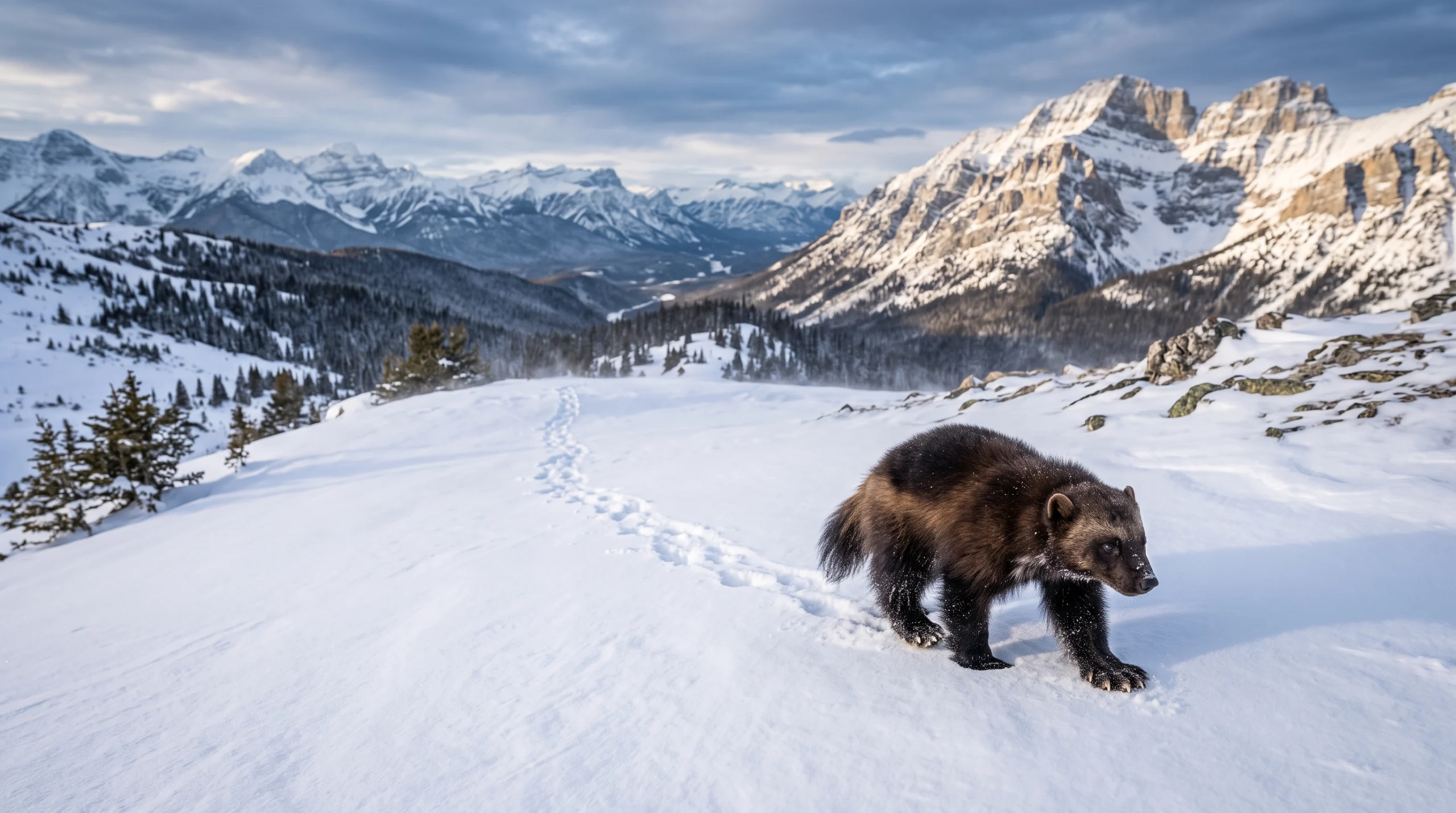
A wolverine crossing a snow-covered mountain can look remarkably well suited to the landscape. Its broad feet spread with each step, its compact body stays low to the ground, and powerful limbs carry it across terrain that would make movement difficult for many mammals.
This has led to a popular description of wolverine paws as “natural snowshoes.” The comparison is useful—but only to a point. Wolverines do not simply float across deep powder. Their success in winter comes from an integrated set of wolverine snow adaptations involving broad paws, muscular limbs, insulating fur, flexible foraging behavior, and an extraordinary capacity to move through large, cold landscapes.
Understanding those adaptations reveals much more about Gulo gulo than the familiar snowshoe analogy suggests.
Built for a Landscape Covered in Snow
The wolverine (Gulo gulo) is the largest terrestrial member of the mustelid family, the group that also includes weasels, martens, badgers, and otters. In North America, adult males generally outweigh females, but even a large wolverine is far smaller than a wolf or bear.
Yet wolverines routinely occupy environments that are physically demanding.
Across their circumboreal distribution, they occur in northern forests, tundra, and mountainous landscapes. At the southern edge of their North American range, they are strongly associated with cold, high-elevation environments.
Research in the Greater Yellowstone Ecosystem, for example, found wolverines selecting high-elevation landscapes near alpine treeline containing forests, meadows, and boulder fields.
Their ability to function there does not depend on one extraordinary anatomical feature. Instead, wolverine winter survival combines efficient movement, insulation, strength, behavior, and access to enormous areas.
What Does a Wolverine’s Paw Actually Look Like?
Wolverine feet are broad relative to the animal’s body and contribute to its distinctive winter tracks.
Each foot has five toes. The toes carry curved, semi-retractile claws that are useful for digging, gripping, and climbing.
The wolverine is plantigrade, meaning that more of the foot contacts the ground than in a digitigrade animal such as a wolf, which primarily bears weight through its toes.
This broad contact with the substrate matters in snow.
It increases the area over which forces can be distributed during parts of a step. That can reduce foot loading and help explain why wolverines are effective winter travelers. Research on wolverine movement has specifically connected their large paws and plantigrade locomotion with relatively low foot loading.
But broad feet should not be imagined as enormous paddles. They remain functional mammalian paws designed for walking, climbing, digging, and negotiating complex terrain throughout the year.
Why Broad Paws Help in Soft Snow
The underlying physics is relatively simple.
Pressure depends partly on how much force is applied over a given area. If the same body weight is supported over a larger contact area, the pressure on the surface can be lower than when that force is concentrated over a smaller area.
That principle helps explain why broad feet can be useful on snow.
Under suitable conditions, spreading the load across a larger area can reduce how deeply a foot penetrates the snowpack. Less sinking may mean less snow must be displaced during each stride.
But this is not equivalent to floating.
A wolverine moving through loose powder still sinks, pushes through snow, lifts its limbs, and expends energy. The animal’s effective pressure also changes dynamically while walking, running, climbing, accelerating, or landing.
So broad paws improve the animal’s interaction with snow without eliminating the mechanical costs of winter travel.
Are Wolverine Paws Really Natural Snowshoes?
Calling wolverine paws “natural snowshoes” is a reasonable educational analogy.
Like a snowshoe, a broad paw can distribute load across a greater area and reduce penetration into some soft surfaces. This can make locomotion easier than it would be with proportionally narrower feet.
The comparison becomes misleading when taken literally.
Human snowshoes dramatically enlarge the support area beneath a person’s feet. Wolverine paws are still relatively small compared with a human wearing snowshoes.
Snow is also highly variable. A paw may interact very differently with dry powder, dense wind-packed snow, a supportive crust, or wet spring snow.
Most importantly, locomotion is dynamic. A walking animal repeatedly shifts weight, pushes backward, accelerates limbs, and changes how forces enter the snow.
Wolverine paws therefore work somewhat like snowshoes, but they are not biological copies of them.
Comparing Wolverine Feet With Other Mammals
Foot size alone cannot tell us which species will travel best through snow.
Hoofed mammals concentrate weight through very different foot structures. Canids such as wolves have a digitigrade gait, while wolverines place more of the foot against the substrate.
Body mass also matters. A very large animal may have large feet but still impose considerable loads on the snow.
Researchers therefore consider concepts such as foot loading rather than simply comparing paw dimensions.
The practical outcome depends on the relationship between body mass, supporting surface area, gait, snow properties, and speed.
That is why statements such as “wolverines have bigger feet, so they always travel better than deer or wolves” are scientifically inadequate.
Snow Is Not One Uniform Surface
The phrase “deep snow” can describe radically different traveling conditions.
Fresh powder may collapse readily under an animal’s weight. Dense, compacted snow can offer greater support. Wind may create a hard surface crust, while temperature changes can produce ice layers.
Wet snow behaves differently again.
Depth is only one variable. Density, grain structure, temperature, moisture content, and crust strength can all influence how much an animal sinks.
A crust may support a relatively light animal while breaking beneath a heavier one. Alternatively, a weak crust can repeatedly collapse underfoot, potentially making travel awkward.
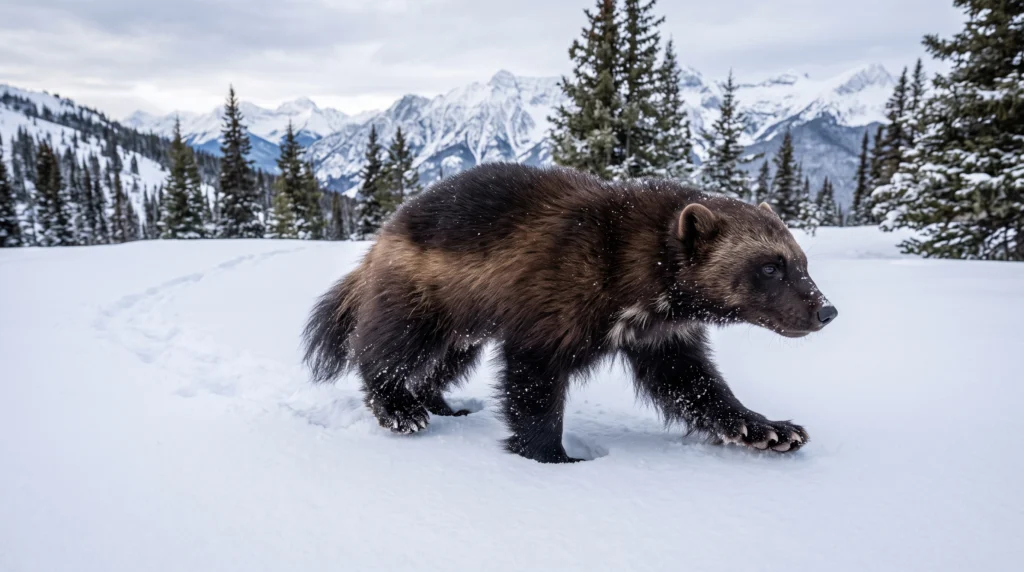
Wolverines have even been reported to favor compacted or denser snow travel surfaces in some situations.
Their broad feet provide flexibility across these conditions, not immunity from them.
Powerful Legs Matter Too
A useful paw is only valuable if the animal can move it effectively.
Wolverines have stocky, muscular bodies and strong limbs. Those features help them negotiate steep slopes, rocky areas, snowfields, forests, and fallen timber.
In mountainous habitat, a route may require climbing through deep snow before crossing exposed rock and descending through forest—all within a relatively short distance.
Strength also helps when a wolverine must repeatedly pull its legs free of soft snow.
This does not mean movement is effortless. Wolverines have energy budgets like every other animal, and moving through resistant snow carries real metabolic costs.
Their adaptation is better understood as an ability to make demanding winter travel sufficiently efficient to support their lifestyle.
A Body Designed for Cold Environments
Movement is only part of the challenge. An animal traveling through a northern winter must also retain heat.
Wolverines possess dense fur with insulating underfur and longer guard hairs. Their relatively compact build, short ears, and robust body proportions are also consistent with life in cold environments.
Good insulation matters especially for an animal that may spend long periods traveling and searching for widely dispersed food.
The fur should not, however, be described as magically “freeze-proof.” Wolverines remain biological organisms affected by temperature, wind, moisture, nutrition, and energetic condition.
Their coat reduces the costs imposed by cold rather than making them invulnerable to it.
Wolverines Travel Remarkable Distances
Perhaps the most impressive feature of wolverine ecology is the scale at which individuals use landscapes.
In a Greater Yellowstone Ecosystem study, multi-year home ranges averaged about 303 square kilometers for adult females and 797 square kilometers for adult males. Researchers also recorded dispersal movements extending at least 170 kilometers.
Those figures should not be treated as universal.
A study in northwestern Ontario, for example, reported substantially different home-range estimates, illustrating how sex, habitat, methodology, food distribution, season, and local ecological conditions can affect measured space use.
The consistent pattern is not one particular number. It is that wolverines use extraordinarily large areas relative to their body size.
Why Wolverines Need So Much Space
Large home ranges make ecological sense in landscapes where food is scattered and productivity is relatively low.
A wolverine cannot depend on finding a large meal at every turn. It may need to investigate widely separated patches of habitat, carcasses, prey concentrations, and cached food.
In the Yellowstone research, resident GPS-collared adults used an area exceeding 75% of their multi-year home range within an average of just 32 days. Limited overlap among home ranges of same-sex adults also supported evidence of territorial spatial organization.
A home range, however, should not automatically be called a territory. A home range describes the area an animal regularly uses; territoriality additionally involves patterns of exclusion or defense.
For wolverines, access to extensive connected landscapes is therefore fundamental to their ecology.
Hunting and Scavenging in Winter
Wolverines are flexible carnivores rather than specialists in a single feeding strategy.
They hunt, scavenge, and cache food.
Depending on region and season, their diet can include small mammals, birds, and ungulates. Large ungulate carcasses can provide particularly valuable concentrations of calories, whether the animal was killed by a wolverine, another predator, an avalanche, disease, or another cause.
Scavenging is therefore not a secondary or embarrassing part of wolverine biology. It is an efficient strategy in environments where large meals may appear unpredictably.
Likewise, portraying the wolverine only as a scavenger ignores documented predation.
Its winter survival strategy depends on flexibility.
Does Deep Snow Give Wolverines an Advantage Over Prey?
Sometimes—but the claim requires careful qualification.
Snow changes locomotion costs differently for different species. Foot structure, body mass, leg length, gait, and snow conditions all affect whether an animal breaks through a surface.
Under particular conditions, a broad-footed predator may move relatively efficiently while a prey animal experiences greater difficulty.
That could create a temporary hunting advantage.
But deep snow does not universally allow wolverines to effortlessly chase down hoofed mammals. A large ungulate’s long legs may be advantageous in some snow, while a supportive crust may completely change the interaction.
Terrain, prey condition, snow density, crust strength, and depth all matter.
The wolverine’s real advantage is adaptability rather than guaranteed superiority.
Snow Can Preserve Food
Wolverines do something particularly useful when food is abundant: they save some for later.
A Scandinavian study following 38 GPS-collared wolverines documented 303 food caches. Animals cached food obtained from both predation and scavenging and used snow, boulder cavities, bogs, and other secluded locations.
Cold conditions can slow microbial and insect activity, potentially delaying decomposition. Concealed sites can also reduce the risk of food being stolen.
Snow can therefore function as part of a naturally cold storage environment.
It is not a perfect freezer. Temperatures fluctuate, snow melts, microorganisms remain active under some conditions, and other scavengers may discover caches.
Nevertheless, caching helps wolverines turn temporary food abundance into resources available later.
Snow and Wolverine Dens
Snow becomes particularly important during reproduction.
Female wolverines give birth in winter and use complex den structures that can occur beneath deep snow and around boulders, fallen trees, or other structural features.
A study in Ontario, for example, described a reproductive den associated with large boulders and downed trees.
One of the most influential large-scale studies of wolverine habitat examined 562 reproductive dens from North America and Fennoscandia. All were located in areas mapped as having persistent spring snow cover during the study’s late-April-to-mid-May snow period.
That association is striking, but it should not be converted into a claim that every wolverine den requires one identical snow depth or configuration.
Snow interacts with terrain and physical structures to create suitable denning environments.
Are Wolverines Completely Dependent on Snow?
Wolverines are strongly associated with cold environments and persistent spring snow, especially at the southern limits of their distribution.
But “wolverines need snow” is only the beginning of the ecological explanation.
Temperature, food availability, reproductive requirements, competition, terrain, connectivity, and human disturbance can all influence where wolverines persist.
Persistent snow may also matter for more than dens. Researchers have proposed that cold landscapes help wolverines preserve cached food, providing another possible explanation for the species’ close association with cold environments.
Snow should therefore be viewed as part of an ecological system rather than the sole variable determining wolverine habitat.
Climate Change and Wolverine Habitat
Changing snow conditions are an important conservation concern.
Climate warming can alter the duration, distribution, and reliability of seasonal snowpack, particularly near the warmer southern margins of wolverine distribution.
Copeland and colleagues concluded that reductions in persistent spring snow could reduce suitable wolverine habitat and connectivity.
Potential consequences extend beyond den construction. Changing winter conditions may affect food storage, prey and carrion availability, competition with other scavengers, and movement between suitable habitat patches.
Research on food caching has likewise suggested that warmer conditions could influence food preservation and interactions with animals capable of stealing caches.
The effects will not necessarily be identical everywhere. Wolverine populations occupy different ecosystems across an enormous geographic range, so regional responses may vary.
Common Misconceptions About Wolverines in Snow
“Wolverine paws keep them completely above deep snow.”
No. Broad feet can reduce sinking under suitable conditions, but wolverines still penetrate and push through soft snow.
“Their feet are literally biological snowshoes.”
The comparison describes load distribution, not literal anatomy.
“Wolverines never struggle in powder.”
Loose snow can increase locomotion costs even for snow-adapted animals.
“Large paws are the only reason wolverines survive winter.”
Their success also involves strong limbs, insulation, behavior, food caching, flexible feeding, and extensive movement.
“Wolverines can effortlessly outrun every hoofed animal in snow.”
Relative performance depends heavily on the species, individual, terrain, snow depth, and crust conditions.
“Every wolverine travels hundreds of miles every day.”
Wolverines can make remarkable movements, but extreme dispersal distances should not be confused with normal daily travel.
“Wolverines only hunt live prey.”
They are both predators and highly effective scavengers.
“Snow alone makes suitable wolverine habitat.”
Suitable habitat also depends on food, terrain, reproduction, connectivity, climate, and disturbance.
Frequently Asked Questions
Why do wolverines have such large paws?
Broad paws increase the area over which forces can be distributed. Combined with their plantigrade gait, this can reduce foot loading and improve locomotion across some soft snow conditions.
Do wolverine paws work like snowshoes?
To an extent. The analogy is useful because broad feet can reduce sinking, but wolverine paws do not provide the enormous additional surface area of human snowshoes.
Can wolverines walk on top of deep snow?
Sometimes a sufficiently firm snow surface may support them, but they frequently sink into softer snow. Their paws reduce the difficulty of snow travel rather than eliminating it.
How far can a wolverine travel?
Movement varies greatly. In the Greater Yellowstone Ecosystem, researchers documented dispersal movements of at least 170 kilometers and very large adult home ranges. These figures describe a particular studied population and should not be treated as universal.
What do wolverines eat during winter?
Their diet varies geographically but can include carrion, small mammals, birds, ungulates, and previously cached food. Wolverines function as both predators and scavengers.
Why is snow important for wolverine reproduction?
Females use snow-associated denning environments for raising young. Research has found a particularly strong association between reproductive dens and landscapes retaining persistent spring snow.
Conclusion
The broad footprint of a wolverine is one of the clearest visible signs of an animal shaped by winter.
Its paws distribute forces across a relatively large contact area and can reduce sinking under certain conditions. Calling them “natural snowshoes” captures part of that function, as long as the analogy is not taken literally.
The more interesting story appears when the paws are considered alongside everything else.
Powerful limbs propel the animal through snow and rugged terrain. Dense fur reduces heat loss. Flexible hunting and scavenging strategies allow it to exploit unpredictable resources. Caching helps preserve temporary food surpluses, while exceptional mobility allows individuals to search enormous northern landscapes.
Even reproduction is closely connected with snowy environments.
Wolverine snow adaptations are therefore best understood not as one spectacular trick, but as an integrated survival system that allows Gulo gulo to live, forage, reproduce, and travel in some of the coldest and least productive landscapes occupied by a terrestrial carnivore.
Internal-linking opportunities
- Link animals adapted to deep snow to an article explaining winter adaptations in northern mammals.
- Link scavenging and carrion to an article about scavengers and nutrient cycling.
- Link food caching to an article explaining how wild animals store food for winter.
- Link snowpack and wildlife to an article about how changing winters affect mountain ecosystems.