
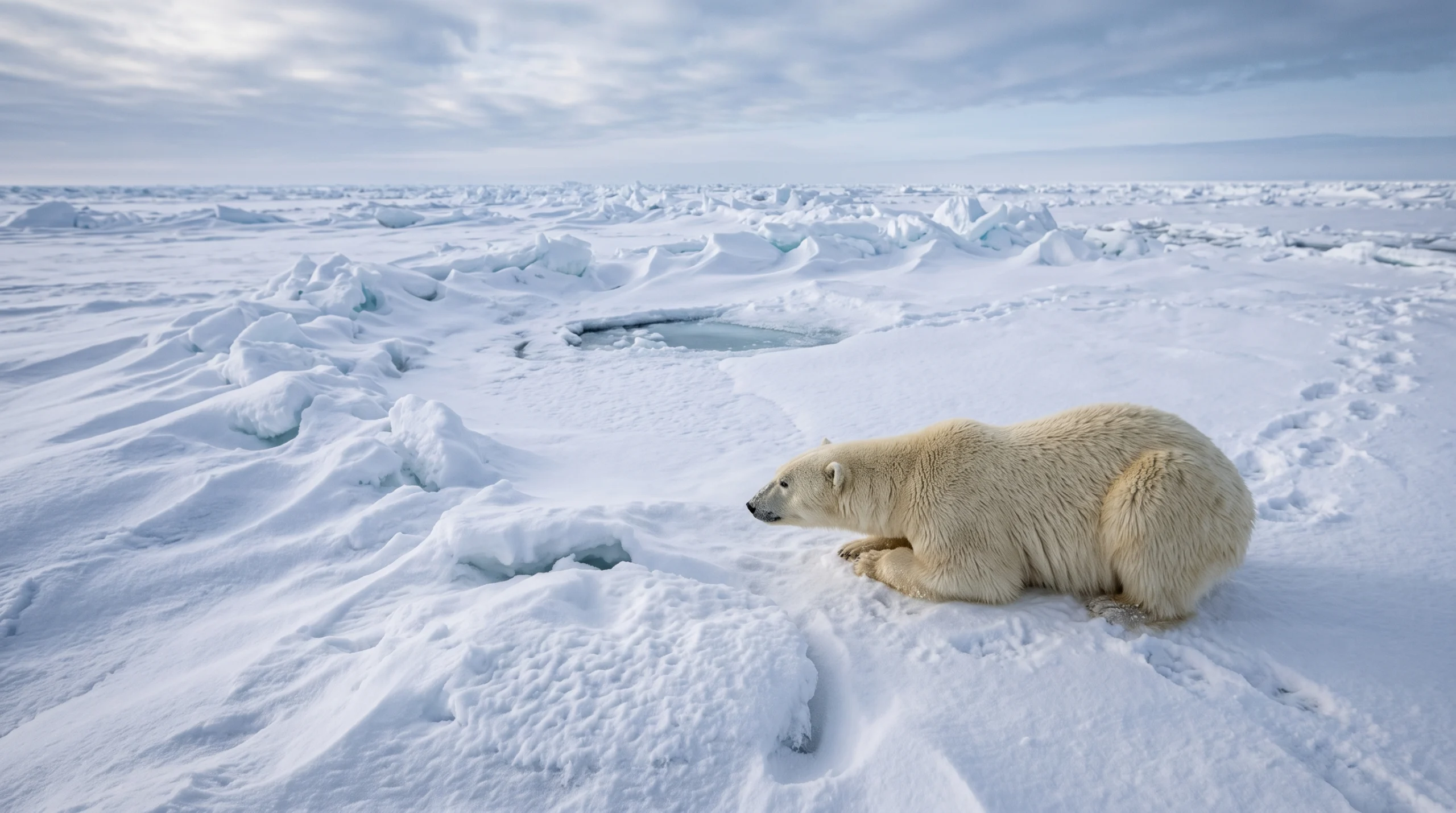
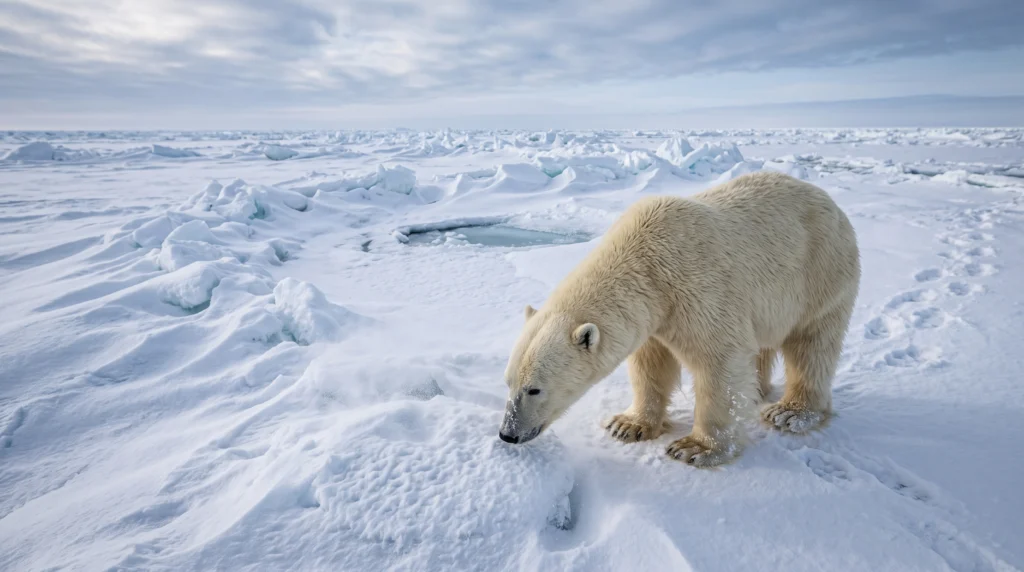
A polar bear moving across Arctic sea ice can appear to be searching an empty landscape. The surface may stretch for miles with little more than snow, pressure ridges, cracks, and patches of wind-polished ice.
Yet beneath that apparently empty surface is an active marine ecosystem. Seals swim below the ice, return to breathing holes for air, and—in the case of ringed seals—use snow-covered lairs for resting, giving birth, and nursing pups.
So how polar bears find seals that may be almost completely hidden is one of the most fascinating questions in Arctic predator ecology.
The answer is more complicated than the familiar claim that a polar bear can simply “smell a seal through the ice.” Ursus maritimus does have highly developed olfactory abilities, but successful hunting combines smell with wind, movement, knowledge of sea-ice habitat, experience, patience, and several distinct hunting techniques.
Hunting Prey You Cannot See
Finding a seal on Arctic sea ice presents an unusual sensory problem.
Ringed seals may be swimming beneath the ice, resting inside snow-covered structures, or briefly surfacing through breathing holes. From a bear’s perspective, much of the prey population is visually concealed for much of the time.
The ice itself is also complex. Pressure ridges, snowdrifts, cracks, leads, and uneven surfaces can restrict long-distance visibility.
Polar bears therefore cannot rely on eyesight alone.
Field research examining polar bear movement in relation to wind has provided strong evidence that olfaction plays an important role in searching for prey. Researchers tracking adult female polar bears in Hudson Bay found movement patterns consistent with crosswind olfactory searching, particularly during winter conditions associated with hunting.
Smell is important, but it is part of a broader hunting system rather than a supernatural prey detector.
Why Polar Bears Depend So Heavily on Seals
Polar bears are marine predators specialized for obtaining much of their food from ice-associated marine mammals.
Ringed seals (Pusa hispida) are particularly important prey across much of the polar bear’s range. Bearded seals (Erignathus barbatus) are also important, especially in some regions, while polar bears can consume other marine mammals and carcasses when opportunities arise. Diet composition varies geographically rather than remaining identical throughout the Arctic.
The nutritional value of seals helps explain this dependence.
Seal blubber is extremely energy-rich. Polar bears can consume skin and fat preferentially when prey is abundant, allowing them to accumulate body reserves that become critical when hunting opportunities decline.
This matters because Arctic food availability is highly seasonal. A bear may encounter productive hunting conditions during one part of the year and much poorer conditions later.
Finding seals efficiently is therefore central to polar bear survival, reproduction, and body condition.
The Hidden World Beneath Arctic Sea Ice
To understand polar bear hunting techniques, it helps to understand how seals live under ice.
Seals are mammals and must breathe air. When extensive sea ice covers the ocean, they therefore need reliable access to the surface.
Ringed seals are exceptionally well adapted to this environment. They use strong claws on their foreflippers to create and maintain breathing holes in sea ice, allowing them to remain in heavily ice-covered waters during winter.
But a breathing hole is not the same thing as a snow lair.
Breathing holes
A breathing hole provides access between the water and the atmosphere. A seal approaches it from below, surfaces to breathe, and can return underwater.
Snow-covered lairs
Where enough snow accumulates over the ice, ringed seals can excavate spaces within snowdrifts associated with breathing holes.
These subnivean—meaning “under the snow”—lairs can be used for resting. Females also use snow-covered lairs for giving birth and nursing pups. The snow provides insulation and helps conceal seals from predators.
That distinction becomes important when discussing how polar bears hunt.
Waiting beside an exposed breathing hole and breaking into a concealed snow lair are different hunting behaviors.
How Powerful Is a Polar Bear’s Sense of Smell?
Polar bears clearly possess highly developed olfactory capabilities.
Anatomical research and extensive field observations support the importance of smell in polar bear ecology, while movement research shows that bears alter their travel relative to wind in patterns consistent with olfactory searching.
This makes ecological sense.
On a landscape where prey is sparse, often hidden, and widely distributed, airborne odor can provide information beyond visual range.
But popular descriptions frequently become too precise.
Claims that a polar bear can always smell a seal from a particular number of miles away, or through an exact thickness of snow or ice, should not be treated as universal biological limits.
Odor detection depends on many variables, including wind speed, wind direction, temperature, the odor source, atmospheric turbulence, terrain, snow structure, and the bear’s position relative to the scent plume.
Researchers studying polar bear movement have explicitly noted that detection distances in mammals are difficult to estimate.
The scientifically safer conclusion is powerful enough: polar bears rely extensively on olfaction when searching Arctic sea ice for prey.
Can Polar Bears Really Smell Through Snow?
Yes—but the wording needs clarification.
A polar bear does not project its sense of smell through snow like a scanner. Odor molecules must physically reach receptors inside the bear’s nose.
Snow is not necessarily an airtight solid barrier.
A snowpack contains interconnected spaces between snow grains. Air can move through portions of it, and seal lairs are associated with openings into the marine environment below. Cracks, gaps, ventilation pathways, and differences in pressure can potentially allow odors associated with a seal or its occupied structure to escape.
A bear reaching those airborne odor molecules can detect them.
Solid sea ice presents a different situation.
It would be misleading to imagine odor simply traveling directly through a thick, impermeable slab of solid ice. When a bear detects odor associated with a seal beneath an ice-covered environment, the relevant scent pathway may involve a breathing hole, crack, snow structure, exposed surface, or other connection with the atmosphere.
So “smelling through snow” can be a useful shorthand. “Smelling directly through any thickness of solid ice” is not.
Why Wind Direction Matters
Odor outdoors does not form a neat, permanent trail.
Wind transports odor molecules away from their source, creating an irregular scent plume whose structure changes with turbulence and wind speed.
That gives a searching predator a problem: it first has to encounter the plume.
A 2017 study led by Ron Togunov analyzed polar bear telemetry together with modeled winds in Hudson Bay. The researchers found patterns consistent with bears traveling crosswind under conditions favorable for olfactory searching. Moving across the wind can expose an animal to new streams of air and increase opportunities to encounter prey odor.
Once an odor is encountered, its location may potentially be narrowed further.
This does not mean every polar bear walking sideways to the wind is hunting a seal, nor should every head movement or change in direction be interpreted as scent tracking.
But the evidence demonstrates that the “windscape” itself can influence polar bear movement.
Finding a Seal’s Breathing Hole
A ringed seal’s breathing hole creates a predictable connection between the underwater world and the surface.
That makes it valuable to a polar bear.
Bears search areas of sea ice used by seals and can locate breathing holes. Odor associated with the hole may contribute to detection, while knowledge of productive seal habitat and experience probably help bears concentrate searching where encounters are more likely.
Finding a hole, however, does not mean finding a meal.
A seal can maintain and use multiple breathing holes. It spends much of its time underwater and may not return to the particular opening beside which a bear is waiting.
The bear has located an opportunity—not a guaranteed seal.
The Waiting Game — Still-Hunting
One of the classic methods of polar bear hunting seals is known as still-hunting.
After locating a seal breathing hole, a polar bear positions itself nearby and waits.
And waits.
The behavior depends on remaining sufficiently quiet and still so that a seal returning for air does not detect the predator before coming within striking range.
USGS researchers have documented polar bears still-hunting at seal breathing holes in the southern Beaufort Sea, and the behavior has long been recognized in field studies of polar bear foraging.
When a seal surfaces, the bear has only a brief opportunity to attack.
Timing matters because the seal remains connected to an enormous underwater escape environment.
Still-hunting therefore combines patience with uncertainty. A bear can select a breathing hole and remain there without knowing whether the seal will return while it is waiting.
There is no guarantee of success.
Hunting Snow-Covered Seal Lairs
Polar bears also use a much more active technique.
During periods when ringed seals occupy subnivean lairs, bears can search the ice for these concealed structures.
Once a lair is detected, a polar bear may attempt to break through its snow roof and capture the seal or pup inside.
This is where descriptions of polar bears “smashing through the ice” can become misleading.
In this hunting situation, the bear is often attacking a snow roof over a seal lair, not punching directly through a massive thickness of solid sea ice to reach an animal swimming below.
Ringed seal lairs occur within snow accumulated over sea ice, frequently in drifts associated with ice deformation and other structures that allow sufficient snow depth.
Olfaction is believed to be important in finding these hidden sites.
The bear may investigate the surface and then attempt to collapse or excavate the lair roof.
But seals have defenses of their own, and many attacks fail.
Does the Bear Hear the Seal Too?
Polar bears can hear, of course, but that does not automatically establish hearing as a primary mechanism for locating seals hidden beneath snow or ice.
This distinction matters.
It may seem intuitive that movement or vocalizations beneath the surface could produce detectable sounds. Yet a plausible mechanism is not the same thing as demonstrated field evidence showing that polar bears routinely locate concealed seals acoustically.
By comparison, olfactory searching has stronger observational and movement-based support.
For that reason, hearing should be discussed cautiously rather than presented as an established equivalent to smell in locating subnivean seal lairs.
Smell Alone Isn’t Enough
An extraordinary polar bear sense of smell does not guarantee successful hunting.
A bear must encounter a useful scent plume, determine where the odor is coming from, reach the site, and find the prey in a vulnerable position.
Many factors can affect that sequence:
- seal abundance and distribution;
- snow and ice structure;
- wind conditions;
- weather;
- season;
- location;
- seal behavior;
- hunting experience;
- accessibility of breathing holes and lairs.
Even after a bear correctly locates a seal structure, the seal may escape.
Historical field research examining attacks on subnivean breathing holes and birth lairs found that only a minority of observed attempts resulted in successful kills. Those results came from particular Arctic regions and periods and should not be converted into a universal success rate for all polar bear hunting.
The larger lesson is more useful: detecting prey and capturing prey are very different challenges.
Different Seasons, Different Hunting Opportunities
Polar bear foraging changes with season and geography.
Spring can be particularly important in many Arctic regions because ringed seals give birth and nurse pups in association with sea ice and snow lairs. Young seals can represent valuable prey at a time when bears have opportunities to accumulate energy reserves.
Later, as snow disappears and seals spend more time exposed on the ice during molting, different hunting opportunities emerge.
Open leads and ice edges can also create places where seals surface.
As seasonal ice retreats, some polar bear populations spend extended periods on land, where access to their preferred marine mammal prey can be greatly reduced.
These patterns vary across the Arctic. A bear in Hudson Bay does not experience precisely the same ice regime, prey community, or annual cycle as a bear in the Chukchi Sea or around Svalbard.
The Seal Is Not a Passive Target
The predator-prey relationship also needs to be considered from the seal’s perspective.
Ringed seals have evolved remarkably effective ways of living in ice-covered seas.
They maintain access to multiple breathing opportunities, can escape underwater, and conceal themselves and their pups inside snow lairs.
The lair itself provides more than warmth. Concealment can reduce exposure to predators, including polar bears and Arctic foxes.
A seal that detects danger may escape into the water.
The underwater environment then shifts the advantage dramatically. Polar bears are capable swimmers, but seals are highly specialized marine mammals.
Polar bear hunting is therefore an evolutionary contest between a predator adapted to finding concealed prey and prey adapted to remain difficult to locate and capture.
How Successful Is a Polar Bear Hunt?
There is no single scientifically meaningful “polar bear hunting success rate.”
Success depends on what kind of hunt is being measured.
Still-hunting at breathing holes, attacking subnivean lairs, stalking seals resting on the ice, hunting along ice edges, and approaching seals from the water are different behaviors with different circumstances.
Region and season matter as well.
A classic field study by Ian Stirling and W. R. Archibald documented low success among observed polar bear attacks on subnivean breathing holes and birth lairs in their study areas.
Those observations are valuable evidence that hidden-seal hunting is difficult.
They are not a universal probability applicable to every polar bear, prey species, hunting technique, season, or Arctic region.
Why Sea Ice Is Part of the Hunting System
Sea ice is often described simply as the platform from which polar bears hunt.
That is true, but incomplete.
Polar bear sea ice is part of an interconnected predator-prey habitat.
Its structure influences where seals maintain breathing holes. Snow accumulating on the ice determines where suitable ringed seal lairs can form. Cracks, leads, ridges, and ice edges influence seal distribution and polar bear movement.
For the bear, sea ice provides access to marine prey that would otherwise be difficult to hunt efficiently.
For the seal, that same environment provides breathing access, resting habitat, reproductive habitat, and protection.
The ice therefore connects both predator and prey within the same dynamic system.
What Happens as Arctic Sea Ice Changes?
Climate change is altering Arctic sea-ice conditions, but ecological consequences are not identical everywhere.
Earlier breakup, later freeze-up, reduced ice duration, and changes in ice distribution can reduce access to seal-hunting habitat for polar bears in affected regions.
This is particularly important because polar bears obtain much of their energy from marine prey while using sea ice.
Ringed seals face related changes. Their reproduction depends not only on ice but also on sufficient snow accumulation for protective lairs. NOAA identifies reductions in sea ice and snow cover as major long-term threats to Arctic ringed seals.
The effects on polar bears can vary by subpopulation because Arctic regions differ in oceanography, prey availability, ice seasonality, and ecosystem productivity.
That geographic variation should not obscure the fundamental relationship: changing sea ice changes the physical environment in which polar bears gain access to seals.
Common Misconceptions About Polar Bear Hunting
“Polar bears can smell directly through any thickness of solid ice.”
Odor molecules need a physical pathway to the bear. Snow, breathing holes, cracks, and moving air can transmit scent; thick impermeable ice should not be imagined as transparent to smell.
“Every hole in sea ice contains a seal.”
A breathing hole is a potential hunting site, not a guarantee that a seal is immediately beneath it.
“A breathing hole and a seal birth lair are the same thing.”
No. A breathing hole provides access to air. A lair is a snow-covered space that can be associated with a breathing hole and used for resting, pupping, or nursing.
“Polar bears just wait beside holes for food.”
Still-hunting is only one technique. Bears also search for snow lairs, stalk exposed seals, and hunt in other sea-ice situations.
“Smelling a seal means catching it.”
Detection is only the first stage. The seal may never surface at that location or may escape during an attack.
“Every polar bear hunts exactly the same way.”
Behavior varies with habitat, season, prey availability, individual experience, and local conditions.
“Every polar bear population eats the same prey in the same proportions.”
Ringed seals are extremely important across much of the range, but diet varies geographically.
“A bear always knows exactly where a hidden seal is.”
Olfaction provides information, but scent plumes are variable and locating the precise source can still require searching.
Frequently Asked Questions
How do polar bears find seals?
Polar bears combine olfaction, movement across productive sea-ice habitat, environmental cues, experience, and specialized hunting behaviors. They may search for breathing holes or snow-covered seal lairs, stalk exposed seals, or ambush seals at openings in the ice.
Can polar bears smell seals under snow?
Yes. Polar bears have highly developed olfactory abilities, and smell is believed to play an important role in detecting snow-covered ringed seal lairs. Odors can escape through porous snow, openings, cracks, and other pathways rather than passing magically through an airtight barrier.
Can polar bears smell seals through ice?
The phrase is potentially misleading. A bear can detect odors associated with seals using an ice-covered habitat, particularly around breathing holes and openings. It should not be assumed that odor passes directly through unlimited thicknesses of solid, impermeable sea ice.
Why do polar bears wait beside holes in the ice?
Ringed seals must eventually surface to breathe. During still-hunting, a polar bear waits near a breathing hole and attempts to capture a seal when it surfaces. The technique requires patience and does not guarantee a meal.
What seals do polar bears hunt?
Ringed seals are primary prey across much of the polar bear’s range. Bearded seals are also important, and other marine mammals may be consumed depending on region and opportunity.
How does sea-ice loss affect polar bear hunting?
In regions where seasonal sea ice is declining, shorter periods of suitable ice can reduce access to seal-hunting habitat. Effects vary among polar bear subpopulations because local ice conditions, ecosystems, and prey availability differ.
Conclusion
The remarkable story of how polar bears find seals is more interesting than the popular idea of an animal simply smelling prey “through the ice.”
A polar bear’s highly developed sense of smell is central to the process, but olfaction operates within a complicated environment. Wind carries scent. Snow and breathing holes provide pathways through which odors can reach the surface. The bear must move across enormous areas, encounter those cues, investigate promising locations, and choose a hunting technique suited to the situation.
Sometimes that means remaining almost motionless beside a breathing hole. At other times it means actively searching for a concealed ringed seal lair and attempting to break through its snow roof.
And even when the bear finds exactly the right place, the seal can escape.
That uncertainty is fundamental to Arctic predator ecology. Ursus maritimus survives not because one extraordinary sense guarantees success, but because smell, movement, patience, experience, and specialized hunting behavior work together in a constantly changing frozen marine environment.
Internal-linking opportunities
- Link Arctic predator adaptations to an article explaining how Arctic mammals survive extreme cold.
- Link ringed seals to a dedicated article about seal adaptations to life beneath sea ice.
- Link sea-ice ecosystems to an article explaining how seasonal ice supports Arctic food webs.
- Link polar bear diet to a broader guide to what polar bears eat throughout the year.
Authoritative external sources
- U.S. Fish & Wildlife Service — Polar Bear Species Profile
- NOAA Fisheries — Ringed Seal Species Profile
- Scientific Reports — Windscapes and Olfactory Foraging in a Large Carnivore
- USGS — Polar Bear Still-Hunting at a Seal Breathing Hole
- Journal of Animal Ecology — Arctic Polar Bear–Ringed Seal Predator-Prey System