
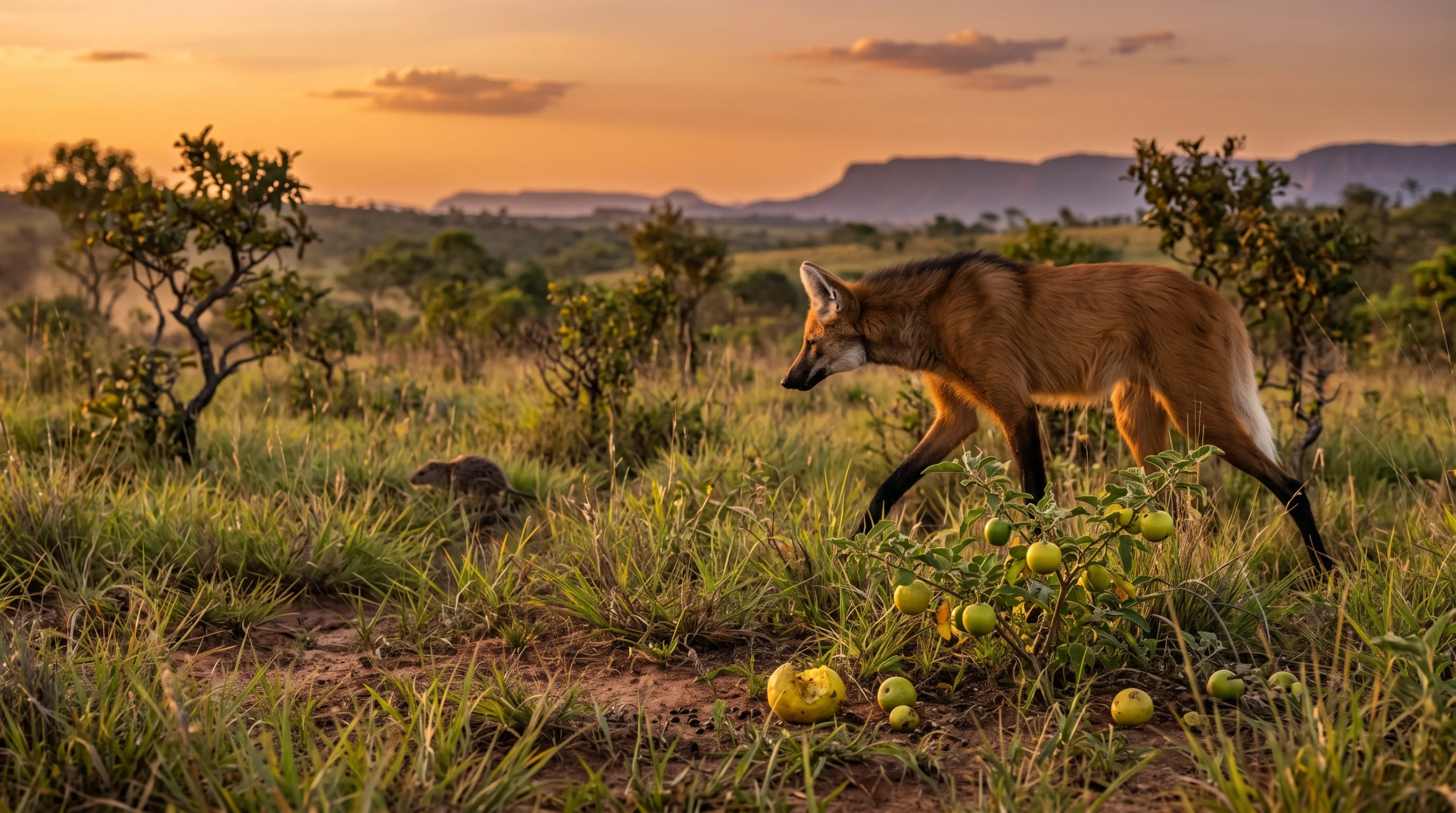
A tall, red-coated canid moves through a South American grassland on impossibly long-looking black legs. At one moment it may be listening for a rodent hidden in the vegetation. Later, it may stop beneath a fruiting shrub and eat a large greenish-yellow fruit packed with seeds.
Both behaviors are normal for the maned wolf.
The maned wolf diet is one of the clearest examples of why the word “carnivore” can be misleading when it is treated as meaning “meat only.” The maned wolf, Chrysocyon brachyurus, belongs to the mammalian order Carnivora, yet its feeding ecology is decidedly omnivorous. Small vertebrates and invertebrates are important, but so are fruits and other plant foods.
One fruit in particular has become closely associated with the species: Solanum lycocarpum, known in Brazil as lobeira or fruta-do-lobo and often translated as “wolf apple.”
By eating fruit and later depositing viable seeds elsewhere, maned wolves can participate not only in predator-prey relationships but also in plant seed dispersal. Research on their diet and seed germination confirms that this ecological role is real, although the outcome differs among plant species and environments.
A “Wolf” With a Very Un-Wolf-Like Diet
The appearance of a maned wolf encourages comparisons with familiar predators.
Its reddish coat can resemble that of a fox. Its name suggests a wolf. Its height makes it look surprisingly large when standing in open grassland.
But its feeding behavior does not fit the stereotypical image of a large wolf pursuing hoofed prey.
Maned wolves are opportunistic omnivores. Studies of their feces have repeatedly identified both animal and plant material, with recorded animal foods including small mammals, birds, reptiles, arthropods, and other prey. Fruits can also be frequent components of the diet. The relative importance of these foods changes with geography, season, and local availability.
That flexibility is central to understanding Chrysocyon brachyurus.
The Maned Wolf Isn’t Actually a Wolf
Despite its common name, the maned wolf is not a species of gray wolf.
It belongs to the family Canidae, which also contains wolves, foxes, coyotes, jackals, domestic dogs, and several distinctive South American canids. But the maned wolf occupies its own living genus, Chrysocyon.
It is therefore equally incorrect to describe it as a fox.
The superficial resemblance comes largely from its reddish fur, pointed muzzle, and large upright ears. Evolutionary relationships among canids are more complicated than outward appearance suggests.
A maned wolf is also not a wolf-fox hybrid. It is a distinct evolutionary lineage native to South America.
Its unusual combination of features simply makes comparisons with better-known canids tempting.
Why Are Its Legs So Long?
Few mammals have proportions quite like a maned wolf.
Its limbs are extremely elongated relative to its body, producing the species’ characteristic tall, narrow silhouette.
The maned wolf is strongly associated with open South American environments, particularly grasslands, savannas, shrublands, and mosaics of open vegetation. Its long limbs are well suited to locomotion through dense grasses and uneven open-country vegetation. Habitat-use research has linked its morphology, including long legs and strong sensory abilities, with life in these environments.
It is best not to reduce the adaptation to a single purpose, however.
Long limbs affect movement, visibility, body posture, and how an animal searches through vegetation. Evolutionary traits rarely exist for only one narrowly defined task.
What Does a Maned Wolf Actually Eat?
The short answer is: many different things.
Research from central and southeastern Brazil has recorded diverse diets containing both plant and animal foods. Commonly documented categories include:
- small mammals such as rodents;
- birds;
- reptiles;
- insects and other arthropods;
- fruits;
- grasses and other plant material.
Small mammals can be particularly important animal prey. Rather than chasing large animals over long distances, maned wolves typically search and hunt alone, taking relatively small prey opportunistically.
Scat studies are especially valuable for documenting this diversity because hair, bones, insect remains, seeds, and other identifiable material can reveal what an animal consumed.
One classic study from central Brazil found a broad mixture of plant and animal items, helping establish the maned wolf as an omnivorous generalist rather than a strict meat eater.
Diet should not be summarized with one universal percentage. What maned wolves eat can change substantially among study sites.
Meet the Lobeira — The Famous “Wolf Apple”
Among all foods associated with the maned wolf, none is as famous as lobeira.
Its scientific name is Solanum lycocarpum. It belongs to the nightshade family, Solanaceae—the same botanical family that includes tomatoes, potatoes, eggplants, and many wild Solanum species.
Despite the English nickname “wolf apple,” it is not botanically an apple.
Lobeira is a shrub or small tree characteristic of open Brazilian landscapes, particularly Cerrado environments and disturbed open areas. Its rounded fruits can become large and contain numerous seeds embedded in fleshy pulp.
The connection between Solanum lycocarpum and the maned wolf is well established. Lobeira fruits have occurred frequently in multiple diet studies, sometimes becoming one of the most common plant foods recorded at a particular site.
But that does not mean every maned wolf population depends on wolf apples to the same degree.
Local vegetation and seasonal fruit availability matter.
How Important Is Fruit to a Predator?
The problem partly comes from terminology.
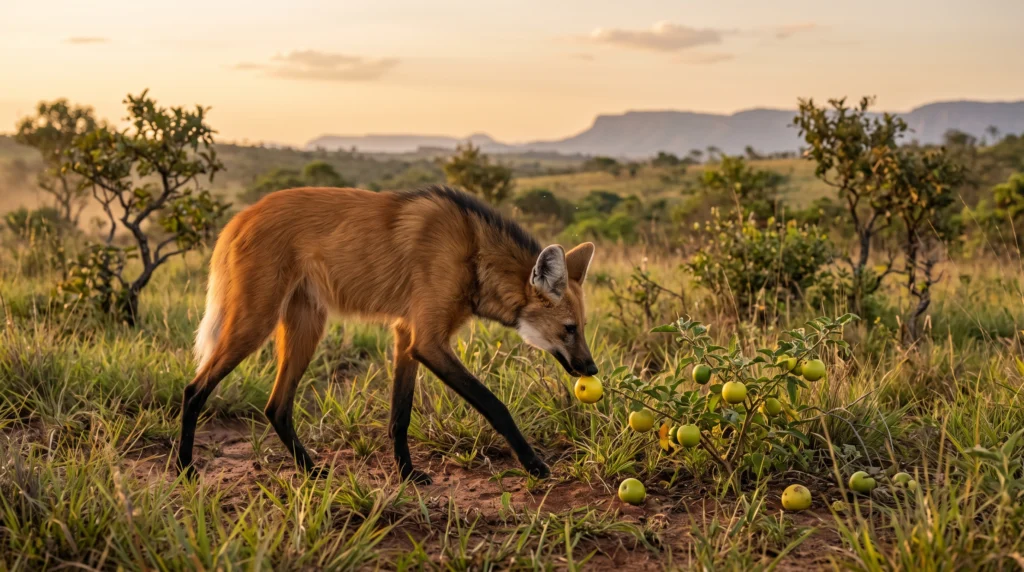
Biologically, the maned wolf belongs to Carnivora. But Carnivora is a taxonomic order, not a guarantee that every member eats only animal tissue.
Bears provide another familiar example: most are classified within Carnivora despite consuming significant plant foods.
For maned wolves, fruit can provide readily available energy and water along with other nutrients. When ripe fruits are abundant, eating them may be an efficient foraging strategy compared with spending time locating and capturing mobile prey.
This does not make animal prey unimportant.
A more accurate description of the maned wolf diet is a flexible combination of plant and animal foods whose balance changes according to ecological circumstances.
Does the Maned Wolf Really Love Wolf Apples?
Scientists cannot measure whether an animal “loves” a food in the human emotional sense.
What they can measure is consumption.
Lobeira repeatedly appears in maned wolf scat studies, sometimes with striking frequency. A study on a Brazilian cattle ranch, for example, identified wolf fruit as an important component of the diet while also documenting mammals, birds, insects, reptiles, grasses, and other fruits.
Earlier central Brazilian research likewise recorded substantial fruit consumption alongside animal prey.
Researchers investigate maned wolf feeding ecology through several approaches, including scat analysis, field observation, prey identification, seasonal sampling, and comparisons among habitats.
What these studies show is not dependence on a single food everywhere, but dietary flexibility.
From Eaten Fruit to Dispersed Seed
Fruit consumption becomes ecologically interesting when the seeds survive.
The process of maned wolf seed dispersal can be summarized step by step.
First, a maned wolf encounters and consumes a ripe fruit.
The fleshy parts are digested, while some seeds may survive passage through the digestive system.
Meanwhile, the wolf continues traveling through its home range.
Eventually, surviving seeds are deposited with feces, potentially at considerable distance from the plant that produced the fruit.
If those seeds remain viable and land in suitable soil under appropriate moisture, temperature, light, and ecological conditions, some may germinate.
The important word is may.
Seed dispersal gives a seed an opportunity to establish elsewhere. It does not guarantee that it will germinate, survive as a seedling, or eventually become a reproductive adult plant.
Does Digestion Help the Seeds Germinate?
This question needs more care than many wildlife summaries give it.
Gut passage can affect different plant species in different ways.
A 2023 experimental study examined seeds from several fruit species consumed by maned wolves and compared seeds recovered from feces with controls taken directly from fruits. All tested species were capable of germinating after maned wolf ingestion, but the effects of digestive passage were not identical. For some species germination was favored, for others it was delayed, and for others it was broadly maintained.
A newer 2026 study examining feeding ecology and seed germination in fragmented Cerrado habitat likewise tested Solanum lycocarpum seeds recovered from maned wolf scats against seeds from ripe fruits. This reinforces the importance of experimentally evaluating dispersal rather than simply assuming that every swallowed seed benefits from digestion.
So it would be inaccurate to say that a maned wolf’s digestive tract universally “activates” seeds.
The effect depends on the plant.
Why Seed Dispersal Matters
A fruiting plant faces a basic ecological challenge: its offspring benefit from reaching places beyond the immediate shadow of the parent.
If every seed simply falls beneath the same plant, seedlings may experience intense competition for light, water, nutrients, and space. They may also encounter pathogens or seed predators concentrated around the parent.
Animals can move seeds across the landscape.
A highly mobile mammal such as a maned wolf is particularly interesting because it travels through large areas rather than remaining beside one fruiting plant.
When viable seeds are transported and deposited elsewhere, they may reach suitable patches that would have been inaccessible through gravity alone.
That is one reason mammalian frugivores can influence vegetation patterns far beyond the individual fruits they consume.
Predator and Seed Disperser at the Same Time
The maned wolf demonstrates how poorly simple ecological labels sometimes describe real animals.
When it captures a rodent, it is functioning as a predator.
When it eats a fruit and later deposits viable seeds elsewhere, it is functioning as a seed disperser.
The same individual can perform both roles within a short period.
Predation can influence populations of small animals, while frugivory can connect the movement of a large mammal with the reproductive biology of plants.
This combination gives Chrysocyon brachyurus a particularly interesting position within Cerrado food webs.
How the Maned Wolf Hunts
Maned wolves usually forage alone rather than cooperating in packs.
They move through vegetation searching for small prey and can use their large ears to detect sounds made by animals hidden in grasses.
Small mammals are frequently represented in diet studies, along with birds, reptiles, and arthropods.
Their hunting style differs markedly from that of gray wolves.
Gray wolves may cooperatively pursue large ungulates over considerable distances. Maned wolves generally rely more on solitary searching and opportunistic capture of smaller animals.
Their tall bodies and long legs are therefore not signs of a miniature version of gray-wolf hunting behavior.
They reflect a very different ecological strategy.
Does It Hunt Large Animals?
Maned wolves are capable predators, but large prey does not define their diet.
The animal component documented in most feeding studies is dominated by much smaller prey such as rodents, birds, reptiles, and invertebrates.
Occasional consumption of larger vertebrates or domestic animals may occur, but that should not be turned into a general portrait of the species.
Conflict can arise when maned wolves are blamed for losses of poultry or other domestic animals. Research and conservation programs in Brazil have emphasized that perceptions of livestock predation can contribute to persecution even where actual losses are limited or difficult to attribute.
Why the Cerrado Matters
Much of the maned wolf’s identity is tied to the Cerrado.
The Brazilian Cerrado is not simply an endless grass field. It is a highly diverse mosaic containing open grasslands, wooded savannas, shrub vegetation, wetlands, and gallery forests along waterways.
This structural diversity creates different feeding opportunities.
Open areas support small vertebrates and invertebrates. Shrubs and trees provide fruit. Wet areas and gallery forests add additional habitat complexity.
The species also occurs beyond the Cerrado across open landscapes in other parts of South America. Distribution research documents maned wolves across a broad portion of central South America, particularly in grassland-dominated regions.
A Canid That Usually Hunts Alone
Maned wolves are often described as solitary, but that does not mean they lack social relationships.
Adults usually forage independently.
Reproductive pairs can occupy overlapping territories and communicate through scent marking and vocalizations, even though they do not generally travel as cooperative hunting packs.
That social organization differs strongly from the familiar gray-wolf pack.
Calling the maned wolf completely antisocial would therefore be inaccurate. It simply has a social system in which day-to-day feeding is largely solitary.
Why Maned Wolf Feces Matter to Botanists
Scat is an ecological record.
For zoologists, it can reveal prey remains and provide information about what an animal has eaten.
For botanists and seed-dispersal researchers, it can contain identifiable seeds.
Scientists can collect those seeds, identify the plant species, test their viability, compare germination with seeds taken directly from ripe fruit, and examine where feces are deposited across the landscape.
A 2023 study found germination among all plant species tested after consumption by maned wolves, although digestive effects differed among species.
This turns a simple feeding event into evidence of potential interaction between an animal’s movement and plant reproduction.
Are Maned Wolves Important Seed Dispersers?
Evidence supports an important dispersal role, but several stages must be kept separate.
Eating a seed is not the same as dispersing it successfully.
A complete pathway includes:
Seed consumption → survival through digestion → transportation → deposition → germination → seedling survival → plant establishment.
A seed recovered intact from feces has passed several of those stages, but not all of them.
Classic work specifically documented the dispersal of Solanum lycocarpum by maned wolves, and later studies have expanded the picture to additional plant species.
This makes the maned wolf a legitimate seed-dispersal agent, while still leaving plant establishment dependent on the conditions at each deposition site.
Conservation Challenges
The maned wolf is currently listed globally as Near Threatened on the IUCN Red List.
Its conservation challenges vary across its range, but habitat loss and landscape transformation are major concerns.
Native grasslands and savannas continue to be converted or fragmented by agriculture, roads, settlements, and other development. Roads also create direct mortality through vehicle collisions.
Conflict with people can lead to persecution, especially where animals are suspected of taking poultry. Domestic dogs may create additional concerns through disease transmission and interactions with wildlife.
Research from Brazilian conservation programs has specifically highlighted human-modified landscapes, persecution, livestock conflict, and potential disease spillover as management concerns.
Protecting the species therefore requires more than protecting individual wolves. It also requires maintaining functional open habitats and connectivity across landscapes.
Common Misconceptions About Maned Wolves
“The maned wolf is a type of gray wolf.”
It is a distinct South American canid in the genus Chrysocyon, not a gray wolf.
“It is a cross between a wolf and a fox.”
No. Its fox-like coloration and wolf-like name are superficial comparisons, not evidence of hybrid ancestry.
“Maned wolves eat only meat.”
False. Fruit and other plant foods are well documented parts of their natural diet.
“They live almost entirely on lobeira.”
Lobeira can be extremely important locally, but dietary composition varies by region, season, and food availability.
“Every seed they swallow becomes a new plant.”
Most dispersed seeds face many barriers before reaching adulthood. Dispersal only creates the possibility of recruitment.
“Long legs automatically make them exceptionally fast.”
Their unusual limbs are strongly associated with movement through open, tall-vegetation habitats, but speed is not the only biological consequence of limb length.
“They hunt in packs like gray wolves.”
Maned wolves usually forage alone.
“Fruit eating is abnormal for a carnivore.”
Carnivora is a taxonomic order containing species with many different diets. Eating fruit is entirely normal maned wolf behavior.
Frequently Asked Questions
What do maned wolves eat?
Maned wolves consume a mixture of animal and plant foods, including small mammals, birds, reptiles, insects, fruits, and other plant material. Diet varies geographically and seasonally.
Why do maned wolves eat fruit?
Fruit provides an accessible source of energy, water, and nutrients. Consuming fruit is a normal component of their flexible omnivorous feeding strategy.
What is a lobeira or wolf apple?
Lobeira, or wolf apple, is Solanum lycocarpum, a South American nightshade plant whose large fruits are frequently eaten by maned wolves. It is not a true apple.
Do maned wolves disperse seeds?
Yes. Researchers have recovered viable seeds from maned wolf feces and experimentally demonstrated germination after gut passage for several plant species. Successful dispersal, however, does not guarantee eventual plant establishment.
Why are maned wolves so tall?
Their unusually long legs are well suited to movement through the tall grasses and open vegetation characteristic of many habitats they occupy.
Are maned wolves actually wolves?
No. They are canids, but they belong to their own genus, Chrysocyon, and are evolutionarily distinct from gray wolves and foxes.
Conclusion
The maned wolf is a useful reminder that nature rarely respects the tidy categories people create for it.
Chrysocyon brachyurus is a predator capable of locating and capturing small vertebrates. It is also an opportunistic omnivore that regularly consumes plant foods. And when viable seeds survive digestion and are transported across its home range, the same animal can contribute to plant dispersal.
Its relationship with the lobeira, Solanum lycocarpum, makes that connection particularly visible.
The maned wolf diet is therefore more than a list of foods. It connects predation, frugivory, animal movement, seed transportation, and the ecology of South America’s open landscapes.
A maned wolf crossing the Cerrado may be hunting one moment and moving the next generation of a plant across the landscape the next.
Internal-Linking Opportunities
- Link Cerrado wildlife to an article explaining the animals and habitats of Brazil’s Cerrado biome.
- Link seed dispersal to an article about animals that transport seeds through digestion.
- Link South American canids to an article comparing maned wolves, bush dogs, and native fox-like canids.
- Link omnivorous carnivores to an article explaining why membership in Carnivora does not mean eating only meat.
Authoritative External Sources
- Motta-Junior et al. — Diet of the Maned Wolf, Chrysocyon brachyurus, in Central Brazil, Journal of Zoology.
- Reis et al. — Germination of Fruits Eaten by the Maned Wolf, Biota Neotropica, 2023.
- Veloso et al. — Feeding Ecology and Seed Germination Effectiveness of a Large Canid, 2026.
- Queirolo et al. — Historical and Current Range of the Near Threatened Maned Wolf in South America, Oryx.
- IUCN/Canid Specialist Group — Maned Wolf (Chrysocyon brachyurus) conservation assessment.