

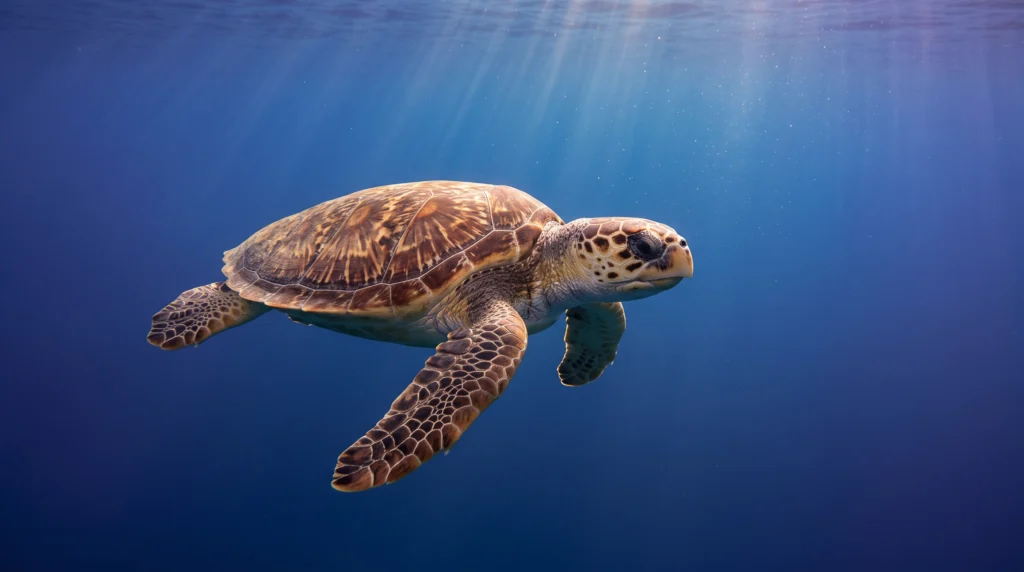
A newly hatched loggerhead sea turtle reaches the edge of the beach and enters an ocean that, from its perspective, contains no road signs, trail markers, or familiar landmarks.
Soon, the coastline can disappear from view. Currents move water across enormous distances, weather changes conditions at the surface, and the young turtle may eventually occupy oceanic regions it has never encountered before.
Yet experiments have revealed something remarkable about sea turtle magnetic navigation: even inexperienced young loggerheads can detect information from Earth’s magnetic field and respond differently to magnetic conditions characteristic of different geographic regions.
Scientists often describe part of this ability as a “magnetic map.” But turtles are not looking at an invisible map or reading magnetic coordinates like a biological GPS.
Instead, evidence indicates that sea turtles can detect geographically varying features of Earth’s magnetic field and use those cues as part of a much larger navigational system involving inherited behavior, ocean currents, waves, experience, and other environmental information.
A Tiny Turtle Enters an Enormous Ocean
For a hatchling loggerhead, Caretta caretta, entering the ocean is only the beginning of a complex navigational challenge.
Immediately after emerging from a nest, hatchlings must first reach the water. Once offshore, they need to continue moving away from dangerous shallow coastal areas. Later, juveniles may spend years moving through large marine environments.
The problem changes as the turtle grows.
A hatchling near a beach has access to cues that may be useful for moving offshore. A juvenile far out at sea faces a different challenge: remaining within broadly favorable oceanic regions despite currents capable of transporting it in multiple directions.
This raises an extraordinary biological question.
How can an inexperienced animal respond appropriately to its geographic surroundings when it has never traveled the route before?
Research suggests that there is no single answer. Sea turtles can use different environmental information at different stages, including wave cues and geomagnetic information. Currents simultaneously transport turtles while the animals’ own swimming behavior modifies where they ultimately go.
Magnetism is therefore important, but it is not the entire navigational system.
Earth Has a Magnetic Field
To understand loggerhead turtle navigation, we first need to understand the environmental information available to the animals.
Earth is surrounded by a geomagnetic field generated largely by processes within the planet’s interior.
We cannot see this field directly, but instruments can measure several of its characteristics. Two are particularly important to research on sea turtle navigation.
Magnetic intensity
Magnetic intensity describes the strength of Earth’s magnetic field at a particular location.
The field is not equally strong everywhere. Its intensity varies geographically.
Magnetic inclination
Magnetic inclination describes the angle at which Earth’s magnetic field intersects the planet’s surface.
The field is not simply parallel to the ground. Its angle relative to Earth’s surface changes systematically across geographic regions.
Intensity and inclination therefore provide environmental gradients that animals capable of magnetoreception could potentially detect.
The important point is not that these values create a perfectly fixed coordinate grid. They do not.
Rather, geographically varying magnetic characteristics can provide information that may be useful for orientation and position.
What Is Magnetoreception?
Magnetoreception is the ability of an organism to detect information associated with magnetic fields.
Magnetic sensitivity has been investigated in numerous animals, including birds, fish, insects, crustaceans, and reptiles.
Sea turtles have become especially important subjects because their life histories create remarkable navigational challenges.
A turtle detecting a magnetic field should not be imagined as consciously seeing glowing lines around Earth or watching an internal compass needle.
Scientists infer magnetic sensitivity from behavior.
If researchers alter magnetic conditions while controlling other environmental information and an animal changes its orientation in a repeatable, biologically meaningful way, that provides evidence that magnetic information is being detected and used.
This experimental approach has produced compelling results in sea turtles.
The Difference Between a Magnetic Compass and a Magnetic Map
This distinction is essential to understanding how sea turtles navigate.
A magnetic compass and a magnetic map perform different navigational functions.
A magnetic compass provides directional information
Functionally, a compass can help answer:
Which direction am I heading?
An animal with a magnetic compass can use Earth’s magnetic field to maintain or select a direction.
This does not necessarily tell the animal where it is.
A magnetic map provides positional information
A map-like sense provides information associated with geographic position.
Functionally, the problem is closer to:
Where am I relative to an important region?
If an animal can recognize geographically varying magnetic conditions and alter its direction accordingly, it may obtain positional information from the field.
The terms “compass” and “map” are functional analogies. They do not demonstrate that turtles possess human-like concepts of maps, coordinates, or geographic space.
A sea turtle magnetic map is therefore not an invisible version of Google Maps.
It is a sensory system capable of extracting geographically useful information from environmental magnetic gradients.
The Experiments That Changed Our Understanding
Some of the strongest evidence for magnetic map-like information in turtles comes from controlled experiments with juvenile loggerheads.
The basic experimental logic is elegant.
Researchers place turtles in controlled environments where their swimming orientation can be measured. Coil systems surrounding the experimental area allow scientists to manipulate the magnetic field experienced by the turtle.
By adjusting the field, researchers can reproduce magnetic conditions associated with geographically distant locations.
The turtle remains physically in the laboratory.
The magnetic environment around it changes.
Many other potentially informative environmental cues can therefore remain essentially unchanged while the magnetic cue is experimentally manipulated.
If turtles exposed to one geographically characteristic magnetic field orient differently from turtles exposed to another, researchers can test whether magnetic information alone is sufficient to trigger location-specific directional responses.
Experiments led by researchers studying loggerhead navigation have repeatedly provided evidence consistent with exactly this capability.
Different Magnetic Locations, Different Directions
In classic magnetic-displacement experiments, juvenile loggerheads were exposed to magnetic fields representing different locations within their broader migratory environment.
The turtles changed their orientation depending on which field they experienced.
This result is important because the animals had not actually been transported between those geographic locations during the experiment.
Only the magnetic conditions changed.
Moreover, the directional responses could be interpreted in relation to the ecological problems young turtles encounter at different parts of their oceanic habitat.
In the North Atlantic, for example, juvenile loggerheads can interact with a large-scale circulation system composed of several major currents. Remaining within broadly favorable regions can matter because being transported into unsuitable areas could carry substantial ecological costs.
A genetically programmed tendency to swim in one direction after encountering one regional magnetic signature and another direction after encountering a different signature could therefore influence a turtle’s trajectory.
This does not mean every juvenile follows an identical circular route.
Nor does it mean turtles memorize a sequence of exact magnetic coordinates.
The evidence instead supports the idea that certain magnetic conditions can trigger directional responses appropriate to particular geographic contexts.
Can Turtles Detect Both Intensity and Inclination?
Experimental research indicates that sea turtles can respond to multiple components of Earth’s magnetic field.
This matters because both magnetic intensity and inclination vary geographically.
In principle, combinations of these variables can help distinguish regions of the ocean.
Imagine two environmental gradients changing across a landscape. A single value might correspond to many possible locations, but combining multiple gradients can provide more useful positional information.
That is roughly the logic behind magnetic map research.
However, Earth’s geomagnetic field is not a perfectly stable coordinate system.
Magnetic parameters change gradually over time through a process known as secular variation. Different locations can also share similar values for individual magnetic components.
For these reasons, it is misleading to say that turtles simply read intensity and inclination as exact latitude and longitude.
The biological system appears to be more flexible than that analogy suggests.
Is the Magnetic Map Inherited?
One of the most fascinating findings in sea turtle magnetoreception is that useful magnetic responses can appear in young animals with little or no relevant navigational experience.
That strongly suggests an inherited component.
A juvenile cannot learn a particular oceanic route from personal experience if it has never previously traveled through the relevant regions.
Likewise, sea turtles do not follow their parents across the ocean and learn migration routes socially.
Inherited behavioral programs therefore offer a compelling explanation for at least part of early navigation.
But “inherited” should not be confused with an exact route genetically stored as a detailed list of geographic coordinates.
A more realistic model involves inherited responses to particular environmental conditions.
When a turtle encounters certain magnetic characteristics, those characteristics might activate a directional response that tends, on average, to improve the animal’s position.
Experience and learning may later modify or supplement this inherited system.
The relative contributions of genetic programming and learning can also change as a turtle matures.
Ocean Currents Are Part of the Story
A young turtle does not navigate through stationary water.
It lives inside a moving fluid.
Ocean currents can transport juvenile turtles over enormous regions, and this passive transport interacts with active swimming.
That distinction is important because young sea turtles were once sometimes portrayed as largely passive drifters.
Research has shown that even relatively small amounts of directed swimming can meaningfully alter trajectories when sustained over time.
For loggerheads in the North Atlantic, major circulation patterns can carry young turtles among oceanic regions. Magnetic orientation may help juveniles respond when they encounter conditions associated with particular parts of this environment.
The resulting movement is therefore produced by an interaction:
ocean current + turtle swimming behavior = actual trajectory.
Neither component alone tells the whole story.
Waves Can Help Hatchlings Find Their Initial Direction
Magnetic navigation is not the first or only orientation system available to a young turtle.
Shortly after entering the sea, hatchlings can use wave direction to help maintain an offshore heading.
Near many nesting beaches, waves tend to approach shore in predictable ways. A hatchling capable of orienting relative to those waves can use that information to move away from the coastline.
Farther offshore, however, wave information does not solve every navigational problem.
This illustrates a broader principle in animal navigation: different cues can become useful in different contexts.
A hatchling escaping a beach, a juvenile moving through an ocean basin, and an adult migrating toward a reproductive region face different navigational tasks.
Sea turtles appear to possess sensory tools appropriate to several of them.
How Do Adult Turtles Find Their Way Back?
The navigational story becomes even more remarkable when turtles reach adulthood.
Female sea turtles often reproduce in the general geographic region where they originated, a phenomenon known as natal homing.
After spending years elsewhere, an adult may undertake a long reproductive migration toward nesting areas.
Geomagnetic information has been proposed as one mechanism contributing to this ability.
Observational and experimental research supports a relationship between Earth’s magnetic field and natal homing, but the process should not be exaggerated.
A female does not necessarily return to the exact square meter of sand where her egg was laid.
Natal homing can occur at different geographic scales, and other environmental information may become important as an animal approaches a coastline or nesting area.
Magnetism is best understood as one potentially powerful component of a hierarchical navigational system.
The Magnetic Imprinting Hypothesis
One influential explanation for natal homing is the magnetic imprinting hypothesis.
The basic idea is that young turtles may learn—or imprint upon—magnetic characteristics associated with their natal region.
Years later, adults could use related geomagnetic information while returning toward that region to reproduce.
There is evidence consistent with this hypothesis.
Researchers have examined long-term changes in Earth’s magnetic field and compared them with patterns of sea turtle nesting. Some findings indicate relationships expected if geomagnetic signatures influence where returning turtles locate nesting areas.
Experimental work has also strengthened the broader case that turtles can recognize and respond to magnetic information associated with particular geographic locations.
Still, magnetic imprinting should be described as a well-supported scientific hypothesis rather than as a completely resolved mechanism.
Scientists continue investigating what information is learned, when imprinting occurs, how precisely it is retained, and how magnetic cues interact with other sensory systems during adult migration.
Earth’s Magnetic Field Changes
Earth’s magnetic field is dynamic.
Its geographic patterns gradually shift through time.
This creates an interesting challenge for any animal relying on magnetic information over a lifespan that may extend for decades.
If a turtle learned a rigid magnetic coordinate as a hatchling and searched for exactly the same value decades later, secular variation could create problems.
This is one reason researchers are interested in flexible mechanisms rather than simplistic GPS analogies.
Animals might use combinations of cues, regional gradients, learned information, updated experience, or other mechanisms that remain functional despite gradual geomagnetic change.
Exactly how turtles compensate for such variation remains an active area of research.
How Do Turtles Physically Detect Magnetism?
This is one of the biggest unresolved questions.
Behavioral experiments provide strong evidence that sea turtles detect magnetic information.
The biological receptor and sensory mechanism responsible, however, have not been definitively established.
Several broad mechanisms have been investigated across magnetoreceptive animals.
One possibility involves tiny magnetic mineral particles, such as magnetite, interacting mechanically with sensory structures.
Another involves light-dependent chemical reactions whose behavior can be influenced by magnetic fields.
Researchers continue investigating these and other possibilities across animal groups.
For sea turtles specifically, it would be premature to claim that scientists have discovered a single confirmed “magnetic organ.”
We know considerably more about what turtles can do behaviorally than about exactly how their nervous systems detect the relevant physical information.
Could Human Magnetic Disturbances Affect Navigation?
Human infrastructure can generate local electromagnetic fields.
That naturally raises the question of whether anthropogenic magnetic disturbances could affect magnetically sensitive animals.
The possibility deserves scientific investigation, especially as submarine cables and other offshore infrastructure expand.
But it should not be converted into an unsupported claim that such infrastructure is routinely causing sea turtles to become lost.
The ecological effect of an artificial field depends on its strength, spatial extent, frequency characteristics, the animal’s sensitivity, exposure duration, and whether alternative cues are available.
Controlled research is therefore needed to determine whether specific human-generated electromagnetic conditions produce biologically meaningful effects.
Potential interaction is scientifically plausible. Population-level harm should not be assumed without evidence.
Why Navigation Research Matters for Conservation
Understanding sea turtle migration is not merely an exercise in solving an extraordinary sensory mystery.
Navigation determines how animals connect different habitats.
Young turtles may use developmental habitats far from their nesting beaches. Adults can migrate between feeding areas and reproductive regions. Populations that appear separated geographically may still be connected through movement.
Studying navigation can therefore improve our understanding of migration corridors, developmental habitats, natal homing, and population connectivity.
That information can complement conservation work addressing much broader threats.
Sea turtles face pressures that include fisheries bycatch, alteration of nesting and coastal habitat, marine pollution, artificial lighting around nesting beaches, vessel interactions, and climate-related environmental change.
Magnetic sensing does not determine whether populations survive on its own.
It is one component of the complex biology conservation strategies need to understand.
Common Misconceptions About Sea Turtle Navigation
“Sea turtles literally see Earth’s magnetic field.”
Experiments show that turtles can detect and respond to magnetic information, but this does not mean they consciously see visible magnetic lines.
“Magnetic inclination works like a compass needle pointing north.”
Inclination is the angle at which Earth’s magnetic field intersects the surface. It can provide geographically varying information but is not equivalent to a human compass needle.
“Every turtle follows exactly the same migration route.”
Individual trajectories vary, and currents, behavior, environmental conditions, life stage, and population can all influence movement.
“Young turtles simply drift wherever currents take them.”
Currents are extremely important, but active swimming and orientation can alter juvenile trajectories.
“Scientists found a tiny compass organ inside the turtle.”
No definitive magnetic receptor has yet been established for sea turtles.
“A magnetic map gives turtles exact latitude and longitude.”
The magnetic-map concept describes the use of geographically varying magnetic information. It does not imply human-style coordinates.
“Magnetism is the only cue turtles use.”
Sea turtles can use multiple cues. Waves, currents, visual information, and other sensory information may contribute depending on context.
“Adult females always return to exactly where they hatched.”
Natal homing often brings females back toward their region of origin, but this should not be interpreted as universal precision to an exact point on a beach.
Frequently Asked Questions
Can sea turtles sense Earth’s magnetic field?
Yes. Controlled behavioral experiments provide strong evidence that sea turtles can detect magnetic-field information and use it for orientation and navigation.
How do sea turtles use Earth’s magnetic field?
Evidence indicates that turtles can use magnetic information in at least two functional ways: as a compass for directional orientation and as map-like information associated with geographic position.
What is a sea turtle magnetic map?
A magnetic map is a functional term for the ability to extract positional information from geographically varying features of Earth’s magnetic field. It is not a literal map that the turtle sees.
How do baby sea turtles know where to go?
Their orientation appears to involve inherited behavioral programs combined with environmental cues. Waves can help during early offshore movement, while magnetic information can guide orientation in broader oceanic contexts. Currents also strongly influence their trajectories.
Do sea turtles use magnetic fields to return to their birth beaches?
Geomagnetic information is strongly implicated in natal homing, and the magnetic imprinting hypothesis proposes that turtles learn magnetic characteristics associated with their natal region. Other cues probably also contribute, particularly during later stages of migration.
Do scientists know how turtles physically detect magnetism?
Not yet. Behavioral evidence for magnetoreception is strong, but the precise receptor and biological mechanism responsible for magnetic detection in sea turtles remain unresolved.
Conclusion
One of the most extraordinary aspects of sea turtle magnetic navigation is that young turtles can respond to geographic information they cannot see.
Earth’s geomagnetic field contains properties that vary systematically across the planet. Controlled experiments demonstrate that loggerhead turtles can detect magnetic information and change their orientation when exposed to fields characteristic of different geographic regions.
That evidence supports both magnetic compass orientation and a more sophisticated magnetic map-like ability.
But describing sea turtles as possessing a “built-in GPS” misses what makes the biology so interesting.
A young loggerhead does not need a human-style map.
Instead, evolution has equipped it with sensory and behavioral mechanisms that can extract useful information from a planet-wide physical field. Those magnetic cues interact with inherited responses, ocean currents, active swimming, waves, experience, and probably additional sensory information.
The result is not perfect navigation along a predetermined line.
It is something far more biological: a flexible system that helps a small animal make useful decisions while moving through one of the largest, most dynamic environments on Earth.
Internal-linking opportunities
- Link animal magnetoreception to an article explaining how migratory animals detect Earth’s magnetic field.
- Link sea turtle natal homing to an article about why adult sea turtles return toward their regions of origin.
- Link ocean currents and animal migration to an article explaining how marine animals combine active swimming with current-driven transport.
- Link loggerhead sea turtle biology to a species guide covering habitat, diet, reproduction, and conservation.
Authoritative external sources
- Lohmann, K. J., Lohmann, C. M. F., & Putman, N. F. — Research on magnetic maps, magnetic compasses, and geomagnetic navigation in sea turtles, including controlled studies of loggerhead turtles.
- Putman, N. F. and colleagues — Peer-reviewed experimental research examining inherited magnetic maps and responses of juvenile loggerheads to geographically characteristic magnetic fields.
- Brothers, J. R. & Lohmann, K. J. — Research examining geomagnetic imprinting and natal homing in sea turtles.
- NOAA Fisheries — Loggerhead sea turtle (Caretta caretta) biology, migration, threats, and conservation information.
- IUCN Marine Turtle Specialist Group — Scientific and conservation resources concerning sea turtle populations, ecology, and migration.