
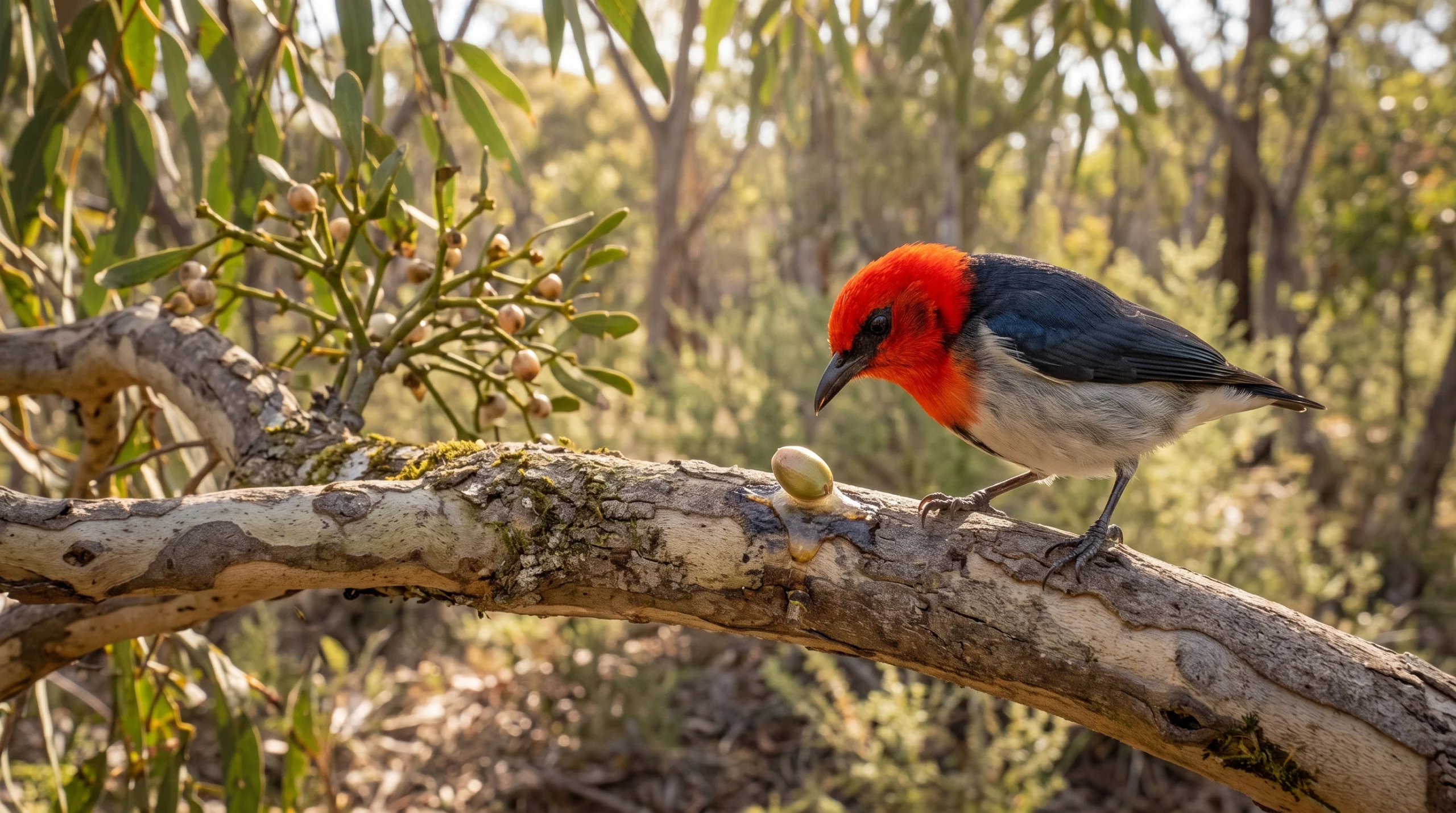
A Bird Eats a Berry — and a Plant May Appear Somewhere Else
High in an Australian woodland, a male mistletoebird moves among branches carrying clusters of ripe mistletoe fruit. The tiny bird is striking: glossy dark upperparts contrast with a brilliant red throat and chest, while another patch of red flashes beneath its tail.
It selects a fruit and swallows its contents.
What happens next is one of Australia’s most remarkable examples of animal-assisted plant dispersal.
The fleshy part of the fruit is processed rapidly. The seed survives, still associated with an extremely sticky material called viscin. When the bird later defecates, its movements can leave the seed stuck to a branch rather than falling to the ground. If that branch belongs to a suitable host and conditions are favorable, the seed can germinate, establish a specialized connection with the host, and eventually develop into another mistletoe plant.
Fruit → bird → digestive tract → sticky seed → branch → germination → possible establishment.
It looks remarkably like the bird has “planted” the mistletoe.
Scientifically, however, that description needs an important correction. The mistletoebird is not gardening and does not understand that its feeding behavior can produce future plants. What we are seeing is mistletoebird seed dispersal—a specialized example of zoochory, or seed dispersal by animals.
And for mistletoe, getting the seed onto a branch rather than onto the ground is especially important.
Meet the Mistletoebird
The mistletoebird, Dicaeum hirundinaceum, is a small Australian songbird belonging to the flowerpecker family, Dicaeidae.
It occurs widely across mainland Australia and on some nearby islands, using many wooded environments where fruiting mistletoes occur. Its movements can vary with local conditions and food availability.
Despite its tiny size, an adult male is difficult to mistake when seen clearly.
Males have dark, often glossy blue-black upperparts, a vivid scarlet-red throat and upper breast, a pale belly, and a red patch beneath the tail. Females are much less conspicuous, with predominantly gray-brown plumage and paler underparts.
That sexual dimorphism gives the species two quite different appearances.
Mistletoebirds eat mistletoe fruit extensively, but they are not restricted to a single food. Their diet can also include other fruits, nectar, and small arthropods.
Their name nevertheless reflects a genuine ecological association. Australian mistletoes produce precisely the kind of fruit this bird is highly effective at consuming and dispersing.
Why Mistletoe Fruit Matters
A mistletoe fruit is more than a container protecting a seed.
Its fleshy tissues provide a nutritional reward to animals willing to consume it. From the plant’s perspective, attracting a mobile animal creates an opportunity to transport the seed away from the parent mistletoe.
That movement matters.
A seed remaining beside its parent may face competition and may have limited opportunities to reach another suitable host. A bird, meanwhile, can move between trees and shrubs in a fraction of the time it would take a seed to travel through purely passive mechanisms.
This does not mean the bird eats the fruit because it intends to help the plant.
Nor does the plant consciously “reward” the bird.
Natural selection has produced complementary traits: fleshy fruits attract consumers, while animal feeding behavior can transport seeds. When that interaction increases successful dispersal, it can persist and become increasingly specialized over evolutionary time.
In the case of Australian mistletoes, the unusual requirements of the seed make effective dispersal especially valuable.
The Seed Has an Unusual Problem
Imagine a bird eating an ordinary fleshy fruit and later dropping its seeds onto the ground.
For many terrestrial plants, that is exactly where a seed needs to be.
A mistletoe faces a different challenge.
Most aerial mistletoes do not begin life rooted in soil. Their seedlings need to establish on the branches of suitable host plants. The Australian National Botanic Gardens notes that there is no direct connection with soil during the life cycle of these aerial mistletoes.
A seed that simply falls to the forest floor is therefore unlikely to establish in the normal way of a terrestrial tree or shrub.
It needs to reach a branch.
More specifically, it needs to remain attached to a suitable part of a compatible host long enough to germinate and establish the specialized connection on which its future survival depends.
This unusual requirement transforms seed dispersal from a simple problem of distance into a problem of precise habitat placement.
A mistletoebird can help solve it.
What Makes a Mistletoe Seed So Sticky?
Anyone handling some mistletoe fruits quickly discovers an unusual feature: the seeds can be extraordinarily sticky.
Much of that adhesion comes from a material known as viscin.
Viscin is a mucilaginous substance associated with the seed. In Australian mistletoes it helps create the sticky connection between a freshly dispersed seed and the surface on which it lands.
It is tempting to call viscin “natural glue,” and the analogy can be useful. But it should not be interpreted as meaning the substance is chemically or mechanically identical to manufactured adhesive.
Its biological function is what matters.
Once the seed reaches a branch, viscin can help prevent it from simply bouncing away or falling to the ground.
As the material adheres to the bark, the seed has an opportunity to remain in the very environment where germination and host attachment can occur.
For a plant that needs to establish above ground, stickiness is an exceptionally useful adaptation.
What Happens After the Bird Swallows the Fruit?
The journey through the mistletoebird is surprisingly fast.
Specialized mistletoe-fruit consumers have digestive characteristics that allow the fleshy portion to be processed while the seed passes through intact.
A controlled study comparing mistletoebirds with spiny-cheeked honeyeaters found that grey mistletoe (Amyema quandang) fruit passed substantially faster through mistletoebirds. The experiment also found that seeds dispersed by both bird species could germinate, although longer-term seedling establishment differed between the two treatments.
That study illustrates why rapid gut passage is frequently discussed in mistletoe ecology.
It should not, however, be turned into a universal stopwatch.
Passage time can vary with the mistletoe species being eaten, quantity of food, bird condition, and experimental circumstances. Although specific studies have measured passage times, there is no need to assume that every fruit consumed by every mistletoebird spends exactly the same number of minutes inside the digestive tract.
The biologically important point is that the bird can process the nutritious fruit while allowing viable mistletoe seeds to emerge intact.
Then comes the critical step: getting the seed onto a branch.
Does the Bird Really Wipe the Seed Onto a Branch?
The famous story of the mistletoebird “wiping” mistletoe seeds onto branches has a basis in observed behavior, but it is often described too anthropomorphically.
Australian botanical accounts describe mistletoebirds making twisting movements during defecation that can wipe the sticky seeds onto the branch where the bird is perched.
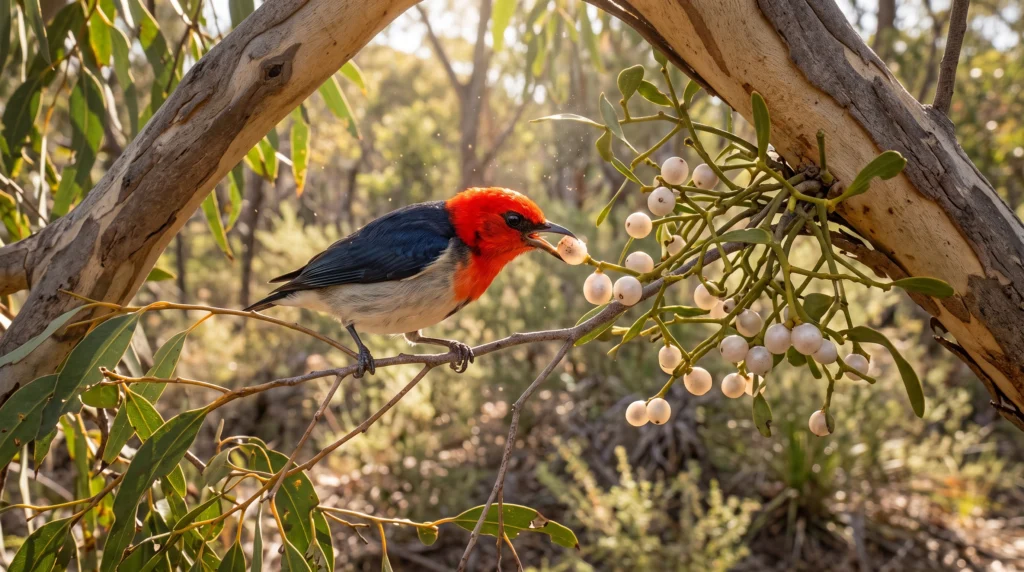
The distinction is important.
The bird is performing behavior associated with eliminating sticky material from its body. The result can be that a mistletoe seed becomes firmly attached to a branch.
That is not the same as the bird inspecting a tree, choosing an ideal planting location, and deliberately positioning a seed because it understands that a future plant will grow there.
Not every seed must be deposited through exactly the same movement, either.
Some may end up on unsuitable surfaces. Others may fail to adhere properly.
But when the behavior places a viable, sticky seed on a suitable host branch, it provides precisely the kind of dispersal opportunity mistletoe needs.
The Seed Sticks — But That Is Only the Beginning
Successful deposition is not successful establishment.
A mistletoe seed stuck to bark still faces a series of biological filters.
The host must be compatible with that particular mistletoe. The branch must provide an appropriate establishment surface. The seed needs to remain viable, avoid being removed or damaged, and experience environmental conditions suitable for germination.
Moisture and microclimate can matter.
So can characteristics of the bark and branch.
And even germination is only another stage in the process.
The developing seedling still has to establish a physiological connection with its host.
For this reason, photographs showing dozens of seeds on branches should never be interpreted as dozens of guaranteed future mistletoe plants.
Dispersal creates an opportunity.
Establishment determines whether that opportunity succeeds.
How Does Mistletoe Germinate on a Branch?
Mistletoe germination can look strange if we expect every plant to send an ordinary root down into soil.
That is not what happens here.
After a viable mistletoe seed has adhered to a suitable host branch, embryonic growth begins while the seed remains above ground.
The details differ among mistletoe groups. Australian mistletoes themselves show variation in early germination form, so there is no single morphology that describes every species.
In many loranthaceous mistletoes of the Australasian region, viscin initially holds the seed to the branch. The developing seedling then forms specialized structures that establish more permanent attachment to the host surface.
Instead of eventually building a conventional underground root system, the mistletoe develops structures adapted for life directly on another plant.
The crucial next step is the formation of the haustorial connection.
The Haustorium — Connecting to the Host
The haustorium is one of the defining structures of parasitic plants.
In mistletoes, the developing attachment system penetrates the host and establishes a physiological connection with its tissues.
Australian mistletoes vary in the detailed structure of their haustoria. Many species form a primary haustorium, while some mistletoes also develop surface-running structures capable of producing additional connections.
The connection allows the mistletoe to draw important resources from its host.
For many mistletoes, this includes water and dissolved mineral nutrients obtained through connections associated with the host’s water-conducting xylem.
This is much more accurate than saying mistletoe simply “sucks all the food out of a tree.”
The relationship is physiologically sophisticated, and the mistletoe remains a functioning photosynthetic plant.
Mistletoe Is a Parasite — But It Is Also Green
Look closely at most Australian mistletoes and one feature is obvious: they have green leaves.
That green color reflects chlorophyll.
Many mistletoes are therefore described as hemiparasites. They parasitize another plant for important resources, especially water and mineral nutrients, while continuing to manufacture much of their own organic carbon through photosynthesis.
The Australian National Botanic Gardens notes that the vast majority of mistletoes have green leaves and photosynthesize, although physiological relationships with hosts can vary among species.
This distinction matters because “parasite” is sometimes incorrectly interpreted to mean an organism that does nothing for itself.
A mistletoe is still photosynthetically active.
Its dependence on a host is real, but it is not equivalent to a plant that has completely abandoned photosynthesis.
Does Mistletoe Always Harm the Host Tree?
Parasitism has a cost.
A mistletoe draws water and other resources through its connection with the host. A heavily infected tree can therefore experience substantial physiological stress.
But the consequences are context dependent.
One mistletoe on a healthy mature host is not automatically a death sentence.
Effects depend on the mistletoe species, host species, number and size of infections, environmental conditions, drought stress, host health, and other pressures acting on the plant.
Heavy mistletoe loads can contribute to branch decline and reduced host performance, particularly when water is limited.
At the same time, mistletoe can provide resources used by many other organisms.
Those two statements are not contradictory.
A plant can be parasitic to its individual host while simultaneously contributing important resources to a wider ecological community.
More Than One Bird Can Spread Mistletoe
The mistletoebird is an especially effective Australian disperser, but it does not have an exclusive contract with mistletoe.
Other fruit-eating birds can transport mistletoe seeds.
Australian examples include several honeyeaters. The Australian National Botanic Gardens identifies mistletoebirds along with honeyeaters such as Grantiella, Acanthagenys, and Plectorhyncha as notable dispersal agents. Elsewhere in the world, completely different bird groups participate in similar interactions.
This is an important reminder not to confuse specialization with exclusivity.
Mistletoebirds possess traits that make them particularly effective consumers and dispersers of mistletoe fruits.
But an ecological network can contain multiple dispersers, multiple mistletoe species, and multiple host plants.
The exact relationships vary across regions and species.
A Surprisingly Important Woodland Plant
Mistletoe’s reputation as a parasite can obscure its broader ecological role.
Its flowers can provide nectar.
Its fruits feed birds and other animals.
Its foliage adds resources and structural complexity to tree canopies, and mistletoe clumps can be used for nesting and shelter.
Some of the strongest evidence for this wider importance comes from an Australian field experiment.
Ecologists David Watson and Matthew Herring removed mistletoe from 17 woodland sites in New South Wales while maintaining control sites where mistletoe remained. Three years later, the treatment woodlands had lost an average of 20.9% of their original total species richness, with even larger declines among some woodland-dependent bird categories.
The study demonstrated that, in those woodlands, mistletoe functioned as a keystone resource whose ecological effects extended well beyond animals directly eating its fruit.
That does not mean every mistletoe species has an identical effect in every ecosystem.
It does show why automatically treating mistletoe as ecologically worthless because it is parasitic can be a serious oversimplification.
Bird, Plant and Host — A Three-Way Ecological Relationship
The mistletoebird story becomes even more interesting when we stop looking at the bird and plant in isolation.
There are at least three participants.
The host plant provides the physical branch on which the mistletoe establishes and the physiological resources accessed through the haustorium.
The mistletoe produces foliage, flowers, and fruit while living on that host.
The mistletoebird consumes the fruit and can transport viable seeds between potential hosts.
Other animals then interact with the flowers, fruit, foliage, and structure created by the mistletoe.
What initially appears to be a simple bird eating a berry is therefore one small event inside a much larger ecological network.
Change one participant and effects can extend to others.
That interconnectedness is one reason mistletoes and their dispersers have attracted so much interest from ecologists.
Does the Mistletoebird “Plant” Mistletoe?
Figuratively, yes.
Scientifically, no.
The expression works because the outcome resembles planting. A bird consumes a fruit and later leaves a viable seed attached to a place where that plant may potentially establish.
But the bird does not know it is propagating mistletoe.
It is eating and processing food.
The correct biological process is zoochory, or seed dispersal by animals.
More specifically, mistletoebird seed dispersal combines fruit consumption, rapid processing of the fruit, survival of the seed, sticky viscin, and deposition behavior that can leave the seed attached to a potential host.
If the seed subsequently germinates, develops its attachment structures, establishes a haustorial connection, and survives, a new mistletoe plant may result.
That entire sequence makes the “planting” metaphor memorable.
The science behind it is even more remarkable.
Common Misconceptions
“Mistletoebirds consciously plant mistletoe.”
No. Their feeding and defecation behavior can result in successful seed placement, but there is no evidence that the bird understands the future botanical consequence.
“Every swallowed seed becomes another mistletoe.”
No. Seeds can be deposited incorrectly, fail to germinate, encounter an unsuitable host, or die before establishing a functional connection.
“Mistletoe seeds normally germinate in soil.”
Aerial mistletoes are adapted to establishing on host branches rather than beginning life as conventional soil-rooted plants.
“The bird must crack the seed before it can grow.”
No. The important process involves consuming the fruit while allowing the viable seed to pass through and be dispersed.
“Mistletoe cannot photosynthesize.”
Most mistletoes are green and photosynthetic. Many are hemiparasites that obtain water and mineral resources from hosts while producing organic carbon through photosynthesis.
“One mistletoe immediately kills its host.”
Not necessarily. Physiological costs depend on infection intensity, host condition, species, and environmental stress.
“Only mistletoebirds disperse Australian mistletoes.”
No. Other fruit-eating birds, including several honeyeaters, can also disperse mistletoe seeds.
“The bird and plant form a completely exclusive partnership.”
Their association can be highly specialized without being an exclusive one-to-one relationship.
Frequently Asked Questions
What does a mistletoebird eat?
Mistletoebirds are strongly associated with mistletoe fruit but can also consume other fruits, nectar, and small arthropods. Their dependence on particular foods varies with availability and ecological conditions.
Why are mistletoe seeds sticky?
Mistletoe seeds are associated with sticky viscin. This material helps a dispersed seed adhere to a branch, reducing the chance that it will simply fall to the ground before it can begin establishment.
How does a mistletoebird spread mistletoe?
The bird consumes mistletoe fruit, digests the fleshy portion, and passes the viable seed. Sticky viscin and the bird’s deposition behavior can leave the seed attached to a potential host branch. If conditions are suitable, it may germinate and establish.
Does a mistletoebird deliberately wipe seeds onto branches?
Twisting and wiping movements during defecation have been described in mistletoebirds and can result in seeds adhering to branches. This should not be interpreted as conscious planting or as proof that every seed is deliberately positioned.
Can mistletoe grow from the ground?
The aerial mistletoes discussed here are adapted to germinating and establishing directly on suitable host branches. A seed falling onto ordinary soil generally does not follow the conventional soil-rooted life cycle of a terrestrial plant.
How does mistletoe attach to a host tree?
After germination, the developing mistletoe forms specialized attachment structures. A haustorium ultimately establishes a connection with host tissues, allowing the parasite to obtain resources such as water and dissolved mineral nutrients.
Conclusion
A mistletoebird feeding on a berry can begin an ecological journey far more complicated than its tiny size suggests.
The bird consumes the fruit. The fleshy portion is processed, while the seed survives. Sticky viscin remains associated with the seed, and the bird’s behavior can leave it attached to another branch.
Then biology takes over.
The seed must remain on a compatible host. It must germinate successfully. Its developing attachment system must establish contact with the host, and a functional haustorial connection must form. Only after passing those filters can a new mistletoe become established.
The bird never needs to understand any of this.
It is not consciously planting a garden in the canopy.
Yet mistletoebird seed dispersal demonstrates how ordinary animal behavior can have extraordinary consequences. A meal eaten by a tiny Australian bird can move a plant from one host to another and, in doing so, help shape a network involving birds, mistletoes, host trees, pollinators, and entire woodland communities.
The popular story says the mistletoebird “plants” mistletoe.
The biological reality—an animal moving a sticky seed to precisely the kind of place where an aerial parasitic plant has a chance to survive—is even better.
Internal-linking opportunities
- Link animal seed dispersal to an article explaining how birds and mammals move seeds through ecosystems.
- Link Australian woodland birds to a guide covering specialized feeding relationships among native Australian species.
- Link hemiparasitic plants to an article explaining how parasitic and partially parasitic plants obtain resources from hosts.
- Link keystone resources to an article explaining how individual plant species can influence wildlife diversity.
Authoritative external sources
- Australian National Botanic Gardens — Mistletoe Bird and Dispersal — overview of mistletoebird seed passage, deposition behavior, attachment, and germination.
- Australian National Botanic Gardens — Dispersal and Germination — botanical overview of mistletoe fruit, viscin, dispersal agents, and aerial establishment.
- PubMed — Differential Passage Time of Mistletoe Fruits Through the Gut of Honeyeaters and Flowerpeckers — experimental comparison involving Dicaeum hirundinaceum and grey mistletoe seeds.
- Australian National Botanic Gardens — What Is a Mistletoe? — explanation of haustoria, host connections, resource acquisition, and photosynthesis.
- Proceedings of the Royal Society B — Mistletoe as a Keystone Resource: An Experimental Test — woodland-scale experimental evidence for mistletoe’s broader ecological importance.