
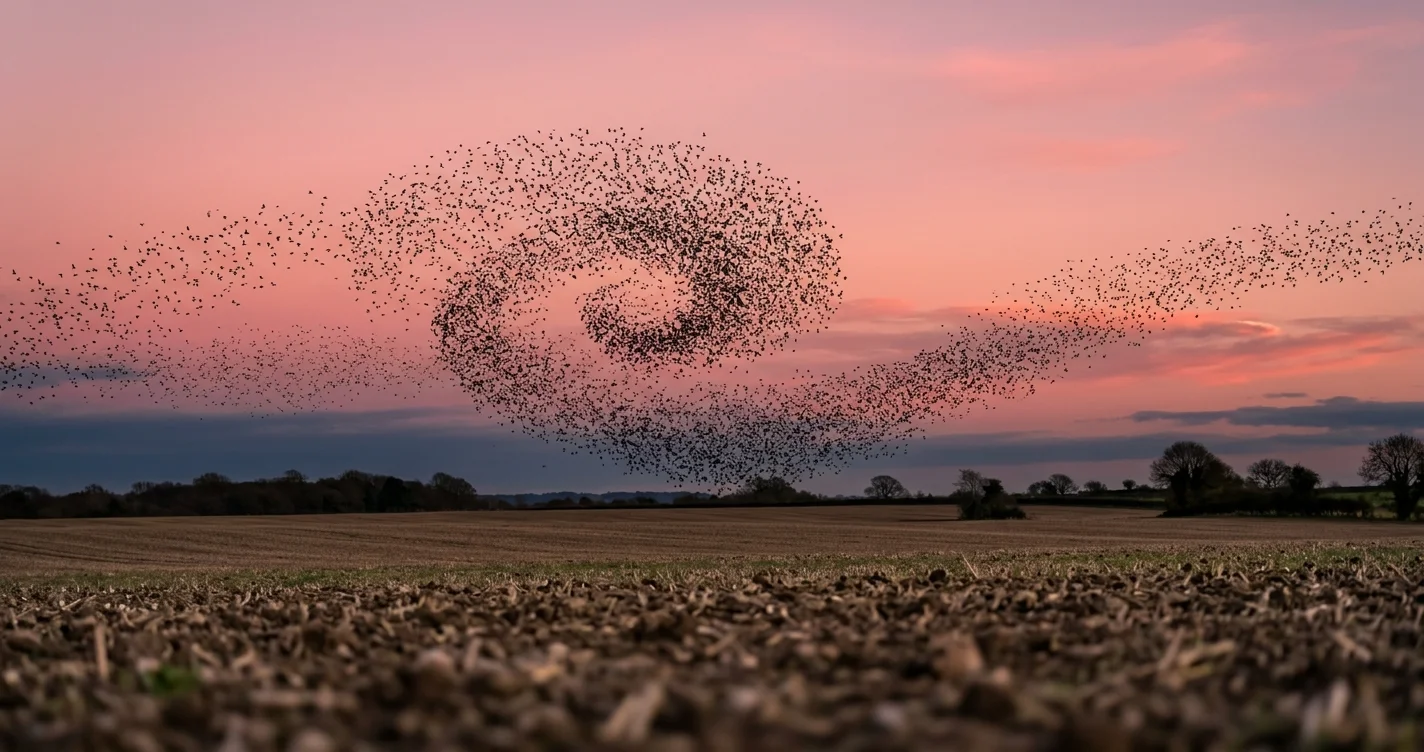
Imagine looking up at the evening sky and watching thousands of birds move like a single living cloud. The flock stretches into a ribbon, folds into a dark spiral, then suddenly changes direction without appearing to collide.
This extraordinary spectacle is called a starling murmuration, one of nature’s most mesmerizing examples of collective animal behavior.
What makes it remarkable is that the birds have no visible leader directing the performance. Instead, each starling responds to nearby flock members, creating flowing patterns that seem almost choreographed.
Behind those beautiful movements lies a fascinating combination of biology, physics, predator avoidance, and social behavior.
Table of Contents
- What Is a Starling Murmuration?
- Why Starlings Gather in Huge Flocks
- How a Starling Murmuration Works
- Why Murmurations Change Shape So Quickly
- When and Where to See Starling Murmurations
- European Starlings in North America
- How Scientists Study Murmurations
- In Your Own Yard: Watching Starlings Responsibly
- What Murmurations Teach Us About Nature
- Frequently Asked Questions
What Is a Starling Murmuration?
A murmuration is a coordinated aerial gathering in which large numbers of starlings fly together, often producing dramatic, continuously changing shapes.
The birds may form broad clouds, narrow streams, twisting ribbons, or dense clusters that expand and contract within seconds.
Although many bird species form flocks, starlings are especially famous for these spectacular aerial displays.
The Birds Behind the Spectacle
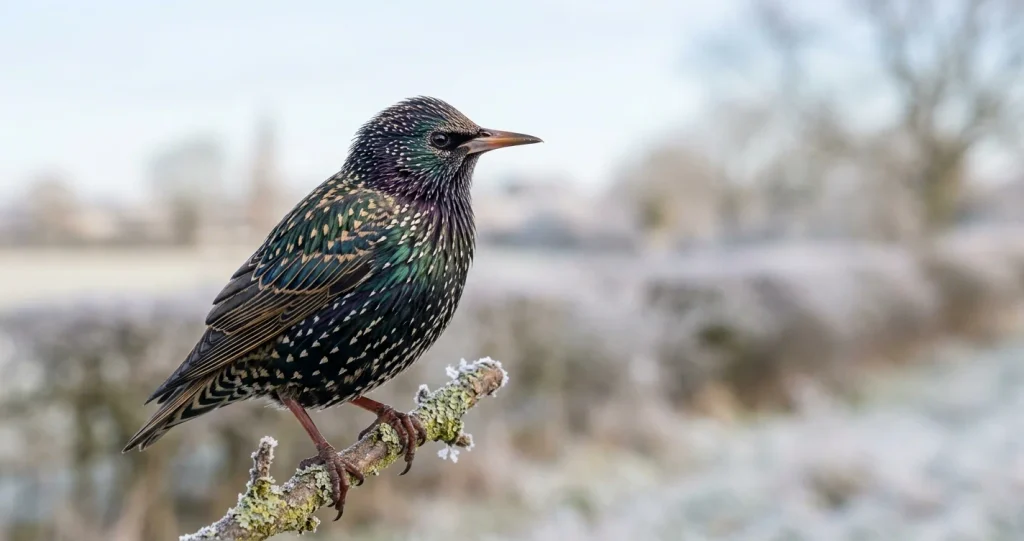
The European starling (Sturnus vulgaris) is a medium-sized songbird with a short tail, pointed wings, and an adaptable lifestyle.
Its plumage can appear nearly black from a distance, but closer inspection reveals glossy green and purple iridescence. During parts of the year, its feathers also display pale spots.
European starlings are native to Europe and portions of Asia and North Africa. They were introduced to North America during the nineteenth century and subsequently spread across much of the continent.
Today, they inhabit cities, farms, parks, grasslands, and suburban neighborhoods.
How Large Can a Murmuration Become?
A murmuration may involve hundreds, thousands, or, under favorable conditions, considerably more birds.
The size varies depending on the location, season, weather, available food, and nearby communal roosting sites.
Not every gathering becomes a spectacular swirling display. Some flocks simply travel together toward a roost without forming elaborate patterns.
Why Starlings Gather in Huge Flocks
Starling murmurations often occur shortly before birds settle into communal nighttime roosts.
These roosts may be located in trees, reed beds, buildings, or other sheltered places.
Gathering in large groups can offer several possible advantages.
Protection From Predators
One widely discussed explanation involves predator avoidance.
Birds of prey, including peregrine falcons and sparrowhawks in regions where they occur, may hunt starlings near communal roosts.
When many birds fly together, a predator may find it harder to isolate and capture an individual.
Rapid changes in flock shape can also make the movement of a particular bird more difficult to predict.
Scientists continue to investigate exactly how flock size, density, and movement influence hunting success.
Safety in Numbers
Large groups can reduce the likelihood that any particular individual becomes the target of an attack.
This principle is sometimes described as the dilution effect.
However, flocking also has costs. Dense groups may attract predators, and competition or disease transmission can increase where birds gather in large numbers.
The benefits of flocking therefore depend on environmental conditions and the behavior of the animals involved.
Preparing for a Communal Roost
Murmurations frequently occur near established nighttime roosting locations.
Birds arriving from different feeding areas may gather before descending into the vegetation or structures where they will spend the night.
Communal roosting may provide shelter and social benefits, although the importance of each advantage can vary.
The dramatic aerial display is part of a larger pattern of daily movement rather than an isolated performance.
How a Starling Murmuration Works: The Science of Collective Flight
The most surprising feature of a starling murmuration is that thousands of birds can move together without a central commander.
Each bird makes rapid decisions based on information from its immediate surroundings.
Together, those local responses create complex movements across the entire flock.
Birds Respond to Their Neighbors
Research on European starling flocks suggests that individuals coordinate their movements with a relatively small number of nearby birds.
An influential study published in 2008 found evidence that starlings interacted with approximately six or seven neighbors, based on their relative positions within the flock.
This is called topological interaction.
Instead of responding only to every bird within a fixed physical distance, a starling appears to track a limited set of neighbors.
That distinction matters because flock density can change rapidly.
A bird may still coordinate with a similar number of companions even when the flock stretches apart or compresses.
Simple Responses Create Complex Patterns
A starling must continually adjust its direction and speed while avoiding collisions.
Its flight behavior reflects several interacting demands: maintaining an appropriate position relative to neighbors, responding to changes in their movement, and reacting to threats or environmental conditions.
The combined effect can produce remarkably organized patterns.
A small directional change by one bird may influence nearby birds, which then influence others.
These responses can spread through the flock, generating waves of movement that appear to travel across the sky.
Information Travels Through the Flock
Scientific studies have examined how changes in direction propagate through starling flocks.
Research published in Nature Physics in 2014 found that turning information could move rapidly through a flock with little apparent loss of strength.
The researchers interpreted this behavior using concepts from physics and collective motion.
Such findings help explain how large groups can remain coordinated even when individuals do not communicate with every other member.
There Is No Single Leader
A murmuration does not require one bird to direct every turn.
Different individuals may initiate movements at different moments, while the rest of the flock responds through local interactions.
This phenomenon is known as self-organization.
It also occurs in other biological systems, including fish schools, insect swarms, and some coordinated animal movements.
The impressive organization emerges from many individuals following local behavioral responses.
Why Murmurations Change Shape So Quickly
A murmuration may transform from a long ribbon into a compact sphere within seconds.
These dramatic changes are not necessarily random.
They reflect the birds’ continual adjustments to one another and to their surroundings.
The Role of Predators
An approaching predator can trigger sudden changes in flock movement.
Starlings may tighten their formation, shift direction, or create wave-like disturbances.
Such reactions can complicate a predator’s attempt to pursue one bird.
However, not every visible change in a murmuration indicates an attack. Ordinary flock adjustments can also produce complex patterns.
Changing Density and Perspective
The appearance of a murmuration depends partly on the observer’s position.
A relatively thin flock viewed from one angle may appear as a dense, dark cloud from another.
As the birds turn, their overlapping silhouettes change.
This can make the flock seem to expand, contract, or briefly disappear against the evening sky.
Light and Atmospheric Conditions
Murmurations are especially striking near sunset because the birds often appear as dark silhouettes against a brighter sky.
Cloud cover, haze, and the direction of sunlight influence how clearly the patterns can be seen.
The changing light can enhance the visual drama, even though it does not explain the flock’s underlying coordination.
When and Where to See Starling Murmurations
Murmurations are often most visible during cooler months, when starlings gather at communal roosts.
In many parts of Europe, autumn and winter are particularly favorable seasons.
The timing and size of gatherings vary geographically, and impressive murmurations are not guaranteed on any particular evening.
The Best Time of Day
Late afternoon and dusk are generally the best periods to look for murmurations.
Birds may begin gathering before sunset, sometimes forming increasingly large groups as additional individuals arrive.
Eventually, the flock may descend into a communal roost.
Some evenings produce only brief aerial activity, while others feature longer displays.
Habitats That Attract Roosting Starlings
Potential roosting areas include reed beds, wetlands, groups of mature trees, and sheltered urban structures.
Agricultural landscapes can also support large starling populations when feeding areas and suitable roosting sites occur nearby.
The presence of many starlings during the day does not necessarily mean a murmuration will develop at that location.
Famous Murmuration Locations
Some of the best-known murmuration viewing sites are in Europe, particularly in the United Kingdom.
Wetlands and reed-bed habitats can provide suitable communal roosting environments.
Organizations such as the Royal Society for the Protection of Birds provide seasonal guidance on starling behavior and viewing opportunities.
Because roost locations can change, recent local wildlife observations are often more useful than relying on an old list of viewing sites.
European Starlings in North America
European starlings are common across much of the United States, but their history here differs from that of native North American birds.
They were introduced to New York City in the nineteenth century and became established across a wide range of habitats.
Their adaptability has contributed to their success.
An Introduced Species With Ecological Impacts
European starlings can compete with native cavity-nesting birds for nesting spaces.
Species such as bluebirds and some woodpeckers may face competition where suitable cavities are limited.
Starlings can also create problems in agricultural areas, particularly when large groups feed on crops or gather around livestock facilities.
Their ecological impacts depend on local conditions.
Recognizing these concerns does not make their collective flight behavior any less scientifically fascinating.
Murmurations in American Landscapes
Large flocks of starlings can be observed in parts of the United States, including agricultural regions, urban areas, and landscapes with suitable roosting habitat.
However, the enormous, elaborate displays frequently featured in European wildlife photography may be less predictable at any given American location.
Local birding groups and community science observations can help identify areas where large flocks gather seasonally.
How Scientists Study Murmurations
Studying a moving flock of thousands of birds presents a remarkable technical challenge.
Researchers need to understand the positions and movements of individual birds within a three-dimensional group.
High-Speed Photography and Tracking
Scientists have used synchronized cameras to reconstruct the positions of birds in flying flocks.
By recording the same group from multiple viewpoints, researchers can estimate how individuals are distributed in space.
This approach makes it possible to investigate flock density, spacing, and coordination.
Mathematical Models
Researchers also use computer simulations to explore how collective behavior emerges.
Models can test how local interactions produce larger patterns.
By comparing simulated movements with real observations, scientists can evaluate competing explanations.
No single simple model captures every feature of a living murmuration, but mathematical approaches provide valuable insight.
Lessons Beyond Birds
Collective movement research has applications beyond ornithology.
Scientists and engineers study related principles when investigating coordinated robots, distributed systems, and the movement of animal groups.
The broader lesson is that sophisticated group behavior can arise without a centralized control system.
In Your Own Yard: Watching Starlings Responsibly
You do not need to travel to a famous wildlife reserve to begin observing flocking behavior.
Even ordinary neighborhood birds can demonstrate fascinating forms of coordination.
Observe Evening Flight Patterns
Spend time outdoors during the hour before sunset.
Watch how small groups of birds travel toward trees, fields, or other resting places.
Notice whether they change direction together, maintain spacing, or merge with additional groups.
A pair of binoculars can help with distant observations, but large flocks are often best appreciated with the naked eye.
Keep a Simple Wildlife Journal
Record the date, approximate time, weather conditions, and number of birds observed.
Note whether the birds were feeding, traveling, gathering, or settling into a roost.
Over several weeks, these observations may reveal recurring patterns.
Protect Native Backyard Birds
Because European starlings are introduced and can compete with native cavity nesters, it is important to support local bird populations thoughtfully.
Use nest boxes designed for the intended native species, follow appropriate monitoring guidance, and maintain suitable native vegetation.
Avoid deliberately attracting large concentrations of starlings with food.
If you discover a communal roost, observe from a respectful distance and avoid disturbing the birds as they settle for the night.
What Murmurations Teach Us About Nature
Starling murmurations demonstrate that complicated patterns do not always require complicated instructions.
Individual birds respond to nearby companions, yet the combined result can resemble a single coordinated organism.
Their movements reveal the importance of local interactions, rapid information transfer, and flexible responses to changing conditions.
They also remind us that beauty and ecological complexity can coexist.
European starlings are an introduced species in North America with documented ecological impacts, but their collective behavior remains a valuable subject for scientific research.
Understanding both sides provides a fuller picture of their place in modern ecosystems.
Frequently Asked Questions
1. Why do starlings form murmurations at sunset?
Starlings often gather near communal nighttime roosts before settling down. Murmurations may help birds coordinate their movements and respond to predators, although researchers continue to investigate the importance of different benefits.
2. How do thousands of starlings avoid crashing into one another?
Each bird continually adjusts its flight in response to nearby flock members. Research suggests that starlings coordinate with a limited number of neighbors, allowing directional changes to spread rapidly through the group.
3. Can you see starling murmurations in the United States?
Yes. European starlings form large flocks in parts of North America, and coordinated aerial displays can occur near communal roosts. Their frequency and size vary by region, season, and local conditions.
Conclusion
A starling murmuration is one of the clearest examples of how extraordinary patterns can emerge from ordinary individual decisions.
Thousands of birds move together, forming clouds, ribbons, and waves without a single leader controlling the flock.
Their synchronized flight offers scientists valuable clues about collective behavior, communication, and predator avoidance.
For anyone watching at dusk, the experience can feel almost impossible: a sky full of individual birds suddenly behaving like one enormous living shape.
The next time a dark cloud of birds twists across the evening horizon, remember that the spectacle is more than a beautiful performance. It is a remarkable expression of nature’s ability to organize itself.
External Sources
1. Collective Behavior and Flock Coordination
Title: Starling Flock Networks Manage Uncertainty in Consensus at Low Cost
Source: PLOS Computational Biology (2013), peer-reviewed research.
Scientific objective: Investigate the interaction networks underlying coordinated movement in starling flocks, including how individuals respond to neighboring birds.
Relevance: Supports the article’s explanation of decentralized coordination and collective decision-making.
Link: https://pubmed.ncbi.nlm.nih.gov/23382667/
2. Information Transfer and Collective Turning
Title: Information Transfer and Behavioural Inertia in Starling Flocks
Source: Nature Physics (2014), peer-reviewed research.
Scientific objective: Examine how directional changes propagate through starling flocks and how individual behavioral responses influence collective movement.
Relevance: Supports the sections explaining rapid changes in flock direction, synchronized flight, and information transfer.
Link: https://www.nature.com/articles/nphys3035
3. Murmuration Ecology and Predator Avoidance
Title: How to Spot a Starling Murmuration
Source: Natural History Museum, London — scientific educational resource.
Scientific objective: Explain the ecological context of starling murmurations, including communal roosting, seasonal behavior, and possible predator-avoidance benefits.
Relevance: Supports the sections on why starlings gather, when murmurations occur, and the environmental conditions associated with these displays.
Link: https://www.nhm.ac.uk/discover/spot-a-starling-murmuration-this-winter.html
4. Seasonal Behavior and Communal Roosting
Title: Starling Murmurations: Explore One of Nature’s Winter Wonders
Source: Royal Society for the Protection of Birds (RSPB) — conservation and ornithological organization.
Scientific objective: Describe seasonal starling aggregations, communal roosting behavior, and the ecological characteristics of murmuration sites.
Relevance: Supports the article’s discussion of autumn and winter gatherings, roosting habitats, and responsible wildlife observation.
Link: https://www.rspb.org.uk/whats-happening/news/starlings-murmurations