
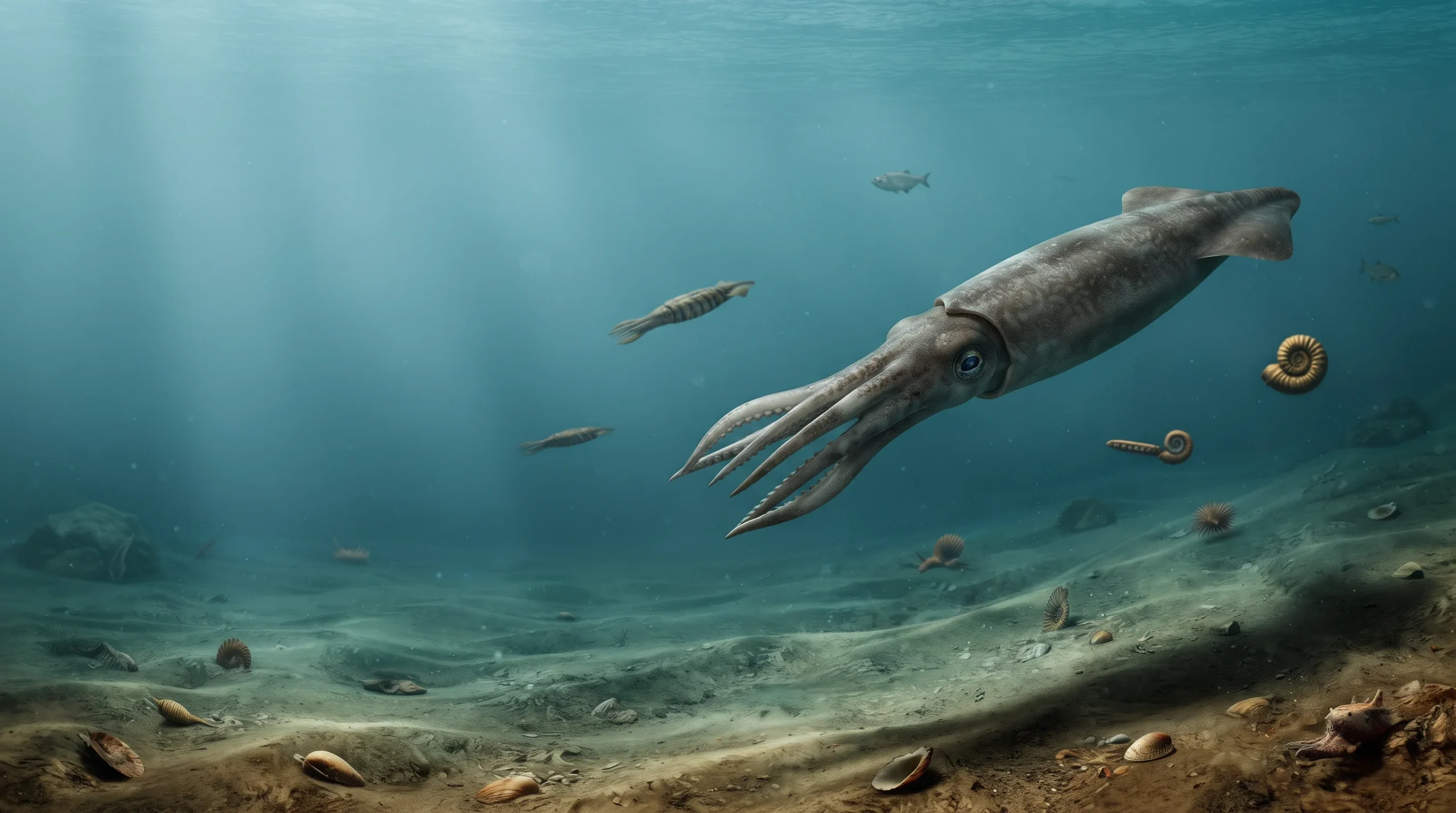
Imagine discovering a fossil in Wyoming that looks like a thick, oversized stone bullet. It might seem unremarkable beside the dramatic bones of dinosaurs, but its shape could tell a fascinating story about an ancient marine predator.
That is the appeal of Wyoteuthis, a name associated with an unusually robust belemnite-like fossil from Wyoming’s prehistoric marine deposits. Rather than a dinosaur or a fish, a belemnite belonged to an extinct group of squid-like cephalopods that once inhabited ancient oceans.
The story of this remarkable belemnite fossil opens a window into a time when parts of the American West lay beneath seawater. It also reveals how scientists use fossilized internal shells to investigate animals whose soft bodies disappeared millions of years ago.
There is one important scientific distinction: the description of Wyoteuthis as the “fattest belemnite ever found” should be treated as an informal characterization, not an established world record. A reliable comparison would require published measurements and a clear taxonomic assessment.
Table of contents
- What Is Wyoteuthis?
- The Ancient Ocean That Covered Wyoming
- Understanding the Belemnite Fossil: Anatomy and Function
- The Discovery That Made Wyoteuthis Extraordinary
- How and Why Did Wyoteuthis Develop Such a Thick Shell?
- How Scientists Identify an Ancient Belemnite Species
- Why This Belemnite Fossil Matters to Paleontology
- In Your Own Yard: Discovering the Geological Past
- Frequently Asked Questions
What Is Wyoteuthis?
Wyoteuthis is a name used for a distinctive fossil cephalopod associated with Wyoming. Its most attention-grabbing feature is the unusually thick, robust shape attributed to its preserved internal shell.
Belemnites were marine mollusks related to modern squid and cuttlefish. They belonged to the larger cephalopod group, which also includes octopuses and nautiluses.
Unlike the external spiral shells of many ammonites, belemnites carried an internal skeletal structure. The most commonly preserved part was the rostrum, sometimes called the guard.
This solid, usually bullet-shaped structure formed part of the rear section of the animal’s internal shell.
Why the Unusual Thickness Matters
Most familiar belemnite guards are elongated, tapering structures. Some are slender, while others are relatively stout.
An exceptionally broad specimen can attract scientific attention because body proportions may help paleontologists distinguish different fossil groups.
However, thickness alone does not establish a new species or prove that an animal was unusually large.
Researchers also examine the shape of the guard, its internal structures, its geological age, and the sedimentary layer in which it was discovered.
The exact classification, dimensions, and record status of Wyoteuthis require confirmation from a formal scientific description. Without that information, it is best understood as an intriguing fossil subject rather than a verified record-holder.
The Ancient Ocean That Covered Wyoming
Wyoming is famous for mountains, grasslands, fossil mammals, and dinosaurs. Yet its geological history also includes extensive marine environments.
During portions of the Mesozoic Era, shallow seas advanced across large areas of what is now North America.
The Western Interior Seaway became especially prominent during the Cretaceous Period, connecting northern and southern marine waters at various times.
Its waters supported diverse communities of marine animals.
These included ammonites, bivalves, fish, sharks, marine reptiles, and numerous smaller invertebrates.
A Very Different Wyoming Landscape
Picture a warm, shallow marine environment where suspended particles drifted through the water and predators searched for prey.
Instead of modern highways and ranchlands, some locations were submerged beneath marine waters.
Mud and other sediments accumulated on the seafloor. Over immense spans of geological time, these deposits hardened into sedimentary rocks.
Some of those rocks now preserve fossils that document the ancient marine ecosystems of the region.
Not every Wyoming marine fossil comes from the same period or environment. Determining the age of an individual specimen requires identifying its geological formation and stratigraphic position.
Why Marine Fossils Appear Far Inland
The presence of marine fossils in Wyoming is not evidence that ancient sea creatures traveled across modern dry land.
It reflects changes in sea level, continental geography, and the Earth’s crust over geological time.
As marine environments expanded and retreated, they left sedimentary deposits containing the remains of organisms that lived there.
Later uplift and erosion exposed some of those deposits at the surface.
Today, a fossil found on a dry Wyoming hillside may have originated in sediment deposited beneath an ancient sea.
Understanding the Belemnite Fossil: Anatomy and Function
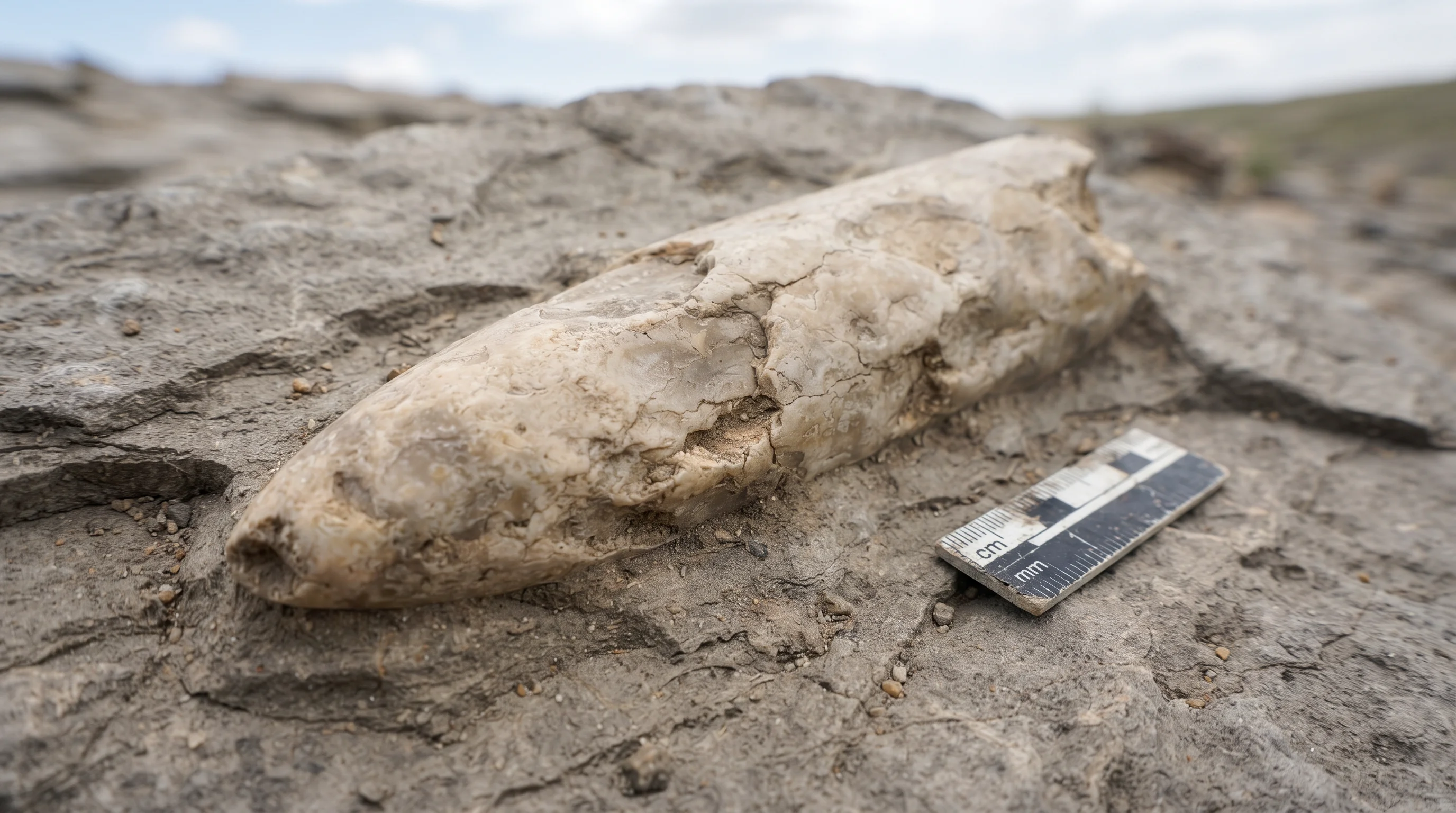
A belemnite fossil can look surprisingly simple, but its preserved anatomy provides valuable clues about the living animal.
The Rostrum: A Solid Internal Guard
The rostrum was a mineralized component of the belemnite’s internal shell.
In many belemnites, it consisted largely of calcite and surrounded or extended behind another shell structure called the phragmocone.
Because the rostrum was relatively resistant to decay, it commonly survived fossilization when soft tissues did not.
Its familiar tapered shape explains why belemnite guards have often been compared to bullets or pointed stones.
The Phragmocone: A Chambered Structure
The phragmocone was the chambered portion of the internal shell.
It played a role in the animal’s buoyancy system, although reconstructing precisely how different belemnites controlled their position in the water involves scientific interpretation.
This structure was more delicate than the solid guard and is less commonly preserved intact.
When researchers find both structures together, they can learn considerably more about the animal’s anatomy.
The Living Animal
The belemnite itself was not simply a pointed shell.
It was an active marine cephalopod with a soft body, arms, eyes, and a muscular swimming system.
Exceptional fossils from some locations preserve soft-tissue evidence, including arm hooks and other anatomical features.
These discoveries help scientists reconstruct animals that otherwise might be known only from their hard internal structures.
Belemnites likely occupied different ecological roles depending on their species, size, and environment.
Many were predators of smaller marine organisms, while also serving as prey for larger marine animals.
The Discovery That Made Wyoteuthis Extraordinary
In September 2026, an international research team formally described Wyoteuthis linsterorum as a new genus and species of belemnite.
The research, published in Papers in Palaeontology, examined two exceptionally unusual fossil guards from Wyoming’s Sundance Formation.
The fossils date to approximately 160 million years ago, during the Late Jurassic Period.
Their most remarkable characteristic is their extraordinary width.
The researchers documented rostra reaching approximately 6–7 centimeters (2.4–2.8 inches) across, making them the thickest belemnite guards currently known.
This confirms that the informal description of Wyoteuthis as the fattest known belemnite has a genuine scientific basis: it refers specifically to the thickness of the fossilized guard, not a measured body weight.
Only Two Known Specimens
Despite the abundance of belemnite fossils in Wyoming, researchers have identified only two specimens of this unusual species.
Both originated in the Redwater Shale Member of the Sundance Formation.
One specimen became the holotype, the reference fossil used to define the new species. The other was designated the paratype, providing additional evidence of its distinctive anatomy.
The species name linsterorum honors the Linster family, who discovered and donated the holotype for scientific study.
This highlights the important contribution that fossil discoveries and responsible donations can make to paleontology.
An Ancient Survivor
The discovery is significant for another reason.
Researchers assigned Wyoteuthis to the family Megateuthididae, a lineage that was much more widespread earlier in the Jurassic.
Most members of this family disappeared from the fossil record long before Wyoteuthis lived.
Its survival suggests that some ancient cephalopod lineages persisted in particular marine environments after becoming rare elsewhere.
The researchers proposed that Wyoteuthis represented a surviving branch of a once-successful group, possibly related to earlier forms such as Brevibelus.
How and Why Did Wyoteuthis Develop Such a Thick Shell?
The unusual proportions of Wyoteuthis raise an intriguing evolutionary question.
Why would a squid-like animal develop such a remarkably broad internal guard?
Scientists do not yet have a definitive answer, but several aspects of belemnite biology offer useful context.
Internal Shells and Swimming Balance
The mineralized rostrum formed part of the animal’s internal skeletal system.
In belemnites, the distribution of mass within the internal shell likely influenced body balance and swimming orientation.
A relatively heavy posterior structure could affect how the animal maintained its position in the water.
However, the precise swimming behavior of Wyoteuthis cannot be reconstructed from its guard alone.
The original study considers the possibility that its unusual proportions were associated with a specialized ecological lifestyle.
A Thick Fossil Does Not Mean a Giant Squid
This distinction is especially important.
Although the guard of Wyoteuthis was exceptionally thick, scientists cannot assume that the living animal was proportionally enormous.
Modern cephalopods demonstrate that body size, body shape, and internal skeletal structures do not always scale in simple ways.
The researchers specifically cautioned against interpreting the fossil’s width as proof that the animal occupied a particularly high position in the marine food web.
Its unusual structure may instead reflect adaptations that are not yet fully understood.
A Possible Shallow-Water Lifestyle
The researchers compared Wyoteuthis with other belemnites possessing relatively short, stout guards.
Some similarly shaped fossil cephalopods have been interpreted as animals associated with relatively shallow marine environments, potentially swimming close to the seafloor.
Such an interpretation remains tentative for Wyoteuthis.
With only two specimens available, there is insufficient evidence to reconstruct its exact swimming habits, diet, or preferred depth.
Nevertheless, its anatomy provides a starting point for future research into the ecological diversity of Jurassic cephalopods.
How Scientists Identify an Ancient Belemnite Species
Naming a new fossil species requires much more than noticing an unusual shape.
Paleontologists must determine whether the specimen differs consistently from previously described animals.
Comparing External Anatomy
Researchers examine features such as the overall proportions of the guard, the position of the pointed end, surface grooves, and the shape of the cavity that accommodated the chambered shell.
In Wyoteuthis, the combination of an exceptionally broad rostrum, a relatively blunt posterior region, and distinctive structural features supported its identification as a separate genus.
Looking Inside the Fossil
Modern fossil research can also involve computed tomography, or CT scanning.
This technology allows scientists to examine internal structures without cutting apart valuable specimens.
For Wyoteuthis, researchers used CT and micro-CT observations to investigate anatomical details and preservation.
These methods helped distinguish original biological structures from damage or alteration that occurred during fossilization.
Comparing Geological Ages
The age of the surrounding rock is another important clue.
A fossil’s position within a geological formation can reveal whether it lived alongside particular groups or survived long after related animals became uncommon.
In this case, the Late Jurassic age of Wyoteuthis helped researchers recognize its significance as a surviving member of an older evolutionary lineage.
Why This Belemnite Fossil Matters to Paleontology
The discovery of Wyoteuthis is about more than a remarkable measurement.
It illustrates how an uncommon fossil can challenge assumptions about the history of an entire animal group.
Before its identification, the known distribution of certain megateuthidid belemnites suggested that the family had largely declined much earlier.
The Wyoming specimens demonstrate that at least one distinctive branch survived into the Oxfordian stage of the Late Jurassic.
They also show that unusual anatomical forms can remain overlooked, even in geological formations that have been studied extensively.
For paleontologists, the discovery creates opportunities to reconsider the geographic distribution, evolutionary relationships, and ecological adaptations of ancient cephalopods.
It is a reminder that the fossil record remains incomplete. Even well-known formations can produce unexpected discoveries.
In Your Own Yard: Discovering the Geological Past
You probably will not discover a Jurassic belemnite while planting tomatoes or digging a flower bed.
However, ordinary rocks can still reveal fascinating clues about local geological history.
Learn About Your Local Bedrock
Start by exploring a geological map of your county or state.
The United States Geological Survey and state geological surveys provide resources explaining the ages and types of rocks found in different regions.
Sedimentary rocks are particularly interesting because they can preserve evidence of ancient environments.
Depending on your location, nearby rock exposures may contain shells, plant impressions, or other fossils.
Examine Rocks Carefully
A hand lens can reveal small details in stones, including layered structures, mineral grains, and possible fossil impressions.
Look for repeated biological patterns rather than assuming that every unusual shape is a fossil.
Photograph interesting specimens beside a ruler and record the location where they were found.
Avoid damaging exposed rock formations or disturbing protected fossil sites.
Respect Fossil Collection Rules
Fossil collecting regulations vary by location, land ownership, and fossil type.
National parks generally prohibit collecting fossils without authorization. Other public lands may have different rules for common invertebrate fossils.
Private property requires the landowner’s permission.
When an unusual specimen appears scientifically significant, contacting a local museum, university, or geological survey is often more valuable than attempting to extract it yourself.
A carefully documented discovery may preserve information that would otherwise be lost.
Frequently Asked Questions
1. What is Wyoteuthis linsterorum?
Wyoteuthis linsterorum is an extinct belemnite species formally described in 2026 from Late Jurassic fossils discovered in Wyoming.
It belonged to a group of squid-like marine cephalopods and is especially notable for its exceptionally thick internal shell guard.
2. Was Wyoteuthis the largest belemnite ever discovered?
Not necessarily.
Its fossilized rostrum is the thickest currently documented, reaching approximately 6–7 centimeters across.
However, the exceptional width does not establish that Wyoteuthis was the longest or heaviest belemnite.
The size of the complete living animal remains uncertain.
3. Where were the Wyoteuthis fossils found?
The two known specimens came from the Redwater Shale Member of the Sundance Formation in Wyoming.
These marine deposits formed during the Late Jurassic, approximately 160 million years ago.
Their discovery provides evidence of an unusual belemnite lineage surviving in the ancient marine environments of western North America.
Conclusion
A thick, seemingly ordinary fossil from Wyoming has revealed an unexpected chapter in the history of prehistoric oceans.
Wyoteuthis linsterorum was not simply another squid-like animal. Its exceptionally broad internal guard and surprising evolutionary relationships distinguish it from many better-known belemnites.
The discovery demonstrates that some ancient cephalopod lineages survived much longer than their previously known fossil records suggested.
It also reminds us that unusual anatomy does not always mean enormous body size.
This remarkable belemnite fossil preserves only part of an extinct animal, yet that fragment has helped scientists reconsider millions of years of evolutionary history.
And that brings us back to the oversized stone bullet: sometimes the most extraordinary prehistoric discoveries are hidden inside the simplest-looking fossils.
External Sources
1. Original Scientific Study
The Big Chunky Belemnite: A New Jurassic Species from Wyoming
Support the scientific identification of Wyoteuthis linsterorum, its unusual thickness, geological age, and evolutionary significance. Wiley — Papers in Palaeontology (2026), https://doi.org/10.1002/spp2.70123
2. Discovery of Wyoteuthis
Peculiar New Species of Jurassic Squid Found in Wyoming
Explain the fossil discovery, the specimens studied, and why this unusual prehistoric cephalopod attracted scientific attention. University of Manchester https://www.manchester.ac.uk/about/news/peculiar-new-species-of-jurassic-squid-found-in-wyoming/
3. Scientific Classification and Evolution
The Big Chunky Belemnite — Academic Research Record
Support information about the classification of Wyoteuthis, its relationship to other belemnites, and its importance to Jurassic evolutionary history. University of Manchester — Research Explorer https://research.manchester.ac.uk/en/publications/the-big-chunky-belemnite-a-new-relict-megateuthidid-from-the-oxfo/