
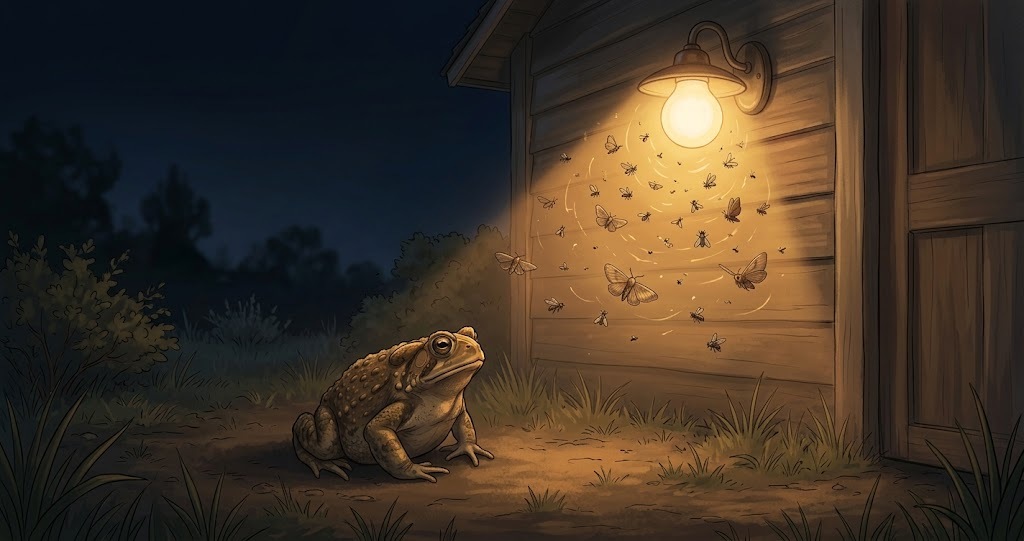
Walk outside after dark and you may notice a squat, brown toad sitting beneath your porch light. Come back tomorrow night, and it may be there again. After several evenings, it can start to look less like coincidence and more like a routine.
There is a practical explanation for this toad porch light behavior. American toads (Anaxyrus americanus) are primarily nocturnal predators, and artificial lights can create concentrated nighttime feeding opportunities by attracting flying insects. A porch, patio, or garage light can therefore become a productive place for a toad to wait for dinner.
The visitor may also spend its days surprisingly close by. Understanding how American toads feed, hide, and use backyard habitat explains why one individual can seem to become a regular part of your summer evenings.
Table of Contents
- Why Toads Appear at Porch Lights
- Understanding Toad Porch Light Behavior
- Why It May Be the Same Toad
- What American Toads Do During the Day
- What Toads Eat Around Your Home
- Why Toads Are Helpful Garden Predators
- Why Warm, Humid Nights Bring More Toad Activity
- Where Your Porch Toad Goes in Winter
- How to Make Your Yard Toad-Friendly
- Why Avoiding Pesticides Matters
- Providing Water Safely
- Creating Damp Daytime Shelter
- Common Myths About Backyard Toads
- Frequently Asked Questions
- Final Thoughts
Why Toads Appear at Porch Lights
To understand why a toad repeatedly appears beneath an outdoor light, start with the insects.
Moths, beetles, flies, and many other nocturnal insects gather around artificial lights. To a predator that hunts small moving invertebrates, that concentration can create a predictable feeding location.
American toads are well suited to exploiting such opportunities. The University of Michigan’s BioKIDS species account describes American toads as primarily nocturnal and notes that they are especially active during warm, humid weather. During daylight hours, they generally remain concealed beneath objects or in soil and leaf litter. (BioKIDS)
After dark, the situation changes. The toad emerges to forage.
If insects repeatedly accumulate beneath the same porch light, returning to that general area can be an efficient strategy. Instead of moving continuously through the yard searching for scattered prey, a toad can position itself where prey regularly passes within striking distance.
That is the basic ecological logic behind toad porch light behavior.
Understanding Toad Porch Light Behavior
American toads are not active pursuit hunters in the way a bird might chase insects through vegetation. Much of their feeding involves detecting nearby moving prey and striking rapidly when an opportunity appears.
Their tongue is specialized for capturing small animals. Penn State’s Ecologist’s Notebook describes American toads feeding on a broad range of prey, including flies, crickets, grasshoppers, beetles, spiders, caterpillars, earthworms, slugs, and snails. (Penn State Sites)
A porch light doesn’t necessarily attract the toad directly in the same way it attracts a moth. The more important attraction is often the food associated with the illuminated area.
Think of the light as creating a tiny feeding station.
Insects fly toward it, land on nearby walls, drop to the ground, or crawl through the vegetation underneath. The toad waits below, where many of those animals eventually become accessible.
This can make toad porch light behavior particularly noticeable during summer, when both insects and amphibians are active.
Why It May Be the Same Toad
Seeing a toad beneath your porch light several nights in a row doesn’t prove with certainty that you’re looking at the same individual. More than one toad can use a productive backyard.
However, American toads are not necessarily wandering randomly across the landscape every night.
The University of Michigan describes them as solitary and includes sedentary behavior among their behavioral characteristics. American toads can occupy gardens, agricultural areas, forests, and suburban landscapes when appropriate shelter, food, and breeding habitat are available. (BioKIDS)
A useful feeding site gives an animal little reason to abandon the general area immediately.
If your porch offers abundant insects at night and your landscaping provides moist hiding places during the day, a toad may be able to satisfy several important needs within a relatively small part of your property.
This is why toad porch light behavior can feel remarkably predictable. You may see the animal sitting within a few feet of yesterday’s position night after night.
What American Toads Do During the Day
The disappearance of your nighttime visitor after sunrise doesn’t necessarily mean it traveled far away.
American toads are adapted to conserve moisture. Unlike reptiles, amphibians have highly permeable skin, which makes access to humid retreats especially important.
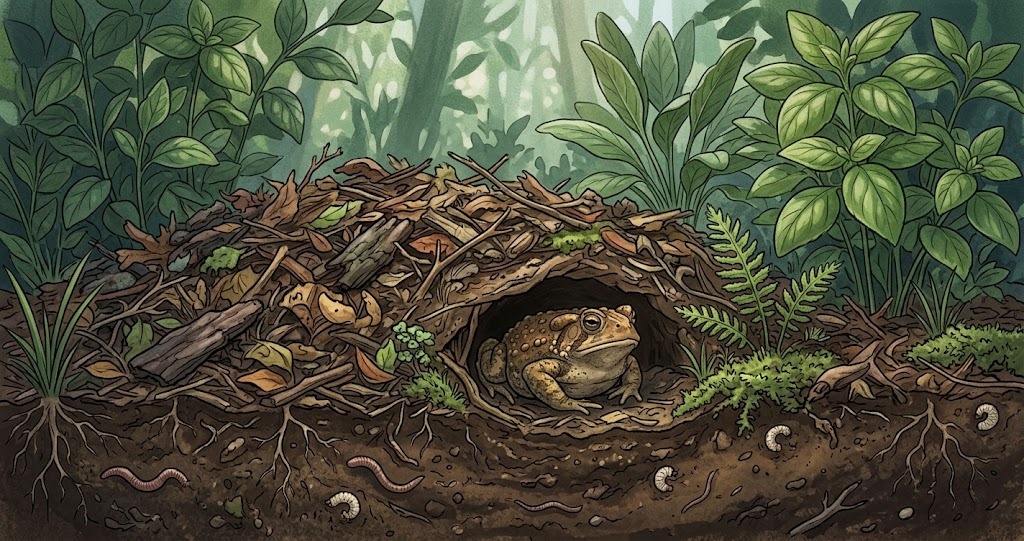
According to the University of Michigan’s BioKIDS account, American toads commonly spend daylight hours beneath porches, boards, flat stones, logs, wood piles, and other cover. They may also dig into soil and dead leaves. (BioKIDS)
Penn State similarly notes that American toads typically spend daylight hours in shallow soil burrows, beneath logs, or within leaf piles before emerging at night to feed. (Penn State Sites)
That means the toad beneath your porch at 10 p.m. could spend the following afternoon beneath a nearby shrub, log, stone, deck edge, or patch of leaf litter.
It doesn’t need an elaborate underground tunnel. A protected retreat that remains cooler and more humid than the exposed surface can provide valuable daytime shelter.
What Toads Eat Around Your Home
American toads are generalist predators rather than specialists.
They consume whatever appropriately sized prey is available, including beetles, flies, crickets, caterpillars, spiders, earthworms, slugs, and other invertebrates. (Penn State Sites)
That flexibility is one reason gardens can be good habitat. A diverse yard contains insects and other small animals at ground level, in mulch, beneath leaves, around vegetable beds, and near outdoor lights.
Toads primarily respond to moving prey. When an insect crawls or lands within range, the toad can capture it with a rapid extension of its sticky tongue.
You may occasionally see this happening beneath your porch light. The toad appears motionless for long stretches, then suddenly lunges or flicks its tongue toward something that you barely noticed.
The waiting isn’t inactivity. It is hunting.
Why Toads Are Helpful Garden Predators
Gardeners sometimes assume any unfamiliar animal among vegetable beds must be causing damage. With American toads, the opposite is usually closer to reality.
Adult toads are predators, not plant eaters. They aren’t visiting your lettuce bed because they want the lettuce.
They are interested in the small animals moving around it.
The University of Minnesota Extension specifically lists toads among the natural enemies that feed on slugs and recommends encouraging natural predators where practical. (Extension de l’Université du Minnesota)
Toads shouldn’t be presented as a complete pest-control system. They won’t selectively eliminate every insect that gardeners consider undesirable, and their diet can include both pest and non-pest invertebrates.
Instead, think of them as one component of a functioning backyard food web.
That principle also applies to other ecological gardening strategies. Our guide to Companion Planting That Actually Works explains how useful garden relationships are often based on real functions such as habitat, physical structure, and interactions among organisms rather than exaggerated claims.
A yard containing toads, ground beetles, spiders, birds, and beneficial insects has multiple predators operating at different times and in different places.
Warm, Humid Nights Can Increase Activity
If your porch toad seems especially reliable after rain, there is another biological reason.
American toads are primarily nocturnal and are particularly active when conditions are warm and humid. (BioKIDS)
Moist conditions reduce the risk of dehydration as the animal moves across exposed ground. Rain and humidity can also influence the activity of worms, slugs, insects, and other potential prey.
A warm summer evening following rain can therefore produce ideal conditions.
You may notice a toad emerging earlier, traveling farther into an open area, or remaining visible for longer than it does during a dry spell.
During very hot or dry conditions, the opposite may happen. The animal may remain concealed in a humid refuge rather than risk excessive moisture loss.
Where Your Porch Toad Goes in Winter
American toads don’t spend freezing winters sitting beneath porch lights.
As temperatures fall, they retreat underground and enter winter dormancy. Penn State notes that their inactive season is spent in deeper hibernation burrows dug into the soil. (Penn State Sites)
American toads are capable diggers. They typically enter the soil backward, using their hind legs to move dirt as they disappear below the surface. (BioKIDS)
The depth and location of the winter refuge depend on local conditions. The goal is to reach a protected position where the animal can avoid lethal freezing.
When spring temperatures return, surviving adults emerge and become active again.
So if your familiar porch visitor disappears in fall, that doesn’t necessarily mean it has permanently left your yard.
How to Make Your Yard Toad-Friendly
You don’t need to turn your backyard into a swamp to support American toads.
The most useful approach is to provide several small habitat features rather than creating one elaborate “toad habitat.”
Avoid unnecessary pesticides
Start by reducing broad pesticide use.
A yard treated heavily for insects can create two problems for insect-eating wildlife: it removes potential prey and can expose non-target animals to chemicals.
Integrated pest management is a better approach. Identify the actual problem first, tolerate minor damage when possible, and use targeted controls only when intervention is necessary.
The University of Minnesota Extension notes that pesticides used against slugs can also affect natural enemies and recommends encouraging predators such as toads when practical. (Extension de l’Université du Minnesota)
A healthy predator community is one more reason to avoid treating every insect sighting as an emergency.
Provide a shallow water source
Adult American toads are terrestrial, so they don’t need to sit in a pond every night.
They do, however, depend heavily on moisture. A shallow dish placed at ground level can provide a useful backyard water source during dry weather.
Keep it genuinely shallow and make sure the animal can enter and leave easily. A plant saucer or similar low container can work.
Replace the water regularly rather than allowing it to become stagnant. Avoid adding chemicals.
If you already have a wildlife pond, shallow edges and easy exit routes are valuable features for amphibians and other small animals.
Leave damp shelter spots
A perfectly stripped garden can be surprisingly unfriendly to wildlife.
American toads use leaf litter, logs, boards, stones, vegetation, and other protected spaces as daytime cover. (BioKIDS)
You don’t need to leave the entire yard untidy. Instead, preserve a few sheltered areas beneath shrubs or at the back of garden beds.
A layer of leaves beneath native plants, a partially embedded log, or a shady area with undisturbed ground can create valuable cover.
You can also make a simple toad shelter using an overturned terracotta pot with an entrance large enough for the animal to pass through. Position it in shade where the soil remains relatively cool.
Don’t Move a Toad Just Because You Keep Seeing It
A toad sitting beside the porch generally doesn’t need to be relocated.
If it has selected that area voluntarily, the site is probably providing something useful. Moving it to a location that appears more “natural” to us may remove it from familiar shelter and feeding opportunities.
The exception is immediate danger.
A toad trapped in a window well, swimming pool, roadway, or another hazardous location may need assistance. When possible, move it only the minimum distance necessary to place it out of danger.
Otherwise, watching from a respectful distance is usually the best option.
Common Myths About Backyard Toads
Myth: Toads give people warts
They do not.
The bumps on a toad’s skin are normal anatomical structures, not human warts. American toads do possess defensive skin secretions, particularly from the prominent parotoid glands behind their eyes, so handling them unnecessarily is still best avoided. (Penn State Sites)
Keep pets from mouthing or biting toads, and wash your hands if contact occurs.
Myth: A toad in the garden is eating your plants
Adult American toads are carnivorous predators.
If one is sitting beside your tomatoes, squash, or flowers, it is much more interested in moving invertebrates than the plants themselves.
Myth: Toads need a permanent pond to live in your yard
Adult American toads spend much of their lives on land.
Water becomes particularly important for reproduction because their eggs and tadpoles develop in freshwater. University of Michigan notes that American toads require freshwater pools or ponds for early development but can occupy many terrestrial habitats as adults. (BioKIDS)
A backyard without a pond can therefore still serve as adult foraging and shelter habitat when breeding water exists somewhere in the surrounding landscape.
Myth: Seeing the same toad means it is trapped
Repeated appearances don’t automatically indicate a problem.
If the animal disappears during daylight and returns voluntarily at night, the more likely explanation is that the area provides suitable cover, moisture, or prey.
Frequently Asked Questions
Why does a toad sit under my porch light every night?
Outdoor lights often concentrate nighttime insects. Because American toads are nocturnal predators, the illuminated area can become a productive place to wait for prey.
Is it really the same toad every night?
It can be, although appearance alone may not allow you to identify an individual with certainty. American toads can remain associated with suitable habitat, and a reliable feeding area combined with nearby shelter can encourage repeated use of the same part of a yard.
Where does the toad go during the day?
It may be much closer than you think. American toads commonly shelter beneath logs, stones, boards, porches, leaf litter, vegetation, or shallow soil during daylight. (BioKIDS)
Are American toads good for vegetable gardens?
Generally, yes. They eat many kinds of invertebrates, including slugs and insects, and do not feed on garden plants. They should be considered part of the garden’s broader predator community rather than a guaranteed solution to any one pest.
Should I leave water out for a toad?
A shallow, easily accessible water dish can provide useful moisture during dry periods. Keep the container shallow, change the water frequently, and don’t add pesticides or other chemicals.
Should I turn off my porch light to protect the toad?
You don’t need to keep a light on specifically for a toad. Artificial lighting has broader ecological effects on nocturnal wildlife and insects, so unnecessary outdoor lighting can be reduced when it isn’t needed for safety.
The toad’s real requirements are prey, moisture, shelter, and suitable surrounding habitat—not the bulb itself.
Can I build a shelter for it?
Yes. A shaded, partially buried terracotta pot or another simple shelter can provide a cool retreat.
Natural cover is equally useful. Leaf litter, logs, dense vegetation, and protected spaces beneath stones or garden structures provide the kinds of hiding places American toads naturally use.
Final Thoughts
Once you understand toad porch light behavior, that nightly visitor becomes much less mysterious.
American toads are predominantly nocturnal hunters. During daylight they retreat into soil, leaf litter, or protected spaces beneath logs, stones, boards, porches, and vegetation. At night, they emerge to search for insects and other small prey. (Penn State Sites)
A porch light can accidentally create a dependable hunting opportunity by concentrating insects in one small area. If suitable daytime shelter is nearby, a toad may repeatedly use that part of your property rather than wandering elsewhere.
That makes the simplest response surprisingly easy: allow it to do what it is already doing.
Reduce unnecessary pesticide use, maintain a few cool and damp hiding places, provide shallow clean water during dry weather, and avoid disturbing the animal unnecessarily.
The toad beneath your porch light isn’t waiting to get inside your house. It may simply have discovered one of the most reliable nighttime restaurants in the neighborhood.
Internal Link Suggestions:
Companion Planting That Actually Works
Why Yellowjackets Get More Aggressive in Late Summer
External Dofollow Authoritative Sources:
University of Michigan BioKIDS — American Toad (Anaxyrus americanus)
https://www.biokids.umich.edu/critters/Anaxyrus_americanus/
Penn State — American Toad, American Lawns
https://sites.psu.edu/ecologistsnotebook/2008/04/21/american-toad-american-lawns/
University of Minnesota Extension — Slugs in Home Gardens
https://extension.umn.edu/yard-and-garden-insects/slugs