
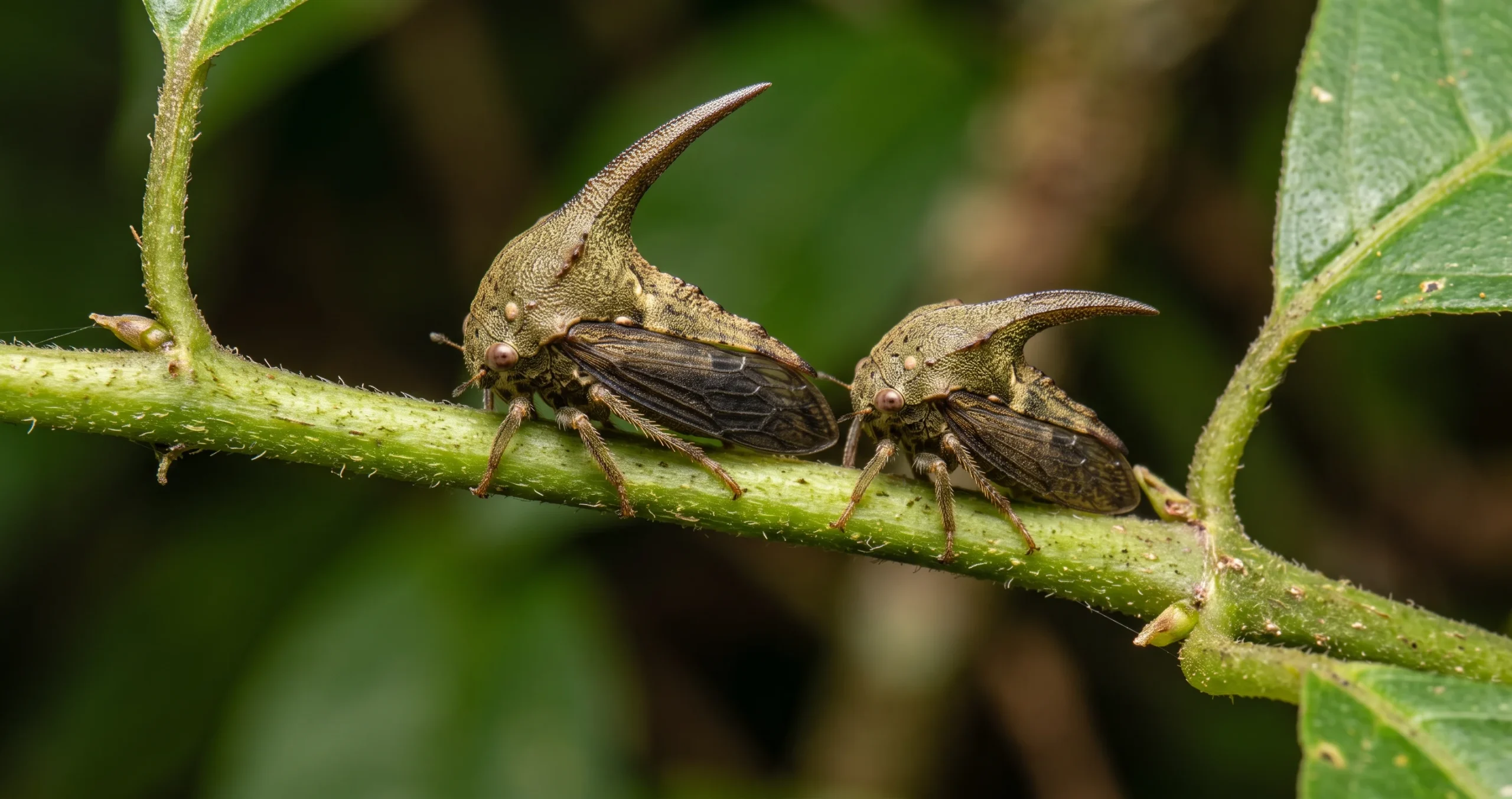
A tiny insect resting on a branch can look so much like a thorn that it becomes difficult to recognize as an animal. This remarkable resemblance is known as treehopper thorn mimicry, one of the most fascinating examples of unusual body structure in the insect world.
Treehoppers belong to the family Membracidae, a diverse group of plant-feeding insects recognized for their extraordinary shapes. Some resemble sharp thorns, while others have elaborate projections, horns, or helmet-like structures.
Their appearance is only part of the story. Treehoppers also feed on plant fluids, communicate through vibrations traveling along stems, and sometimes form cooperative relationships with ants.
Understanding treehopper thorn mimicry reveals how anatomy, communication, and ecological relationships can shape the survival strategies of small insects.
Table of Contents
- Treehoppers and Their Unusual Anatomy
- The Science Behind Treehopper Thorn Mimicry
- The Enlarged Pronotum and Its Development
- Treehopper Camouflage and Predator Avoidance
- Plant Sap Feeding and Specialized Mouthparts
- Treehopper Communication Through Plant Vibrations
- Courtship, Warning Signals, and Social Behavior
- Treehopper Relationships With Ants
- Maternal Care and Protection of Young
- Treehopper Habitats and Global Diversity
- Natural Predators and Ecological Importance
- Treehoppers in Gardens and Agricultural Landscapes
- Frequently Asked Questions
- Conclusion
Treehoppers and Their Unusual Anatomy
Treehoppers are small insects belonging to the order Hemiptera, which also includes cicadas, aphids, and leafhoppers.
Most are relatively small, often measuring only a few millimeters to around a centimeter in body length, although dimensions vary considerably among species.
Their bodies possess the typical insect arrangement of a head, thorax, and abdomen, along with six legs and specialized feeding structures.
What makes many treehoppers immediately recognizable is the enlarged pronotum.
The pronotum is a plate forming part of the first thoracic segment, directly behind the head.
In many insects, this structure is relatively modest. In treehoppers, however, it can extend into extraordinary shapes.
Some species have a single pointed projection resembling a thorn. Others display rounded helmets, branching structures, or elaborate spines.
These unusual forms have made treehoppers important subjects in studies of insect morphology, evolution, and behavior.
The Science Behind Treehopper Thorn Mimicry
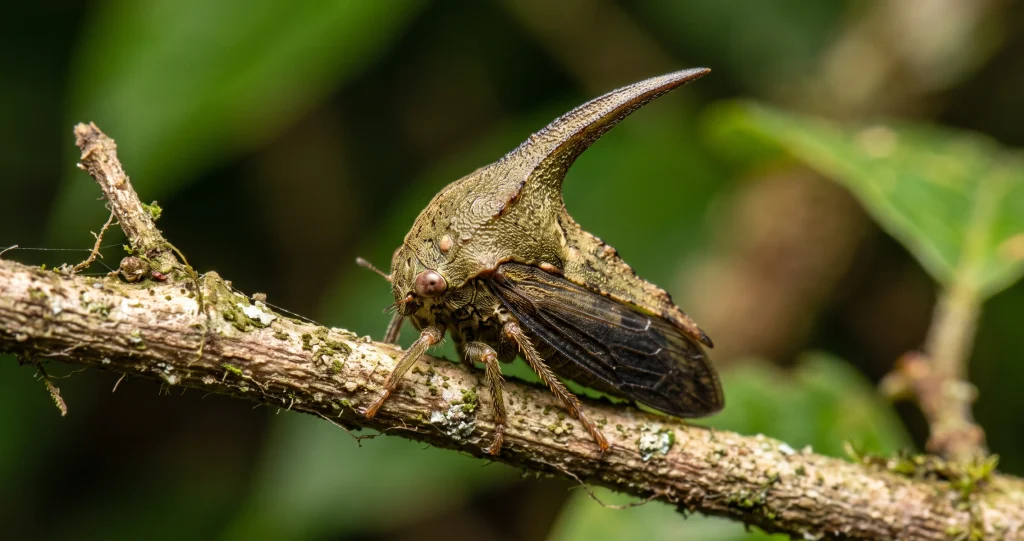
Treehopper thorn mimicry occurs when an insect’s body shape resembles a thorn or another natural structure on a plant.
A thorn-like treehopper resting motionlessly along a branch may blend into the surrounding vegetation.
The resemblance can be especially convincing when its body color matches the bark or stem.
The Difference Between a Thorn and a Treehopper
A true plant thorn is a modified branch or stem structure. Spines and prickles are different botanical structures that can also appear sharply pointed.
A treehopper’s thorn-like projection, by contrast, is part of its body.
It develops from the insect’s thoracic exoskeleton and moves with the animal.
Closer examination reveals compound eyes, jointed legs, folded wings, and feeding mouthparts.
Unlike a plant thorn, the insect can walk, jump, feed, and fly when its wings are fully developed.
The Evolutionary Significance of Thorn-Like Shapes
Researchers have proposed that thorn-like body forms may make some treehoppers less recognizable to visually hunting predators.
This explanation is biologically plausible because predators often use shape, color, and movement to identify prey.
However, resemblance alone does not establish how effective a particular body shape is against predators.
Different treehopper species may experience different selective pressures, and their unusual structures may have multiple functions.
Therefore, treehopper thorn mimicry should be understood as a potential defensive adaptation whose effectiveness can vary among species and environments.
The Enlarged Pronotum and Its Development
The treehopper pronotum is one of the most structurally diverse features found among insects.
Its unusual appearance results from modifications in the growth and development of the thoracic exoskeleton.
During immature stages, treehoppers undergo a series of molts as they develop toward adulthood.
The final adult form may possess a much more elaborate pronotum than the immature stages.
A Remarkable Evolutionary Structure
Scientific research has investigated the developmental processes responsible for the extraordinary diversity of treehopper pronotal shapes.
The enlarged structure is associated with the first thoracic segment rather than being an additional pair of wings.
This distinction is important because earlier interpretations of treehopper morphology generated debate about whether the pronotum represented a novel wing-like structure.
Subsequent developmental and anatomical research has examined these competing interpretations.
The resulting diversity demonstrates how evolutionary changes in an existing body region can produce striking differences in appearance.
Treehopper Camouflage and Predator Avoidance
Camouflage involves characteristics that make an organism harder to detect or recognize against its surroundings.
In thorn-like treehoppers, body shape and coloration may work together to reduce visual recognition.
A brown or green insect with a pointed pronotum can resemble a small projection on a woody stem.
Remaining still may further strengthen that resemblance.
The Limits of Camouflage
Treehopper thorn mimicry does not make an insect invisible.
Birds, spiders, predatory insects, and other animals may still detect and capture treehoppers.
Some predators rely on movement, while others use additional sensory information.
Furthermore, not every member of the Membracidae family resembles a thorn.
Some species possess unusual structures that do not closely resemble any obvious plant defense.
The function of these forms should be evaluated individually rather than assuming that all elaborate pronotums evolved for camouflage.
Plant Sap Feeding and Specialized Mouthparts
Treehoppers obtain nourishment using piercing-sucking mouthparts.
These mouthparts form a slender feeding apparatus called a rostrum, which contains specialized stylets.
The stylets penetrate plant tissues and allow the insect to access fluids from vascular structures.
Many treehoppers feed primarily on phloem sap, a sugar-rich fluid that transports products of photosynthesis through plants.
Feeding preferences vary among species, and some can use other plant tissues.
The Relationship Between Treehoppers and Host Plants
Treehoppers may feed on stems, twigs, and other suitable plant parts.
Different species specialize in different host plants, while others use a broader range.
Their feeding can influence plant health, particularly when many individuals concentrate on the same plant.
However, occasional treehopper activity does not automatically indicate serious damage.
The consequences depend on the species, host plant, insect abundance, and growing conditions.
Treehopper feeding also contributes to relationships involving ants, predators, and other organisms within plant communities.
Treehopper Communication Through Plant Vibrations
One of the most remarkable aspects of treehopper biology is their ability to exchange information through mechanical vibrations.
Unlike animals that rely primarily on airborne sounds, many treehoppers transmit signals through the plants on which they live.
This process is called substrate-borne vibrational communication.
The Production of Vibrational Signals
Treehoppers can generate vibrations through specialized body movements and muscular activity.
These movements transfer mechanical energy into the stem or leaf supporting the insect.
The resulting signals travel through plant tissues.
Other individuals in contact with the same plant can detect these vibrations using specialized mechanosensory structures.
The signals may contain information encoded in their timing, duration, rhythm, and frequency.
Vibrations Traveling Through Plant Stems
A plant stem acts as a physical transmission pathway.
When one treehopper produces a vibrational signal, mechanical waves travel along the connected plant structure.
The properties of the stem influence how these waves move.
Stem thickness, stiffness, branching, and distance can affect the signal received by another insect.
This communication system is especially useful for animals that spend much of their lives on plants.
Although the vibrations are generally difficult for humans to hear without specialized equipment, they can carry meaningful information between insects.
Courtship, Warning Signals, and Social Behavior
Treehopper vibration communication serves several documented biological functions.
One important function is reproductive communication.
Courtship and Mate Recognition
In certain species, males produce characteristic vibrational signals during courtship.
Females may respond with their own signals, creating an exchange that helps individuals locate or recognize potential mates.
Signal patterns can differ among species.
These differences may help reduce confusion between closely related insects sharing the same habitat.
Predator Warnings and Family Communication
Research on the thornbug treehopper, Umbonia crassicornis, has demonstrated vibrational communication between mothers and their offspring.
When young treehoppers encounter a disturbance or potential threat, they can produce coordinated signals.
The attending female responds to these signals and may display defensive behavior.
This is an especially compelling example of communication contributing to parental care.
However, such behavior should not be generalized to every treehopper species.
Some are relatively solitary, while others form aggregations or display complex social interactions.
Treehopper Relationships With Ants
Many treehoppers produce honeydew, a sugar-rich waste fluid associated with their plant-sap diet.
Honeydew can attract ants.
In some species, ants regularly visit treehopper groups to collect this sugary resource.
In return, the ants may defend the insects against certain predators or parasitoids.
This relationship is known as mutualism when both partners benefit.
Benefits and Limitations of Ant Attendance
Treehoppers provide a food resource, while ants may reduce the risk of attack.
However, the strength and outcome of the relationship depend on the species involved and environmental conditions.
Not all treehoppers receive ant protection.
Some interactions may also involve costs, including competition or changes in feeding behavior.
These relationships illustrate how a small sap-feeding insect can influence a larger network of organisms living on the same plant.
Maternal Care and Protection of Young
Parental care is relatively uncommon among insects compared with many vertebrates, but some treehoppers provide striking examples.
In certain species, females remain near their eggs and newly hatched offspring.
A female may guard an egg mass against predators or parasitoids.
After hatching, young nymphs may remain grouped together on the host plant.
In species such as Umbonia crassicornis, maternal defense is associated with the detection of vibrational signals from offspring.
These behaviors can improve offspring survival under particular conditions.
Nevertheless, maternal care varies across the family, and many treehoppers do not exhibit the same level of parental investment.
Treehopper Habitats and Global Diversity
Treehoppers occur across much of the world, with particularly high diversity in tropical regions of the Americas.
They inhabit forests, woodlands, grasslands, gardens, and other environments containing suitable host plants.
Their distribution is strongly influenced by vegetation, climate, and host-plant availability.
A Family of Extraordinary Shapes
The family Membracidae includes thousands of described species.
Some resemble thorns, while others display structures resembling helmets, branches, or unusual ornamental projections.
Species such as the buffalo treehopper and thornbug treehopper are familiar examples in North America.
Other species occur in tropical forests, where complex plant communities support diverse insect populations.
The extraordinary variety of pronotal forms makes this family particularly interesting for evolutionary research.
Natural Predators and Ecological Importance
Treehoppers occupy several positions within terrestrial food webs.
As plant feeders, they consume resources produced by vegetation.
As prey, they provide food for spiders, birds, predatory insects, and other animals.
Their eggs and immature stages may also be attacked by parasitoids and specialized predators.
Ant-attended treehoppers can influence interactions between plants, herbivores, and predatory insects.
Treehopper thorn mimicry represents one possible defensive strategy within this broader ecological network.
Their survival depends not only on their appearance but also on their behavior, host plants, and surrounding community.
Treehoppers in Gardens and Agricultural Landscapes
Treehoppers are sometimes found on ornamental shrubs, fruit trees, and other garden plants.
Many species cause little noticeable damage when present in small numbers.
However, certain species can become agricultural pests.
Heavy feeding, egg-laying injuries, or large aggregations may affect vulnerable plants.
Responsible Garden Management
Gardeners should identify the insect and assess actual plant damage before considering control measures.
A few treehoppers resting on branches do not necessarily require intervention.
Maintaining diverse vegetation and supporting natural predators can contribute to balanced garden ecosystems.
When a genuine infestation occurs, management should be based on the specific species and host plant rather than treating all treehoppers as harmful.
Frequently Asked Questions About Treehoppers
Are treehoppers dangerous to humans?
Treehoppers are not considered dangerous to people. They feed on plants using specialized mouthparts and do not possess venomous stingers. Their thorn-like structures are part of their exoskeleton rather than weapons designed to attack humans.
Do treehoppers bite humans?
Treehoppers are specialized plant feeders and do not normally bite people. Their piercing-sucking mouthparts are adapted for accessing plant fluids rather than feeding on human blood or skin.
Can treehoppers damage plants?
Some species can damage plants when populations become large. Feeding activity or egg-laying may affect stems and other tissues. However, many treehoppers occur at low densities and cause little noticeable injury.
Can treehoppers fly and jump?
Yes. Adult treehoppers generally possess functional wings and can fly. They also have jumping abilities that help them move between plant surfaces or escape disturbances.
Do treehoppers communicate through sound?
Many treehoppers communicate through vibrations transmitted along plants. These mechanical signals are different from ordinary airborne sounds, although specialized recording equipment can detect and convert them into signals people can hear.
Does thorn mimicry protect treehoppers from predators?
Thorn-like shapes may make certain species harder for visually hunting predators to recognize. However, the degree of protection varies and cannot be assumed for every species without supporting evidence.
Do all treehoppers look like thorns?
No. The family includes species with pointed horns, rounded helmets, branching projections, and relatively simple body shapes. Thorn mimicry represents only one part of their remarkable anatomical diversity.
Do treehoppers live in groups?
Some species form groups, particularly during immature stages. Others are more solitary. Social organization varies, and certain species exhibit maternal care, ant associations, and coordinated vibrational communication.
Conclusion
Treehoppers demonstrate that remarkable biological adaptations can occur in animals only a few millimeters long.
Their enlarged pronotums create some of the most unusual silhouettes in the insect world, while their feeding structures allow them to obtain nutrients from living plants.
Treehopper thorn mimicry may help certain species remain inconspicuous, but their survival involves much more than appearance.
Their ability to exchange vibrations through stems, maintain relationships with ants, and protect offspring in some species reveals a surprisingly complex natural history.
These insects offer a valuable reminder that even the smallest organisms can participate in intricate ecological relationships that help shape the living world.
Internal Sources :
- Insect Orders Explained: A Beginner’s Guide — useful in the opening anatomy section.
- How Antlion Larvae Build Pit Traps to Ambush Prey — a related example of unusual insect survival adaptations.
External Sources :