
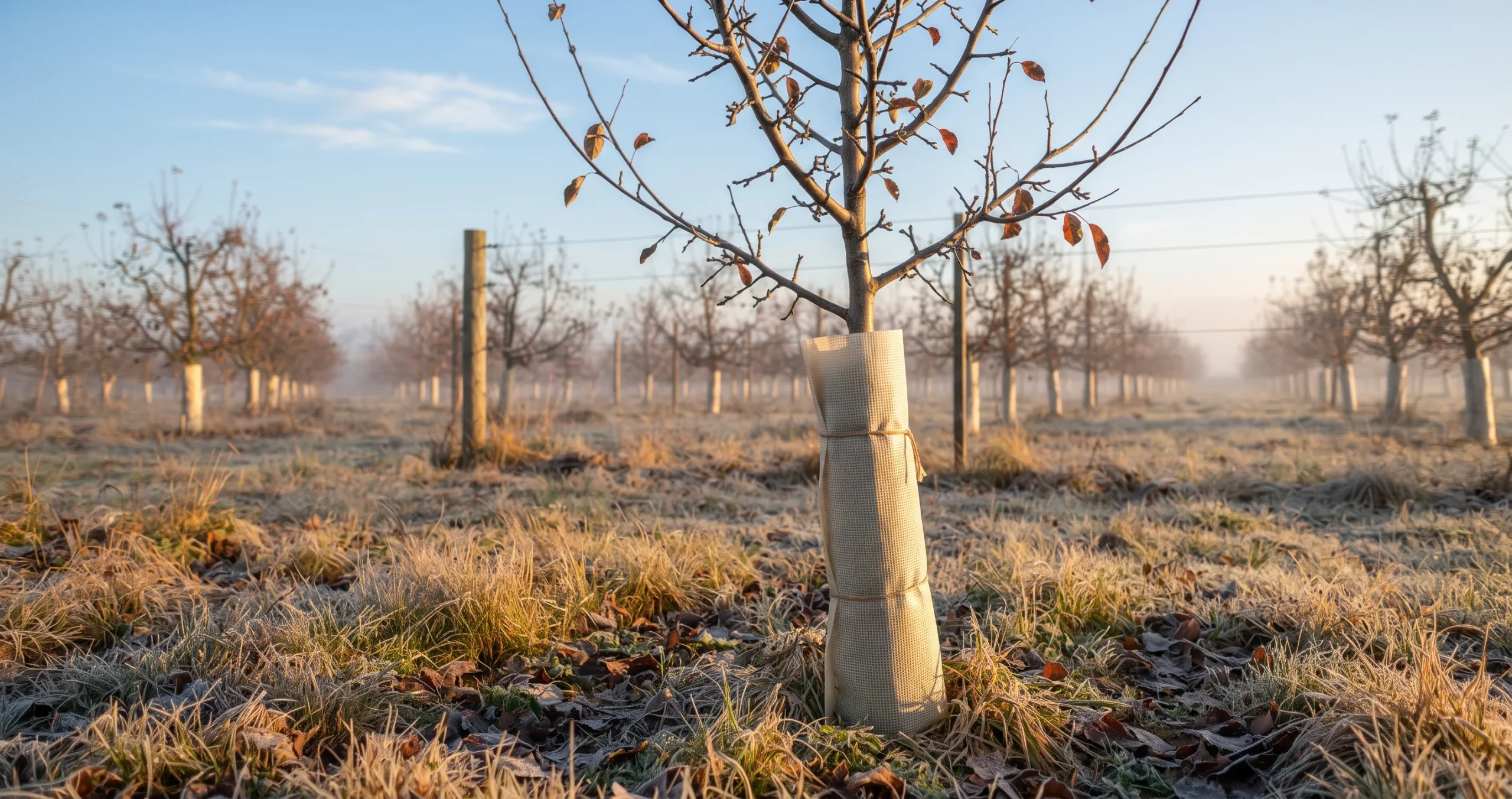
A young apple tree can look perfectly healthy in November and develop a long, damaged patch of bark by spring. One possible cause is sunscald on trees, a winter injury that happens when strong sunlight warms exposed bark and freezing temperatures follow.
This damage is especially common on young trees with thin bark, particularly on the south and southwest sides of their trunks in the Northern Hemisphere. A sunny winter afternoon may seem harmless, but rapid temperature changes can injure living tissues beneath the bark.
Fortunately, winter sunscald is often preventable. With the right trunk protection, sensible planting choices, and timely spring maintenance, gardeners can help young trees establish healthy bark as they mature.
Table of Contents
- What Is Sunscald on Trees?
- Which Trees Are Most at Risk?
- When to Wrap Young Trees for Winter
- Choosing the Best Materials for Tree Wrapping
- How to Wrap a Young Tree Trunk Step by Step
- When to Remove Tree Wrap in Spring
- Alternatives to Wrapping Tree Trunks
- How to Recognize Sunscald Damage
- How to Care for a Sunscald-Damaged Tree
- Common Mistakes to Avoid
- Frequently Asked Questions
What Is Sunscald on Trees?
Winter sunscald is a type of bark injury associated with strong sunlight and sudden temperature changes during cold weather.
On a clear winter day, sunlight can warm the exposed side of a tree trunk considerably above the surrounding air temperature. This warming may reduce the cold hardiness of living bark tissues.
When temperatures drop rapidly after sunset, those tissues can freeze and become damaged.
The injury commonly affects the south or southwest side of the trunk, where afternoon sunlight is often strongest. The damage may not become obvious until weeks or months later.
Why young bark is especially vulnerable
Young trees have relatively thin bark that provides less insulation against rapid temperature changes.
As trees mature, many species develop thicker bark that offers greater protection. However, bark thickness and susceptibility vary among species.
Winter sunscald is sometimes confused with summer sunburn, which occurs when intense heat and sunlight damage exposed bark. Although both involve sunlight, the underlying environmental conditions are different.
Which Trees Are Most at Risk?
Not every tree has the same susceptibility to winter sunscald.
Young, newly planted trees are particularly vulnerable because their bark has not yet developed substantial protective thickness. Trees moved from shaded nursery conditions into exposed landscapes may also experience increased sunlight on previously protected bark.
Apple and crabapple trees
Young apple and crabapple trees can develop winter bark injuries, especially in exposed planting sites.
Their lower trunks may receive direct afternoon sunlight during winter, particularly when surrounding vegetation has lost its leaves.
Protecting these trunks during the establishment period can reduce the risk of temperature-related injury.
Cherry and other stone fruit trees
Cherry trees are another group worth monitoring.
Their relatively thin bark can be vulnerable to winter injury, especially in climates with bright sunshine followed by freezing nights.
Young ornamental cherries and fruit-producing cherries may both benefit from appropriate trunk protection.
Maple trees
Certain maples, including young red maples and other thin-barked species, can be susceptible to sunscald.
Newly planted specimens in open lawns or exposed streetscapes may receive intense winter sunlight on their lower trunks.
Other trees that can experience similar injuries include some lindens, honey locusts, and ornamental species with thin or smooth bark.
The need for protection depends on species, age, local climate, and exposure rather than a universal rule that every tree must be wrapped.
When to Wrap Young Trees for Winter
The best time to install winter trunk protection is generally late fall, after the growing season has ended and before persistent freezing weather arrives.
In many cold regions, this means sometime between October and December, although local conditions matter more than a particular calendar date.
Wrapping too early can keep the trunk covered during warm, moist weather when protection is unnecessary.
The goal is to have the protective material in place before repeated cycles of sunny winter afternoons and freezing nights.
How many winters should a tree be protected?
Some young, thin-barked trees may benefit from protection for their first several winters after planting.
The exact duration depends on how quickly the bark matures and how exposed the planting site is.
A newly planted tree in an open, snowy landscape may face greater risk than a similar tree in a sheltered garden.
Rather than wrapping indefinitely, reassess the tree’s bark and growing conditions each fall.
Choosing the Best Materials for Tree Wrapping
An effective winter trunk covering should reduce direct solar heating without trapping excessive moisture or constricting the trunk.
Light-colored materials are generally preferred because they reflect more sunlight than dark coverings.
Light-colored commercial tree wrap
Purpose-made paper or fabric tree wrap is a common option for young trunks.
Choose a product intended for seasonal winter protection. It should be flexible enough to follow the trunk without requiring tight tension.
The material should be installed according to the manufacturer’s instructions and removed when winter protection is no longer needed.
Spiral tree guards
Light-colored plastic spiral guards are another option.
They can be convenient for narrow trunks and may also offer some protection against animal damage, depending on their design.
However, guards must fit properly and allow room for trunk growth. They should be checked for trapped moisture, debris, and insects.
White trunk guards
Rigid or semi-rigid white guards can shade the trunk while reflecting sunlight.
Some designs are ventilated, allowing air circulation around the bark.
Choose a guard that will not rub against the trunk, trap water, or create pressure as the tree grows.
Materials to avoid
Dark plastic, tightly wound tape, and nonbreathable materials can create undesirable conditions beneath a covering.
Avoid fastening anything directly into the bark.
Permanent wrapping is also generally inappropriate because prolonged coverage can conceal pests, retain moisture, or restrict growth.
How to Wrap a Young Tree Trunk Step by Step
Correct installation matters as much as the material itself.
A loose, properly positioned covering can protect vulnerable bark, while an excessively tight wrap may cause additional problems.
Step 1: Inspect the trunk
Begin by checking the lower trunk for existing wounds, insects, damaged bark, and rubbing branches.
Remove loose debris around the base, but leave attached bark intact.
If the trunk already has extensive injury, wrapping should not replace an assessment of the underlying problem.
Step 2: Start near the base
Position the wrap near the bottom of the exposed trunk, just above the soil line.
Avoid burying the material in soil or piling mulch against it.
The root flare should remain visible, and the covering should not encourage moisture accumulation around the trunk base.
Step 3: Work upward with overlapping turns
Wind the material upward in a gentle spiral.
Overlap successive turns enough to avoid leaving large exposed gaps, following the product’s recommended overlap.
Keep the material secure without pulling it tightly against the bark. The trunk should not be compressed or constricted.
Step 4: Stop below the lowest branches
Continue upward until the wrap reaches the lowest permanent branches or the upper limit recommended for the product.
There is usually no reason to wrap the entire canopy.
Secure the end using the wrap’s built-in fastening system or another method recommended by its manufacturer.
Step 5: Check the installation
Inspect the finished covering for tight sections, exposed gaps, and places where water might collect.
Make sure it will not flap excessively in strong winds or rub against tender bark.
Check it periodically during winter, particularly after severe weather.
When to Remove Tree Wrap in Spring
Winter trunk coverings should generally be removed in early spring, once the period of severe winter temperature fluctuations has passed.
Leaving seasonal wrap in place throughout the growing season can trap moisture and conceal insects or developing bark problems.
As temperatures rise, the trunk also begins a new period of active growth.
A covering that fitted correctly in winter may become too restrictive later.
Remove the material carefully, avoiding cuts or scrapes to the bark. Inspect the trunk afterward for discoloration, cracks, or signs of rubbing.
In regions with recurring winter sunscald, seasonal protection can be installed again the following late fall if the tree remains vulnerable.
Alternatives to Wrapping Tree Trunks
Tree wrapping is not the only way to reduce winter sunscald risk.
In some gardens, shading the vulnerable side of a trunk is a practical alternative.
Shade boards
A light-colored board positioned on the south or southwest side of a young tree can reduce direct winter sunlight on the trunk.
The board should be supported independently rather than nailed to the tree.
Leave sufficient space for air circulation and avoid arrangements that rub against bark or damage roots.
This method can be particularly useful when repeated wrapping is inconvenient.
Thoughtful planting locations
Consider winter exposure before planting a young tree.
Open south-facing sites may receive strong afternoon sunlight, while nearby structures or vegetation can provide partial protection.
However, winter shade should not come at the expense of the tree’s essential growing-season sunlight requirements.
Species selection, proper planting depth, and adequate spacing remain important for long-term health.
Proper watering and mulching
Good growing-season care supports overall tree vigor.
Water newly planted trees appropriately until the soil freezes, particularly during dry autumn weather.
Apply organic mulch around the root zone while keeping it away from direct contact with the trunk.
Mulch does not replace sunscald protection, but it can moderate soil temperature changes and conserve moisture.
How to Recognize Sunscald Damage
Sunscald injuries are not always obvious immediately after the freezing event.
Symptoms may become more noticeable as the growing season begins and damaged bark dries or separates.
Discolored or sunken bark
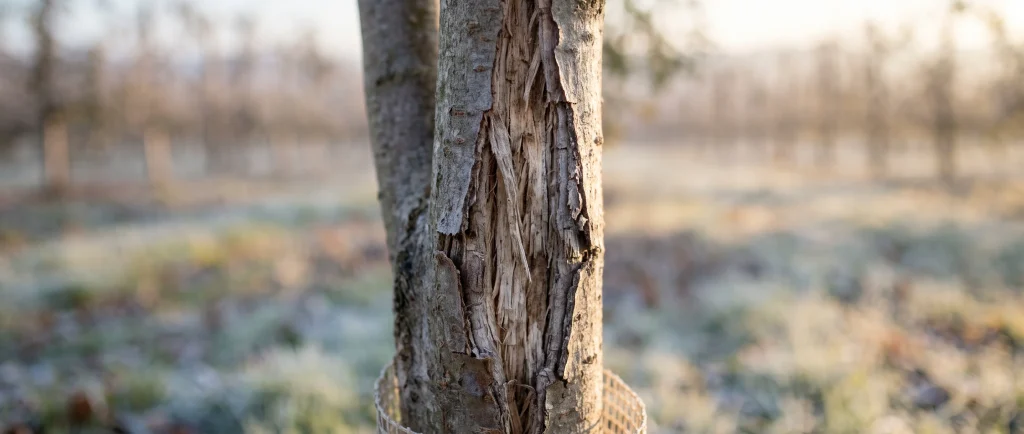
An affected section may appear reddish-brown, darker than surrounding bark, or slightly sunken.
Over time, the injured tissue can dry and die.
The damage frequently forms an elongated patch on the south or southwest side of the trunk.
Cracking and peeling
Severely damaged bark may split or peel away, exposing underlying wood.
These openings can become entry points for decay organisms or wood-boring insects.
However, not every bark crack is caused by sunscald. Frost cracks, mechanical injuries, animal feeding, and certain diseases can produce similar symptoms.
Delayed growth or branch decline
If damage affects a large portion of the trunk’s circumference, the tree may experience reduced growth or dieback.
Smaller wounds may gradually become surrounded by new woundwood as the tree grows.
A diagnosis should consider the tree species, location of the injury, recent weather, and other possible causes.
How to Care for a Sunscald-Damaged Tree
Once living bark tissue has been killed, it cannot simply be restored by applying a coating.
The goal is to support the tree’s natural wound response and prevent additional stress.
Leave attached bark undisturbed
Avoid peeling away bark that remains firmly attached.
Do not enlarge the wound or carve its edges into a particular shape.
Unnecessary cutting can injure healthy tissue and increase the area the tree must compartmentalize.
Avoid wound paints and sealants
Traditional wound dressings generally do not improve the healing of ordinary tree injuries.
Some products can interfere with natural drying or make it harder to inspect the damaged area.
Unless a qualified professional recommends a treatment for a specific situation, leave the wound uncovered.
Support healthy growth
Provide appropriate watering during dry periods, maintain a properly mulched root zone, and avoid mechanical injury from lawn equipment.
Do not automatically apply fertilizer to a stressed tree. Fertilization is most useful when a genuine nutrient deficiency has been identified.
For extensive bark loss, major trunk cracks, or declining trees, consult a qualified arborist.
Common Mistakes to Avoid
One common mistake is installing dark, heat-absorbing material around a vulnerable trunk.
Another is wrapping too tightly, which may damage the bark as the tree expands.
Leaving winter wrap on throughout summer can also create problems, especially when moisture or insects accumulate beneath it.
Finally, wrapping should not be treated as a substitute for proper tree care. A tree planted too deeply, damaged by equipment, or suffering from drought may develop problems that trunk protection alone cannot solve.
Frequently Asked Questions
Can mature trees get sunscald?
Yes. Although young, thin-barked trees are more vulnerable, mature trees can develop sunscald when previously shaded bark becomes suddenly exposed. Heavy pruning, storm damage, or the removal of nearby trees can increase exposure.
Is white paint better than tree wrap?
In some orchard settings, appropriately formulated white trunk coatings are used to reflect sunlight. However, products and recommendations vary, and ordinary household paint should not automatically be applied to landscape trees. For homeowners, removable light-colored guards or wraps are often simpler options.
Will a tree recover from winter sunscald?
Many trees survive localized sunscald injuries. Their ability to recover depends on the extent of damage, overall vigor, and whether the injury affects a large portion of the trunk. New woundwood may gradually develop around damaged areas, but the original dead bark does not regenerate.
Conclusion
Sunscald on trees is a winter injury that can develop when sunlight warms exposed bark before temperatures fall sharply. Young apple, cherry, crabapple, and certain maple trees are among those that may benefit from protection in cold, sunny locations.
Installing light-colored trunk protection in late fall, applying it correctly, and removing it in spring can reduce the risk. Combined with suitable planting locations and good tree care, these simple seasonal habits give young trees a better chance to develop strong, healthy trunks.
External Sources
1. Protecting Trees and Shrubs in Winter
Verify sunscald symptoms, susceptible species, recommended white guards, fall installation, and spring removal. University of Minnesota Extension — Winter Tree Protection
2. Sunscald Injury or Southwest Winter Injury on Deciduous Trees
Support the explanation of winter bark injury, vulnerable trees, shade boards, trunk wrapping, and preventive maintenance. Utah State University — Sunscald Injury
3. Environmental Disorders of Woody Plants
Verify proper wrapping techniques, seasonal timing, symptoms, and the risks of leaving coverings on trees throughout the year. Colorado State University — Environmental Disorders of Woody Plants