
A long-legged creature appears in the corner of your basement, and someone immediately calls it a daddy longlegs. Another person insists it is the most venomous spider in the world, but its fangs are too small to bite humans. That familiar story is the daddy longlegs myth, and it combines several misunderstandings into one memorable piece of folklore.
The surprising part is that “daddy longlegs” does not even identify one particular animal. Depending on where you live, the name may describe a harvestman, a cellar spider, or a crane fly. These creatures can look similar at a glance, yet their anatomy, diets, and relationships with humans are remarkably different.
Understanding those differences makes it easier to recognize the animals sharing your home and garden. It also reveals why some daddy longlegs are useful predators, why others are harmless flying insects, and how the famous venom story became so widespread.
Table of Contents
- What Is a Daddy Longlegs?
- Harvestmen: The Daddy Longlegs That Are Not Spiders
- Cellar Spiders: The Web-Building Daddy Longlegs
- Crane Flies: The Flying Daddy Longlegs
- How to Tell the Three Daddy Longlegs Apart
- The Daddy Longlegs Myth About Deadly Venom
- What Daddy Longlegs Eat and How They Help Gardens
- Common Daddy Longlegs Myths and Facts
- Living Alongside Daddy Longlegs
- Frequently Asked Questions
What Is a Daddy Longlegs?
The name “daddy longlegs” is a common nickname rather than a precise scientific classification. It is used for several unrelated-looking animals that share one noticeable feature: unusually long, slender legs.
In North America, the name often refers to harvestmen or cellar spiders. In the United Kingdom and some other regions, it frequently refers to crane flies. Local usage varies, which helps explain why people sometimes disagree about what a daddy longlegs actually is.
The three animals belong to different biological groups:
- Harvestmen: Arachnids in the order Opiliones.
- Cellar spiders: True spiders in the family Pholcidae.
- Crane flies: Six-legged insects, primarily in the family Tipulidae and related crane fly families.
Only cellar spiders are true spiders. Harvestmen are arachnids, but they belong to a different order. Crane flies are insects, more closely related to mosquitoes than to spiders.
That distinction is essential when examining the daddy longlegs myth, especially claims about venom, biting, and danger to people.
Harvestmen: The Daddy Longlegs That Are Not Spiders
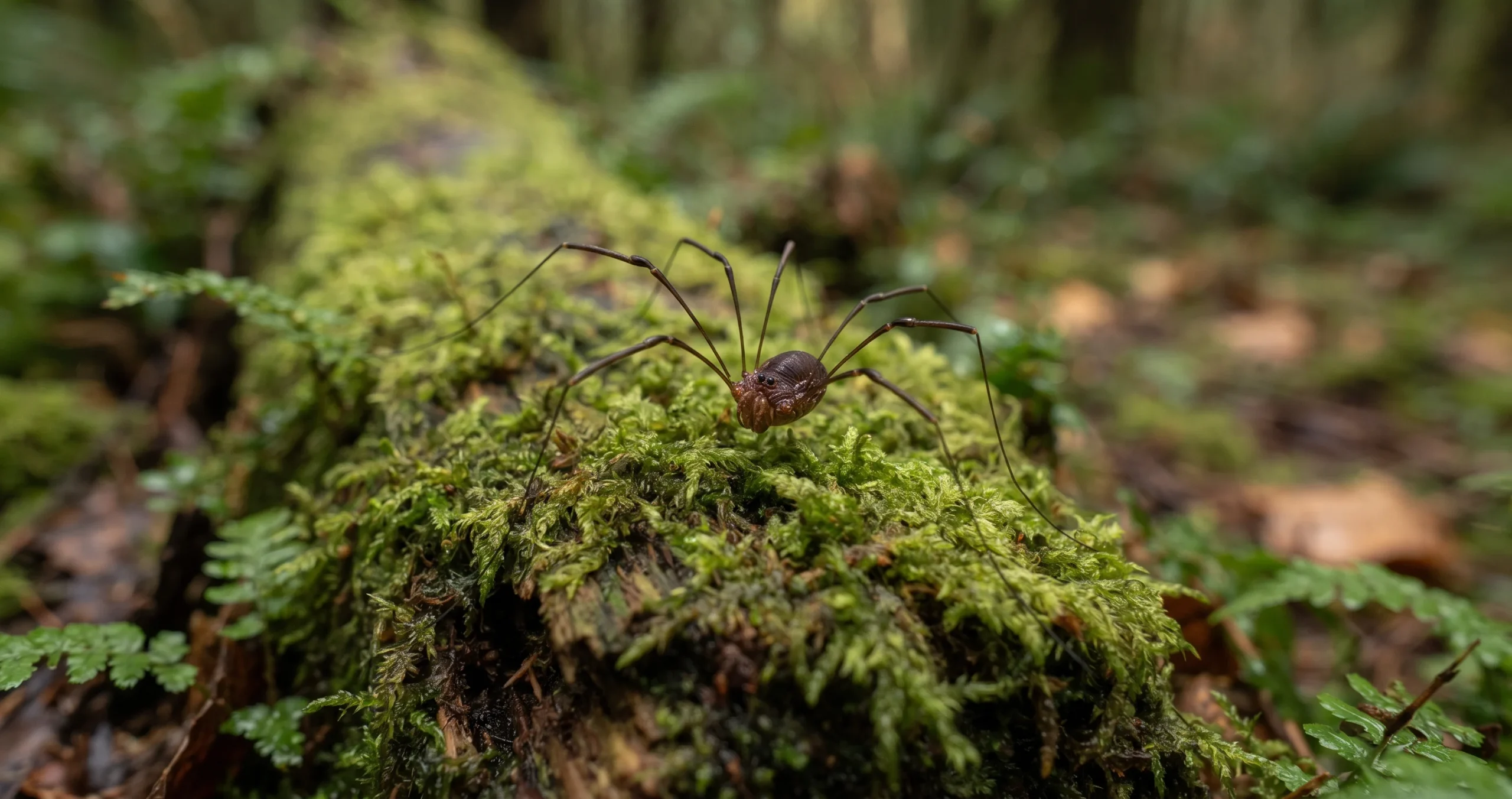
One body that looks like a tiny oval
Harvestmen are among the most recognizable creatures in gardens, woodland leaf litter, and shaded outdoor spaces.
Their bodies usually appear as a single rounded or oval structure. Unlike true spiders, harvestmen do not have the narrow waist that clearly separates a spider’s front body region from its abdomen.
Many species have eight exceptionally long legs, although leg length varies considerably. Some harvestmen are compact, with relatively short legs and sturdy bodies.
Harvestmen also lack the silk-producing structures used by spiders to make webs. They cannot construct the familiar sticky traps found in corners, bushes, or beneath outdoor furniture.
Are harvestmen venomous?
Harvestmen do not possess venom glands or fangs of the kind true spiders use to inject venom. They therefore cannot deliver a venomous spider bite.
They do have small mouthparts called chelicerae, which help them handle food. Those structures should not be confused with the venom-injecting fangs of spiders.
Some harvestmen can release defensive chemicals when disturbed. These secretions may discourage predators, but they are not evidence that harvestmen are dangerously venomous.
This makes harvestmen an especially clear example of why the daddy longlegs myth is scientifically misleading.
Where harvestmen live
Harvestmen often occupy moist, sheltered environments. You may find them beneath logs, among fallen leaves, on tree trunks, or resting against exterior walls.
Many are more active during cooler or darker periods, when conditions reduce the risk of drying out. Their preference for sheltered spaces also makes them common visitors to gardens with mulch, stones, and dense vegetation.
Cellar Spiders: The Web-Building Daddy Longlegs
A true spider with extraordinarily long legs
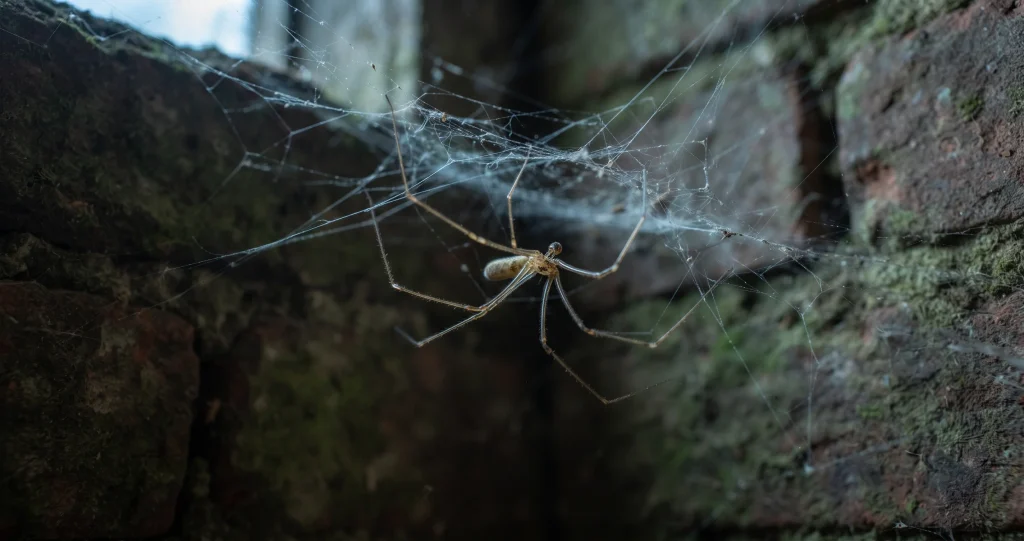
Cellar spiders belong to the family Pholcidae. The long-bodied cellar spider, Pholcus phalangioides, is a familiar species in buildings across many regions.
Unlike harvestmen, cellar spiders have two main body regions connected by a narrow waist. Their bodies are often small compared with their extremely long legs.
They usually build loose, irregular webs in quiet indoor locations. Basements, garages, storage rooms, and ceiling corners provide suitable places to capture small insects.
If a long-legged creature is hanging upside down in a messy web, it is much more likely to be a cellar spider than a harvestman.
Why cellar spiders shake their webs
One fascinating behavior of cellar spiders is their rapid movement when disturbed. Some vibrate or spin in their webs, making their bodies difficult to follow visually.
This behavior may interfere with a predator’s ability to locate or capture the spider. It can look dramatic, especially when the web is near a light or doorway.
Cellar spiders also prey on other spiders, sometimes including species larger than themselves. Their ability to subdue spider prey has helped inspire exaggerated stories about exceptionally powerful venom.
However, successful predation on another spider does not establish that a species is dangerous to humans.
Do cellar spiders bite?
Cellar spiders possess venom glands and fangs, as true spiders generally do. Their venom helps them capture and immobilize prey.
Nevertheless, there is no credible evidence that ordinary cellar spiders pose a serious venom-related danger to humans. Bites are uncommon, and the famous claim that their venom is extraordinarily deadly is unsupported.
The idea that their fangs are universally too small to penetrate human skin is also incorrect. Small spider fangs are not, by themselves, proof that a spider cannot bite.
Crane Flies: The Flying Daddy Longlegs
Six legs and two wings
Crane flies are completely different from harvestmen and cellar spiders. They are insects, which means they have six legs rather than eight.
Adult crane flies typically have a slender body, long legs, and one functional pair of wings. Their appearance sometimes resembles an oversized mosquito.
That resemblance has produced another mistaken belief: that crane flies are giant mosquitoes capable of delivering especially painful bites.
In reality, crane flies are not blood-feeding mosquitoes. Adults do not sting people, and they are not equipped to take blood meals.
What crane flies eat
Adult feeding habits vary among crane fly species. Some consume nectar or other liquids, while others feed little or not at all during their relatively brief adult lives.
Their larvae are often more ecologically important than the adults. Many live in moist soil, decaying vegetation, or aquatic environments.
Depending on the species, larvae may consume decomposing plant material, fungi, microorganisms, or living plant tissues.
Some soil-dwelling crane fly larvae, commonly called leatherjackets, can damage lawns when populations become unusually high. Others contribute to decomposition and nutrient cycling.
Crane flies therefore cannot be described as universally beneficial or harmful. Their ecological roles depend on the species and its surroundings.
How to Tell the Three Daddy Longlegs Apart
The simplest identification method begins with three questions: how many legs are visible, whether the animal has wings, and whether it occupies a web.
| Feature | Harvestman | Cellar spider | Crane fly |
|---|---|---|---|
| Legs | Eight | Eight | Six |
| Wings | None | None | One pair |
| Body shape | Broadly joined, oval-looking body | Two main regions with narrow waist | Slender insect body |
| Makes silk webs | No | Yes | No |
| Venom glands | No | Yes | No |
| Typical location | Garden soil, logs, vegetation | Indoor corners and webs | Gardens, lights, moist habitats |
A flying daddy longlegs is almost certainly a crane fly. A long-legged arachnid resting in a loose web is probably a cellar spider.
An eight-legged creature walking through leaf litter with a compact, oval-looking body is more likely a harvestman.
These observations are usually sufficient for broad identification, although some unusual species may require closer examination.
The Daddy Longlegs Myth About Deadly Venom
Where did the daddy longlegs myth originate?
The famous story claims that daddy longlegs possess the world’s strongest venom but cannot harm people because their fangs are too short.
There is no well-established single origin for this tale. It appears to have spread through informal storytelling, repeated assumptions, and confusion between different animals sharing the same common name.
The story may have gained credibility because cellar spiders sometimes capture other spiders. Watching a delicate-looking cellar spider overpower another arachnid can create the impression that it possesses unusually lethal venom.
But venom potency depends on the species being tested, the animal receiving the venom, the dose, and the biological effects measured. There is no meaningful scientific basis for calling cellar spider venom the most powerful in the world.
What scientists actually know
Harvestmen have no venom glands, so the deadly-venom claim cannot apply to them.
Cellar spiders do possess venom, but there is no evidence supporting the extraordinary toxicity attributed to them in folklore. Their venom is adapted to capturing prey, not to attacking people.
Crane flies do not have venomous spider fangs, and adult crane flies do not bite people to obtain blood.
For a clear explanation of this misconception, see the Burke Museum’s scientific discussion of spider myths.
The important lesson is that a memorable claim can persist for generations even when it combines facts about completely different animals.
What Daddy Longlegs Eat and How They Help Gardens
Harvestmen are opportunistic feeders
Harvestmen have varied diets. Many eat small invertebrates, dead insects, decaying organic material, and occasionally plant or fungal matter.
Unlike spiders that depend primarily on capturing live prey, numerous harvestmen can consume food that is already dead.
This scavenging behavior makes them participants in the garden’s decomposition processes. By feeding on small organisms and organic remains, they contribute to the complex food web surrounding soil and leaf litter.
Harvestmen may also consume small garden pests, although they should not be considered a dependable stand-alone pest-control method.
Cellar spiders capture indoor insects
Cellar spiders primarily help by trapping small arthropods in their webs. Depending on the location, their prey may include flies, mosquitoes, moths, and other spiders.
Their presence can indicate that a room supports a small community of insects and arachnids.
A cellar spider in an undisturbed corner is generally not a reason for alarm. However, maintaining clean storage areas and reducing insect entry points can limit unwanted indoor populations.
Crane flies support broader food webs
Crane flies provide food for birds, spiders, fish, and other animals. Their larvae also contribute to soil and aquatic ecosystems.
Many larvae help break down organic material, while others feed on living vegetation. Their ecological importance extends beyond what people observe when an adult crane fly appears near a porch light.
Common Daddy Longlegs Myths and Facts
Myth: Every daddy longlegs is a spider
Fact: Only cellar spiders are true spiders. Harvestmen are arachnids in a separate order, while crane flies are insects.
Myth: Daddy longlegs have the world’s deadliest venom
Fact: There is no scientific evidence supporting this claim. Harvestmen lack venom glands, and cellar spider venom is not known to present a serious threat to people.
Myth: Daddy longlegs cannot bite because their mouths are too small
Fact: This statement mixes different animals and oversimplifies spider anatomy. Cellar spiders have fangs and can potentially bite, although bites are uncommon and generally not medically significant.
Myth: Crane flies are giant mosquitoes
Fact: Crane flies are related to mosquitoes within the order Diptera, but they do not feed on human blood.
Myth: Harvestmen are useless garden creatures
Fact: Harvestmen feed on various small organisms and organic remains, and they serve as prey for other wildlife. They are part of a functioning garden ecosystem.
Living Alongside Daddy Longlegs
The best response to a daddy longlegs depends on which animal you have encountered and where it is living.
Harvestmen outdoors can usually be left undisturbed. Maintaining a mixture of leaf litter, plants, and sheltered areas supports them alongside many other small invertebrates.
Cellar spiders in garages or unused corners can often be tolerated. If removal is necessary, gently relocating an individual may be preferable to spraying pesticides.
Crane flies found indoors can usually be guided toward an open door or window. Their appearance does not indicate a mosquito infestation.
In gardens, avoid treating every unfamiliar long-legged creature as a pest. Identifying the animal first helps prevent unnecessary disturbance to useful wildlife.
Frequently Asked Questions
Are daddy longlegs poisonous or venomous?
The answer depends on the animal. Harvestmen do not have venom glands, while cellar spiders possess venom used to capture prey. Crane flies do not deliver venomous bites. None of these groups supports the popular claim that daddy longlegs are extraordinarily dangerous to humans.
Why do daddy longlegs have such long legs?
Long legs serve different purposes across these groups. They can help with movement, sensing surroundings, navigating vegetation, or maintaining distance from threats. Because the animals evolved separately, their long-legged appearance does not necessarily reflect one shared adaptation.
Should I remove daddy longlegs from my garden?
Usually, removal is unnecessary. Harvestmen and many crane fly species participate in garden food webs, while cellar spiders consume other small arthropods. If you suspect crane fly larvae are damaging a lawn, identify the larvae and assess the damage before considering treatment.
Conclusion
The daddy longlegs myth survives because three very different animals share one memorable nickname. Harvestmen are nonvenomous arachnids, cellar spiders are true spiders with venom but no demonstrated serious danger to people, and crane flies are harmless-to-humans flying insects.
Recognizing their differences turns an old scary story into a fascinating lesson about biodiversity. Whether one is walking through garden mulch, hanging in a basement web, or flying past a porch light, each daddy longlegs has its own place in the natural world.
External Sources
1. The Deadly Daddy-Longlegs Myth
Support the explanation that the venom legend is false and that the common name applies to three different animals, Burke Museum: Daddy-Longlegs Venom Myth Burke Museum.
2. American Arachnological Society — Frequently Asked Questions
Verify that harvestmen lack venom and that cellar spider venom is not known to be especially harmful to humans. American Arachnological Society FAQs American Arachnological Society.
3. University of Maine Cooperative Extension — Crane Flies
Support the identification of crane flies and explain the ecological roles of their larvae, including decomposition and occasional lawn damage. University of Maine: Crane Flies University of Maine Cooperative Extension.