
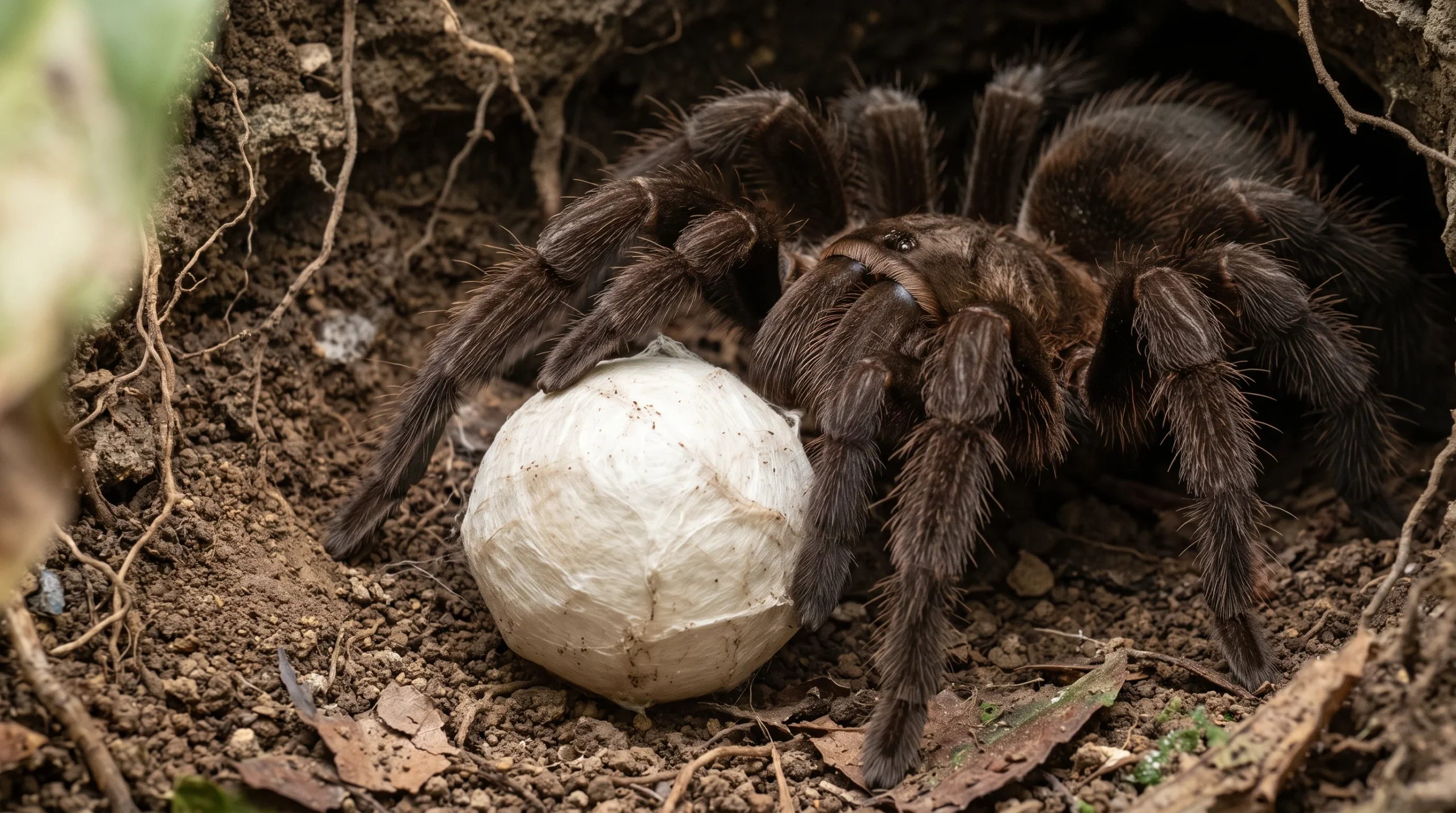
Deep beneath the rainforest floor, a female tarantula rests inside a sheltered chamber lined with silk. Beside her lies a pale, rounded egg sac containing the next generation. Although these large, hairy spiders are often portrayed as fearsome predators, their reproductive behavior reveals a remarkably protective side of their lives.
Tarantula maternal care is an important example of parental investment among invertebrates. Many female tarantulas construct silk egg sacs, remain close to their developing offspring, and respond defensively when their nesting areas are disturbed. These behaviors help protect vulnerable eggs during some of the most delicate stages of the tarantula life cycle.
From South American rainforests to Australian grasslands, tarantulas have evolved reproductive strategies suited to different habitats. Their use of silk, sheltered retreats, and maternal guarding demonstrates how even predominantly solitary predators can invest considerable resources in the survival of their young.
Table of Contents
- The Remarkable Biology of Tarantula Maternal Care
- Tarantula Reproduction Begins Before Egg Laying
- Silk Egg Sacs Provide the First Layer of Protection
- Tarantula Burrows Create Sheltered Nurseries
- Female Tarantulas Guard Their Developing Eggs
- Spiderlings Develop Through Several Early Stages
- Maternal Behavior Differs Among Tarantula Species
- Young Tarantulas Face Numerous Natural Threats
- Tarantula Reproduction Supports Healthy Ecosystems
- Frequently Asked Questions
- Conclusion
The Remarkable Biology of Tarantula Maternal Care
Tarantulas belong to the spider family Theraphosidae, a diverse group found across tropical, subtropical, and some temperate regions. Most species live solitary lives, occupying burrows, crevices, or silk-lined retreats where they hunt and shelter.
Reproduction creates an important exception to this solitary existence. A female may spend an extended period protecting a silk enclosure containing her developing offspring.
Unlike animals that simply deposit eggs and leave them exposed, many tarantulas remain associated with their egg sacs. Their behavior can include guarding, carrying, or repositioning the sac, depending on the species.
These actions represent maternal investment because they require time, energy, and resources. In some circumstances, remaining near an egg sac may also limit a female’s opportunities to forage.
Tarantula maternal care is not identical across all species. Different habitats, nesting structures, and reproductive strategies influence how females protect their young.
Tarantula Reproduction Begins Before Egg Laying
Tarantula reproduction begins when a mature male transfers sperm to a female using specialized structures on his pedipalps, the paired appendages near his mouth.
The female can store sperm internally before fertilizing her eggs. Consequently, egg laying may occur considerably later than mating, depending on the species and environmental conditions.
Before depositing her eggs, a female typically prepares a suitable location within her retreat. This may involve laying down silk and modifying the immediate nesting area.
Egg production requires substantial biological resources. Nutrients stored within the eggs support embryonic development, while additional energy is needed for silk construction and reproductive activity.
A successful mating does not guarantee that a viable egg sac will develop. Female condition, reproductive timing, and environmental circumstances can all influence the outcome.
Silk Egg Sacs Provide the First Layer of Protection
One of the most distinctive features of tarantula reproduction is the construction of a silk egg sac.
Spider silk is produced by specialized glands and released through spinnerets located near the rear of the abdomen. Its flexibility and structural properties make it useful for many purposes, including protecting developing eggs.
The Construction of a Tarantula Egg Sac
A female tarantula generally begins by producing a silk sheet or mat. She deposits her eggs onto this prepared surface before enclosing them with additional silk.
The resulting structure often resembles a pale, rounded bundle. Its dimensions and appearance vary according to the species and reproductive circumstances.
The silk keeps the eggs together and separates them from direct contact with much of the surrounding environment.
Although the sac provides protection, it is not an impenetrable barrier. Predators, parasites, and unsuitable environmental conditions can still threaten the developing offspring.
The Protective Properties of Spider Silk
Silk fibers create a flexible enclosure around the eggs, helping protect them against some forms of physical disturbance.
The layered structure can also moderate direct exposure to environmental conditions, although its effectiveness depends on the surrounding habitat.
Spider egg sacs vary widely in design. Some are suspended in vegetation, while others remain inside burrows or enclosed retreats.
For tarantulas, the silk sac works alongside maternal guarding and shelter selection rather than functioning as a completely independent defense.
Tarantula Burrows Create Sheltered Nurseries
Many terrestrial tarantulas spend much of their lives inside underground burrows or protected ground-level retreats.
These shelters provide concealment and can reduce exposure to disturbances occurring at the surface. Their interiors may contain silk lining, loose soil, and chambers used for resting or reproduction.
Underground Shelters Reduce Environmental Exposure
The soil surrounding a burrow can buffer rapid changes in temperature compared with exposed ground.
Underground conditions may also reduce direct sunlight and wind exposure. Moisture levels depend on soil type, rainfall, drainage, and burrow depth.
These characteristics matter because developing spider embryos can be vulnerable to unfavorable environmental conditions.
However, underground shelters are not always safe. Flooding, excessive moisture, and damage to the burrow may threaten an egg sac.
Arboreal Tarantulas Use Different Retreats
Not all tarantulas live beneath the ground.
Arboreal species inhabit trees, bark crevices, and vegetation, often constructing silk-lined retreats above ground level.
Their reproductive shelters differ from those of burrowing species, but the protective principles are similar.
The female places her eggs within a sheltered silk structure and may remain nearby during development.
This diversity demonstrates how tarantula maternal care has adapted to different environments without following a single universal nesting pattern.
Female Tarantulas Guard Their Developing Eggs
After constructing an egg sac, many female tarantulas remain close to it during development.
Their presence may discourage some disturbances and provides an opportunity to respond when the nesting area is threatened.
Defensive Behavior Protects the Nest
A female tarantula may adopt a defensive posture when an animal approaches her retreat.
Depending on the species, this can involve raising the front legs, displaying the fangs, or moving deeper into shelter.
Some New World tarantulas possess urticating hairs, specialized bristles capable of irritating potential attackers.
These defensive structures are not present or used identically across all tarantula groups.
Maternal guarding does not mean that females constantly attack intruders. Defensive responses vary with species, individual condition, and the nature of the disturbance.
Egg Sac Movement Varies Between Species
Some female tarantulas carry or reposition their egg sacs.
The Goliath birdeater is among the species for which egg sac carrying has been described.
However, movement should not automatically be interpreted as deliberate temperature or humidity regulation. Such explanations require direct behavioral evidence.
The broader significance of egg sac guarding lies in the combined protection offered by silk, shelter, and the female’s presence.
Spiderlings Develop Through Several Early Stages
Inside the silk egg sac, fertilized eggs undergo embryonic development.
Each embryo uses nutrients stored within the egg to form the structures needed for life as a spider, including its legs, mouthparts, and body regions.
The time required for development varies among species and environmental conditions.
Early Development Continues After Hatching
Hatching does not necessarily mean that young spiders immediately emerge from the silk enclosure.
In some species, early developmental stages continue inside the egg sac.
The newly hatched young may initially have limited mobility and remain together while their bodies develop further.
The timing of emergence depends on species-specific biology rather than a fixed schedule shared by all tarantulas.
Molting Allows Spiderlings to Grow
Spiders possess an external skeleton called an exoskeleton.
Because this covering cannot expand continuously, growing spiders must periodically shed it through a process known as molting.
After a molt, the new outer covering is initially softer and gradually hardens.
Young tarantulas undergo repeated molts as they increase in size, eventually developing the proportions and characteristics associated with older individuals.
Dispersal Marks the Beginning of Independence
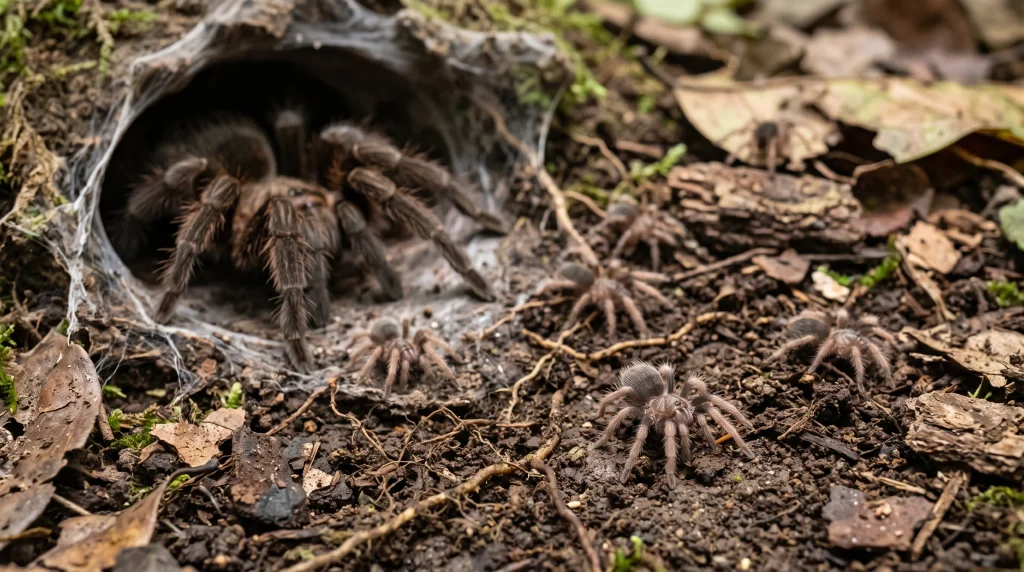
After completing their earliest developmental stages, spiderlings eventually leave the maternal retreat.
Many terrestrial tarantula spiderlings disperse by walking, seeking suitable shelter and opportunities to capture prey.
Once independent, they must avoid predators, obtain food, and survive subsequent molts.
This transition represents an important stage in the tarantula life cycle because the young no longer benefit from the same degree of maternal protection.
Maternal Behavior Differs Among Tarantula Species
Although tarantulas share important reproductive characteristics, their nesting habitats and maternal behaviors vary considerably.
Some species protect eggs deep underground, while others construct silk retreats in trees. These differences influence the conditions surrounding developing eggs and the opportunities females have to defend them.
The Goliath Birdeater Demonstrates Rainforest Maternal Care
The Goliath birdeater (Theraphosa blondi) is one of the world’s largest spiders by mass. It inhabits tropical rainforests in northern South America, where it occupies sheltered burrows and spaces beneath roots or rocks.
According to the Smithsonian’s National Zoo, a female Goliath birdeater may lay approximately 50–200 eggs, enclosing them in a rounded silk sac that she can carry. The institution also reports that an egg sac may contain around 70 spiderlings. These figures describe different reproductive stages and should not be interpreted as a fixed survival rate.
This species demonstrates how maternal protection can occur even among large, solitary predators. However, its behavior should not be treated as representative of every tarantula.
For a more detailed examination of this particular species, see our companion feature on Goliath birdeater egg sac and maternal protection.
Different Habitats Shape Reproductive Behavior
The differences become clearer when several documented species are compared.
| Tarantula Species | Typical Retreat | Maternal Behavior |
|---|---|---|
| Goliath birdeater (Theraphosa blondi) | Rainforest burrows | Encloses eggs in silk and carries the egg sac |
| Chilean rose tarantula (Grammostola rosea) | Ground-level shelters | Constructs and guards a silk egg sac |
| Pink-toed tarantula (Avicularia avicularia) | Trees and vegetation | Wraps eggs in silk and guards the sac |
| Australian tarantula (Selenocosmia stirlingi) | Underground burrows | Protects eggs within the burrow; young remain through early molts |
An especially interesting example comes from Selenocosmia stirlingi. The Australian Museum reports that spiderlings have been observed feeding on an insect provided by their mother.
This observation suggests that maternal investment can sometimes extend beyond guarding the egg sac. It does not establish that food provisioning occurs in all tarantula species.
Young Tarantulas Face Numerous Natural Threats
Despite the protection provided by silk and maternal guarding, tarantula eggs and spiderlings remain vulnerable.
Spider egg sacs can be attacked by predatory animals and specialized parasitoids. The Australian Museum describes wasps, flies, and mantispid lacewings exploiting the egg sacs of various spiders, although these interactions should not all be attributed specifically to tarantulas.
Environmental disturbances can also threaten reproduction. Flooding, damage to nesting sites, and unsuitable moisture conditions may compromise the protective environment surrounding an egg sac.
After emergence, spiderlings face additional dangers. Their small size makes them vulnerable to predators, while finding food and suitable shelter becomes essential for survival.
Competition among siblings can increase as they grow. Dispersal helps reduce crowding, but it also removes the protection associated with the maternal retreat.
For many young tarantulas, independence is therefore a particularly demanding stage of life.
Tarantula Reproduction Supports Healthy Ecosystems
Tarantulas play important roles in terrestrial food webs.
As predators, they consume insects and other arthropods, while some larger species occasionally capture small vertebrates. Their feeding activity contributes to the complex relationships between predators and prey.
Tarantulas also provide food for other animals. Birds, reptiles, and specialized predators such as tarantula hawk wasps are among their natural enemies.
Successful reproduction helps maintain these ecological relationships across generations.
Burrowing tarantulas are closely associated with soil conditions, while arboreal species depend on vegetation and suitable elevated retreats.
Habitat destruction can affect their reproduction by removing nesting locations, altering local environmental conditions, and reducing available prey.
Protecting tarantula habitats therefore helps preserve the wider ecological communities in which these spiders live.
Frequently Asked Questions
Do tarantula mothers protect their eggs?
Yes. Many female tarantulas construct silk egg sacs and remain near their developing offspring. Some species carry or reposition their sacs, while others guard them inside sheltered retreats. The degree of protection varies among species, and maternal guarding cannot guarantee that every egg will survive.
How many eggs can a tarantula lay?
Egg production varies considerably among species. The Smithsonian’s National Zoo reports approximately 50–200 eggs for the Goliath birdeater, while the San Diego Zoo gives a broader range of 75–1,000 eggs for tarantulas generally. These figures describe reproductive potential rather than the number of offspring guaranteed to survive.
How long do tarantula eggs take to hatch?
The incubation period depends on species and environmental conditions. The San Diego Zoo provides a general range of six to nine weeks, although individual species may differ. Hatching and emergence are separate events because young spiders can remain within the silk enclosure while completing early developmental stages.
Do tarantula mothers carry their egg sacs?
Some species do. The Smithsonian describes female Goliath birdeaters carrying their silk egg sacs, while other species protect their eggs within burrows or elevated retreats. Carrying behavior should not be assumed to occur identically in every tarantula species.
Do baby tarantulas stay with their mothers?
Young tarantulas may remain inside or near the maternal retreat during their earliest development. In Selenocosmia stirlingi, spiderlings undergo early molts before leaving their mother’s nest. Eventually, the young disperse and begin independent lives, since most tarantulas do not form permanent family groups.
Do tarantulas feed their babies?
Regular food provisioning is not established as a universal feature of tarantula maternal care. However, the Australian Museum reports an observation of Selenocosmia stirlingi spiderlings feeding on an insect provided by their mother. This illustrates a potentially more involved form of maternal behavior in that species.
Do all spiders demonstrate maternal care?
No. Spider maternal behavior varies widely. Some species guard egg sacs, others carry them, and some leave their eggs without continued attendance. Wolf spiders, for example, carry newly emerged spiderlings on their backs, a behavior distinct from the typical reproductive strategies described for tarantulas.
Conclusion
Tarantulas are often remembered for their impressive size, powerful fangs, and intimidating appearance. Yet their reproductive behavior reveals another remarkable aspect of their biology.
Through carefully constructed silk egg sacs, sheltered retreats, and protective behavior, many female tarantulas invest considerable resources in the earliest stages of their offspring’s lives.
Tarantula maternal care demonstrates that parental investment is not limited to mammals, birds, or other animals commonly associated with nurturing behavior.
Across rainforests, grasslands, and underground habitats, these spiders have evolved different reproductive strategies shaped by their environments.
Their lives involve far more than hunting and survival. Understanding their reproductive adaptations reveals the complexity of spider behavior and the important ecological relationships that allow future generations to thrive.
External Sources :
- Smithsonian’s National Zoo — Goliath Bird-Eating Tarantula: https://nationalzoo.si.edu/animals/goliath-bird-eating-tarantula
- Australian Museum — Australian Tarantulas: https://australian.museum/learn/animals/spiders/australian-tarantulas/
- San Diego Zoo — Tarantula: https://animals.sandiegozoo.org/animals/tarantula.