
Table of Contents
- What Is Companion Planting?
- Why Companion Planting Is So Popular
- What the Research Actually Says
- Companion Planting That Works
- French Marigolds and Certain Soil Nematodes
- Basil and Tomatoes
- The Three Sisters Planting System
- Functional Companions That Improve Garden Health
- Companion Planting Claims with Weak or Limited Evidence
- Structural and Ecological Benefits That Are Often More Reliable
- How to Build a Science-Based Companion Planting Plan
- Practical Tips
- Common Mistakes
- Frequently Asked Questions
- Conclusion
Companion Planting That Actually Works (And the Pairings That Don’t)
Companion planting has been part of gardening traditions for centuries. Open almost any gardening book or browse social media, and you’ll find long lists of “good neighbors” and “bad neighbors” supposedly capable of boosting harvests, repelling pests, or improving flavor. Some of these recommendations are supported by research, while others rely mainly on tradition or anecdotal observations. Understanding companion planting that works means separating well-supported practices from ideas that have little scientific evidence behind them.
That doesn’t mean traditional gardening wisdom should be dismissed entirely. Many companion planting methods have practical value even if researchers haven’t fully explained every mechanism. Others work because they improve the garden’s structure, attract beneficial insects, or make better use of space—not because one plant somehow “protects” another through mysterious interactions.
By combining horticultural research with practical gardening experience, you can build planting combinations that are both productive and realistic.
What Is Companion Planting?
Companion planting is the practice of growing different plant species together with the goal of providing mutual benefits.
Those benefits may include:
- Improved use of garden space
- Better pest management
- Increased pollinator activity
- Weed suppression
- Shade for sensitive crops
- Natural support structures
- Improved soil health
Some claims involve direct biological interactions between neighboring plants.
Others simply reflect good garden design.
The important distinction is that not every traditional pairing has been scientifically verified.
Why Companion Planting Is So Popular
Gardeners naturally look for ways to reduce pesticide use while increasing harvests.
Companion planting offers an appealing idea: plants helping one another through natural processes.
Many traditional combinations have been passed through generations of gardeners.
In some cases, research has confirmed genuine benefits.
In others, evidence remains limited, mixed, or absent.
University Cooperative Extension programs increasingly encourage gardeners to evaluate companion planting claims using available research while recognizing that local conditions may influence outcomes.
North Carolina State Extension offers balanced guidance on companion planting and integrated pest management:
https://gardening.ces.ncsu.edu/
What the Research Actually Says
Scientific evidence for companion planting exists along a spectrum.
Some practices are well documented.
Others show promise under certain conditions.
Some have little reliable evidence despite widespread popularity.
Rather than thinking in terms of “true” or “false,” it helps to ask:
- Has this pairing been tested?
- Under what conditions?
- Does it work consistently?
- Is the benefit biological or simply practical?
This evidence-based approach leads to more realistic expectations.
H2: Companion Planting That Works
Several companion planting methods have reasonable research support or well-established practical value.
French Marigolds and Certain Soil Nematodes
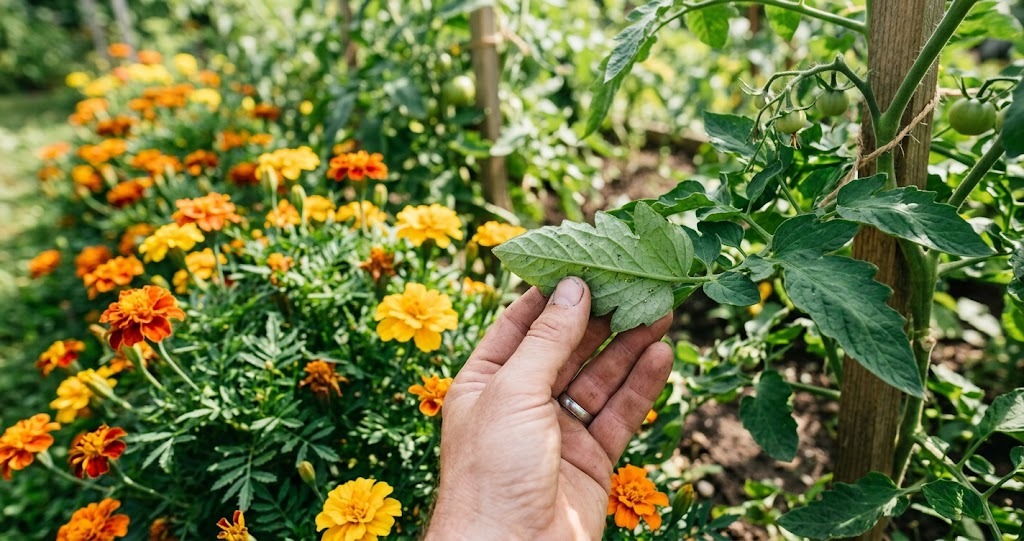
One of the strongest examples involves specific French marigold varieties (Tagetes patula).
Research has shown that some marigolds produce compounds capable of suppressing certain species of root-knot nematodes when used appropriately.
However, it’s important to understand the limitations.
Not all marigold species perform equally.
Not every nematode species is affected.
Simply planting one marigold beside a tomato does not guarantee protection.
Successful nematode suppression often depends on:
- Correct marigold species
- Adequate planting density
- Sufficient growing period
- Appropriate nematode species
This is a good example of a companion planting concept supported by research—but only under specific conditions.
Basil and Tomatoes
The classic basil-and-tomato pairing is widely recommended.
Scientific evidence remains mixed regarding whether basil directly repels insect pests from tomatoes.
Some studies suggest aromatic herbs may influence insect behavior under certain conditions, while others find little measurable effect.
Regardless of pest suppression, basil grows well alongside tomatoes because:
- Both enjoy similar growing conditions.
- Basil occupies otherwise unused space.
- Its flowers attract pollinators and beneficial insects if allowed to bloom.
- Gardeners often harvest both crops together.
Rather than guaranteeing fewer pests, basil should be viewed as a compatible companion that may contribute to overall garden diversity.
The Three Sisters Planting System
One of the best-known examples of functional companion planting comes from Indigenous agricultural traditions across North America.
The Three Sisters combines:
- Corn
- Pole beans
- Squash
Each crop performs a practical role.
Corn provides natural support for climbing beans.
Beans contribute nitrogen to the soil through their association with nitrogen-fixing bacteria, although much of that benefit becomes available after plant residues decompose rather than directly feeding neighboring corn during the same season.
Squash spreads across the soil surface, helping reduce weeds and shade the ground.
This system demonstrates companion planting through complementary growth habits rather than magical plant interactions.
Functional Companions That Improve Garden Health
Some of the most reliable companion planting strategies involve ecological function.
Examples include:
Pollinator Attraction
Flowering herbs such as:
- Dill
- Cilantro
- Fennel
- Alyssum
provide nectar and pollen that attract beneficial insects.
These visitors may improve pollination and help support natural enemies of common pests.
Trap Cropping
Certain plants can attract pests away from valuable crops.
Because effectiveness depends heavily on timing, species selection, and local conditions, trap cropping works best when carefully planned rather than casually applied.
Living Mulches
Low-growing companion plants sometimes reduce soil erosion and suppress weeds while improving moisture retention.
Companion Planting Claims with Weak or Limited Evidence
Many popular companion planting charts include recommendations that lack strong scientific support.
Examples often repeated include claims that:
- Tomatoes dramatically improve the flavor of nearby vegetables.
- One aromatic herb completely prevents insect attacks.
- Specific flowers repel every garden pest.
- Certain vegetables should never grow beside one another despite little supporting evidence.
This doesn’t necessarily mean these pairings never work.
Instead, current research has not consistently demonstrated the dramatic effects often claimed.
Garden performance depends on many interacting factors including weather, soil fertility, pest pressure, irrigation, and plant variety.
Oversimplified companion planting charts rarely account for these variables.
Structural and Ecological Benefits Are Often More Reliable
Some of the greatest benefits of companion planting have little to do with chemical interactions between neighboring plants.
Instead, they involve thoughtful garden design.
Shade
Tall crops such as sweet corn or sunflowers may provide afternoon shade for cool-season greens during hot weather.
Trellising
Natural climbing structures reduce the need for artificial supports.
Pole beans growing on corn remain the classic example.
Pollinator Habitat
Flowering companion plants increase nectar availability throughout the season.
Greater pollinator diversity often benefits fruiting crops.
Biodiversity
Growing many plant species together creates a more complex ecosystem.
Diverse plantings may make it harder for certain pests to locate large uninterrupted patches of their preferred host plants.
Although biodiversity is not a guaranteed pest-control solution, it generally contributes to healthier garden ecosystems.
How to Build a Science-Based Companion Planting Plan
Instead of relying on long internet lists, build your garden around proven principles.
Choose plants with:
- Similar sunlight requirements.
- Similar watering needs.
- Compatible mature sizes.
- Overlapping pollinator benefits.
- Structural compatibility.
Then experiment.
Every garden differs in climate, soil, pest pressure, and local insect populations.
Keeping notes from year to year often provides more valuable information than any generic companion planting chart.
If you’re looking for more ways to reduce pest problems naturally, explore our guide:
https://secretsofthegreengarden.com/vegetable-garden-pest-management/
Practical Tips
- Choose companion plants with similar cultural requirements.
- Plant flowering herbs to attract pollinators.
- Use French marigolds strategically where root-knot nematodes are a concern.
- Focus on biodiversity rather than relying on a single “magic” companion.
- Observe your own garden and keep seasonal notes.
- Combine companion planting with crop rotation and healthy soil management.
Common Mistakes
Expecting Companion Plants to Eliminate Pests
No companion plant guarantees complete pest control.
Believing Every Traditional Pairing Is Proven
Many popular recommendations have little or inconsistent scientific support.
Ignoring Basic Plant Needs
Compatible sunlight, water, and soil requirements matter far more than most companion charts.
Forgetting Crop Rotation
Companion planting complements—but does not replace—good crop rotation and overall garden management.
Frequently Asked Questions
Does companion planting really work?
Some methods are supported by research, especially those involving structural benefits, biodiversity, and specific plant interactions. Others remain largely anecdotal.
Do marigolds repel every garden pest?
No. Certain French marigold varieties may suppress specific root-knot nematodes under appropriate conditions, but they are not a universal pest solution.
Does basil improve tomato flavor?
There is little scientific evidence that basil changes tomato flavor simply by growing nearby. The two plants are compatible because they thrive under similar conditions.
Is the Three Sisters method scientifically sound?
Yes. Its benefits come from complementary plant growth habits rather than unexplained biological effects.
Should I ignore traditional gardening advice?
Not necessarily. Traditional practices often contain useful observations, but it’s wise to evaluate them alongside modern horticultural research.
Conclusion
Companion planting remains one of gardening’s most fascinating topics because it blends centuries of observation with ongoing scientific discovery. The most successful gardeners understand that companion planting that works usually relies on practical ecology rather than gardening myths. Functional partnerships such as the Three Sisters, carefully selected French marigolds for certain nematode issues, and flowering herbs that support pollinators offer realistic benefits grounded in research and experience.
At the same time, it’s important to approach sweeping claims with healthy skepticism. No single plant can eliminate pests or guarantee larger harvests on its own. Healthy soil, crop rotation, proper spacing, irrigation, biodiversity, and thoughtful garden design remain the foundation of productive gardens. Companion planting works best when viewed as one valuable tool within a broader, science-based gardening strategy.