
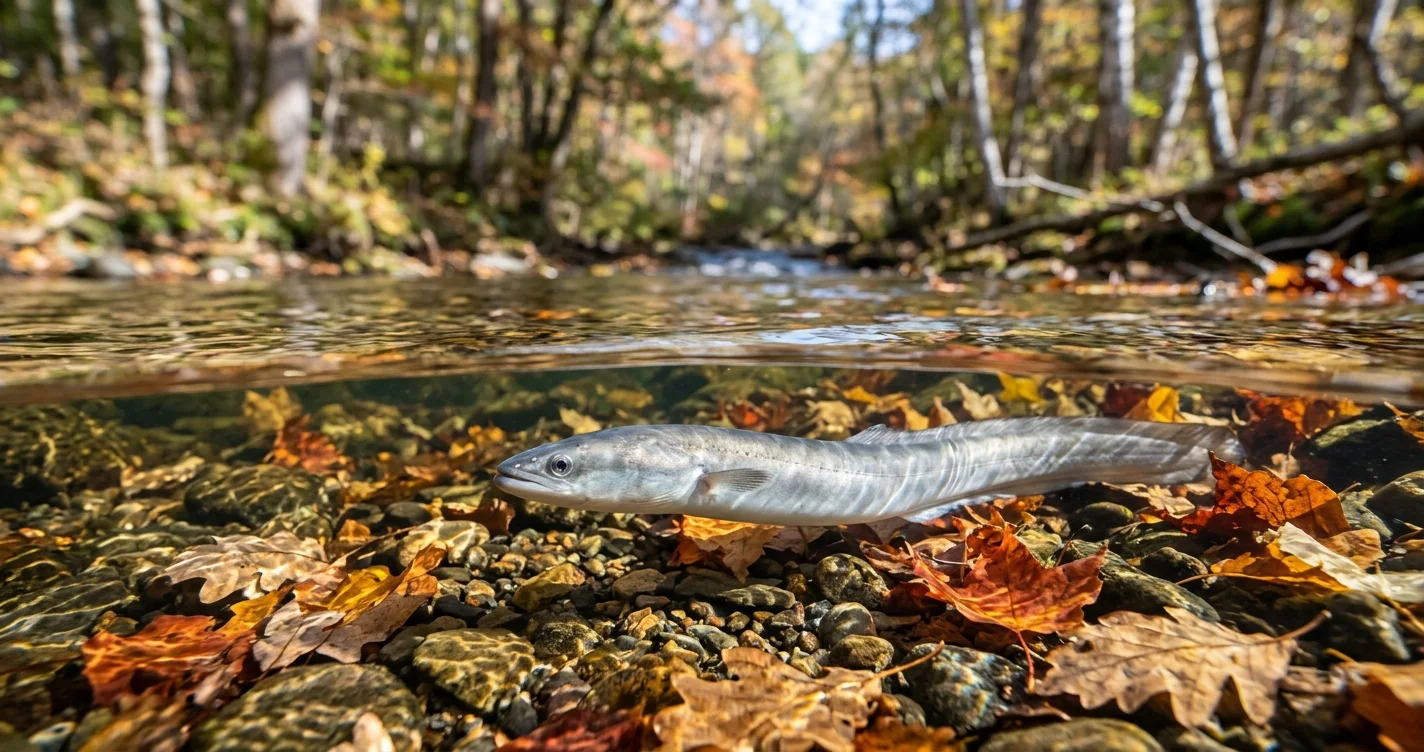
Every autumn, a mysterious traveler begins leaving American rivers, lakes, and coastal wetlands. It may have spent decades hidden beneath rocks, buried in mud, or hunting in the darkness. Then, guided by biological changes and environmental signals, it begins an extraordinary journey toward the Atlantic Ocean.
This traveler is the American eel (Anguilla rostrata).
The American eel migration is one of North America’s most fascinating wildlife mysteries. These remarkable fish travel from freshwater and coastal habitats toward the Sargasso Sea, a vast region of the Atlantic Ocean associated with their reproduction.
Scientists have collected American eel larvae in the Sargasso Sea, providing strong evidence that this is their spawning region. Yet the actual spawning behavior of wild American eels has never been directly observed there.
How do they navigate such enormous distances? Why do they leave familiar rivers after years of growth? And what happens to their bodies as they prepare for the journey?
The answers reveal an extraordinary life cycle connecting backyard streams, distant oceans, and one of the most mysterious breeding migrations in the animal kingdom.
Table Of Contents
- What Makes the American Eel So Mysterious?
- American Eel Migration: How and Why the Journey Happens
- The Sargasso Sea: A Breeding Ground Hidden in the Atlantic
- How American Eels Find Their Way Across the Ocean
- From Transparent Larva to River-Dwelling Eel
- Why American Eels Matter to Freshwater Ecosystems
- The Biggest Threats to American Eel Migration
- In Your Own Yard: Helping American Eels and Aquatic Wildlife
- Frequently Asked Questions
What Makes the American Eel So Mysterious?
American eels are long, slender fish with smooth-looking skin and small scales embedded beneath a protective mucus layer.
Their snake-like appearance often causes confusion, but they are true fish, not snakes.
They have elongated bodies, continuous dorsal, caudal, and anal fins, and the ability to move through surprisingly complex aquatic habitats.
A Fish That Lives in Two Worlds
American eels are catadromous fish, meaning they generally grow in freshwater or coastal environments and migrate to the ocean to reproduce.
Their life cycle is almost the reverse of that of many salmon, which typically grow at sea and return to freshwater to spawn.
American eels occur across a broad geographic range, from eastern North America into parts of the Caribbean and northern South America.
Some live far upstream in rivers and lakes, while others spend much of their growth phase in estuaries or coastal marine waters.
Years of Life Before One Final Journey
American eels can remain in their feeding and growth habitats for many years.
Their age at maturity varies widely depending on sex, habitat, latitude, growth conditions, and other factors.
Females often grow larger and may mature later than males.
Eventually, mature eels undergo dramatic physical changes and begin their reproductive migration.
Unlike fish that reproduce repeatedly, American eels are generally considered semelparous, meaning they are believed to reproduce once before dying.
This makes their final migration especially significant.
American Eel Migration: How and Why the Journey Happens
The transformation from a growing eel into a migrating adult is one of the most remarkable events in its life.
Scientists call this process silvering.
It involves changes in body coloration, physiology, and behavior that prepare the eel for ocean travel.
From Yellow Eel to Silver Eel
During much of their growth phase, American eels are commonly called yellow eels.
Their coloration varies, but they often have yellowish or brownish undersides and darker backs.
As they approach reproductive maturity, they enter the silver eel stage.
Their backs become darker, their undersides become lighter or more silvery, and their bodies develop characteristics associated with long-distance migration.
These changes are more than cosmetic.
They reflect a major transition in the animal’s life.
Larger Eyes for Ocean Travel
Migrating silver eels develop relatively larger eyes.
This change is thought to help them function in the dim environments encountered during ocean migration.
Their visual system changes as part of the broader silvering process.
Scientists have also documented physiological adjustments associated with saltwater tolerance and reproductive development.
Preparing for Saltwater
American eels must regulate the balance of water and salts inside their bodies.
Freshwater and seawater present very different challenges.
As eels prepare to leave rivers and estuaries, their bodies undergo changes that support life in marine conditions.
Their gills, kidneys, and other tissues participate in this process.
The transition allows them to move from inland habitats toward the open Atlantic.
Why Autumn Often Triggers Migration
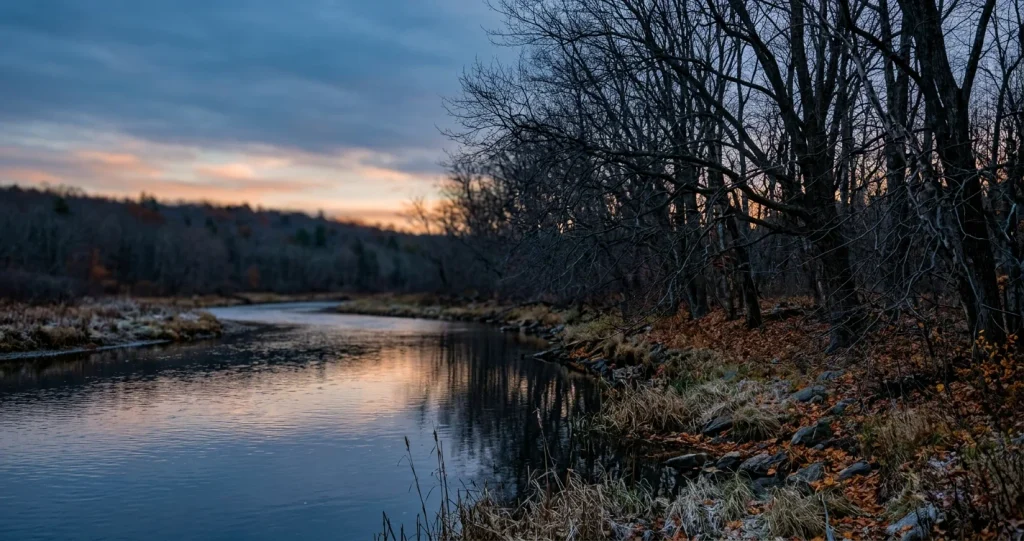
In many temperate regions, downstream movement becomes particularly noticeable during autumn.
Changes in water temperature, day length, river discharge, and other environmental conditions may influence migration timing.
Rainfall and increased river flows can help migrating eels move downstream.
However, not every population follows exactly the same seasonal schedule.
Timing varies with geography, local habitat, and individual maturity.
The Journey Toward the Sargasso Sea
After leaving inland waters, silver eels move through estuaries and coastal areas into the Atlantic Ocean.
Their ultimate reproductive destination is believed to be the Sargasso Sea.
This region lies in the North Atlantic and is defined by surrounding ocean currents rather than coastlines.
It is famous for floating mats of Sargassum seaweed.
The exact routes taken by individual American eels remain incompletely understood.
Tracking studies have improved scientists’ understanding of eel movement, but many details of their oceanic journey remain unresolved.
The Sargasso Sea: A Breeding Ground Hidden in the Atlantic
The Sargasso Sea is unlike most seas.
It has no land boundaries.
Instead, it occupies a broad region of the North Atlantic associated with major ocean currents.
Its floating seaweed communities support fish, invertebrates, sea turtles, and other marine organisms.
But beneath the surface lies an extraordinary reproductive mystery.
How Scientists Identified the Spawning Region
Researchers discovered that the smallest American eel larvae occur in the Sargasso Sea region.
These tiny larvae provide crucial evidence about where reproduction takes place.
By studying larval distribution and development, scientists established the Sargasso Sea as the principal spawning region for American eels.
However, identifying the general spawning region is not the same as observing reproduction directly.
Why Nobody Has Seen Wild American Eels Spawn There
Despite decades of research, scientists have not directly documented the natural spawning behavior of American eels in the Sargasso Sea.
The ocean is enormous, and spawning may occur across a broad area or under conditions that are difficult to observe.
Adult eels may travel at considerable depths during portions of their migration.
The timing and precise location of spawning also remain uncertain.
As a result, one of the most important events in the American eel’s life cycle is still largely hidden from direct observation.
What Scientists Still Don’t Know
Researchers continue investigating how eels locate the spawning region, how they coordinate reproduction, and what environmental conditions influence spawning.
The role of ocean currents, magnetic cues, and other navigation mechanisms remains an active area of research.
Although the Sargasso Sea connection is strongly supported, the final details of the journey are not fully understood.
How American Eels Find Their Way Across the Ocean
Imagine leaving a river in Maine or the Chesapeake Bay and traveling toward a distant region of the Atlantic without roads, landmarks, or a visible destination.
That is the navigation challenge faced by migrating American eels.
Possible Magnetic Navigation
Some research on anguillid eels suggests that they can detect aspects of Earth’s magnetic field.
Magnetic information may help eels orient during migration.
However, the exact importance of magnetic navigation in adult American eels remains uncertain.
Scientists are still investigating how different sensory systems contribute to long-distance movement.
Ocean Currents May Influence Their Routes
Ocean currents can affect the movement of marine organisms.
They may also influence the routes and conditions encountered by migrating eels.
However, adult eels are active swimmers rather than passive passengers.
Their migration likely involves a combination of swimming behavior and environmental influences.
Movement Through Different Depths
Research on migrating eels has documented changes in swimming depth over daily cycles in some species and tracked individuals.
Such vertical movements may relate to light conditions, temperature, predator avoidance, or other factors.
The exact patterns and their functions vary.
For American eels, many aspects of offshore depth use still require further study.
From Transparent Larva to River-Dwelling Eel
The American eel’s life cycle is remarkable not only because adults migrate to the ocean, but also because their offspring travel in the opposite direction.
The Leptocephalus Stage
American eel larvae are called leptocephali.
They are transparent, flattened, and leaf-shaped.
Their unusual appearance is very different from the familiar snake-like form of an adult eel.
After hatching in the ocean, larvae are transported through the Atlantic circulation system.
Their journey toward continental waters can take many months.
Glass Eels Arrive Near the Coast
As larvae approach coastal habitats, they transform into glass eels.
At this stage, they have a more recognizable eel-shaped body but remain largely transparent.
Glass eels enter estuaries and coastal waters, where they continue developing.
Elvers Move Into New Habitats
As pigmentation increases, young eels are often called elvers.
Some travel upstream into rivers, streams, and lakes.
Others remain in estuarine or coastal habitats.
Their ability to occupy different environments helps explain their broad distribution.
Yellow Eels Grow for Years
Once established in suitable habitat, young eels enter a prolonged growth phase.
They feed on a variety of aquatic organisms, including insects, crustaceans, worms, and small fish.
Their diet depends on size, habitat, and available prey.
Years later, some of these eels will undergo silvering and begin the return migration toward the Sargasso Sea.
The cycle begins again.
Why American Eels Matter to Freshwater Ecosystems
American eels are important members of many aquatic food webs.
Their presence connects freshwater, estuarine, and marine ecosystems.
Predators in Rivers and Wetlands
Eels feed on a wide variety of aquatic animals.
Their flexible bodies allow them to move through crevices, vegetation, and other complex habitats.
They can occupy environments that are difficult for many other fish to use.
Prey for Other Wildlife
American eels also serve as prey for larger fish, birds, and other predators.
Their role changes throughout their life cycle.
Small juvenile eels and larger adults encounter different predators and ecological challenges.
Connections Across Ecosystems
Because American eels move between freshwater and marine environments, their life cycle connects distant habitats.
Their survival depends on conditions in rivers, estuaries, coastal waters, and the open ocean.
A disturbance in one part of that journey can affect the entire life cycle.
The Biggest Threats to American Eel Migration
American eels face multiple pressures across their range.
These challenges can affect both juvenile eels moving inland and mature adults migrating toward the ocean.
Dams and Other Barriers
Dams, culverts, and other structures can restrict access to upstream habitats.
Young eels may struggle to reach areas where they could grow.
Migrating adults may also face injury or mortality when passing through certain hydropower facilities.
Fish passage improvements can help, but solutions must account for eel behavior and life stage.
Habitat Loss and Degradation
Wetlands, streams, and estuaries provide important habitat for American eels.
Development, altered water flow, pollution, and shoreline modification can reduce habitat quality.
Protecting connected aquatic habitats is therefore important.
Fishing Pressure
American eels are harvested at different life stages in parts of their range.
Fishing regulations vary among jurisdictions.
Management agencies monitor eel populations and establish rules intended to support sustainable use.
Climate and Ocean Changes
Changes in ocean temperature, currents, and other environmental conditions may influence eel migration and larval transport.
However, predicting the specific consequences is difficult.
The American eel’s complex life cycle makes it challenging to separate the effects of different environmental pressures.
Parasites and Disease
American eels can be affected by parasites and pathogens.
One concern is the introduced swim bladder nematode Anguillicola crassus, which can damage the swim bladder.
Researchers have investigated how such infections may affect eel health and migration.
The severity of effects varies among individuals and populations.
In Your Own Yard: Helping American Eels and Aquatic Wildlife
You don’t need to live beside the Sargasso Sea to support the habitats connected to American eel migration.
If you live near a stream, river, wetland, or estuary within the species’ range, local conservation actions can help protect aquatic ecosystems.
Protect Natural Stream Banks
Vegetation along waterways helps stabilize soil and reduce erosion.
Native plants can also provide shade, habitat, and food-web support.
Avoid removing streamside vegetation unnecessarily.
Reduce Runoff Pollution
Rainwater can carry fertilizers, pesticides, sediment, and other pollutants into waterways.
Use lawn and garden chemicals carefully and follow label directions.
Avoid applying products immediately before heavy rain.
Where practical, rain gardens and vegetated areas can help manage runoff.
Keep Yard Waste Out of Waterways
Grass clippings, leaves, and other debris should not be dumped into streams or drainage channels.
Excess organic material can affect water quality as it decomposes.
Compost yard waste appropriately instead.
Support Stream Connectivity
Healthy aquatic ecosystems depend on connected waterways.
If a local stream contains a damaged culvert or other barrier, report concerns to the appropriate local authority.
Do not attempt to remove or modify water-control structures without authorization.
Community watershed groups may organize restoration projects.
Respect Wildlife During Migration
If you encounter an eel in a stream or near a waterway, observe it without unnecessary handling.
American eels are slippery, powerful animals that can be injured by improper handling.
Avoid relocating them without guidance from wildlife authorities.
Join a Watershed Conservation Project
Local conservation organizations often organize stream cleanups, water-quality monitoring, and habitat restoration.
Participating in these activities can benefit many aquatic species, including migratory fish.
Protecting a small stream may contribute to the health of a much larger watershed.
Frequently Asked Questions
1. Where do American eels go to reproduce?
American eels are believed to reproduce in the Sargasso Sea region of the North Atlantic Ocean.
Scientists have found their smallest larvae there, strongly supporting this location as their spawning region.
However, natural spawning behavior by wild American eels has not been directly observed in the Sargasso Sea.
2. How far do American eels migrate?
The distance varies depending on where an eel begins its journey.
Eels originating in northern rivers may need to travel thousands of miles to reach the Sargasso Sea region.
Their exact routes and total travel distances remain incompletely documented.
3. Do American eels return to freshwater after spawning?
American eels are generally believed to spawn once and then die.
They are not known to return to freshwater after reproducing.
Their offspring eventually travel toward coastal and inland habitats, continuing the next generation’s life cycle.
Conclusion
Every autumn, some American eels leave the rivers and wetlands they have inhabited for years and begin a journey toward the open Atlantic.
Their bodies transform, their behavior changes, and they travel toward a reproductive region that scientists have identified largely through the presence of tiny larvae.
Yet the final act of their journey remains hidden.
The American eel migration is a remarkable reminder that even familiar freshwater animals can have extraordinary lives beyond our view.
Protecting connected waterways, reducing pollution, and conserving aquatic habitats can help support these mysterious travelers.
And somewhere beneath the Atlantic’s dark waters, the next generation of American eels may already be beginning its journey toward the rivers of North America.
External Sources
1. Direct Observations of American Eels Migrating Across the Continental Shelf to the Sargasso Sea
Support the mystery of American eel migration. Researchers used satellite tags to track migrating eels, including one that traveled approximately 2,400 km toward the northern boundary of the Sargasso Sea spawning region. Nature Communications (2015), peer-reviewed research.
2. American Eel (Anguilla rostrata)
Explain the American eel’s life cycle, migration between rivers and the Sargasso Sea, feeding behavior, and importance to freshwater ecosystems. U.S. Fish & Wildlife Service (USFWS).
3. The Role of Pheromones in Guiding American Eel Migration. U.S. Geological Survey (USGS).
Explain how dams and hydropower turbines threaten migrating eels and how researchers investigate chemical signals that may help guide eel movement.