
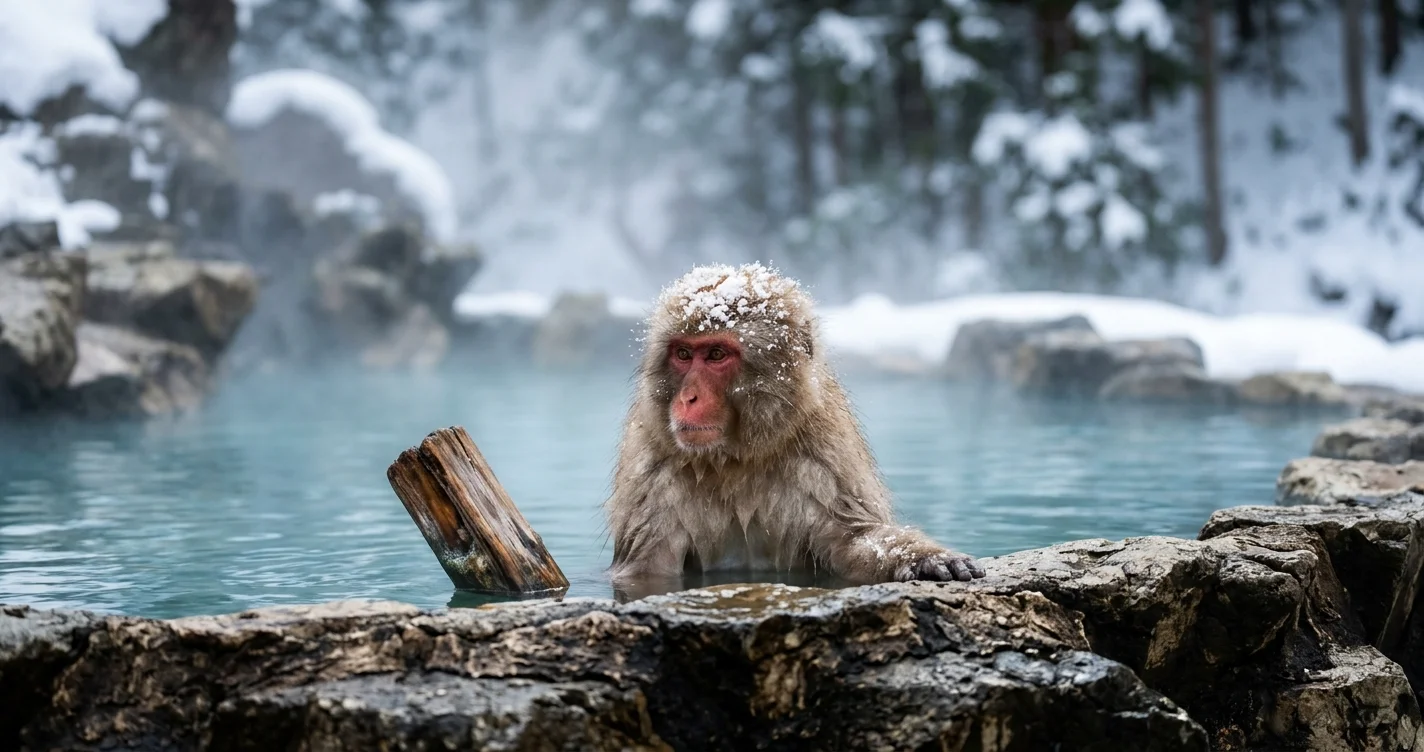
Imagine walking through a snowy Japanese forest and discovering a group of monkeys sitting quietly in steaming water. Snowflakes settle on their thick fur, their pink faces peek above the surface, and their eyes appear almost closed with contentment.
It looks remarkably like a winter spa retreat.
But behind this peaceful scene lies a fascinating story about animal behavior, survival, and adaptation.
The famous snow monkeys hot springs phenomenon involves Japanese macaques (Macaca fuscata), a primate species that has developed remarkable ways of coping with cold winters.
At Jigokudani in Japan, some macaques regularly enter naturally heated water during the coldest months. Researchers have investigated whether this unusual behavior helps them conserve body heat and reduce physiological stress.
Yet the story goes beyond staying warm. It involves social learning, group relationships, individual preferences, and a behavior that became famous around the world.
Why do these monkeys bathe while others remain in the snow? And what can their winter habits teach us about the surprising flexibility of wildlife?
Table of contents
- What Are Japanese Snow Monkeys?
- Where Can You See Snow Monkeys Bathing?
- Snow Monkeys Hot Springs: The Science Behind Their Winter Baths
- How Did Snow Monkeys Discover Hot Springs?
- Do All Snow Monkeys Enjoy Hot Springs?
- What Do Snow Monkeys Do When They Are Not Bathing?
- Are Snow Monkeys the Only Animals That Use Warm Water?
- What Threatens Japanese Macaques in the Wild?
- In Your Own Yard: What Snow Monkeys Teach Us About Winter Wildlife
- Frequently Asked Questions
What Are Japanese Snow Monkeys?
Japanese macaques are medium-sized monkeys native to Japan. They are among the most northerly living nonhuman primates, inhabiting environments that range from relatively mild forests to regions with deep winter snow.
Their ability to survive seasonal temperature changes makes them particularly interesting to wildlife researchers.
A Monkey Built for Cold Weather
Japanese macaques have thick fur that provides insulation during winter.
Their coats become especially important in mountainous regions where temperatures can remain below freezing.
Unlike humans, these monkeys do not depend on clothing or artificial shelters.
Instead, they rely on a combination of physical adaptations, behavior, food availability, and social living.
Their relatively short tails and compact bodies are also characteristic features of the species.
However, their winter survival does not depend on hot springs. Many Japanese macaque populations live successfully without access to geothermal pools.
Where Japanese Macaques Live
Japanese macaques occupy forests and mountainous habitats across several Japanese islands.
They use deciduous forests, mixed woodlands, and other suitable environments.
Their diets change seasonally and may include fruits, leaves, seeds, buds, bark, insects, and other available foods.
Winter can be particularly challenging because snow covers parts of the landscape and many food sources become scarce.
The monkeys must balance the energy required to stay warm with the energy they obtain from food.
Where Can You See Snow Monkeys Bathing?
The world’s best-known bathing snow monkeys live around Jigokudani Yaen-Koen in Nagano Prefecture.
The park is located in a mountainous area known for its geothermal activity and snowy winters.
The Famous Jigokudani Monkey Park
Jigokudani Yaen-Koen opened in 1964 and became internationally recognized for its bathing macaques.
The monkeys are free-ranging animals rather than captive zoo exhibits.
However, the park is a managed setting where provisioning influences the animals’ movements and opportunities for observation.
This distinction matters when interpreting their behavior.
Why This Location Is Special
Jigokudani has naturally heated water, cold winters, and an established macaque population.
The combination creates an unusual opportunity to observe primates interacting with geothermal water.
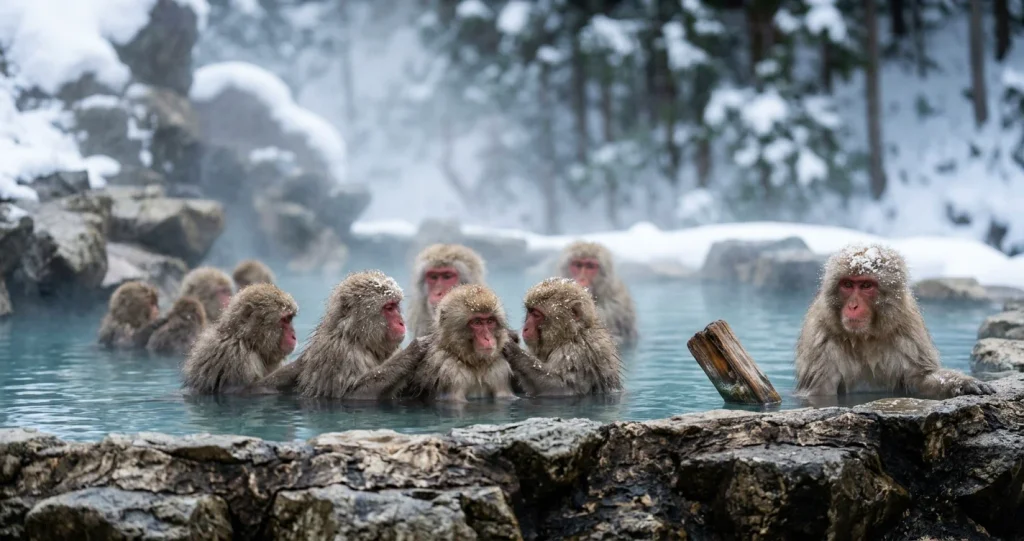
Visitors may see monkeys sitting in the pool, grooming one another, resting nearby, or moving through the surrounding forest.
Not every monkey bathes, and bathing behavior can vary with weather, individual preferences, and social circumstances.
Snow Monkeys Hot Springs: The Science Behind Their Winter Baths
The most compelling explanation for hot-spring bathing involves thermoregulation: the process by which animals maintain a suitable internal body temperature.
But the full picture includes physiology, behavior, and social relationships.
How Cold Weather Challenges the Body
Mammals must maintain body temperatures within a range that supports normal physiological functions.
In cold environments, heat escapes from the body into the surrounding air.
Wind, wet fur, and prolonged exposure can increase the challenge.
Animals compensate through insulation, changes in behavior, and physiological responses that help conserve or generate heat.
For Japanese macaques, maintaining body temperature requires energy.
During winter, that energy can be especially valuable because food availability may be limited.
How Warm Water Changes Heat Exchange
Warm water transfers heat to the body when its temperature is higher than the animal’s skin temperature.
A macaque sitting in a sufficiently warm pool can gain heat from the surrounding water.
This may reduce the energy needed to maintain body temperature during cold conditions.
However, the effect depends on water temperature, immersion time, air temperature, and the animal’s condition.
Wet fur can also increase heat loss after leaving the pool, particularly in cold or windy weather.
The overall benefit therefore depends on circumstances rather than simply entering water.
What Researchers Have Discovered
A 2018 study published in Primates investigated hot-spring bathing among female Japanese macaques at Jigokudani.
The researchers examined seasonal bathing patterns and measured fecal glucocorticoid metabolites, which can provide information about physiological stress responses.
The study found evidence consistent with hot-spring bathing helping monkeys cope with cold-related stress.
Bathing was more frequent during winter, and the results suggested a thermoregulatory benefit.
However, the study did not establish that every macaque experiences the same benefit.
It also focused on a particular population and group of animals, so the findings should not automatically be generalized to all Japanese macaques.
Does Bathing Reduce Stress?
Warm water may help reduce some physiological demands associated with cold exposure.
But animal stress is complex.
Glucocorticoid levels can change for many reasons, including social interactions, reproduction, environmental conditions, and food availability.
A monkey resting quietly in warm water may appear relaxed, but its facial expression alone cannot establish its emotional state.
Researchers therefore use behavioral observations alongside physiological measurements.
Is Bathing a Learned Behavior?
The Jigokudani bathing tradition is especially interesting because it appears to have developed locally rather than being a universal behavior of Japanese macaques.
Historical accounts describe macaques beginning to use warm water in the area during the 1960s.
The behavior subsequently spread among members of the local group.
This suggests that observation and social learning may have contributed to its development.
It provides an intriguing example of how animals can acquire new behaviors through experience and interactions with others.
How Did Snow Monkeys Discover Hot Springs?
The story of the bathing monkeys begins with curiosity and opportunity.
The First Bathing Monkeys
According to accounts associated with Jigokudani, monkeys began entering warm water near a local inn before the park’s dedicated monkey pool became established.
A young macaque is often described as one of the earliest individuals observed bathing.
Other members of the group gradually adopted the behavior.
The precise sequence is difficult to reconstruct independently from historical observations, but the broader pattern is consistent with a locally developed tradition.
Learning Through Observation
Japanese macaques are highly social animals.
Young individuals observe adults and other group members while learning about food, movement, grooming, and social relationships.
This makes them capable of acquiring behaviors that are common within their particular group.
Hot-spring bathing may be one such behavior.
Why Other Macaques Rarely Bathe
Most Japanese macaque populations do not have regular access to suitable geothermal pools.
Even where water is available, bathing traditions may never develop.
The Jigokudani phenomenon illustrates how local environmental opportunities can interact with social behavior.
It does not mean that all Japanese macaques naturally seek hot springs.
Do All Snow Monkeys Enjoy Hot Springs?
Despite their reputation, not every macaque enters the water.
Some individuals bathe frequently, while others may remain on surrounding rocks or move through the forest.
Individual Preferences Matter
Animals within the same species often show different behavioral tendencies.
Age, sex, experience, and social circumstances may influence how often a macaque uses the pool.
Researchers have also observed differences in bathing behavior associated with social status.
However, these relationships can vary and should not be interpreted as rigid rules.
Mothers and Young Monkeys
Young macaques learn many behaviors while staying close to their mothers.
A juvenile may observe bathing adults or spend time near the pool before entering the water.
However, young monkeys do not necessarily develop identical habits to their mothers.
Social Rank and Pool Access
Japanese macaque groups have social hierarchies.
Dominant individuals may gain priority access to certain resources or locations.
Research at Jigokudani has explored relationships between dominance rank and bathing behavior.
The findings suggest that social position can influence opportunities to use the pool, although the pattern is more complicated than a simple rule that dominant monkeys always bathe first.
What Do Snow Monkeys Do When They Are Not Bathing?
Hot-spring bathing is only one small part of a Japanese macaque’s daily life.
Most of their time is spent engaging in ordinary primate activities.
Searching for Winter Food
During winter, Japanese macaques forage for whatever foods remain accessible.
Depending on habitat, this can include buds, bark, seeds, and other plant materials.
Some populations also consume animal foods when available.
Food availability strongly influences their movements and activity.
Grooming and Social Bonding
Grooming is an important social behavior among macaques.
Individuals remove debris and parasites from one another’s fur while maintaining social relationships.
Grooming can also occur near or inside the hot-spring pool.
These interactions are part of a broader social system involving alliances, family relationships, and dominance.
Resting and Conserving Energy
During harsh weather, macaques may reduce unnecessary movement and choose sheltered resting locations.
Conserving energy can be valuable when temperatures are low and food is difficult to find.
Hot-spring bathing may contribute to this broader set of cold-weather strategies for some individuals.
Are Snow Monkeys the Only Animals That Use Warm Water?
Japanese macaques are among the most famous animals associated with geothermal bathing, but animals interact with warm water in many different ways.
Geothermal Habitats Attract Wildlife
Naturally warm springs can create unusual local environments.
They may support distinctive microbial communities and influence nearby vegetation.
Some wildlife species visit geothermal areas because of water availability, food resources, or favorable local conditions.
However, visiting a warm spring does not necessarily mean an animal is deliberately using it to regulate body temperature.
Behavioral Flexibility in Nature
Animals often respond creatively to environmental opportunities.
Birds may use sheltered roosting sites, mammals may seek sun-warmed surfaces, and some reptiles rely heavily on external heat sources.
These behaviors differ physiologically, but they demonstrate how animals use their surroundings to manage environmental challenges.
The snow monkeys of Jigokudani provide a particularly visible example.
What Threatens Japanese Macaques in the Wild?
Japanese macaques are adaptable, but they still face challenges associated with human activity and environmental change.
Habitat Changes
Forest management, development, and land-use changes can alter macaque habitat.
These changes may affect food availability and movement routes.
The consequences vary across Japan.
Human-Wildlife Conflict
Japanese macaques sometimes enter agricultural areas and consume crops.
This can lead to conflict with farmers and local communities.
Management strategies must balance human needs with wildlife conservation.
Tourism and Human Interaction
Wildlife tourism can create opportunities for education and local economic activity.
However, close contact with wild animals can cause disturbance or encourage unsafe interactions.
At Jigokudani, visitors are expected to follow park rules, including restrictions on touching or feeding monkeys.
Responsible observation helps protect both animals and people.
In Your Own Yard: What Snow Monkeys Teach Us About Winter Wildlife
Most American gardeners will never see a wild Japanese macaque in their backyard.
But the principles behind their winter survival offer useful lessons about supporting local wildlife.
Provide Natural Shelter
Native shrubs, trees, and dense vegetation can create sheltered spaces for birds and small mammals.
These areas may reduce exposure to wind and provide resting or nesting opportunities.
Retaining suitable vegetation through winter can make gardens more useful to wildlife.
Protect Natural Food Sources
Native plants can provide seeds, berries, and other seasonal foods.
Leaving some seed heads standing through winter may benefit certain birds.
Plant choices should reflect local ecosystems and avoid invasive species.
Maintain Safe Water Access
In cold regions, accessible water can be valuable to birds and other wildlife.
A properly maintained birdbath or wildlife-safe water source may help.
Keep water features shallow or provide safe escape routes where appropriate.
Avoid creating hazards involving hot water, exposed heating elements, or deep containers.
Reduce Unnecessary Disturbance
Winter can be an energetically demanding season for wildlife.
Repeatedly disturbing resting animals may cause them to expend energy.
Observe from a respectful distance and keep pets under control.
Learn From Local Wildlife
The most useful lesson from snow monkeys is not that animals need hot springs.
It is that wildlife often depends on a combination of physical adaptations, learned behavior, and suitable habitat.
Supporting those natural resources can help local animals cope with seasonal challenges.
Frequently Asked Questions
1. Why do Japanese snow monkeys sit in hot springs during winter?
Research suggests that hot-spring bathing can help some Japanese macaques reduce cold-related physiological stress and conserve body heat.
The behavior is especially associated with the Jigokudani population.
However, not all Japanese macaques bathe, and their reasons for entering the water may vary.
2. Do snow monkeys get cold after leaving the hot springs?
They can experience increased heat loss after leaving warm water, particularly if their fur remains wet in cold or windy conditions.
Their thick fur provides insulation, but wetting can change its effectiveness.
The overall thermal benefit of bathing depends on environmental conditions and individual behavior.
3. Are the snow monkeys at Jigokudani wild animals?
Yes. The macaques at Jigokudani are free-ranging animals that move through the surrounding habitat.
However, the park is managed, and food provisioning influences their presence and behavior.
Visitors should treat them as wild animals and follow park rules.
Conclusion
Few wildlife scenes are as memorable as a Japanese macaque sitting peacefully in steaming water while snow falls around it.
Yet the famous snow monkeys hot springs phenomenon is more than a charming winter spectacle.
It reveals how animal behavior can develop through environmental opportunity, social learning, and the need to cope with challenging conditions.
Research suggests that bathing may help some macaques manage cold-related physiological stress, although the benefits and motivations vary among individuals.
Most Japanese macaques survive winter without ever entering a hot spring.
That makes the Jigokudani tradition especially remarkable: it is a local behavioral adaptation rather than a universal requirement for survival.
And perhaps that is the most fascinating part of the story.
In a snowy mountain valley, a group of monkeys discovered an unusual way to interact with their environment—and turned an ordinary natural hot spring into one of the world’s most recognizable wildlife scenes.
External Sources
1. Beneficial Effect of Hot Spring Bathing on Stress Levels in Japanese Macaques — published in Primates (2018). Best for the thermoregulation and physiological stress discussion. The researchers studied 12 adult females, finding evidence that bathing helped with cold-related stress. PubMed
2. The Bathing Monkey — best for the origin of bathing behavior, social transmission, and why some monkeys use the pool while others do not. The bathing monkey
3. Snow Monkeys — best for the history of Jigokudani, the establishment of the monkey park, and the development of its famous bathing tradition.