

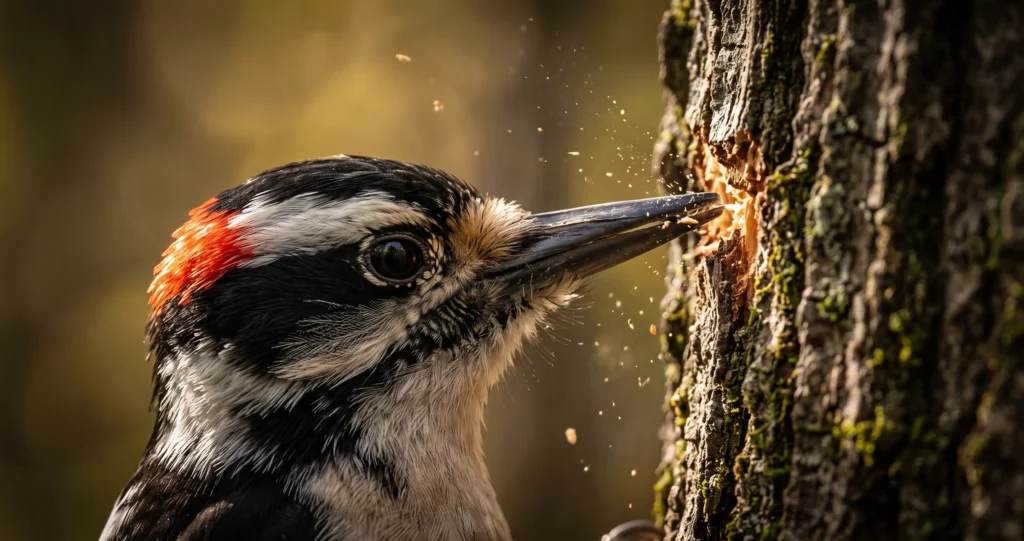
Every day, woodpeckers repeatedly slam their beaks into solid wood at speeds that would seem dangerous for almost any other animal. Some species can deliver thousands of powerful strikes during a single day while searching for insects, excavating nesting cavities, or communicating with rivals. For decades, scientists believed these birds possessed an extraordinary natural shock absorber that completely protected their brains from injury. Today, research into woodpecker brain protection tells a more nuanced—and even more fascinating—story.
Modern studies reveal that woodpeckers do not rely on one magical anatomical feature. Instead, a combination of specialized skull structure, powerful neck muscles, precise pecking mechanics, brain orientation, and a unique tongue-supporting bone called the hyoid apparatus all work together to reduce the forces acting on the brain. Engineers have even looked to these adaptations for inspiration when designing protective helmets, impact-resistant materials, and shock-absorbing systems. Understanding how woodpeckers survive repeated impacts continues to reshape both biology and engineering.
Table of Contents
- Why Woodpeckers Peck So Much
- Understanding Woodpecker Brain Protection
- How Hard Does a Woodpecker Peck?
- The Skull Structure Behind Impact Resistance
- The Remarkable Hyoid Bone
- Why Scientists Revised the Old “Shock Absorber” Theory
- Pecking Technique Matters as Much as Anatomy
- Why Woodpeckers Drum
- Biomimicry: Inspiring Safer Helmets and Engineering
- Other Adaptations That Support Repeated Pecking
- Common Myths About Woodpecker Brain Protection
- Frequently Asked Questions
- Conclusion
Why Woodpeckers Peck So Much
Woodpeckers belong to a family of birds specially adapted for climbing tree trunks and extracting food hidden beneath bark.
Their powerful beaks allow them to reach beetle larvae, ants, termites, and other insects unavailable to many competitors.
Pecking also serves several other important purposes.
Woodpeckers excavate nesting cavities inside dead or decaying trees.
They establish territories by producing loud drumming sounds.
Some species even use pecking to attract mates.
Because these behaviors occur daily throughout much of the year, repeated impacts are an unavoidable part of woodpecker life.
Understanding Woodpecker Brain Protection
The question that has fascinated scientists for decades is simple.
How can a bird repeatedly strike solid wood without suffering brain injuries?
Early explanations focused on the skull acting like a built-in shock absorber.
Although this idea contained some truth, recent research demonstrates that the answer is much more complex.
Rather than relying on one protective structure, woodpeckers reduce injury risk through an integrated system involving anatomy, behavior, and biomechanics.
Each component contributes to minimizing harmful forces before they reach the brain.
How Hard Does a Woodpecker Peck?
Different woodpecker species vary in pecking speed and force.
Some strikes occur at speeds approaching 6–7 meters per second (about 13–16 mph).
Peak deceleration during impact can exceed 1,000 times the force of gravity (1,000 g) under certain measurements.
Although these numbers sound enormous, they cannot be compared directly with human head injuries.
Woodpeckers possess much smaller brains.
The distance their brains can move inside the skull is extremely limited.
Their precise pecking mechanics also reduce rotational forces, which play an important role in many human traumatic brain injuries.
The Skull Structure Behind Impact Resistance
Woodpecker skulls differ from those of many other birds in several important ways.
The skull bones combine strength with carefully distributed flexibility.
Certain regions contain spongier bone, while others remain denser.
This arrangement helps distribute impact forces efficiently across the skull.
The beak also contributes.
Researchers have found slight differences in stiffness between the upper and lower portions of the beak.
These differences may influence how impact forces travel through the head.
Rather than concentrating energy in one location, the skull and beak together help spread mechanical stress.
The Remarkable Hyoid Bone
One of the most unusual features of woodpecker anatomy is the hyoid apparatus.
In most animals, the hyoid supports the tongue.
Woodpeckers possess an exceptionally elongated version.
The hyoid begins near the tongue but extends backward around the skull before anchoring near the nostrils or upper beak.
For many years, scientists believed this structure functioned like a seatbelt or shock absorber surrounding the skull.
Its unusual path certainly attracted attention.
Modern research, however, suggests the story is more complicated.
The hyoid likely contributes to force distribution and tongue control, but evidence indicates it probably does not act as the primary cushioning device once imagined.
Instead, it represents one part of a broader protective system.
Why Scientists Revised the Old “Shock Absorber” Theory
Recent biomechanical studies have challenged several traditional explanations.
Computer modeling and experimental measurements suggest that if the skull absorbed too much impact energy, the bird would actually lose drilling efficiency.
To excavate wood effectively, much of the force generated by neck muscles must transfer directly into the tree.
Researchers now propose that woodpeckers do not eliminate impact forces entirely.
Instead, they tolerate them remarkably well because multiple adaptations reduce the most damaging components.
Their brains fit tightly inside the skull, limiting movement.
Their pecking direction remains highly controlled.
The small size of the brain itself reduces momentum during impacts.
Neck muscles stabilize the head throughout each strike.
This revised understanding highlights how evolution often favors integrated systems rather than single “perfect” solutions.
Pecking Technique Matters as Much as Anatomy
Behavior plays an equally important role.
Woodpeckers rarely strike trees randomly.
Their heads move in highly controlled, nearly straight lines.
This minimizes rotational acceleration, which is particularly damaging in many human brain injuries.
Each strike also involves precise coordination between neck muscles, body posture, and beak alignment.
By maintaining consistent mechanics, woodpeckers reduce unnecessary stress on sensitive tissues.
The entire body contributes to safe pecking rather than relying solely on the skull.
Why Woodpeckers Drum
Not every peck serves to obtain food.
Woodpeckers also perform rapid sequences known as drumming.
Unlike foraging pecks, drumming usually occurs on resonant surfaces that amplify sound.
The purpose is communication.
Drumming announces territory ownership.
It attracts potential mates.
It may also help neighboring birds recognize individual competitors.
Different species produce distinct drumming rhythms and durations.
Some even prefer metal roofs, gutters, utility poles, or signs because these objects generate louder sounds than natural wood.
Biomimicry: Inspiring Safer Helmets and Engineering
Woodpecker biology has inspired numerous engineering studies.
Researchers interested in impact protection examine how natural systems manage repeated mechanical stress.
Potential applications include:
Sports Helmets
Improved energy distribution concepts may contribute to future helmet designs.
Industrial Safety Equipment
Protective headgear for construction workers may benefit from biomimetic impact management principles.
Automotive Engineering
Crash-energy management systems sometimes draw inspiration from biological force distribution.
Aerospace Components
Lightweight structures capable of absorbing repeated impacts remain valuable engineering goals.
Importantly, engineers do not simply copy woodpecker anatomy.
Instead, they study the underlying mechanical principles and adapt them for human technologies.
Other Adaptations That Support Repeated Pecking
Woodpeckers possess numerous additional features that complement brain protection.
Strong Neck Muscles
Powerful muscles generate striking force while stabilizing the head.
Reinforced Eyelids
A specialized inner eyelid helps protect the eyes during impacts.
Stiff Tail Feathers
Strong tail feathers brace the bird against tree trunks, providing stability.
Specialized Feet
Two toes face forward and two backward in most woodpecker species, creating a secure climbing grip.
Together, these adaptations create an integrated system optimized for vertical climbing and repeated pecking.
Why Scientists Continue Studying Woodpeckers
Research into woodpecker biomechanics contributes to several scientific disciplines.
Biomechanics explores how living organisms manage physical forces.
Neuroscience investigates brain injury mechanisms.
Evolutionary biology examines how complex adaptations develop.
Engineering uses biological inspiration to improve human technologies.
As imaging methods and computer simulations continue advancing, scientists are refining earlier models of woodpecker head mechanics.
These studies illustrate how science evolves by continually testing and improving previous ideas.
If you enjoy learning about remarkable biological adaptations, you may also enjoy our article exploring the extraordinary sensory system of the star-nosed mole at secretsofthegreengarden.com.
For additional information about woodpecker biology and conservation, the Cornell Lab of Ornithology provides extensive educational resources:
https://www.allaboutbirds.org/
Common Myths About Woodpecker Brain Protection
Myth: Woodpeckers never experience any force during pecking.
False.
They experience substantial forces but possess adaptations that reduce injury risk.
Myth: The hyoid bone alone prevents brain damage.
False.
Modern research shows protection results from multiple anatomical and behavioral adaptations working together.
Myth: Their skull functions like a soft cushion.
False.
The skull must remain rigid enough to transfer drilling force efficiently.
Myth: Every peck is for finding food.
False.
Many pecks serve communication, territory defense, or nest excavation.
Myth: Engineers copied woodpecker skulls directly into helmets.
False.
Researchers use biological principles for inspiration rather than exact anatomical duplication.
Frequently Asked Questions
How many times can a woodpecker peck each day?
Active individuals may deliver several thousand strikes daily, with some estimates reaching around 12,000 impacts depending on species and activity.
What protects a woodpecker’s brain?
Protection comes from a combination of skull structure, tight brain fit, controlled pecking mechanics, neck muscles, and the hyoid apparatus.
Why do woodpeckers drum on metal?
Metal surfaces often amplify sound better than wood, making territorial signals travel farther.
Does the hyoid bone wrap around the skull?
Yes.
The elongated hyoid extends around the back of the skull before attaching near the upper beak.
Have scientists solved the mystery completely?
Not entirely.
Although much has been learned, researchers continue refining our understanding of how different adaptations work together.
Conclusion
The science of woodpecker brain protection demonstrates that nature often solves complex engineering problems through the interaction of many specialized adaptations rather than a single extraordinary feature. Woodpeckers withstand thousands of daily head impacts because their skull structure, elongated hyoid apparatus, powerful neck muscles, tightly fitted brains, and remarkably precise pecking mechanics function as an integrated protective system. Recent research has moved beyond the older idea of a simple biological shock absorber, revealing a far more sophisticated combination of anatomy and behavior.
Beyond expanding our understanding of bird biology, these discoveries continue influencing engineering, medicine, and materials science. By studying how woodpeckers safely manage repeated impacts, researchers hope to improve protective equipment, develop more effective energy-absorbing structures, and better understand traumatic brain injuries. Once again, one of nature’s most familiar birds reminds us that even everyday wildlife can inspire extraordinary scientific innovation.
2 Internal Link Suggestions:
- https://secretsofthegreengarden.com/the-star-nosed-mole-the-fastest-forager-in-the-animal-kingdom/
- https://secretsofthegreengarden.com/can-birds-see-earths-magnetic-field-inside-the-science-of-avian-magnetoreception/
3 External Dofollow Authoritative Sources with URLs:
- Cornell Lab of Ornithology – All About Birds: https://www.allaboutbirds.org/
- Smithsonian’s National Zoo – Woodpeckers: https://nationalzoo.si.edu/
- National Audubon Society – Woodpeckers: https://www.audubon.org/