

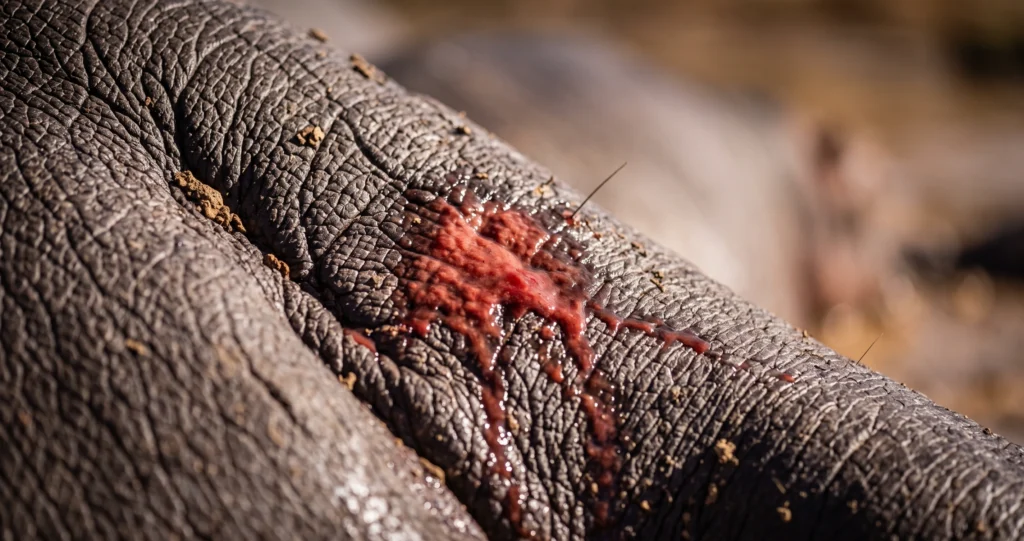
At first glance, it looks alarming. On hot days, hippopotamuses often appear covered with a reddish-orange fluid that resembles blood mixed with sweat. For years, this unusual secretion inspired myths, legends, and even scientific curiosity. Modern research has revealed that hippo blood sweat is neither blood nor sweat. Instead, it is a remarkable skin secretion containing specialized pigments that help protect one of Africa’s largest mammals from intense sunlight, dehydration, and harmful bacteria.
Scientists have identified two key compounds—hipposudoric acid and norhipposudoric acid—that give this secretion its characteristic color and remarkable biological properties. Together, these chemicals function as a natural sunscreen and antimicrobial shield, helping hippos survive in challenging aquatic environments where skin injuries and prolonged sun exposure are common. Their unusual chemistry has even attracted interest from pharmaceutical researchers searching for new antimicrobial compounds.
Table of Contents
- Why Hippos Produce “Blood Sweat”
- What Is Hippo Blood Sweat?
- The Chemistry Behind the Red Secretion
- Hipposudoric Acid Explained
- Norhipposudoric Acid and Its Role
- A Natural Sunscreen
- An Antimicrobial Defense System
- Why Hippos Need Extra Skin Protection
- Pharmaceutical Research and Future Possibilities
- Other Fascinating Hippo Adaptations
- Common Myths About Hippo Blood Sweat
- Frequently Asked Questions
- Conclusion
Why Hippos Produce “Blood Sweat”
Hippos spend much of their day submerged in rivers and lakes across sub-Saharan Africa.
Although they appear well protected by water, they frequently leave the water to graze during the evening and early morning.
Even while partially submerged, parts of their enormous bodies remain exposed to intense tropical sunlight.
Unlike many mammals, hippos possess relatively little body hair.
Their skin is thick but highly sensitive to drying and prolonged ultraviolet (UV) radiation.
Evolution has provided an elegant solution.
Specialized skin glands produce a protective secretion that coats the body soon after exposure to air.
What Is Hippo Blood Sweat?
Despite its dramatic appearance, hippo blood sweat is neither blood nor perspiration.
It contains no blood cells.
Nor is it produced by sweat glands like those found in humans.
Instead, specialized mucus glands in the skin secrete a colorless fluid.
After exposure to air, this secretion gradually changes color through chemical reactions.
Initially, it appears nearly transparent.
It soon becomes reddish-orange before eventually turning brown as the compounds continue oxidizing.
These color changes contributed to centuries of misunderstanding about its origin.
The Chemistry Behind the Red Secretion
Researchers identified two major pigments responsible for the secretion’s unusual appearance:
- Hipposudoric acid
- Norhipposudoric acid
These compounds belong to a rare group of highly reactive pigments.
Both molecules absorb ultraviolet light while also displaying antimicrobial activity.
Because they are chemically unstable, studying them proved difficult for many years.
Scientists eventually isolated and characterized the compounds using advanced analytical chemistry techniques.
Their discoveries revealed one of the most unusual chemical defense systems known among mammals.
Hipposudoric Acid Explained
Hipposudoric acid is the reddish pigment primarily responsible for the characteristic appearance of fresh hippo secretions.
The compound absorbs ultraviolet wavelengths that would otherwise damage exposed skin.
By acting as a natural UV filter, it reduces harmful radiation reaching underlying tissues.
Researchers have demonstrated that hipposudoric acid absorbs portions of both UVA and UVB radiation.
Although it does not function exactly like commercial sunscreen ingredients, its protective effect helps reduce sun-induced skin damage.
The compound also contributes to maintaining skin moisture by forming part of the protective surface layer covering the body.
Norhipposudoric Acid and Its Role
Norhipposudoric acid closely resembles hipposudoric acid but produces a more orange-colored appearance.
Together, both pigments create the reddish-orange coloration commonly observed on hippos.
Like its companion molecule, norhipposudoric acid contributes to UV absorption.
Researchers believe the combined activity of both compounds provides broader protection than either would alone.
Their interaction illustrates how multiple biological chemicals often work together rather than functioning independently.
Hippo Blood Sweat as a Natural Sunscreen
One of the most remarkable functions of hippo blood sweat is protection against ultraviolet radiation.
African sunlight can be extremely intense.
Large mammals with limited hair coverage face considerable risk of skin damage.
The protective pigments absorb harmful UV wavelengths before they penetrate deeper skin layers.
This reduces cellular damage caused by prolonged solar exposure.
Unlike humans, hippos cannot simply seek complete shade throughout the day.
Their natural sunscreen provides continuous protection whenever they leave the water.
Although researchers caution against comparing it directly with commercial sunscreen products, the biological principle remains remarkably similar.
An Antimicrobial Defense System
Sun protection represents only part of the secretion’s function.
Hippos frequently sustain cuts and abrasions.
They fight aggressively with one another using large canine teeth.
Living in warm freshwater environments also exposes wounds to numerous microorganisms.
Laboratory studies have demonstrated antimicrobial activity associated with hippo skin secretions.
These compounds inhibit the growth of certain bacteria.
By reducing microbial colonization of damaged skin, the secretion likely lowers infection risk.
This dual-purpose system—combining UV protection with antimicrobial defense—is exceptionally unusual among mammals.
Why Hippos Need Extra Skin Protection
Hippos face several unique environmental challenges.
Limited Hair Coverage
Sparse hair leaves large areas of skin directly exposed to sunlight.
Thick but Sensitive Skin
Although their skin can exceed several centimeters in thickness, it remains vulnerable to dehydration and surface damage.
Frequent Injuries
Territorial disputes often result in bites and cuts requiring protection from infection.
Warm Aquatic Habitats
Rivers and lakes contain diverse bacteria capable of colonizing open wounds.
The specialized secretion addresses all of these challenges simultaneously.
Pharmaceutical Research Interest
The unusual chemistry of hippo blood sweat has attracted attention beyond zoology.
Researchers interested in antimicrobial resistance continue searching for naturally occurring compounds capable of controlling bacterial growth.
Although hippo pigments themselves are chemically unstable and unsuitable for direct medical use, studying their structure may inspire future drug development.
Scientists investigate questions such as:
- How do these molecules inhibit bacterial growth?
- Can similar synthetic compounds be developed?
- Might related chemicals improve wound care?
Research remains in early stages.
No commercial medicines currently derive directly from hippo skin secretions.
Nevertheless, the compounds illustrate how studying wildlife often contributes valuable ideas for biomedical science.
Other Fascinating Hippo Adaptations
The unusual skin secretion is only one of many remarkable hippo adaptations.
Semi-Aquatic Lifestyle
Hippos spend much of each day submerged, helping regulate body temperature.
Automatic Surfacing
Even while sleeping, hippos automatically rise to breathe before submerging again without fully awakening.
Powerful Jaws
Their enormous jaws can open to nearly 150 degrees and contain some of the largest canine teeth among mammals.
Efficient Movement Underwater
Although often described as swimming, hippos typically walk or bound along river bottoms rather than floating continuously.
These adaptations work together to support life in freshwater ecosystems.
Why Scientists Continue Studying Hippo Skin
Understanding hippo skin biology extends beyond curiosity.
The secretion demonstrates how evolution solves multiple environmental problems using relatively simple chemical strategies.
It also illustrates the importance of preserving biodiversity.
Countless plants and animals produce unique molecules that may someday contribute to medicine, materials science, or biotechnology.
Protecting wildlife therefore safeguards not only ecosystems but also valuable opportunities for scientific discovery.
If you enjoy learning about remarkable animal adaptations, you may also enjoy our article about platypus electroreception and the extraordinary sensory systems found in mammals at secretsofthegreengarden.com.
For additional information about hippopotamus biology and conservation, the Smithsonian’s National Zoo provides reliable educational resources:
https://nationalzoo.si.edu/
Alt text:
Common Myths About Hippo Blood Sweat
Myth: Hippos sweat blood.
False.
The reddish secretion contains neither blood nor traditional sweat.
Myth: The red color comes from injuries.
False.
Healthy hippos naturally produce this protective secretion.
Myth: Hippo blood sweat is poisonous.
False.
Its primary functions involve UV protection and antimicrobial defense.
Myth: The secretion completely blocks sunlight.
False.
It helps reduce UV damage but does not function identically to human sunscreen products.
Myth: Scientists already use hippo pigments in medicines.
False.
Researchers are studying these compounds, but no approved pharmaceuticals currently derive directly from them.
Frequently Asked Questions
What is hippo blood sweat?
It is a specialized skin secretion containing protective pigments rather than actual blood or sweat.
What chemicals create the red color?
Hipposudoric acid and norhipposudoric acid produce the characteristic reddish-orange appearance.
Why do hippos produce this secretion?
It helps protect the skin from ultraviolet radiation, dehydration, and bacterial infection.
Does every hippo produce it?
Healthy hippos naturally produce the secretion when exposed to air.
Is pharmaceutical research ongoing?
Yes.
Scientists continue investigating the chemistry and antimicrobial properties of these unusual compounds.
Conclusion
The remarkable story of hippo blood sweat demonstrates how evolution can solve multiple biological challenges with a single sophisticated adaptation. Rather than producing blood or ordinary sweat, hippos secrete a unique mixture of pigments that shield their skin from intense African sunlight while simultaneously helping protect wounds from bacterial infection. The discovery of hipposudoric acid and norhipposudoric acid transformed a long-standing biological mystery into one of the most fascinating examples of natural chemical defense found in mammals.
Beyond its ecological importance, this unusual secretion continues inspiring scientific research into antimicrobial chemistry and biomimetic medicine. Although much remains to be learned, hippo skin biology reminds us that nature often develops elegant solutions to complex problems—solutions that may one day contribute to advances in human health while deepening our appreciation for the extraordinary diversity of life on Earth.
2 Internal Link Suggestions:
- https://secretsofthegreengarden.com/how-platypuses-hunt-using-electroreception-while-blind-deaf-and-unable-to-smell/
- https://secretsofthegreengarden.com/the-star-nosed-mole-the-fastest-forager-in-the-animal-kingdom/
3 External Dofollow Authoritative Sources with URLs:
- Smithsonian’s National Zoo – Hippopotamus: https://nationalzoo.si.edu/
- San Diego Zoo Wildlife Alliance – Hippopotamus: https://animals.sandiegozoo.org/
- IUCN Red List – Hippopotamus (Hippopotamus amphibius): https://www.iucnredlist.org/