
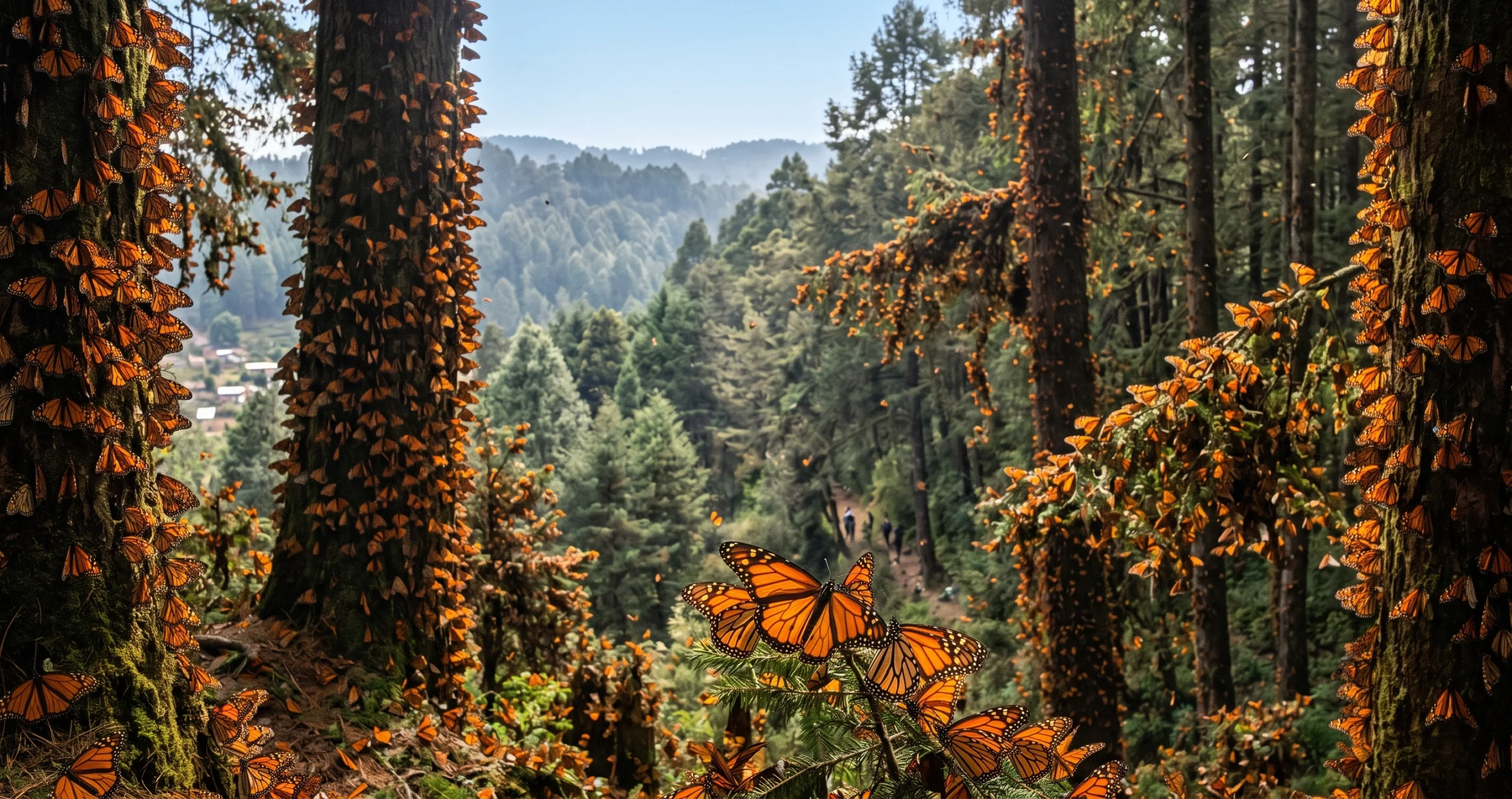
Every autumn, millions of monarch butterflies begin one of the most extraordinary migrations on Earth. These delicate insects travel thousands of miles from Canada and the northern United States to overwintering forests in central Mexico, despite weighing less than a gram. What makes monarch butterfly migration even more remarkable is that the butterflies completing the journey have never been there before. They are several generations removed from the butterflies that made the same trip the previous year.
This astonishing feat has fascinated scientists for decades. Research suggests monarchs rely on an intricate combination of inherited navigation systems, including a time-compensated sun compass and possibly Earth’s magnetic field. At the same time, their survival depends heavily on healthy habitats filled with milkweed and nectar-rich flowers. Understanding monarch butterfly migration not only reveals one of nature’s greatest mysteries but also shows how gardeners can play an important role in conserving this iconic species.
Table of Contents
- The Incredible Journey of the Monarch Butterfly
- Understanding the Monarch Butterfly Migration Cycle
- The Special “Super Generation”
- How Monarchs Navigate Across a Continent
- The Sun Compass Explained
- Do Monarchs Use Earth’s Magnetic Field?
- Why Milkweed Is Essential
- Habitat Loss and Population Declines
- How to Create a Monarch Waystation at Home
- Why Monarch Conservation Matters
- Common Myths About Monarch Butterflies
- Frequently Asked Questions
- Conclusion
The Incredible Journey of the Monarch Butterfly
Monarch butterflies (Danaus plexippus) are among the world’s most recognizable insects.
Their brilliant orange and black wings serve as a warning to predators because monarch caterpillars accumulate defensive chemicals from milkweed plants.
Each year, eastern North American monarchs travel from breeding areas across Canada and the United States to mountain forests in central Mexico.
Western monarchs complete a shorter migration to coastal California.
The eastern migration can exceed 3,000 miles (4,800 kilometers), making it one of the longest known insect migrations on Earth.
Remarkably, no single monarch completes the entire annual round trip.
Instead, multiple generations share the journey.
Understanding the Monarch Butterfly Migration Cycle
Unlike birds that often migrate as the same individuals year after year, monarch butterflies follow a multigenerational migration.
Spring migration begins when butterflies overwintering in Mexico fly northward.
They lay eggs primarily on milkweed before dying.
Their offspring continue moving farther north.
Successive generations repeat the process throughout spring and summer.
By late summer, a very different generation emerges.
This final generation undertakes the entire southward migration back to Mexico.
The cycle then begins again the following spring.
The Special “Super Generation”
The final generation of each year differs dramatically from earlier generations.
Scientists often call these butterflies the “super generation.”
Unlike spring and summer monarchs that usually live only two to six weeks, the super generation may survive for eight or even nine months.
Several biological changes make this possible.
These butterflies delay reproduction.
They accumulate greater fat reserves.
Their metabolism shifts toward long-term survival rather than immediate breeding.
These adaptations allow them to survive migration, overwinter in Mexican forests, and begin the following year’s northward journey.
Without the super generation, the annual migration could not continue.
Monarch Butterfly Migration and Inherited Navigation
One of the greatest mysteries surrounding monarch butterfly migration is navigation.
The butterflies reaching Mexico have never visited those forests before.
How do they find the same region generation after generation?
Scientists believe navigation depends largely on inherited biological mechanisms rather than learning from older butterflies.
Research indicates monarchs possess internal navigation systems programmed by evolution.
Although many details remain under investigation, several mechanisms appear especially important.
The Sun Compass Explained
The strongest evidence supports the existence of a time-compensated sun compass.
Monarch butterflies monitor the Sun’s position throughout the day.
Because the Sun moves across the sky, simple directional orientation would not be sufficient.
Instead, monarchs combine solar information with an internal circadian clock located partly within their antennae.
This biological clock allows butterflies to compensate for the Sun’s changing position.
As a result, they maintain a consistent migratory direction throughout daylight hours.
Experiments altering monarchs’ internal clocks cause predictable changes in flight direction, strongly supporting the sun compass theory.
Do Monarchs Use Earth’s Magnetic Field?
Scientists also continue investigating whether monarch butterflies use Earth’s magnetic field.
Laboratory studies suggest monarchs may possess a magnetic compass that functions under certain lighting conditions, particularly when sunlight is unavailable.
Researchers suspect specialized light-sensitive proteins called cryptochromes may participate in this process.
These proteins have also been implicated in magnetic sensing among migratory birds.
Evidence indicates magnetic cues probably complement rather than replace the sun compass.
Together, these systems may help monarchs maintain orientation during cloudy conditions or at sunrise and sunset.
Although research continues, magnetoreception remains one of the most promising areas of monarch navigation science.
The Importance of Milkweed
No discussion of monarch butterfly migration is complete without milkweed.
Milkweed serves two critical purposes.
First, it is the only plant on which female monarchs lay eggs.
Second, monarch caterpillars feed almost exclusively on milkweed leaves.
Without milkweed, monarch reproduction cannot occur.
The plants also contain cardiac glycosides, compounds that make caterpillars and adult butterflies distasteful to many predators.
Their bright orange coloration advertises this chemical defense.
Native milkweed species vary across North America, but all provide essential breeding habitat.
Protecting and restoring milkweed populations remains one of the most effective conservation actions available.
Habitat Loss and Population Declines
Monarch butterflies face numerous environmental challenges.
Habitat loss has reduced both breeding and overwintering areas.
Major threats include:
- Urban expansion
- Agricultural intensification
- Herbicide use that removes milkweed
- Climate change
- Severe weather events
- Forest degradation in overwintering habitats
Because monarch migration depends on suitable habitat across an enormous geographic range, conservation requires international cooperation between Canada, the United States, and Mexico.
Even relatively small habitat improvements across many locations can contribute meaningfully to population recovery.
How to Create a Monarch Waystation at Home
Home gardeners can make a real difference by creating monarch-friendly habitats.
A monarch waystation provides food, breeding sites, and shelter during migration.
Plant Native Milkweed
Choose milkweed species native to your region whenever possible.
Native plants generally provide the best ecological benefits.
Include Nectar Flowers
Adult monarchs require nectar throughout migration.
Plant a variety of flowers that bloom from spring through autumn.
Examples include:
- Coneflowers
- Black-eyed Susans
- Goldenrod
- Asters
- Blazing star
- Bee balm
Avoid Pesticides
Many insecticides harm butterflies directly or contaminate host plants.
Reducing pesticide use benefits monarchs and numerous other pollinators.
Provide Continuous Bloom
A diverse planting schedule ensures nectar remains available throughout the migration season.
Leave Some Natural Areas
Avoid excessive garden tidiness.
Native grasses, shrubs, and leaf litter support many beneficial insects alongside monarchs.
Certified Monarch Waystations promoted by conservation organizations can provide especially valuable habitat within urban and suburban landscapes.
Why Monarch Conservation Matters
Monarch butterflies contribute to healthy ecosystems by participating in pollination networks.
Although they are not among the most efficient pollinators compared with bees, they visit many flowering plants while feeding.
More importantly, monarchs serve as powerful ambassadors for insect conservation.
Protecting monarch habitat also benefits countless native bees, moths, beetles, birds, and other wildlife that depend on diverse flowering landscapes.
If you enjoy learning about remarkable insect migrations, you may also enjoy our article exploring how birds detect Earth’s magnetic field during long-distance journeys at secretsofthegreengarden.com.
For additional information about monarch conservation and migration, Monarch Joint Venture provides science-based educational resources:
https://monarchjointventure.org/

Common Myths About Monarch Butterflies
Myth: One butterfly completes the entire annual migration.
False.
The migration spans multiple generations, with only the super generation completing the southward journey.
Myth: Monarchs navigate only using the Sun.
False.
Evidence suggests they combine several navigation systems, including an internal clock and possibly magnetic cues.
Myth: Any flowering plant can replace milkweed.
False.
Adult butterflies feed on many flowers, but monarch caterpillars require milkweed to develop.
Myth: Monarch populations are declining everywhere equally.
False.
Population trends differ between eastern and western populations and vary from year to year.
Myth: Planting one milkweed species is always best.
False.
Native regional milkweed species generally provide the greatest ecological value.
Frequently Asked Questions
Why is monarch butterfly migration unique?
It spans multiple generations, with different butterflies completing different stages of the annual journey.
What is the super generation?
It is the long-lived autumn generation that migrates to overwintering forests and survives until spring.
How do monarchs find Mexico?
They primarily use a time-compensated sun compass and may also use magnetic cues under certain conditions.
Why is milkweed important?
Milkweed is the only host plant on which monarch butterflies lay eggs and the primary food source for their caterpillars.
Can home gardeners help monarchs?
Yes.
Planting native milkweed, providing nectar flowers, and avoiding pesticides all support monarch conservation.
Conclusion
The story of monarch butterfly migration is one of nature’s most extraordinary examples of inherited navigation and multigenerational survival. Through a remarkable combination of specialized physiology, an internal sun compass, possible magnetic sensing, and the unique adaptations of the super generation, monarch butterflies accomplish journeys that rival those of many birds despite their delicate size. Each migration demonstrates the incredible precision that evolution can produce over millions of years.
At the same time, the future of monarch butterflies depends increasingly on healthy habitats filled with native milkweed and nectar-rich flowers. By creating monarch waystations, reducing pesticide use, and supporting habitat conservation across North America, gardeners and nature enthusiasts can contribute directly to protecting one of the world’s most iconic insect migrations. Every restored patch of habitat helps ensure that future generations of monarchs continue returning to the same forests year after year.
2 Internal Link Suggestions:
- https://secretsofthegreengarden.com/can-birds-see-earths-magnetic-field-inside-the-science-of-avian-magnetoreception/
- https://secretsofthegreengarden.com/how-platypuses-hunt-using-electroreception-while-blind-deaf-and-unable-to-smell/
3 External Dofollow Authoritative Sources with URLs:
- Monarch Joint Venture: https://monarchjointventure.org/
- Xerces Society for Invertebrate Conservation – Monarchs: https://www.xerces.org/monarchs
- U.S. Fish & Wildlife Service – Monarch Butterfly: https://www.fws.gov/species/monarch-butterfly-danaus-plexippus