
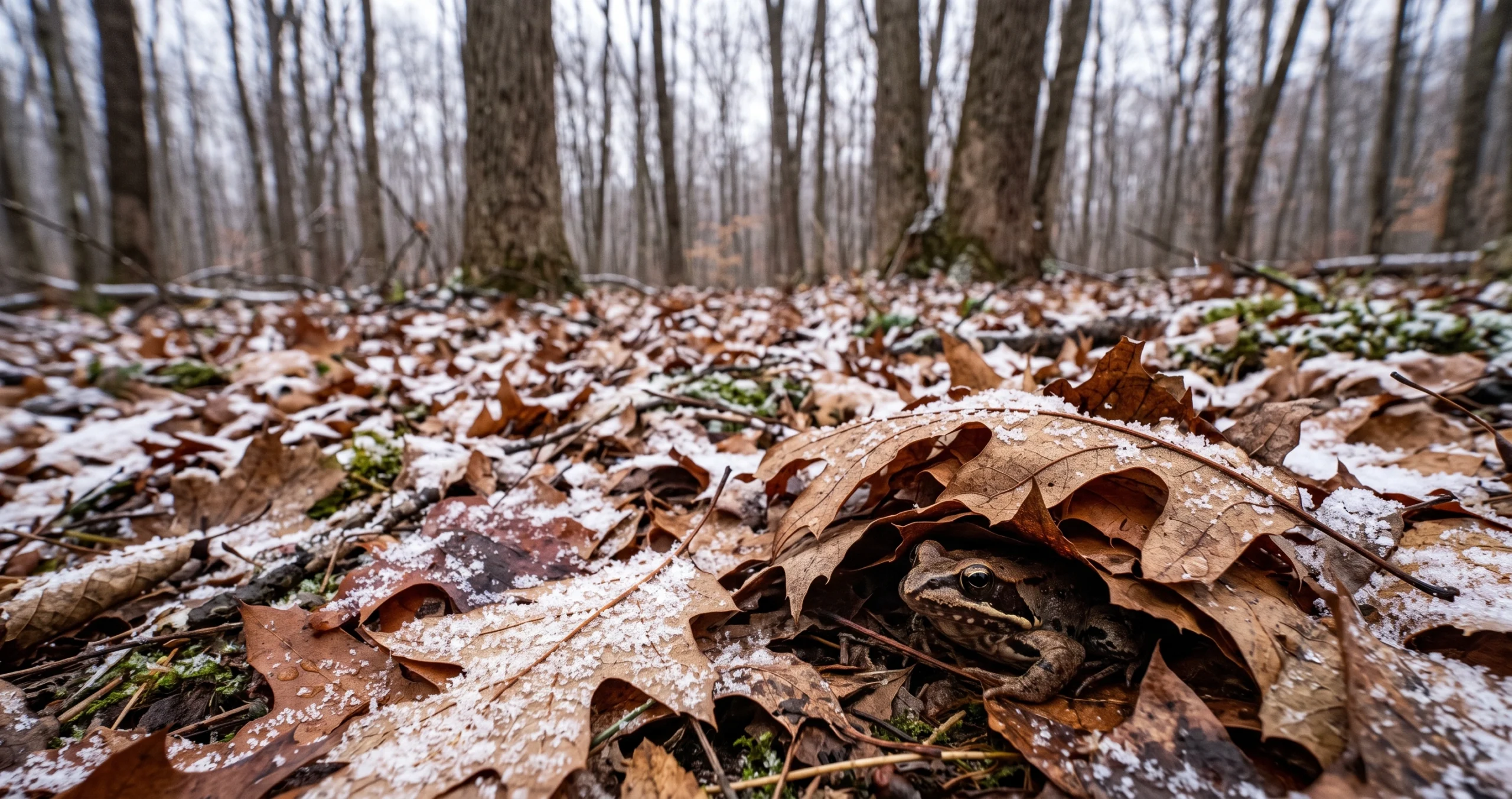
Every winter across North America, one small amphibian performs what seems impossible. The wood frog freezing survival strategy allows this remarkable species to endure conditions that would kill nearly every other frog. As temperatures plunge below freezing, its body partially freezes, its heart stops beating, and breathing ceases—yet it returns to life when spring arrives.
This extraordinary adaptation has fascinated biologists for decades. Scientists have discovered that wood frogs survive freezing through a combination of specialized cryoprotectants, carefully controlled ice formation, and unique cellular defenses. Beyond its ecological importance, wood frog freezing survival has become a valuable model for medical research, particularly in improving organ preservation for transplantation.
Table of Contents
- Meet the Remarkable Wood Frog
- Why Most Frogs Cannot Survive Freezing
- The Science Behind Wood Frog Freezing Survival
- How Glucose Works as a Natural Antifreeze
- What Happens to the Organs During Freezing
- Waking Up After Months Frozen
- Why Scientists Study Wood Frogs
- Other Animals That Survive Freezing Temperatures
- Where and When to Spot Wood Frogs
- Common Myths About Frozen Frogs
- Frequently Asked Questions
- Conclusion
Meet the Remarkable Wood Frog
The wood frog (Lithobates sylvaticus) lives throughout much of Canada, Alaska, and the northern United States. Unlike many amphibians that escape winter by remaining underwater or deep below the frost line, wood frogs often spend the cold months beneath leaf litter on the forest floor.
This exposes them to freezing air temperatures, snow cover, and ice formation. Instead of avoiding winter entirely, they have evolved one of the most remarkable survival strategies found in vertebrates.
Their ability to survive repeated freezing events allows them to colonize regions where many other amphibians cannot survive.
Why Most Frogs Cannot Survive Freezing
Water expands when it freezes.
Inside living cells, expanding ice crystals rupture membranes, damage proteins, and destroy delicate cellular structures. For most animals, widespread ice formation quickly becomes fatal.
Additionally, freezing causes severe dehydration because water leaves cells and joins growing ice crystals outside them.
Blood circulation stops.
Oxygen delivery ends.
Without specialized adaptations, organs begin to fail rapidly.
The wood frog has evolved an elegant solution to these problems.
The Science Behind Wood Frog Freezing Survival
Wood Frog Freezing Survival Relies on Controlled Freezing
The wood frog does not prevent freezing altogether.
Instead, it carefully controls where ice forms and protects living cells from damage.
As temperatures fall below freezing, tiny ice crystals begin forming outside the body’s cells.
Special proteins encourage ice to develop primarily in extracellular spaces rather than inside individual cells.
This distinction is critical.
Keeping ice outside cells greatly reduces the mechanical damage that normally accompanies freezing.
Although nearly two-thirds of the frog’s body water may freeze, most cells remain structurally intact.
How Glucose Works as a Natural Antifreeze
One of the most fascinating aspects of wood frog freezing survival is the rapid production of glucose.
When freezing begins, the frog’s liver quickly converts stored glycogen into massive amounts of glucose that flood the bloodstream.
Blood glucose concentrations can increase dozens of times above normal levels within only a few hours.
This glucose serves as a cryoprotectant.
Unlike automotive antifreeze, glucose does not stop ice from forming completely.
Instead, it reduces cellular dehydration, stabilizes proteins, and limits damage caused by freezing.
The concentrated sugar solution helps maintain cell volume while protecting membranes from structural injury.
Scientists often compare this process to adding protective compounds before placing delicate biological materials into extremely cold storage.
Other Cryoprotectants Play an Important Role
Although glucose receives most of the attention, it is not the only protective compound involved.
Wood frogs also accumulate urea before winter arrives.
Urea contributes additional protection by reducing water loss from cells and supporting the overall freeze-tolerance strategy.
Together, glucose and urea create a biochemical shield that allows tissues to survive conditions that would normally prove fatal.
Researchers continue investigating other protective molecules that may contribute to this remarkable adaptation.
What Happens to the Organs During Freezing
Perhaps the most astonishing feature of wood frog freezing survival is what happens inside the body.
As freezing progresses:
- The heart stops beating.
- Breathing stops completely.
- Blood circulation ceases.
- Muscles become rigid.
- Brain activity declines dramatically.
- The frog appears completely lifeless.
Despite these dramatic changes, many cells remain alive because their internal structures stay protected.
The organs essentially enter a suspended state.
Energy use drops to extremely low levels, allowing tissues to survive until temperatures rise again.
Scientists often describe this as a highly controlled pause rather than true death.
Waking Up After Months Frozen
Spring thaw triggers an equally remarkable recovery.
As temperatures climb above freezing, ice gradually melts throughout the body.
The heart typically resumes beating first.
Blood circulation restarts.
Oxygen once again reaches tissues.
Within hours, many wood frogs begin moving.
Soon afterward they migrate toward temporary woodland ponds where breeding begins almost immediately.
Because these frogs emerge so early in spring, they often reproduce before predators become abundant and before seasonal wetlands begin drying.
Why Scientists Study Wood Frogs
The medical importance of wood frog freezing survival extends far beyond amphibian biology.
One of modern medicine’s greatest challenges is preserving donated organs long enough for successful transplantation.
Human organs remain viable only for relatively short periods after removal.
If researchers could better understand how wood frogs protect cells during freezing, similar strategies might improve organ storage techniques.
Scientists are particularly interested in:
Cell Protection
Understanding how glucose stabilizes membranes may inspire better preservation fluids.
Cryoprotectant Chemistry
Wood frogs naturally produce protective compounds that function without causing the toxicity associated with many artificial cryoprotectants.
Tissue Recovery
Equally important is learning how organs regain normal function after circulation has stopped for extended periods.
Although translating these discoveries directly into medicine remains challenging, wood frogs continue providing valuable insights into cryobiology and regenerative research.
For additional information about ongoing cryobiology research, the National Institutes of Health provides resources on organ preservation science:
https://www.nih.gov/
Comparing Wood Frogs to Other Freeze-Tolerant Species
Wood frogs are not entirely unique, although they remain among the best-known freeze-tolerant vertebrates.
Several other animals have evolved similar adaptations.
Gray Treefrogs
Certain gray treefrogs also survive partial freezing using cryoprotectants, although their freeze tolerance generally differs from wood frogs.
Arctic Ground Squirrels
Rather than freezing solid, Arctic ground squirrels enter deep hibernation while allowing body temperatures to fall below the freezing point of water without extensive ice formation.
Woolly Bear Caterpillars
Some insects survive winter by producing glycerol and other cryoprotectants that protect tissues from freezing damage.
Antarctic Nematodes
Several microscopic worms tolerate repeated freezing and thawing through specialized cellular adaptations.
Each species has evolved different biochemical solutions to the same environmental challenge.
Ecological Importance of Early Spring Emergence
Wood frogs are often among the first amphibians to become active after snowmelt.
They breed in temporary woodland pools called vernal pools, where fish are usually absent.
This reduces predation on eggs and tadpoles.
Their tadpoles become important food for aquatic insects, birds, reptiles, and mammals, making wood frogs a key component of forest ecosystems.
Healthy amphibian populations also serve as indicators of environmental quality because they are sensitive to pollution, habitat destruction, and climate change.
If you enjoy discovering how wildlife contributes to healthy ecosystems, you may also like our guide to beneficial pollinators and native wildlife on secretsofthegreengarden.com.
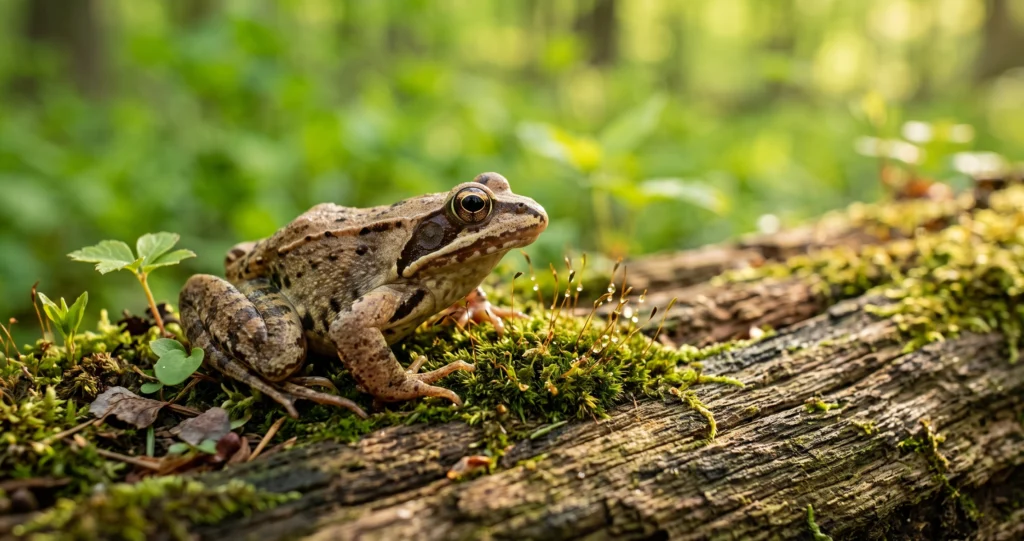
“wood frog freezing survival after emerging from winter hibernation.”
Where and When to Spot Wood Frogs
Wood frogs are widespread throughout northern forests.
The best opportunities to observe them occur during late winter and early spring.
Look for them in:
- Deciduous forests
- Mixed woodlands
- Forest edges
- Temporary woodland ponds
- Vernal pools
Early spring evenings often bring loud breeding choruses that resemble the quacking of ducks.
Because breeding occurs soon after snowmelt, activity may last only a short period before adults return to surrounding forests.
Observe frogs from a respectful distance without disturbing breeding sites or handling the animals.
Common Myths About Frozen Frogs
Myth: Wood frogs die every winter.
False.
Although they appear lifeless while frozen, living cells remain protected until thawing occurs.
Myth: Their bodies freeze completely solid.
Not exactly.
Much of their body water freezes, but specialized mechanisms prevent widespread ice formation inside living cells.
Myth: Any frog can survive freezing.
False.
Most amphibians cannot tolerate freezing and rely on different overwintering strategies.
Myth: Glucose works exactly like car antifreeze.
False.
Glucose mainly protects cells and tissues rather than preventing all ice formation.
Myth: Frozen frogs can survive indefinitely.
No.
Their freeze tolerance has biological limits that depend on temperature, duration, and environmental conditions.
Frequently Asked Questions
How cold can a wood frog survive?
Wood frogs tolerate temperatures well below freezing, although survival depends on duration and environmental conditions.
Does the heart really stop?
Yes. During freezing, heartbeat and circulation temporarily cease before restarting after thawing.
Why doesn’t the brain die without oxygen?
Metabolism slows dramatically, reducing oxygen demand while protective compounds help preserve tissues.
Where do wood frogs spend winter?
Most shelter beneath leaf litter, logs, or shallow soil within northern forests.
Can scientists copy this ability for humans?
Not directly, but research continues to improve cryobiology, organ preservation, and cellular protection using lessons learned from freeze-tolerant animals.
Conclusion
Wood frog freezing survival represents one of the most extraordinary physiological adaptations ever discovered in vertebrates. By carefully controlling ice formation and flooding their tissues with protective glucose and other cryoprotectants, these amphibians accomplish what once seemed biologically impossible.
Their frozen winter state is not simply a curiosity of nature. It continues to guide important research into cryobiology, tissue preservation, and future medical technologies. At the same time, wood frogs remind us how evolution can solve seemingly impossible environmental challenges through elegant biological innovation.
The next time early spring arrives and the first woodland ponds come alive with calling frogs, remember that many of those voices belong to animals that spent the winter with frozen hearts, frozen lungs, and frozen bodies—only to awaken once again when the forest thawed.
2 Internal Link Suggestions:
- https://secretsofthegreengarden.com/why-fireflies-are-important-for-healthy-gardens/
- https://secretsofthegreengarden.com/how-pollinators-help-your-garden-thrive/
3 External Dofollow Authoritative Sources with URLs:
- National Institutes of Health (NIH): https://www.nih.gov/
- Animal Diversity Web – Wood Frog (Lithobates sylvaticus): https://animaldiversity.org/accounts/Lithobates_sylvaticus/
- U.S. National Park Service – Wood Frog: https://www.nps.gov/articles/wood-frog.htm