
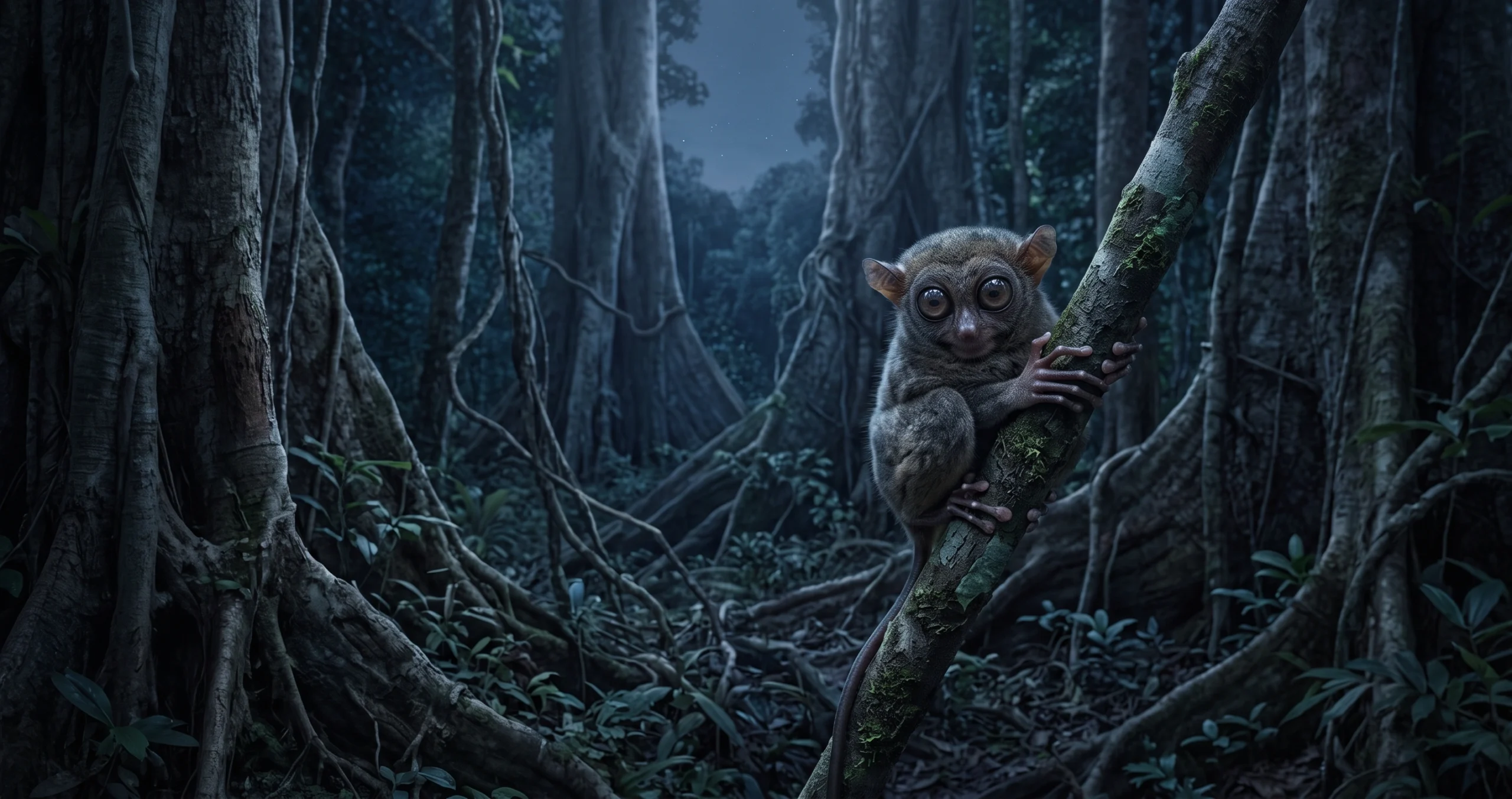
A tarsier staring through a dark Southeast Asian forest looks almost unreal. Its enormous eyes dominate its tiny face, giving the impression that it can see everything around it. Yet those remarkable eyes have an unusual limitation: they cannot move normally inside their sockets. The tarsier eye adaptation solves this problem by combining enormous, largely fixed eyes with a highly mobile neck that allows the animal to rotate its head dramatically when scanning its surroundings.
This strange arrangement is not an evolutionary mistake. Large eyes help tarsiers hunt in extremely low light, while their specialized neck compensates for the loss of ordinary eye movement. Together, these adaptations turn a small nocturnal primate into an extraordinarily effective predator.
Table of Contents
- What Is a Tarsier?
- Understanding the Tarsier Eye Adaptation
- Why Tarsiers Cannot Move Their Eyes Normally
- Why Their Eyes Became So Large
- How the Neck Compensates
- How Far Can a Tarsier Rotate Its Head?
- How Tarsiers Hunt at Night
- What Do Tarsiers Eat?
- Hearing and Ultrasonic Communication
- How Tarsiers Compare With Owls
- Conservation Status and Threats
- Common Myths
- FAQ
- Conclusion
What Is a Tarsier?
Tarsiers are tiny primates native to islands and forests of Southeast Asia. Modern species occur in the Philippines, Indonesia, Malaysia, and Brunei, with different species occupying separate geographic ranges.
They belong to the family Tarsiidae and represent one of the most unusual branches of the primate evolutionary tree.
Their name comes from another distinctive anatomical feature: extremely elongated tarsal bones in their hind limbs.
Those elongated ankle structures contribute to the tarsier’s extraordinary jumping ability.
A tarsier spends much of its active period clinging vertically to branches and trunks. When prey appears, powerful hind limbs allow it to launch itself through the vegetation.
But the feature most people notice first is the eyes.
Relative to body size, they are enormous.
Understanding the Tarsier Eye Adaptation
The tarsier eye adaptation represents an extreme solution to one of the major problems faced by nocturnal animals: gathering enough light to see.
A larger eye can collect more light than a smaller one.
For an animal hunting insects and other small prey beneath a dark forest canopy, that provides a major advantage.
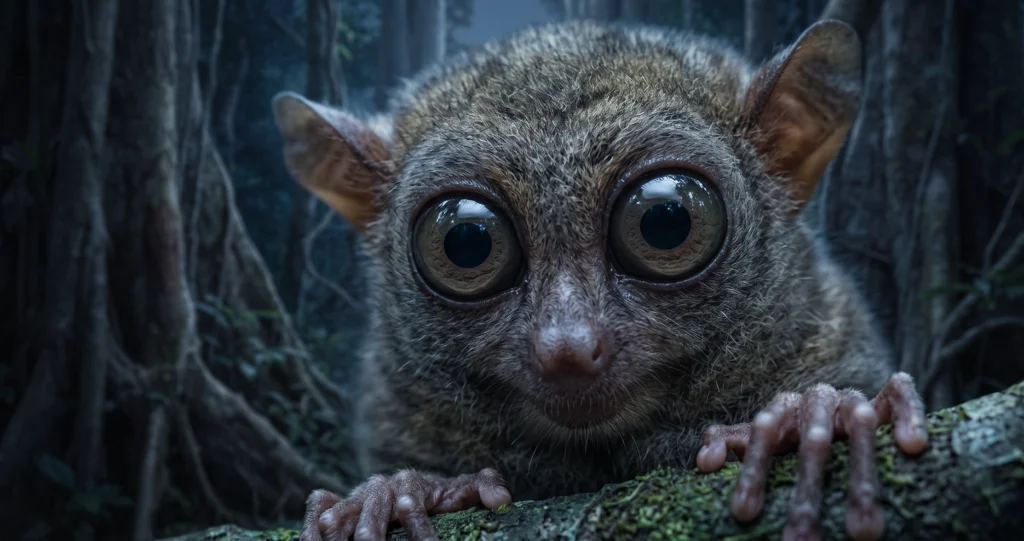
Tarsiers have evolved eyes so large that each eye is often described as being roughly comparable in size to the animal’s brain.
The result is excellent visual sensitivity under dim conditions.
But there is a trade-off.
The eyes occupy so much space within the skull and are so tightly associated with their sockets that tarsiers cannot rotate them freely the way humans can.
When a person looks toward something on the left, the eyes can move first while the head remains stationary.
A tarsier cannot rely on the same strategy.
Its head must do much more of the work.
Why Tarsiers Cannot Move Their Eyes Normally
Human eyeballs are approximately spherical and sit within eye sockets that permit substantial movement.
Several extraocular muscles rotate each eye, allowing us to shift our gaze without moving the entire head.
The tarsier arrangement is more constrained.
Its extraordinarily enlarged eyes occupy a substantial portion of the available cranial space and are effectively fixed within their bony orbits.
That means the tarsier cannot simply roll its eyes from side to side to inspect its surroundings.
This is an important clarification because descriptions sometimes suggest that tarsiers literally have no muscles associated with their eyes.
That oversimplifies the anatomy.
The central issue is functional mobility.
The unusual dimensions and arrangement of the eyes severely restrict normal rotational movement within the sockets.
The tarsier eye adaptation therefore required a compensatory mechanism elsewhere in the body.
Evolution found it in the neck.
Why Did Tarsier Eyes Become So Large?
Large eyes are particularly valuable to nocturnal predators.
At night, photons are scarce. An eye capable of gathering more available light can create a stronger visual signal.
Tarsiers need that sensitivity because they hunt living prey.
Unlike many small primates that eat substantial quantities of fruit, leaves, gums, or other plant material, tarsiers are highly specialized animal hunters.
Their prey can move rapidly.
An insect jumping between leaves or a small lizard moving along a branch gives the predator only a brief opportunity to strike.
Detecting movement accurately under dim conditions is therefore critical.
The enormous eyes help solve that problem.
Interestingly, tarsiers do not depend on a reflective retinal structure called a tapetum lucidum, which produces the familiar “eye shine” seen in many nocturnal mammals.
Instead, their visual system relies heavily on the size and sensitivity of the eyes themselves.
This makes the tarsier eye adaptation particularly striking.
Rather than adding a reflective layer behind the retina, evolution dramatically enlarged the optical system.
The Neck Solves the Fixed-Eye Problem
Enormous fixed eyes would be a serious disadvantage if the tarsier could only look directly forward.
Predators could approach from the side.
Prey could move behind it.
A tarsier clinging vertically to a tree would constantly need to reposition its entire body just to inspect its surroundings.
Its neck provides the solution.
Tarsiers possess anatomical adaptations allowing an exceptionally wide range of head rotation.
The exact skeletal and soft-tissue mechanisms are more complicated than simply having “extra neck bones.” Like other mammals, tarsiers have seven cervical vertebrae.
What differs is the anatomy and mobility of those structures and the surrounding tissues.
The cervical region permits an unusually large rotational range without requiring the body to follow.
This means a tarsier can remain attached to a branch while rapidly directing its enormous eyes toward sounds or movement elsewhere.
The combination works almost like a biological camera system.
The eyes provide powerful low-light optics.
The neck functions as the rotating mount.
How Far Can a Tarsier Rotate Its Head?
Tarsiers are widely reported to rotate their heads approximately 180 degrees in either direction.
That produces an overall scanning range approaching 360 degrees, although it does not mean the animal continuously spins its head all the way around.
This distinction matters.
Popular descriptions sometimes claim that tarsiers can rotate their heads “360 degrees.”
That can create the false impression that the animal can turn its head completely around in a single direction like a rotating mechanical joint.
It cannot.
Instead, the tarsier can turn dramatically to the left or right, providing an exceptionally broad field of inspection.
The behavior is visually reminiscent of an owl.
That resemblance is not accidental in a functional sense.
Both animals face a similar anatomical problem.
Tarsiers and Owls Found Similar Solutions
Owls also possess eyes that are unusually constrained in their sockets.
Rather than moving their eyes extensively, owls compensate with extraordinary neck mobility.
Tarsiers independently evolved a broadly similar strategy.
This is an example of how unrelated animals facing similar functional challenges can arrive at comparable solutions.
Owls are birds.
Tarsiers are primates.
Their last common ancestor lived extraordinarily far back in evolutionary history, yet both became visually specialized nocturnal predators with restricted eye mobility.
Both therefore depend heavily on head movement.
The details of their anatomy differ, but the underlying principle is similar: when the eyes cannot move sufficiently, move the entire visual platform instead.
For another remarkable example of specialized nocturnal sensory biology, see our article on how owls evolved feathers for nearly silent flight.
How Tarsiers Hunt at Night
The tarsier eye adaptation becomes especially impressive when combined with the rest of the animal’s hunting equipment.
A tarsier often spends time clinging vertically to a trunk or branch while scanning its surroundings.
Its enormous eyes search for movement.
Its independently mobile ears help detect tiny sounds.
When prey is located, the tarsier does not slowly climb toward it.
It can leap.
The elongated tarsal bones and powerful hind limbs act as a launching system, propelling the animal rapidly between vertical supports.
A tarsier may jump several times its own body length.
It then grabs prey with its hands and may use its mouth to deliver the killing bite.
This hunting style has been described as vertical clinging and leaping.
The animal can remain relatively stationary while searching, then suddenly explode into motion.
For a predator weighing only around the same as a small piece of fruit, the performance is remarkable.
What Do Tarsiers Eat?
Tarsiers stand apart from most other living primates because they are essentially obligate animal feeders.
Insects make up a major portion of the diet.
Depending on species and availability, prey can include crickets, beetles, moths, grasshoppers, cockroaches, and other arthropods.
But tarsiers are not limited to insects.
They can also take spiders and small vertebrates such as lizards.
Some species have been observed eating small birds, bats, snakes, and other animals when opportunities arise.
This makes the combination of large eyes, mobile neck, sensitive hearing, and powerful jumping legs easier to understand.
These are not adaptations for quietly searching for ripe fruit.
They belong to an active predator.
Hearing Adds Another Layer to the Hunt
Vision is only part of the tarsier’s sensory world.
Their large, mobile ears can help localize sounds produced by prey moving through vegetation.
Research on the Philippine tarsier has revealed something even more surprising.
Scientists found that the species can communicate using ultrasonic frequencies extending far above the normal range of human hearing.
A study published in Biology Letters documented extraordinarily high-frequency vocalizations and hearing sensitivity in Philippine tarsiers, suggesting that ultrasonic communication may help them communicate while remaining less detectable to some predators or prey.
The Smithsonian’s National Zoo also notes the unusual sensory biology and insectivorous lifestyle of Philippine tarsiers.
The combination gives these tiny primates a sensory environment very different from our own.
We see their giant eyes.
But much of what they perceive may arrive through sounds we cannot hear.
Why the Tarsier Eye Adaptation Works So Well
Every major adaptation involves compromises.
The tarsier eye adaptation provides extraordinary low-light capability but sacrifices normal eye mobility.
The neck compensates.
A highly predatory diet demands rapid prey detection.
Sensitive hearing complements vision.
Living among vertical branches requires powerful movement.
Elongated hind limbs provide explosive jumping ability.
Seen separately, each feature looks strange.
Seen together, they form a coherent ecological system.
That is one of the most useful ways to understand unusual animal anatomy.
Evolution does not build individual features in isolation.
It modifies interconnected systems that must function together.
Conservation Status Is Complicated
There is no single conservation status for “the tarsier” because multiple living species exist.
Their conservation situations differ substantially.
Some species have relatively broad distributions, while others occur on extremely restricted islands or fragmented forest habitats.
Several are listed as Vulnerable or Endangered on the IUCN Red List, while others currently receive lower threat classifications.
The critically important point is that many tarsiers depend on functioning forest habitats.
Deforestation and habitat fragmentation can isolate populations and reduce suitable hunting and sleeping areas.
Agricultural expansion, logging, mining, road construction, and urban development can all contribute to habitat loss depending on location.
Small geographic ranges make some species particularly vulnerable.
A population restricted to one island or small forest system cannot simply move hundreds of miles when habitat disappears.
Tourism Can Also Become a Threat
Tarsiers attract tourists because of their unusual appearance.
Responsible wildlife tourism can provide conservation benefits when local communities receive income from protecting habitat.
Poorly managed encounters can create the opposite result.
Tarsiers are nocturnal animals that normally spend daylight hours resting.
Handling them, surrounding them with visitors, making loud noises, using flash photography, or forcing them to remain exposed during the day can cause unnecessary stress.
Wild tarsiers should be observed quietly and at an appropriate distance.
Visitors should choose reputable conservation-oriented operators and facilities that prioritize natural behavior rather than close-contact photographs.
A tiny primate does not become domesticated simply because it remains still while tourists photograph it.
Stillness can also be a response to stress.
Common Myths About Tarsiers
Myth 1: Tarsiers Can Roll Their Eyes Like Humans
The enormous eyes are largely fixed within their sockets.
The animal compensates by moving its head.
Myth 2: Tarsiers Can Spin Their Heads Completely Around
They cannot continuously rotate the head through 360 degrees.
Instead, extreme rotation to either side gives them an exceptionally broad scanning range.
Myth 3: Tarsiers Are Monkeys
Tarsiers are primates, but they are not monkeys.
They belong to their own distinctive evolutionary lineage within the haplorhine primates.
Myth 4: Tarsiers Are Rodents
Their small bodies, long tails, and enormous eyes sometimes lead people unfamiliar with them to mistake them for rodents.
They are primates.
Myth 5: Tarsiers Eat Fruit
Tarsiers are unusual among primates because their natural diet is overwhelmingly animal-based.
Insects dominate, with small vertebrates also taken.
Myth 6: Giant Eyes Mean Tarsiers Can See Perfectly in Total Darkness
Large eyes improve performance under very low light.
They do not create light where none exists.
A tarsier still requires photons reaching the retina to form a visual image.
FAQ
Why can’t tarsiers move their eyes?
The extreme size and anatomical arrangement of the eyes restrict normal movement within the sockets. The tarsier eye adaptation compensates for this limitation with exceptional neck mobility.
Why are tarsier eyes so big?
Their large eyes gather substantial amounts of available light.
This is especially valuable because tarsiers are nocturnal predators that need to detect moving insects and other small animals in dim forest environments.
Can a tarsier rotate its head 360 degrees?
Not in one continuous rotation.
Tarsiers can rotate their heads dramatically to either side, commonly described as roughly 180 degrees in each direction, creating a very broad scanning range.
Are tarsiers related to owls?
No.
Owls are birds and tarsiers are mammals.
Their similar reliance on head rotation represents a functional resemblance produced by comparable visual challenges rather than close evolutionary relationship.
What do tarsiers hunt?
Their diet consists primarily of insects and other animal prey.
Depending on species and opportunity, they can also capture spiders, lizards, snakes, bats, birds, and other small vertebrates.
Do tarsiers hunt using only their eyes?
No.
Hearing is also extremely important. Their large mobile ears help detect and locate prey, while some tarsiers communicate at ultrasonic frequencies.
Are tarsiers endangered?
It depends on the species.
The IUCN Red List evaluates tarsier species separately because their ranges, populations, and threats differ. Several face significant conservation concerns, particularly where forest loss and fragmentation are severe.
Can tarsiers be kept as pets?
Tarsiers are highly specialized wild primates with complex habitat, dietary, behavioral, and social requirements.
Removing them from the wild or keeping them in inappropriate captive conditions can create serious welfare and conservation problems.
Conclusion
The tarsier eye adaptation initially looks like an anatomical contradiction.
Evolution produced enormous eyes capable of gathering precious light beneath a dark tropical forest canopy, but enlarging those eyes came with an important limitation: they became largely fixed within their sockets.
The solution was not to make the eyes smaller again.
Instead, the rest of the animal adapted around them.
An unusually mobile neck allows the tarsier to redirect its entire visual system. Sensitive ears detect movements that the eyes may initially miss. Long hind limbs transform the tiny primate into an explosive jumper capable of launching toward prey among branches.
Its unusual diet completes the picture.
Tarsiers are not passive fruit eaters carrying oversized eyes for decoration. They are highly specialized nocturnal predators hunting insects and small vertebrates in an environment where detecting movement quickly can determine whether a hunt succeeds.
Their similarities to owls provide an especially striking lesson in evolution.
Both lineages developed highly specialized nocturnal vision accompanied by restricted eye movement, and both compensated with extraordinary head mobility.
But the tarsier’s future depends on more than anatomy.
Forest destruction, fragmentation, human disturbance, and poorly managed tourism threaten populations across parts of their Southeast Asian range. Some species occupy such restricted habitats that protecting individual forest systems can be crucial to their survival.
Those enormous eyes are therefore more than one of nature’s strangest visual adaptations.
They are part of a tightly integrated predator built for life in a dark forest — a forest that many tarsier species cannot survive without.
Internal Link Suggestions:
- How Owl Feathers Make Their Flight Almost Completely Silent
Use naturally in the tarsier-and-owl comparison. It provides a strong contextual connection between two nocturnal predators with highly specialized sensory and hunting adaptations. - How Bats Use Echolocation to Navigate and Hunt in Complete Darkness
Use in the hunting or sensory section as another example of a nocturnal animal evolving specialized mechanisms for locating prey when visual conditions are difficult.
External Dofollow Authoritative Sources:
- Smithsonian’s National Zoo & Conservation Biology Institute — Philippine Tarsier
https://nationalzoo.si.edu/animals/philippine-tarsier
Useful for species biology, habitat, diet, behavior, physical adaptations, and conservation information.
- IUCN Red List of Threatened Species — Tarsier species assessments
https://www.iucnredlist.org/
Use individual Tarsiidae species assessments when publishing specific conservation classifications because conservation status differs among species.
- PubMed / Biology Letters — Primate Communication in the Pure Ultrasound
https://pubmed.ncbi.nlm.nih.gov/22319094/
Useful for the Philippine tarsier’s extraordinary ultrasonic hearing and vocal communication research.