
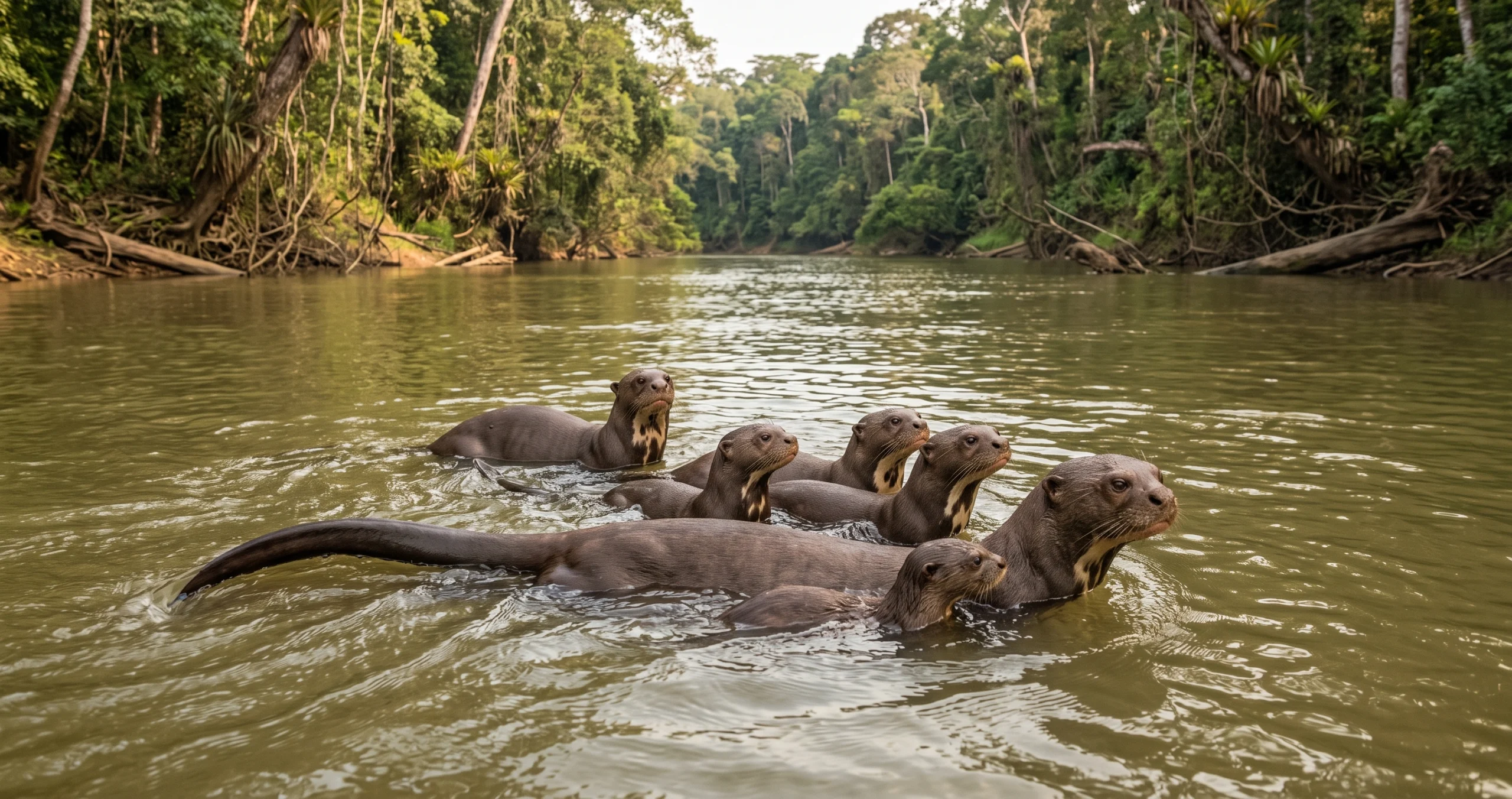
A group of giant river otters moving through an Amazonian river can look less like a collection of independent animals and more like a coordinated team. Adults hunt, patrol territorial boundaries, communicate constantly, and help protect younger members. This cooperative lifestyle makes the giant river otter pack unusual among mustelids and helps explain how these animals can occupy a powerful ecological position in South American freshwater systems.
Known scientifically as Pteronura brasiliensis, the giant river otter is the world’s longest otter species. Yet size alone does not explain its success. Family cooperation, sophisticated vocal communication, territorial defense, and group responses to threats — including encounters with caimans — make this endangered predator one of South America’s most remarkable social mammals.
Table of Contents
- Meet the Giant River Otter
- Inside a Giant River Otter Pack
- How Family Groups Hunt
- The Otters’ Extraordinary Vocal Communication
- How Giant River Otters Defend Territory
- What Happens When Otters Encounter Caimans?
- Are Giant River Otters Apex Predators?
- Their Role in Freshwater Ecosystems
- Why They Can Be Indicator Species
- Conservation Status and Historical Fur Trade
- Modern Threats
- Common Myths
- FAQ
- Conclusion
Meet the Giant River Otter
Giant river otters live in freshwater environments across parts of tropical South America, particularly within the Amazon, Orinoco, and La Plata drainage systems.
They favor rivers, creeks, oxbow lakes, wetlands, and seasonally flooded forests where fish are abundant and banks provide suitable areas for dens and resting sites.
Adults can approach roughly 1.8 meters, or about six feet, in total length, making Pteronura brasiliensis the longest member of the weasel family.
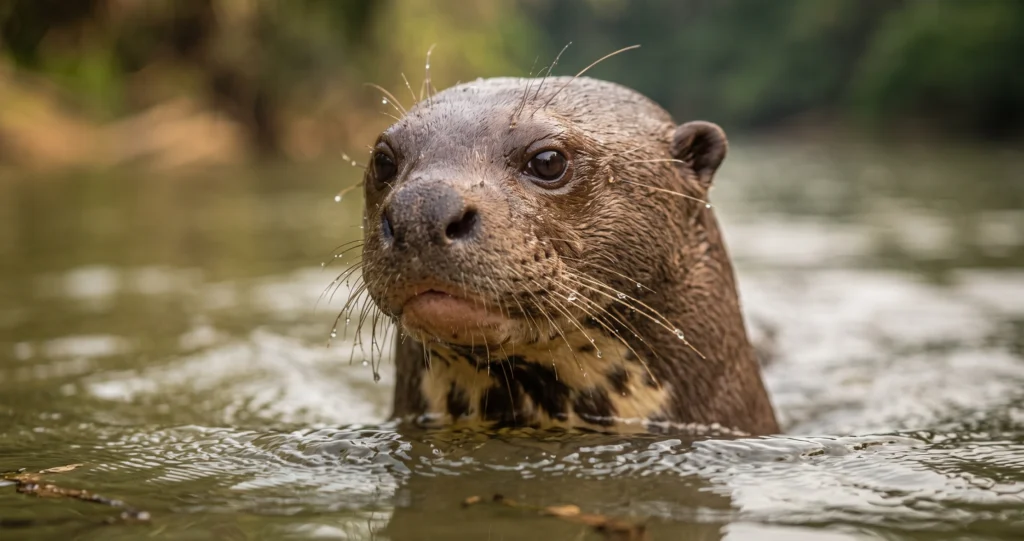
Their streamlined bodies, flattened tails, dense waterproof fur, and webbed feet make them highly efficient aquatic predators.
One feature makes individual identification relatively easy.
Each animal has a pale cream or white throat marking. The pattern differs between individuals and functions almost like a natural identification badge.
Researchers can use photographs of these markings to recognize particular animals without physically capturing them.
But perhaps the most distinctive characteristic is social rather than anatomical.
Unlike many mustelids that spend much of their lives alone, giant river otters live in cohesive family groups.
Inside a Giant River Otter Pack
A typical giant river otter pack centers on a breeding pair and their offspring from one or more breeding seasons.
Group size varies.
Some families contain only a few individuals, while larger groups can include numerous related animals traveling, resting, hunting, and defending territory together.
Older offspring may remain with their parents for considerable periods.
That creates an extended family structure in which juveniles can gain experience while participating increasingly in group activities.
Eventually, young adults may disperse and attempt to find mates and territories of their own.
This social organization provides several potential advantages.
Multiple adults can watch for danger, help defend valuable habitat, and contribute to activities associated with raising offspring.
The result is a level of family cooperation unusual enough that giant river otters have become important subjects for research into mammalian social behavior.
How a Giant River Otter Pack Hunts
Fish dominate the giant river otter’s diet.
Common prey can include catfish, characins, cichlids, and other fish available within local freshwater systems.
Individual otters are capable hunters.
They use excellent underwater mobility and sensitive whiskers to locate and pursue prey, usually capturing fish with their mouths.
However, members of a giant river otter pack can also forage in proximity to one another, and cooperative or coordinated hunting has been documented.
Group hunting does not necessarily mean every fish is captured through an elaborate preplanned strategy.
In many situations, animals may pursue individual prey while remaining socially coordinated with the family.
Under other circumstances, multiple otters can influence fish movement or work around concentrations of prey.
This distinction is important because popular descriptions sometimes portray giant river otters as if they hunt exactly like wolves.
They do not.
Their social system and aquatic hunting ecology are very different.
Still, being part of a family group provides advantages beyond the immediate capture of a fish.
Other members can watch for threats and competitors while individuals concentrate on feeding.
What Else Do Giant River Otters Eat?
Fish are overwhelmingly important, but giant river otters are opportunistic predators.
They may occasionally take crustaceans, amphibians, snakes, turtles, and other available animals.
Diet varies geographically and seasonally because South American freshwater ecosystems change dramatically through wet and dry cycles.
Water levels influence where fish concentrate.
During periods when shrinking pools or channels concentrate prey, hunting opportunities may become particularly favorable.
The giant river otter pack therefore operates within a constantly changing aquatic landscape.
Its survival depends not merely on the presence of water but on functioning river systems capable of supporting abundant prey.
Giant River Otters Are Remarkably Vocal
You may hear a giant river otter family before seeing it.
These animals possess one of the richest vocal repertoires documented among otters.
Researchers studying giant river otter communication have identified multiple call types associated with different social contexts.
Calls can help maintain contact between group members, signal alarm, coordinate movement, communicate submission or reassurance, and respond to unfamiliar individuals.
Young animals have their own developmental vocal patterns.
This matters because visibility in tropical rivers is often poor.
Water can be dark or sediment-rich. Dense vegetation surrounds many channels, while animals repeatedly dive below the surface.
Sound provides a way for members of a giant river otter pack to maintain social cohesion when visual contact becomes difficult.
Research published in PLOS ONE documented a complex vocal repertoire in giant river otters, identifying distinct call types and linking them with behavioral contexts. The study highlights just how important acoustic communication is to this highly social species.
Territory Is a Family Resource
Giant river otters are strongly territorial.
A successful territory must contain more than fish.
Families need suitable riverbanks for dens, resting sites, latrines, and areas where they can safely raise young.
The otters establish conspicuous campsites along banks.
Vegetation may be cleared, and animals repeatedly use particular areas for resting, grooming, scent marking, and defecation.
Scent becomes part of territorial communication.
So does sound.
When unfamiliar otters approach, resident animals can produce conspicuous vocal displays.
Physical confrontation is possible, but preventing a fight through warning signals is advantageous when possible.
A serious injury could reduce an animal’s ability to hunt and care for offspring.
Territorial behavior therefore combines scent, vocalization, group presence, and direct aggression when escalation becomes necessary.
Giant River Otters and Caimans
One of the most dramatic aspects of giant river otter behavior involves their interactions with caimans.
South American rivers contain several caiman species, including large black caimans capable of posing a genuine threat to an otter.
An isolated young otter is not invulnerable.
But confronting an entire giant river otter pack is a very different situation.
Groups have been observed approaching, surrounding, harassing, or mobbing caimans.
These encounters can function as predator deterrence.
By responding collectively, adults can make remaining near the family costly or dangerous for a potential predator.
This does not mean giant river otters routinely attack and kill every caiman they encounter.
That popular interpretation exaggerates the evidence.
The relationship depends on the species and size of the caiman, the number and age of the otters, and the circumstances of the encounter.
A large black caiman remains a formidable predator.
Still, coordinated mobbing demonstrates one of the major benefits of social living.
An animal that might be vulnerable alone becomes considerably harder to intimidate when surrounded by several alert relatives.
Can Giant River Otters Kill Caimans?
Yes, giant river otters are physically capable of attacking smaller caimans, and predatory interactions have been documented.
But these events should not be interpreted as their normal diet.
Fish remain their primary food.
Caiman encounters are especially interesting because they blur the boundaries between predation, competition, and defense.
A smaller caiman could potentially become prey.
A larger one might threaten young otters.
Both predators may also use the same aquatic habitat and pursue overlapping prey.
The giant river otter pack gives the mammals an advantage that cannot be measured simply by comparing one otter with one caiman.
The relevant unit is sometimes the family.
Are Giant River Otters Apex Predators?
Giant river otters occupy a very high trophic position within South American freshwater food webs and are commonly described as apex or top predators.
But “apex predator” does not mean invincible.
Jaguars, large caimans, and potentially other predators can threaten otters under the right circumstances.
Young animals are especially vulnerable.
The ecological importance of a top predator is better understood through its relationship with the food web.
Giant river otters consume substantial quantities of fish and can influence prey behavior, distribution, and community interactions.
Their presence is part of a larger network involving fish, reptiles, aquatic birds, river dolphins, jaguars, caimans, and humans.
For another example of an aquatic mammal whose feeding behavior can reshape an ecosystem, see our article on how sea otters function as a keystone species.
Marine sea otters and South American giant river otters occupy very different habitats, but both demonstrate how predators can influence ecosystems far beyond the animals they directly consume.
Why Giant River Otters Can Indicate Ecosystem Health
A large predator needs a functioning food web beneath it.
For a giant river otter pack to survive and reproduce, its territory must provide abundant prey, usable riverbanks, relatively suitable water conditions, and enough connected habitat for movement and dispersal.
That makes giant river otters useful conservation indicators.
Their presence does not automatically prove that an ecosystem is pristine.
However, stable breeding populations can signal that important ecological processes remain functional.
The reverse can also be informative.
If pollution destroys fish communities, mining damages river channels, forests disappear from banks, or human disturbance becomes intense, a specialized top predator may struggle even before the ecosystem appears completely degraded.
Protecting giant river otters therefore protects much more than one charismatic mammal.
It can require protecting entire watersheds.
Historical Fur Trade Devastated Populations
Giant river otter fur is extraordinarily dense.
That is excellent for an aquatic mammal.
It was disastrous when international demand for wild animal pelts intensified.
During the twentieth century, giant river otters were hunted extensively for their skins.
Commercial hunting caused severe population declines across much of their historical range.
Thousands of animals were killed, and populations disappeared from areas where the species had once been common.
International protection eventually reduced the legal trade.
The Convention on International Trade in Endangered Species of Wild Fauna and Flora places giant river otters under its highest level of international commercial-trade restriction.
But stopping widespread commercial hunting did not automatically restore populations.
Large predators reproduce relatively slowly, and recolonizing fragmented habitat can take decades.
Giant River Otters Remain Endangered
The giant river otter is classified as Endangered on the IUCN Red List.
Historical hunting created the initial catastrophic decline.
Today, habitat destruction and degradation are among the most important continuing threats.
Deforestation can alter riverbanks and aquatic ecosystems.
Hydroelectric dams modify natural river flow and fragment habitat.
Road development increases human access to previously remote areas.
Mercury and sediment associated with gold mining can contaminate aquatic food webs.
Overfishing can reduce prey availability and create competition between humans and otters.
Direct conflict also occurs when fishers perceive giant river otters as competitors.
Because a giant river otter pack requires substantial territory and reliable fish populations, changes occurring across an entire watershed can affect family survival.
Why Protecting Riverbanks Matters
A healthy river is more than flowing water.
Giant river otters need terrestrial features along its edges.
They dig dens into banks, maintain campsites, rest on land, and raise young in protected areas close to water.
Removing riverside vegetation can increase erosion, change water temperatures, reduce habitat complexity, and eliminate suitable denning sites.
Forest protection is therefore freshwater conservation.
This connection is especially important across the Amazon, where aquatic and terrestrial ecosystems cannot realistically be treated as separate worlds.
Leaves, insects, sediments, nutrients, roots, fallen trees, and seasonal flooding connect forest and river continuously.
The giant river otter exists at the center of those connections.
Common Myths About Giant River Otters
Myth 1: Giant River Otters Hunt Like Wolves
Their social structure makes the comparison tempting, but it is too simplistic.
Giant river otters often forage socially and can coordinate during hunting, defense, and territorial encounters, but their prey-capture behavior and group organization differ significantly from wolf packs.
Myth 2: They Regularly Hunt Large Caimans
Giant river otters can confront and sometimes attack caimans.
However, large caimans are dangerous predators themselves, and fish remain overwhelmingly more important in the otter diet.
Myth 3: Giant River Otters Are Aggressive Toward Everything
They can be intensely territorial, particularly when protecting family members.
That does not mean they indiscriminately attack other animals or humans.
Myth 4: They Are Simply Larger Versions of Other Otters
Size is only part of what makes Pteronura brasiliensis unusual.
Their complex vocal communication, cohesive family groups, territorial behavior, and cooperative defense distinguish them from many other mustelids.
Myth 5: The Fur Trade Is Still Their Main Threat
Historical commercial hunting caused enormous population declines.
Today, habitat destruction, river modification, pollution, mining, declining fish resources, and human conflict are major concerns.
Myth 6: Protecting the Otters Alone Is Enough
A predator cannot survive without its ecosystem.
Conservation must protect rivers, fish communities, riparian forests, denning areas, and connections between populations.
FAQ
How many animals live in a giant river otter pack?
Group size varies, but families generally center on a breeding pair and offspring from one or more years.
Some groups contain only a few animals, while larger families can include considerably more.
Do giant river otters hunt together?
They can forage and hunt socially, and coordinated behavior has been documented.
However, individual otters also capture their own fish, so group hunting should not automatically be equated with the highly specialized cooperative hunting strategies of wolves or African wild dogs.
How do giant river otters communicate?
They use a diverse collection of vocalizations associated with contact, alarm, cohesion, territorial encounters, and other social situations.
Scent marking and visual behavior also contribute to communication.
Can giant river otters fight caimans?
Yes.
Groups have been documented confronting and mobbing caimans, and smaller caimans may sometimes be attacked or killed.
Large caimans, however, can also pose a serious threat to otters.
What do giant river otters eat?
Fish dominate their diet.
Depending on availability, they may also consume crustaceans, amphibians, reptiles, and other aquatic or semi-aquatic prey.
Are giant river otters dangerous to humans?
They are powerful wild predators and should always be treated with respect.
Attacks on humans are not their normal behavior, but people should never approach, feed, corner, or interfere with wild family groups.
Why are giant river otters endangered?
Historical hunting for the fur trade devastated populations.
Modern threats include habitat loss and fragmentation, mining pollution, dams, overfishing, disturbance, and conflict with people.
Where do giant river otters live?
They occur in freshwater habitats across parts of South America, particularly within major tropical river basins.
Their current distribution is substantially reduced and fragmented compared with their historical range.
Conclusion
The giant river otter pack demonstrates how social cooperation can transform the survival strategy of a predator.
One otter is already an accomplished aquatic hunter.
A family becomes something more.
Adults and older offspring can travel together, communicate through an unusually sophisticated vocal repertoire, defend important stretches of river, respond collectively to threats, and create a protective social environment in which younger animals develop.
Their confrontations with caimans illustrate the advantage clearly.
A large reptile may be dangerous to an isolated otter, particularly a juvenile. Several adult otters approaching, vocalizing, surrounding, and mobbing that same predator fundamentally change the encounter.
But the importance of giant river otters extends beyond dramatic battles.
As high-level freshwater predators, they are tied to the health of the ecosystems beneath them.
A breeding giant river otter pack requires fish-rich water, functioning riverbanks, denning habitat, connected waterways, and enough space to maintain a territory.
When those elements disappear, the otters eventually disappear too.
The twentieth-century fur trade demonstrated how quickly humans could devastate their populations. Modern conservation has reduced that particular pressure, but habitat destruction, mining, pollution, dams, declining fish resources, and human conflict continue to threaten recovery.
Protecting giant river otters therefore means protecting rivers as complete living systems.
Their family groups are not merely spectacular examples of animal cooperation.
They are signs that some of South America’s most complex freshwater ecosystems still retain enough ecological integrity to support one of their most demanding predators.
Internal Link Suggestions:
- Sea Otters Keep Personal Tools for Years — Here’s How and Why
Use in the ecological-role section to compare two very different otter species and their influence on aquatic ecosystems. - How Jaguars Hunt: The Powerful Bite Behind the Amazon’s Apex Predator
Use naturally when discussing the broader predator community of South American freshwater and riparian ecosystems.
External Dofollow Authoritative Sources:
- IUCN Red List — Giant Otter (Pteronura brasiliensis)
https://www.iucnredlist.org/
Best used for conservation status, population threats, geographic distribution, and habitat information. - CITES — Convention on International Trade in Endangered Species of Wild Fauna and Flora
https://cites.org/
Useful for explaining international protection and the historical consequences of commercial trade in giant river otter pelts. - PLOS ONE — Vocal Repertoire of the Social Giant Otter
https://journals.plos.org/plosone/
Useful as an authoritative scientific source for the species’ complex vocal communication, social organization, and context-specific calls.