

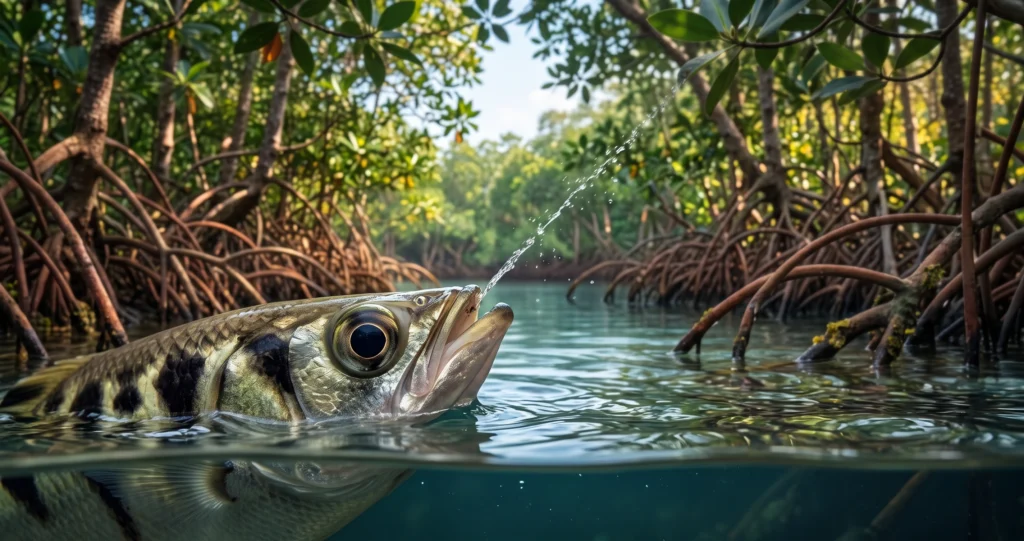
A small insect rests on a branch above a tropical stream. Below it, an archerfish approaches the surface, aims upward, and fires a concentrated jet of water from its mouth. Seconds later, the insect falls into the water and becomes lunch. The archerfish hunting technique looks simple, but it requires the fish to overcome refraction, gravity, distance, changing target positions, and the physical challenge of producing a water jet powerful enough to knock prey loose.
Archerfish do not consciously calculate equations. Instead, evolution, sensory processing, specialized anatomy, and learning allow them to solve physical problems that would challenge a human attempting the same task underwater.
Table of Contents
- What Is an Archerfish?
- How the Archerfish Hunting Technique Works
- The Refraction Problem
- How Archerfish Compensate for Refraction
- How the Mouth Creates a Water Jet
- Why the Jet Becomes Stronger Before Impact
- How Archerfish Adjust for Distance
- Do Young Archerfish Have to Learn to Shoot?
- Learning From Experience and Other Fish
- What Happens After the Insect Falls?
- Other Extraordinary Hunting Adaptations
- Common Myths
- FAQ
- Conclusion
What Is an Archerfish?
Archerfish belong to the family Toxotidae, a group of fishes native to tropical parts of Asia and the western Pacific. Different species occupy freshwater and brackish habitats, including rivers, estuaries, mangrove systems, and coastal waterways.
They are best known for hunting animals that are not actually in the water.
Insects and other small terrestrial prey frequently occupy vegetation hanging above tropical waterways. Instead of waiting for them to fall naturally, archerfish bring the prey down themselves.
The fish approaches the surface, positions its body beneath the target, and fires water upward.
A successful shot knocks the prey from its perch.
The fish then races toward the predicted landing point and captures it.
This unusual behavior has made archerfish valuable research animals for studying vision, learning, decision-making, motor control, and the ways animal nervous systems deal with physical laws. A scientific review of archerfish behavior describes an impressive collection of abilities associated with their specialized hunting strategy, including visual search, learning, jet adjustment, and rapid decisions after prey begins falling.
How the Archerfish Hunting Technique Works
The basic sequence can happen remarkably quickly.
First, the fish detects a potential target above the surface.
It moves into a suitable firing position, raises the tip of its snout toward the target, and brings its mouth close to or slightly above the water surface while its eyes remain underwater.
Then it fires.
The jet travels through the air and strikes the insect with enough force to dislodge it.
But hitting an insect from underwater is not equivalent to throwing something at a target in air.
The archerfish is looking through a boundary between two materials with different optical properties: water and air.
That creates a major visual problem.
The Refraction Problem
Put a drinking straw into a glass of water and look at it from the side.
The straw appears bent at the water’s surface.
Nothing has happened to the straw. Light changes direction when it travels between air and water because its speed changes between the two media.
This bending is called refraction.
The same phenomenon affects an archerfish looking at an insect above the water.
Light traveling from the insect into the water bends at the surface before reaching the fish’s eyes. As a result, the apparent position of the target differs from its actual position.
If the fish simply fired toward where the insect appeared to be without compensation, many shots would miss.
The geometry changes with viewing angle, making the problem even more complicated.
A 2024 study of archerfish motor adaptation describes how targets above water appear shifted toward the zenith because of Snell’s law. The fish must also cope with gravity acting on the water jet, target height, shooting angle, and environmental disturbances such as wind.
How Archerfish Compensate for Refraction
The archerfish hunting technique has sometimes been described as though the fish somehow “knows Snell’s law.”
That is a colorful description, but it can be misleading.
There is no evidence that the fish understands mathematical optics. Its nervous system instead generates appropriate behavioral responses to visual information.
Research shows that archerfish can shoot successfully from different positions rather than relying on one fixed angle that would conveniently minimize refraction.
That means their visual-motor system must compensate for changing conditions.
Exactly how much of this ability is innate and how much develops through learning remains an important scientific question.
Recent experiments provide strong evidence that experience matters.
Researchers introduced airflow above tanks containing trained archerfish. The airflow pushed the water jet away from its normal trajectory.
Initially, accuracy deteriorated.
But after repeated attempts, the fish gradually reduced its errors. When the airflow was removed, the animals briefly produced errors in the opposite direction before returning toward their previous performance.
That “aftereffect” is characteristic of motor adaptation.
The experiment suggests that archerfish can recalibrate their shooting behavior when physical conditions change rather than relying entirely on a rigid, preprogrammed aiming system.
How the Archerfish Mouth Creates a Water Jet
Accurate vision would be useless without a biological mechanism capable of firing water toward the target.
The archerfish’s mouth provides that mechanism.
Its oral anatomy includes structures that can help create a narrow channel for directing water. Traditionally, descriptions of archerfish shooting emphasize the tongue interacting with a groove in the roof of the mouth to create a tube-like passage.
The fish then compresses its oral cavity and expels water through the narrowed opening.
However, scientists are still investigating the detailed mechanics and evolutionary history of the shooting apparatus. Anatomical research notes competing hypotheses about exactly how pressure is generated and which oral structures contribute most strongly.
So describing the mouth as a simple biological “water pistol” misses much of the complexity.
The fish must control not only direction but also water volume, velocity, timing, and jet stability.
Its fins participate as well.
Research on shooting archerfish found that rapid movements of the pectoral and pelvic fins are precisely coordinated with the release of the jet. These movements begin around the shot while helping the animal maintain the stability required for accurate firing.
The Jet Is More Sophisticated Than a Squirt
The water leaving an archerfish’s mouth is not simply a random splash traveling toward an insect.
The fish manipulates the jet dynamically.
Research reviewed in the scientific literature shows that archerfish can adjust the timing of mouth movements so that water toward the rear of the jet moves faster than water at the front.
The faster trailing water catches up.
This concentrates water and momentum near the target rather than allowing the stream to disperse uselessly along its entire path.
Think of several runners leaving a starting line at different speeds.
If the runners at the back move faster than those in front, the group eventually bunches together.
Something broadly similar happens to the archerfish’s water jet.
The fish times this convergence so that the concentration occurs near its prey.
That makes the archerfish hunting technique not just an aiming problem but a hydrodynamic one.
Distance Changes the Shot
An insect ten centimeters above the water presents a different problem from one much farther away.
A jet traveling farther has more time to break apart and lose useful momentum.
Archerfish compensate.
Research shows that they adjust aspects of their shots according to target distance and size. The volume of water fired can change, while fine adjustments to mouth opening and closing help stabilize the jet so that maximum effectiveness occurs close to the target.
This is one reason describing the behavior as “spitting” is inadequate.
Human spitting generally produces a projectile and hopes it reaches the destination.
The archerfish hunting technique actively shapes the physical properties of the stream according to the problem being solved.
How Young Archerfish Improve Their Accuracy
Archerfish are not necessarily perfect marksmen from their first attempt.
Experience can improve performance.
The ability to shoot requires coordination between vision and motor output. As a fish grows, the dimensions of its body, mouth, eyes, and shooting apparatus change.
A completely fixed motor program would therefore face a serious problem.
The correct movements for a small juvenile would not necessarily generate identical results after substantial growth.
Motor learning provides a solution.
The 2024 airflow experiments demonstrate that archerfish can detect systematic errors and gradually alter subsequent shots. This ability allows their shooting system to remain flexible when physical circumstances change.
Another recent study found shooting success increased as experimental trials progressed, which the researchers suggested could reflect growing familiarity with the task.
Practice therefore matters.
The fish does not need to understand why a shot missed. Its nervous system can use the difference between intended and actual outcomes to modify future attempts.
Archerfish Can Also Learn by Watching
Individual trial and error is not the only form of learning associated with archerfish.
Experiments have produced evidence that these fish can acquire aspects of difficult targeting behavior after observing experienced individuals.
This is particularly interesting because social learning is sometimes casually associated with mammals and birds possessing large brains.
Archerfish demonstrate why that assumption is unreliable.
Their nervous systems have evolved around ecological problems that reward rapid visual processing and flexible behavior.
A fish that can benefit from observing another hunter may avoid some of the energetic costs of discovering everything independently.
Scientific reviews describe archerfish learning as remarkably efficient in some contexts, with substantial generalization and evidence of learning through observation.
This does not mean every part of the archerfish hunting technique is learned socially.
Innate predispositions, individual practice, maturation, and observation can all contribute to the finished behavior.
Hitting the Insect Is Only Half the Problem
Imagine successfully knocking an insect from a branch only to have another fish eat it.
That is a genuine problem for archerfish.
Their habitats contain competitors capable of detecting prey striking the water. Other archerfish can steal a successful hunter’s meal, and unrelated surface-feeding fish may do the same.
Research in natural archerfish habitats has found highly capable competitors, including halfbeaks that can rapidly detect prey hitting the water. This competition may have helped favor increasingly sophisticated hunting behavior.
The shooter therefore needs to anticipate where its target will land.
Archerfish can make remarkably rapid decisions after prey begins falling. Research summarized in comparative cognition literature indicates that fish can predict the direction and distance to the future impact point and adjust their movement so they arrive at approximately the right location.
So the hunt contains two physics problems.
First, calculate behaviorally where to shoot.
Then predict where the falling prey will hit the water.
Other Extraordinary Hunting Adaptations
The archerfish hunting technique belongs to a much broader collection of specialized hunting strategies produced by evolution.
Bats use echolocation, analyzing returning echoes to locate prey in darkness. Their nervous systems must deal with the relationship between elapsed echo time and the speed of sound.
Peregrine falcons attack from above at extraordinary speeds, combining aerodynamic body shapes with specialized respiratory and visual adaptations.
Chameleons use ballistic tongues that rapidly accelerate toward prey.
Some spiders use webs as external prey-capture devices, while others hunt using exceptional visual processing.
And cephalopods can manipulate their appearance while stalking prey. For another example of an animal combining sophisticated sensory processing with an unusual hunting strategy, see our article on how cuttlefish use dynamic skin displays while hunting.
What makes archerfish unusual is the separation between predator and prey.
The fish does not initially bite, grab, sting, or collide with its target.
It manipulates water as a projectile.
In that sense, the surrounding environment becomes part of its hunting apparatus.
Common Myths About the Archerfish Hunting Technique
Myth 1: Archerfish Simply Spit at Insects
Their shots are considerably more controlled than ordinary spitting.
The fish can regulate the jet’s direction, volume, timing, and velocity profile according to target conditions.
Myth 2: Archerfish Always Hit Their Target
Early accounts sometimes portrayed them as virtually infallible.
Modern research shows that archerfish do miss. What is remarkable is their ability to achieve effective accuracy under difficult and changing physical conditions and to adapt when systematic errors occur.
Myth 3: They Memorize One Shooting Angle
Archerfish can shoot from different positions and deal with changing viewing geometries.
Their success cannot be explained by simply memorizing one convenient angle.
Myth 4: Archerfish Understand Physics Like Humans
Archerfish do not need a conceptual understanding of Snell’s law, gravity, or hydrodynamics.
Evolution and neural processing can produce behavior that compensates for physical laws without conscious mathematical reasoning.
Myth 5: The Fish Only Needs to Hit the Insect
A successful hunter must also reach the prey after it falls.
Competition from other fish makes predicting the landing point and moving quickly toward it an important part of the hunt.
FAQ
How does an archerfish shoot water?
The fish shapes its oral structures to create a narrow pathway and rapidly expels water from its mouth. Precise mouth movements influence the speed and structure of the resulting jet, while coordinated fin movements help stabilize the fish.
How does an archerfish compensate for refraction?
Light bends as it passes from air into water, shifting the apparent location of above-water prey. Archerfish visual and motor systems compensate for this displacement when aiming. Research also shows that their shooting system can adapt when environmental conditions systematically alter a shot.
Are archerfish born knowing how to shoot?
They possess biological adaptations for shooting, but experience is also important.
Evidence for motor adaptation, improvement across trials, and observational learning shows that archerfish hunting behavior is not simply an inflexible reflex.
How powerful is an archerfish’s water jet?
The jet is powerful enough to dislodge insects and other small prey from vegetation above the water.
Rather than maintaining identical force throughout the stream, the fish can manipulate the velocity profile so that water concentrates near the target.
Why doesn’t the water jet break apart before reaching the insect?
It eventually does, but archerfish can delay and manipulate that process.
Fine control over mouth movements and water velocity helps produce a concentrated portion of the jet near the distance where the target is located.
What do archerfish eat?
They are opportunistic predators. Above-water insects are famous targets, but their diet is not restricted to prey shot from vegetation.
Where do archerfish live?
Archerfishes occur in freshwater and brackish environments across parts of the Asia-Pacific region, including mangroves, rivers, streams, and estuarine habitats.
Can archerfish learn from other fish?
Experimental work reviewed in the scientific literature provides evidence of observational learning in archerfish.
They can also improve through individual experience and adjust their motor behavior when environmental conditions cause repeated errors.
Conclusion
The archerfish hunting technique is extraordinary not because the fish somehow possesses a human understanding of physics, but because evolution has produced a sensory and motor system capable of solving several physical problems simultaneously.
The challenge begins with vision.
An archerfish looking through the water-air boundary cannot simply aim at the apparent location of an insect. Refraction has displaced the image, and the amount of displacement depends on geometry.
Then comes the shot.
Specialized oral structures generate the stream, while precisely timed mouth movements alter its physical properties. Water released later can move faster, allowing the jet to concentrate momentum close to the target instead of dispersing too early.
Distance, gravity, target size, and environmental conditions introduce additional complications.
Yet the system remains flexible.
Experiments show that archerfish can gradually correct systematic shooting errors when airflow pushes their jets away from the target. This motor adaptation provides compelling evidence that experience helps calibrate their remarkable ability.
Even a successful hit does not end the calculation.
The fish must predict where the dislodged prey will land and reach it before competitors do.
The result is an animal that effectively transforms a mouthful of water into a precision hunting tool.
No equations are written and no physical laws are consciously understood. Nevertheless, refraction, hydrodynamics, gravity, learning, vision, and rapid decision-making all come together every time an archerfish looks above the surface and takes its shot.
Internal Link Suggestions:
- How Cuttlefish Use Their Skin During Hunting
Use in the section comparing unusual hunting adaptations. Both animals combine specialized sensory processing with highly unusual prey-capture mechanisms. - Why Peregrine Falcons Are the Fastest Animal on Earth
Use in the hunting-adaptations comparison as another example of physical principles and specialized anatomy working together during prey capture.
External Dofollow Authoritative Sources:
- PubMed / eLife — The Archerfish Uses Motor Adaptation in Shooting to Correct for Changing Physical Conditions
https://pubmed.ncbi.nlm.nih.gov/38829209/
Useful for refraction, airflow experiments, error correction, and motor adaptation. - PubMed — Hunting in Archerfish: An Ecological Perspective on a Remarkable Combination of Skills
https://pubmed.ncbi.nlm.nih.gov/30530768/
Useful for jet control, learning, visual search, observational learning, target-distance adjustment, and ecological context. - PubMed — Competition Drives Sophisticated Hunting Skills of Archerfish in the Wild
https://pubmed.ncbi.nlm.nih.gov/26196481/
Useful for understanding natural hunting conditions, competition, prey theft, and the evolutionary pressures associated with sophisticated archerfish behavior.