

Watch a raccoon investigate a stream bank and its front paws rarely stay still. The long, mobile digits probe beneath stones, rotate objects, feel along surfaces, and gather information even when visibility is poor. That remarkable raccoon paw sensitivity is not simply a matter of having “hand-like” feet. It comes from a highly developed sensory system extending from specialized receptors in the skin all the way into the brain.
The result is one of the most impressive tactile systems among mammals. It also helps explain raccoon dexterity, their reputation for solving physical problems, and the strange behavior commonly described as “washing” food.
Table of Contents
- What Makes Raccoon Paws So Sensitive
- The Neurology Behind Raccoon Paw Sensitivity
- How the Brain Interprets Touch
- Sensitive Paws and Raccoon Dexterity
- Touch as a Tool for Problem-Solving
- Raccoons Are Not Really Washing Their Food
- Water Can Change Paw Sensitivity
- Raccoon Touch Compared With Other Mammals
- Why Sensitive Paws Matter in Nature
- Common Myths
- FAQ
- Conclusion
What Makes Raccoon Paws So Sensitive?
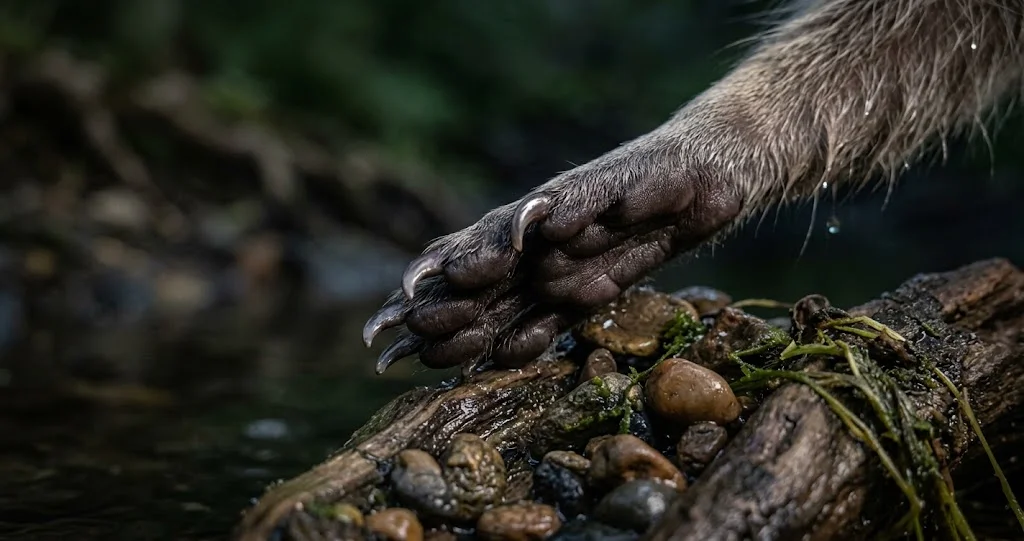
A raccoon’s front paw has five long digits that can move with considerable independence. The underside is covered in glabrous, or hairless, skin that comes into direct contact with objects.
Beneath that skin is an impressive sensory network.
Research examining raccoon forepaw nerves has identified several classes of mechanoreceptive fibers, including rapidly adapting, slowly adapting, and Pacinian-type fibers. These broad receptor categories are also found in primate hands, including ours.
Different sensory receptors respond to different mechanical events.
Some are particularly useful for detecting changes in contact and movement across the skin. Others continue responding when pressure is maintained. Pacinian receptors are especially responsive to rapid mechanical changes and vibration.
Together, these systems allow the paw to deliver much richer information than simply “something is touching me.”
The nervous system can receive information about where contact occurs, how pressure changes, whether an object moves, and aspects of its physical structure.
The Neurology Behind Raccoon Paw Sensitivity
The extraordinary raccoon paw sensitivity begins with sensory nerve endings distributed throughout the forepaw.
Anatomical studies have revealed specialized endings including Pacinian corpuscles and Merkel-associated endings. Researchers have also found that sensory innervation becomes denser toward the distal portions of the paw pads—the areas near the ends of the digits that are particularly important during exploration.
The paw is divided among several sensory nerves.
For example, research found that the median nerve serves much of the ventral surface of the first four digits and a large portion of the palm, while branches of the ulnar nerve contribute sensory information from other parts of the paw. The dorsal surface has its own patterns of innervation.
Touch therefore produces electrical activity in sensory fibers, which carries information toward the central nervous system.
The sophistication continues inside the brain.
A Brain That Takes Touch Seriously
The raccoon nervous system does not simply receive tactile signals. It organizes and analyzes them.
Research into the raccoon somatosensory system has demonstrated precise connections associated with the hairless skin of the forepaw. Individual digits have organized neural representations, allowing information arriving from different parts of the paw to remain spatially meaningful.
Even more strikingly, experiments on neurons in the somatosensory thalamus have identified responses to complex spatial characteristics, including tactile edges and orientations.
Imagine a raccoon running its paw along the edge of a submerged object.
The nervous system is not merely registering contact. Different receptors and neural circuits can help encode changing pressure, location, movement, and spatial characteristics.
That makes touch an active information-gathering sense.
For an animal that regularly explores holes, stream bottoms, vegetation, tree cavities, and unfamiliar objects, such detailed tactile processing is enormously useful.
Sensitive Paws Create Extraordinary Dexterity
A powerful sense of touch becomes even more useful when paired with mobile digits.
Raccoons can grasp, rotate, pull, press, pry, and reposition objects with their front paws. They do not have human hands or opposable thumbs, but their five long digits provide impressive manipulative ability.
This allows raccoon paw sensitivity to work together with movement.
When a raccoon touches an unfamiliar object, it can change the position of its digits and immediately receive new sensory information.
It can feel one surface, rotate the object, contact another edge, apply pressure, and adjust again.
This creates a continuous feedback loop:
Touch → Manipulate → Feel the Result → Adjust
That process helps explain why raccoons appear so skilled at investigating complicated objects.
Their paws are simultaneously manipulators and sensory organs.
Touch Helps Raccoons Solve Physical Problems
Raccoons have become famous for opening containers, investigating latches, raiding food sources, and exploring almost anything accessible to their paws.
Calling this behavior “intelligence” alone misses an important part of the story.
Problem-solving depends partly on what information an animal can gather from its environment and what actions its body allows it to perform.
A raccoon has an unusually effective combination.
Its sensory system can collect detailed tactile information, while its mobile forepaws can repeatedly test an object.
Consider a movable lid.
The animal can touch the edge, push it, feel movement, change its grip, pull, and immediately experience the consequences of each action. Learning can then operate on that sensory and motor information.
This does not mean every raccoon automatically understands complicated mechanisms. It means its anatomy provides excellent tools for exploration and learning.
That combination of dexterity, tactile feedback, curiosity, and behavioral flexibility helps raccoons interact successfully with both natural environments and human-made objects.
Raccoons Are Not Really “Washing” Their Food
One of the most recognizable raccoon behaviors has also produced one of the biggest misconceptions about the animal.
A raccoon takes food to water, holds it between its paws, and repeatedly manipulates it.
It looks remarkably like washing.
But describing the behavior as food hygiene imposes a human interpretation on something more complicated.
A classic zoological study examined the so-called food-washing behavior in captive raccoons and argued that “dousing” was a more appropriate description. The study investigated what kinds of food triggered the behavior and what features of the water environment influenced it, while questioning simple explanations based on cleansing or moistening food.
Read the original Zoological Society study on raccoon dousing behavior
This distinction matters.
A raccoon does not need to clean every item before eating it, and the familiar water behavior should not be interpreted as evidence that raccoons understand cleanliness in the human sense.
Instead, the behavior fits much better into the broader picture of an animal whose forepaws are major exploratory organs.
Water Can Make Sensitive Paws Even More Responsive
The relationship between raccoon paws and water becomes especially interesting when scientists examine the nerves themselves.
Researchers recorded activity from slowly adapting sensory fibers in the median and ulnar nerves supplying the hairless skin of raccoon forepaws.
When researchers wetted the skin, they observed substantial increases in fiber responsiveness and decreases in sensory threshold. Responses to prolonged indentation also lasted longer after wetting.
In simpler terms, wetting the skin changed how strongly certain touch-sensitive nerve fibers responded.
This gives the famous association between raccoons, water, and touch a real physiological basis.
It does not mean that raccoons need water to feel effectively. Their paws remain sophisticated sensory organs on dry land.
Nor does it prove that every instance of food dousing occurs because an animal consciously intends to increase paw sensitivity.
The safer conclusion is that moisture can enhance aspects of tactile responsiveness, while paw-based exploration is already central to raccoon behavior.
Raccoon Paw Sensitivity Compared With Other Mammals
Raccoons are not the only mammals with specialized touch systems.
Human fingertips are packed with mechanoreceptors that allow us to detect fine textures, pressure, vibration, edges, and movement. Primates combine tactile sensitivity with highly developed motor control of the fingers.
Raccoons share some broad categories of skin mechanoreceptors with humans and monkeys, but that does not make their paws equivalent to human hands. The structures evolved within very different bodies and ecological contexts.
Other mammals take tactile specialization in entirely different directions.
Cats, rats, seals, and many other mammals use whiskers as highly sensitive tactile structures. Whiskers can provide information about nearby objects and movements without requiring direct contact by the paws.
The star-nosed mole provides an even more dramatic example. Its extraordinary nasal appendages form a highly specialized tactile surface used to rapidly investigate its surroundings and locate food.
Raccoons follow another strategy.
They concentrate remarkable tactile abilities in appendages that can also physically manipulate whatever they detect.
That combination is especially powerful.
Why Raccoon Paw Sensitivity Matters in Nature
The raccoon’s tactile system makes sense when viewed in the environments where the animal evolved.
Picture a raccoon searching along a creek at night.
It reaches into shallow, muddy water and probes beneath a stone. At that moment, vision provides limited information about what the paw encounters.
Touch continues working.
The animal can detect physical contact, manipulate potential prey, and explore spaces hidden from view.
The same principle works on land.
Sensitive forepaws help raccoons investigate crevices, handle food, climb, probe cavities, and manipulate unfamiliar objects.
This versatility is valuable for an opportunistic omnivore.
Instead of depending on one highly specialized food source, raccoons can interact with many different resources. Sensitive, dexterous paws give them an effective interface with that varied environment.
Common Myths About Raccoon Paws
Myth: Raccoons always wash their food
They do not. The behavior traditionally called washing is more accurately described as dousing, and researchers have questioned interpretations based simply on cleaning food.
Myth: A raccoon can only feel properly when its paws are wet
False. The paws contain sophisticated sensory receptors whether wet or dry. Experiments show that moisture can increase the responsiveness of certain sensory fibers; it does not create the animal’s sense of touch.
Myth: Raccoon paws are basically human hands
Their long digits and dexterity create a striking resemblance, but raccoon forepaws are not primate hands. Similarities in broad mechanoreceptor categories do not make the anatomy identical.
Myth: Dexterity comes entirely from intelligence
Cognition matters, but anatomy and sensation matter too. Mobile digits, sensitive skin, neural processing, motor control, and learning work together to produce the behaviors we observe.
FAQ
How sensitive are raccoon paws?
Raccoon forepaws possess multiple classes of mechanoreceptive fibers, and the digits contain dense, specialized sensory innervation. Their nervous system is also highly organized for processing information arriving from the paws.
Does water really make raccoon paws more sensitive?
Experiments found that wetting the hairless forepaw skin increased the responsiveness and lowered the thresholds of slowly adapting sensory fibers. The effect is therefore supported by physiological evidence.
Why do raccoons put food in water?
The familiar behavior is better called dousing than washing. Research has challenged the idea that its primary purpose is simply cleaning or moistening food. It should be understood in the context of the raccoon’s highly tactile exploratory behavior rather than human-style hygiene.
Do raccoons have opposable thumbs?
No. Their five long digits are highly mobile and capable of impressive manipulation, but raccoons do not possess human-like opposable thumbs.
Can raccoons recognize objects by touch?
Their sensory system is well equipped to gather detailed information about objects through touch. Research has identified precise mechanoreceptive pathways and even neurons responsive to complex tactile spatial features.
Conclusion
A raccoon’s paws are much more than tools for grabbing food.
Exceptional raccoon paw sensitivity begins with specialized receptors embedded in richly innervated skin. Those signals travel through organized neural pathways that allow the animal to extract meaningful information from touch.
Combine that sensory ability with five mobile digits, dexterous movements, behavioral flexibility, and learning, and the familiar raccoon suddenly makes much more sense.
Even the famous image of a raccoon “washing” dinner looks different when viewed through biology. It is not simply a tiny animal practicing good hygiene. The behavior belongs to a species that relies heavily on its forepaws to investigate the physical world.
Perhaps the strangest detail is that water really can change the system. Experiments show that wetting the paw can increase the responsiveness of certain sensory fibers.
For raccoons, touching something is not merely the final step before picking it up.