
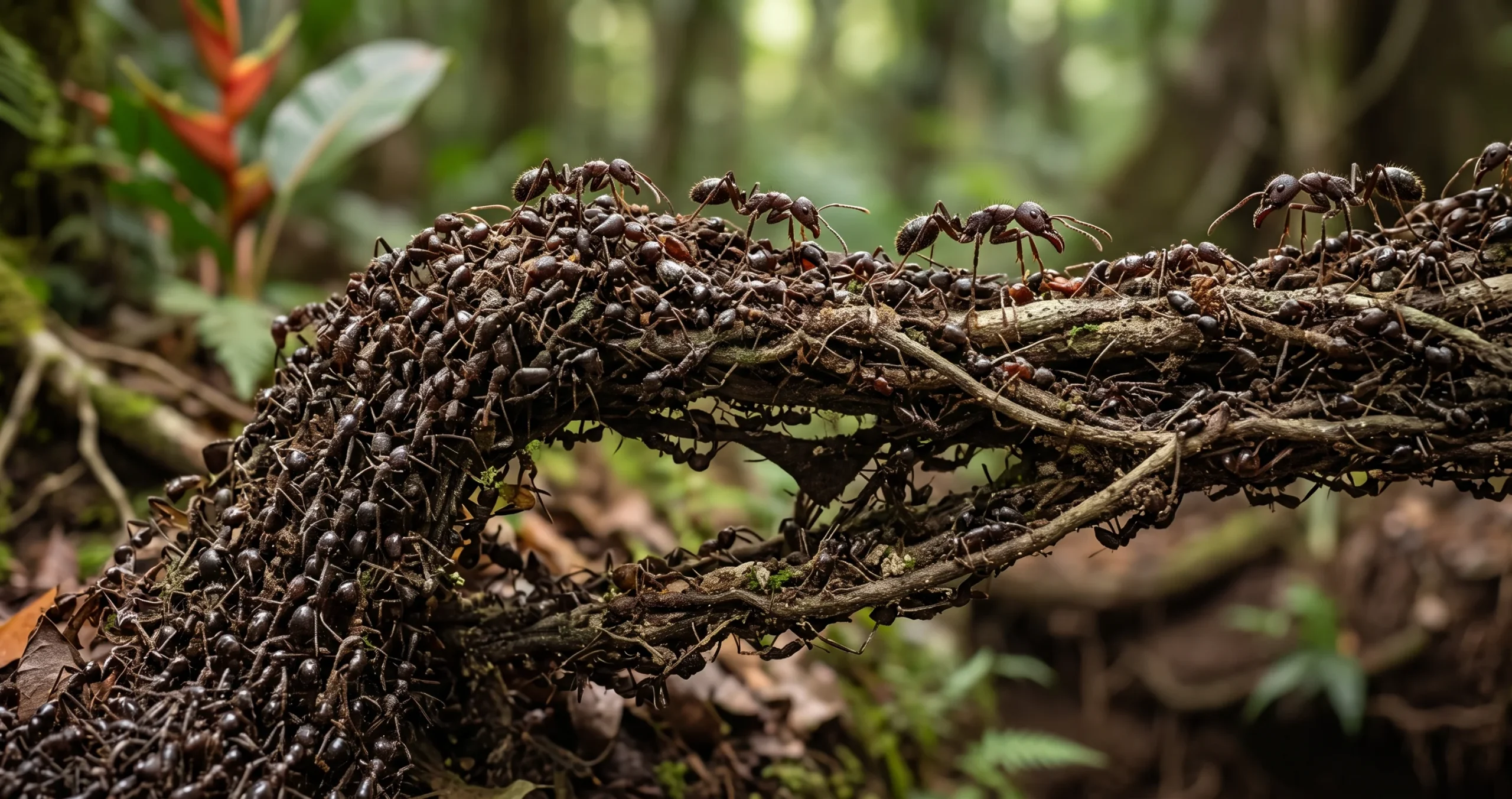
A column of army ants races across the forest floor when suddenly the trail reaches a gap between branches. There is no engineer directing traffic and no leader ordering workers into position. Yet within moments, ants begin linking their bodies together until other workers can run directly across them.
These army ant living bridges are among the most striking examples of self-organization in the animal world. The bridge can grow, shrink, widen, and even change position as traffic conditions change. Research on Eciton army ants shows that colonies effectively balance the advantage of a shorter route against a surprising cost: every ant serving as part of the bridge is temporarily unavailable for other work.
The result looks planned. Remarkably, no ant needs to understand the plan.
Table of Contents
- What Is an Army Ant Living Bridge?
- How Army Ants Build a Bridge Without a Leader
- The Bridge Is Constantly Changing
- The Hidden Cost of Building With Workers
- How Colonies Balance Cost Against Traffic Benefit
- Army Ant Living Bridges and Collective Intelligence
- Simple Rules Create Complex Structures
- How Researchers Study Living Bridges
- What Happens When the Ground Moves?
- Living Bridges Beyond New World Army Ants
- What Engineers Can Learn From Army Ants
- FAQ
- Conclusion
What Is an Army Ant Living Bridge?
Army ants are famous for enormous coordinated raids. Rather than relying on permanent trails leading to fixed food sources, many species send large numbers of workers through forest environments in search of prey.
Uneven terrain creates a problem.
A trail may encounter gaps between leaves, branches, roots, rocks, or other surfaces. Workers could follow the longer route around an obstacle, but thousands of ants may need to travel through the same area.
A shortcut can therefore save an enormous amount of collective travel.
Some army ants create that shortcut using themselves.
Workers grip one another with their legs and bodies, producing a temporary structure across the gap. Other ants then walk directly over their immobilized nestmates.
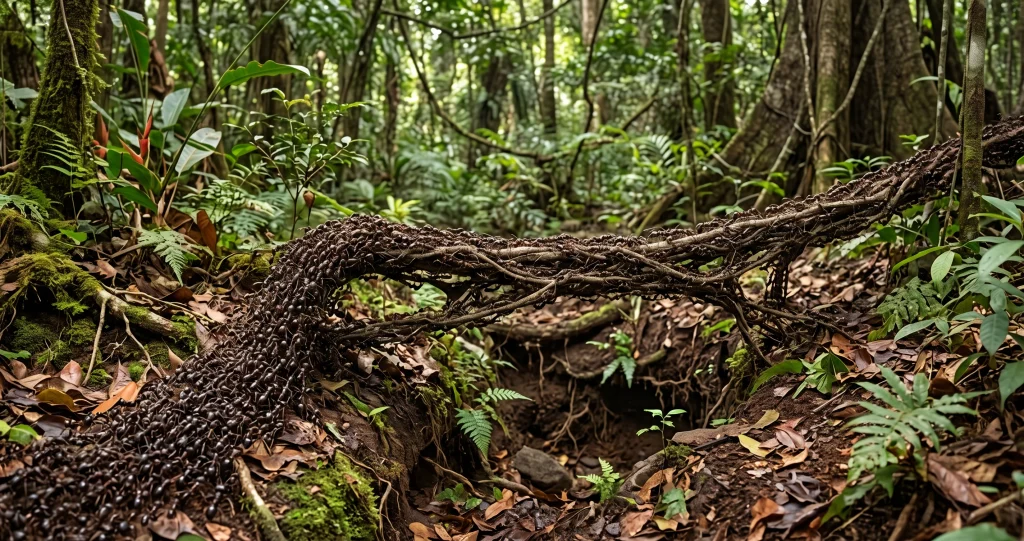
These bridges range enormously in scale. Research on Eciton hamatum found structures involving only a few ants across small openings as well as bridges composed of many hundreds of workers spanning gaps many times an individual ant’s body length.
The ants have effectively turned individual workers into construction material.
How Army Ants Build a Bridge Without a Leader
The strangest part of army ant living bridges is not simply that ants join together.
It is that nobody appears to be in charge.
There is no architect ant examining the terrain and deciding where a bridge should go. There is no construction supervisor counting workers or measuring the gap.
Instead, individual ants respond to local conditions.
An ant encountering congestion, a gap, other workers, or a suitable attachment point can contribute to the developing structure. As additional ants encounter the same local conditions, their individual responses combine.
A colony-level structure emerges.
This phenomenon is known as self-organization. Complex collective behavior develops from interactions among individuals following relatively simple rules rather than from centralized instructions.
The 2015 Proceedings of the National Academy of Sciences study of E. hamatum demonstrated just how sophisticated the resulting structures can become. Researchers found that bridges responded dynamically to both traffic intensity and environmental geometry.
The colony does not need a blueprint.
The behavior of thousands of ants effectively creates one in real time.
The Bridge Is Constantly Changing
A human bridge is normally constructed in one location and remains there.
An army ant bridge behaves more like living tissue.
Researchers discovered that experimental bridges did not simply appear at their final position. They initially formed where the ants’ route deviated around an obstacle.
Then something remarkable happened.
Through continuous construction and deconstruction, the bridges moved.
As ants joined one side and others left another, the structure gradually migrated toward a position that provided a more direct shortcut. Bridges became longer and wider as they moved farther across the gap.
This reduced the distance traveling ants had to cover.
But the bridges did not simply continue growing until they created the shortest route physically possible.
They stopped.
Understanding why revealed one of the most fascinating examples of cost-benefit balancing in collective animal behavior.
The Hidden Cost of Building With Workers
A bridge is useful, but its construction material is extremely valuable.
Every ant locked into the structure is a worker that cannot simultaneously search for prey, transport food, defend the trail, or perform another task.
A longer bridge creates a better shortcut.
But a longer bridge also requires more ants.
Researchers described this as a colony-level cost-benefit tradeoff. The benefit is reduced travel distance and potentially improved foraging efficiency. The cost is removing workers from the active labor force and turning them temporarily into infrastructure.
Imagine a colony using 20 ants to shorten a heavily traveled route.
If thousands of workers cross that bridge, the saved travel time may easily compensate for having 20 workers immobilized.
But extending the bridge farther might require many more ants while saving only a small additional amount of distance.
At some point, the additional shortcut stops being worth the additional workers.
That point helps determine where the living bridge stabilizes.
How Colonies Balance Cost Against Traffic Benefit
The 2015 experiments provided a way to measure this tradeoff directly.
Researchers Chris Reid, Matthew Lutz and colleagues constructed an adjustable apparatus and placed it in active E. hamatum raiding trails in Panama. The apparatus forced ants to travel along a deviating path while allowing them to construct a shortcut across the gap.
They tested path deviations at several angles.
As bridges migrated, researchers measured how much travel distance they saved and how much bridge area—and therefore how many ants—was required.
The bridges did not reach the position that would produce the absolute shortest trail.
Instead, their final positions reflected a compromise.
High traffic increases the value of shortening the trail because many ants benefit from every unit of distance saved. Low traffic makes sacrificing large numbers of workers to infrastructure less worthwhile.
The researchers built a mathematical model to estimate the bridge position expected to maximize the colony’s foraging rate.
Its predictions qualitatively matched the bridges observed in the experiments.
In other words, thousands of ants following local behavioral rules collectively approached a solution to an optimization problem.
Army Ant Living Bridges and Collective Intelligence
This behavior provides a striking example of what researchers call collective intelligence.
That phrase does not mean an ant colony thinks exactly like a human brain.
Rather, information distributed across many individuals can produce adaptive group-level behavior even when no single individual possesses all of the relevant information.
An ant joining a bridge does not need to know the total length of the foraging trail.
It does not need to calculate how many nestmates will cross during the next hour.
It certainly does not solve a mathematical equation comparing worker costs with travel-distance savings.
Yet the colony behaves as though those factors have been considered.
The 2015 researchers emphasized that bridge adjustment occurred without individual ants possessing information about the global costs and benefits.
That is what makes the system so scientifically interesting.
Optimization emerges from interactions.
Simple Rules Create Complex Structures
Self-organized systems often rely on feedback.
If many ants are successfully crossing a bridge, local conditions encourage the structure to persist. If the structure contains more ants than necessary, workers can leave and rejoin normal traffic.
The result is not perfect stability.
It is controlled flexibility.
This is particularly useful because a rainforest floor is constantly changing. Leaves bend. Twigs shift. Animals disturb vegetation. Wind moves attachment points.
A rigid structure could quickly become useless.
A living bridge can respond.
More recent experiments published in Nature Communications investigated how army ant bridges respond when the gaps beneath them change size. Researchers found evidence of separate local cues influencing ants joining and leaving bridges.
Workers traveling along the trail were more likely to join high-performing bridges when additional structural material was needed. Ants already incorporated into an oversized bridge could leave.
The structure effectively adds and removes its own building material.
Except the building material has legs.
How Researchers Study Living Bridges
Studying army ant living bridges requires bringing controlled experiments into the ants’ natural environment.
For the influential 2015 study, researchers worked with Eciton hamatum colonies on Barro Colorado Island in Panama.
They constructed a roughly 1.5-foot-high experimental apparatus containing ramps and adjustable arms. The design allowed researchers to change the geometry of the route and measure how the ants responded.
The apparatus was inserted into active raiding trails.
Because army ants use chemical trail information, researchers used material such as leaves and sticks from the original route to help guide the column onto the experimental path.
Then the ants did the rest.
Researchers could observe bridge formation, measure its dimensions, track movement, quantify traffic, and compare the travel distance saved with the approximate cost of workers incorporated into the structure.
This combination of field biology and mathematical modeling made it possible to examine something normally difficult to quantify: both the cost and benefit of a collective animal behavior.
What Happens When the Ground Moves?
A bridge across forest litter faces another engineering challenge: its foundations are unreliable.
A leaf can shift.
A branch can move.
A gap can suddenly become larger or smaller.
A 2022 Nature Communications study experimentally changed the gaps spanned by army ant bridges and discovered that the structures adjusted to persistent changes while avoiding excessive reactions to every tiny disturbance.
Researchers identified a phenomenon known as hysteresis.
For a particular gap size, bridge size depended partly on whether the gap had previously been larger or smaller. Modeling suggested this behavior can help stabilize the structure, allowing it to respond to meaningful environmental changes without continually rebuilding in response to insignificant fluctuations.
That distinction is valuable.
A bridge that reacted dramatically whenever a leaf moved slightly in the wind would waste workers and destabilize traffic.
A bridge that never responded would eventually fail when conditions genuinely changed.
The colony achieves something between those extremes.
Living Infrastructure Appears Elsewhere in Army Ant Life
Bridging is part of a broader ability among army ants to turn their own bodies into useful structures.
Researchers have also documented workers filling holes along trails.
In experiments with Eciton burchellii, ants used their bodies to plug potholes in rough surfaces, creating smoother paths for nestmates carrying prey. The behavior produced a measurable benefit to prey delivery.
Different-sized workers could fit different-sized holes.
Once again, some ants temporarily stopped behaving as travelers and became part of the road itself.
The principle is similar to living bridges: sacrificing the immediate productivity of a small number of individuals can increase the efficiency of a much larger stream of workers.
The colony becomes both the workforce and the infrastructure.
Living Bridges Beyond New World Army Ants
For years, this bridge-building behavior was primarily associated with New World Eciton army ants.
A fascinating recent observation has broadened the picture.
Researchers reported living bridge formation in the Old World army ant Aenictus glabrinotum. When scientists experimentally created a small gap in a trail on a twig, ants accumulated near the opening and linked their bodies until traffic could cross. As traffic declined, the bridge eventually disassembled.
The researchers caution that this was a single opportunistic observation rather than evidence that every Aenictus colony routinely constructs bridges.
Still, it raises an intriguing evolutionary possibility.
Living bridge behavior may have evolved independently in separate army ant lineages.
If further observations confirm that pattern, scientists could compare different species to investigate which ecological pressures repeatedly favor turning workers into temporary infrastructure.
What Engineers Can Learn From Army Ants
Army ant bridges interest more than entomologists.
Engineers and computer scientists study decentralized biological systems because many technological systems face a similar challenge: how can numerous simple units coordinate without relying on one vulnerable central controller?
A swarm of small robots, for example, might someday need to cross an obstacle without being told exactly where every robot should move.
The army ant solution offers several principles worth studying.
Structures can assemble only when needed. Their size can respond to demand. Components can leave when they are no longer useful. The entire construction can adapt when the environment changes.
Most importantly, useful global behavior can emerge from local information.
The PNAS researchers specifically noted that understanding these living structures could have implications for engineered self-assembling systems.
That does not mean engineers can simply copy an ant behavioral rule and instantly create intelligent robots.
But evolution provides a remarkable working example of decentralized construction operating in an unpredictable real-world environment.
FAQ
Why do army ants build living bridges?
Living bridges can shorten foraging routes across gaps and obstacles. Shorter routes allow workers and prey to move more efficiently along heavily traveled trails.
How do army ants know where to build a bridge?
No central leader selects the site. Individual ants respond to local terrain, traffic, other ants, and conditions around the developing structure, producing bridge formation through self-organization.
How many ants can form a living bridge?
The number varies dramatically with the obstacle. Observed bridges can involve only a few individuals or many hundreds of ants.
Do ants become permanently trapped in the bridge?
No. Living bridges are dynamic structures. Ants can join and leave as conditions change, allowing bridges to grow, shrink, move, or eventually disassemble.
Why don’t army ants always make the shortest possible bridge route?
A more ambitious shortcut generally requires more workers to become part of the bridge. Research indicates colonies balance the travel benefit against the cost of removing those ants from other foraging activities.
Do army ant bridges move?
Yes. Experiments with Eciton hamatum showed bridges could migrate from their initial formation point, becoming longer and wider while shortening the trail.
Is there a leader ant controlling construction?
Researchers have found no evidence of a central controller directing bridge construction. The adaptive colony-level behavior emerges from decentralized interactions among workers.
Are army ants intelligent?
Individual ants have relatively limited information, but colonies can display sophisticated collective problem-solving. Living bridges demonstrate how simple local decisions can generate adaptive behavior at the group level.
Conclusion
An army ant living bridge looks almost impossible when viewed as a single structure.
Hundreds of insects may lock themselves together across empty space. Thousands of nestmates race over their backs. The bridge changes shape, shifts position, adjusts to traffic, responds to moving terrain, and eventually disappears when it is no longer worth maintaining.
Yet there is no architect.
No ant knows the entire traffic network. No individual calculates the number of workers required, measures the distance saved, or decides where the finished bridge should stop.
Instead, relatively simple local interactions create a sophisticated collective outcome.
The colony effectively balances two competing demands: shortening the route makes foraging more efficient, while building a larger bridge removes valuable workers from the active workforce. Experiments show that the resulting compromise can closely resemble the solution predicted by mathematical cost-benefit models.
That makes army ant living bridges far more than an extraordinary wildlife spectacle.
They demonstrate one of nature’s most powerful principles: complex problem-solving does not always require a leader, a blueprint, or even an individual capable of understanding the problem.
Sometimes intelligence emerges from the group.
External Sources:
1. Use the peer-reviewed PNAS paper in the section “How Colonies Balance Cost Against Traffic Benefit.”