
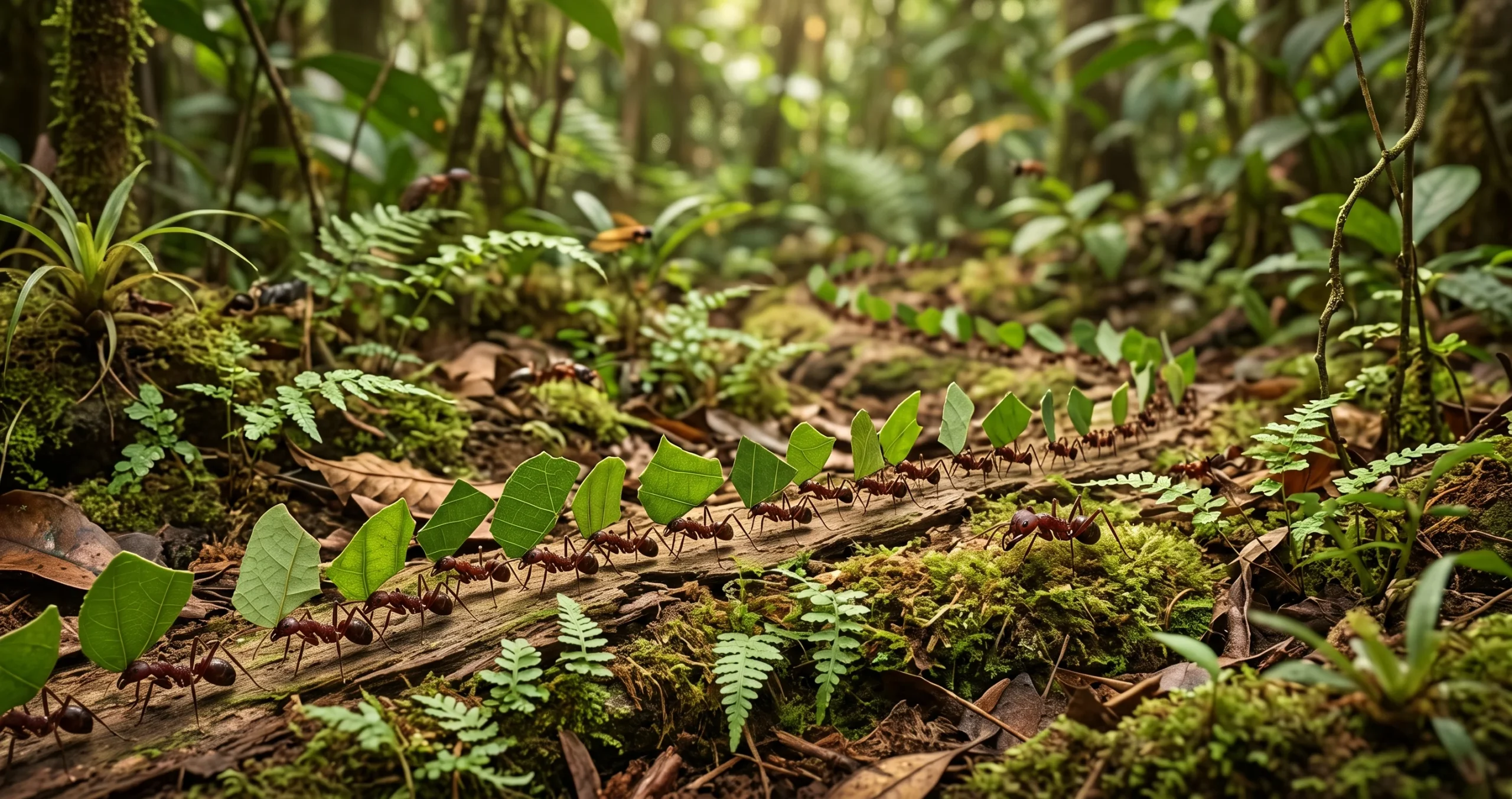
Across a tropical forest floor, thousands of ants march in organized trails, each carrying a freshly cut piece of leaf overhead. It looks as though the insects are hauling dinner home. But the leaves are not their meal.
They are raw material for leafcutter ants fungus farming, one of the most sophisticated agricultural systems outside human society. Deep underground, leafcutter ants use harvested vegetation to cultivate a domesticated fungus that converts plant material into food the colony can use. Workers prepare growing material, tend their crop, remove contaminants, manage waste, and protect their gardens from disease.
This relationship is so specialized that the ants and their cultivated fungus have become deeply dependent on one another. Long before humans planted their first crops, ants were already practicing agriculture.
Table of Contents
- Leafcutter Ants Don’t Actually Eat the Leaves
- How Leafcutter Ants Fungus Farming Works
- Meet the Ants’ Fungal Crop
- An Underground Agricultural System
- Division of Labor: Millions of Specialized Farmers
- Ants Weed and Protect Their Gardens
- A Queen Carries Her Farm to a New Colony
- How Ant Agriculture Compares With Human Farming
- Ant Farming Is Much Older Than Human Agriculture
- Leafcutter Ants as Ecosystem Engineers
- Are Leafcutter Ants Helpful or Harmful?
- FAQ
- Conclusion
Leafcutter Ants Don’t Actually Eat the Leaves
The most familiar image of a leafcutter ant can be misleading.
Workers cut pieces from leaves, flowers, and other fresh plant material and carry them along busy trails into their nest. It seems obvious that they are collecting vegetation to eat.
They generally aren’t.
Instead, the plant fragments are delivered to underground fungus gardens. Workers process the vegetation into substrate on which their fungal partner grows.
The fungus performs a biochemical job the ants cannot efficiently accomplish alone. It processes plant material and produces nutritious fungal structures that become a major food source for the colony, particularly for developing larvae.
The leaves are therefore better compared with fertilizer or growing substrate than with salad.
Smithsonian researchers describe leafcutter colonies as industrial-scale fungus farms capable of supporting colonies containing millions of workers.
How Leafcutter Ants Fungus Farming Works
Leafcutter ants primarily belong to the genera Atta and Acromyrmex. They occur in the Americas, particularly in tropical and subtropical environments of Central and South America.
Their agricultural system begins above ground.
Foraging workers locate suitable vegetation and cut sections using powerful mandibles. They then transport those fragments back to the nest, sometimes forming spectacular trails stretching across the forest floor.
But bringing the leaf underground is only the beginning.
Inside the nest, workers progressively reduce the plant material into smaller fragments. These fragments are incorporated into the fungus garden, where the cultivated fungus grows through them.
The fungal cultivar associated with many leafcutters is generally identified as Leucoagaricus gongylophorus. This partnership is not a casual association between ants and whatever mushroom happens to appear inside their nest.
It is a highly specialized mutualism.
The ants provide food, protection, dispersal, and carefully maintained growing conditions for the fungus. The fungus processes plant material and produces food that supports the ant colony.
Neither side is simply exploiting the other.
They function as agricultural partners.
Meet the Ants’ Fungal Crop
The fungus garden does not resemble rows of mushrooms.
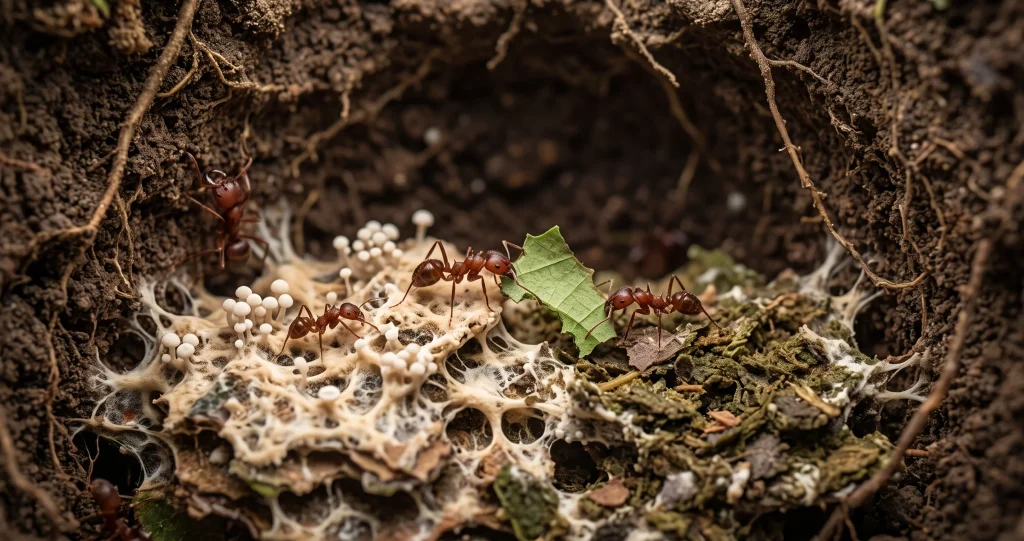
Much of it appears as a pale, sponge-like mass formed by fungal hyphae growing throughout the processed vegetation.
The ants harvest specialized swollen structures produced by their fungal crop. These nutrient-rich structures are known as gongylidia.
For larvae especially, the cultivated fungus is indispensable.
Research on the evolutionary history of ant agriculture indicates that fungus-farming ants and their crops became progressively more specialized over millions of years. Some highly domesticated fungal cultivars associated with advanced ant agriculture have become so dependent on their farmers that they are not known as free-living organisms in nature.
The dependence runs both ways.
Modern leafcutter societies rely heavily on their cultivated fungus for nutrition. A collapse of the garden can threaten the entire colony.
That makes maintaining the crop one of the colony’s most important jobs.
An Underground Agricultural System
A mature leafcutter nest is far more than a hole containing ants.
It can be an enormous subterranean structure with networks of tunnels and chambers dedicated to different activities. Some chambers hold active fungus gardens, while others serve as waste areas.
Workers continuously move plant material through this system.
Fresh vegetation arrives from outside. It is processed, incorporated into gardens, colonized by fungus, and eventually broken down.
Old or contaminated material is removed.
The colony must also maintain conditions that allow the crop to thrive.
This makes leafcutter ants fungus farming less like simply keeping food in storage and more like operating a living agricultural facility.
Smithsonian researchers describe mature colonies as using a complex division of labor in which workers perform numerous distinct tasks involved in collecting vegetation, processing it, cultivating fungus, maintaining the nest, caring for young, and handling waste.
Division of Labor: Millions of Specialized Farmers
One individual ant does not perform every agricultural job.
Leafcutter colonies contain workers of dramatically different sizes, and those workers divide the workload.
Larger workers can cut and transport vegetation or participate in colony defense. Other workers process incoming plant fragments.
Progressively smaller ants work deeper within the agricultural system.
Some prepare plant material for fungal growth. Others tend the garden itself, while tiny workers can move through the delicate fungal structures and care for developing brood.
Additional workers handle refuse.
This division of labor allows the colony to operate almost like an assembly line.
A piece of leaf may be selected and cut by one worker, transported by another, processed by smaller nest workers, incorporated into the garden, colonized by fungus, and eventually transformed into nutrition.
No individual ant understands the overall agricultural system in the human sense.
Yet millions of relatively simple individual behaviors combine into something remarkably sophisticated.
Ants Weed and Protect Their Gardens
Every farmer faces pests and disease.
Leafcutter ants are no exception.
A fungus garden containing abundant organic material creates opportunities for unwanted microorganisms. One particularly important enemy is Escovopsis, a group of specialized fungi capable of attacking ant fungus gardens.
The ants actively remove contaminated material and maintain their gardens.
But the defensive system becomes even more fascinating.
Some leafcutter ants also maintain relationships with bacteria, including Pseudonocardia, that grow on their bodies and can produce antifungal compounds.
Research published in Nature Communications describes Acromyrmex leafcutter agriculture as a multipart partnership involving the ants, their crop fungus, and antibiotic-producing Pseudonocardia. These bacteria can help suppress Escovopsis, which can otherwise overwhelm the crop.
In effect, these insects do more than plant and harvest.
They also weed their gardens and employ microbial allies that help protect their crops from disease.
That resemblance to pest management in human agriculture is difficult to ignore.
A Queen Carries Her Farm to a New Colony
Perhaps the strongest evidence that the fungus is a true crop appears when a new colony begins.
A young leafcutter queen does not simply leave home and hope to find the correct fungus later.
She takes part of the farm with her.
Before leaving her natal nest, a queen carries a small piece of the fungal cultivar. After mating and finding a suitable location for her colony, she uses this starter culture to establish a new fungus garden.
The behavior resembles a farmer carrying seeds or cuttings to establish a crop in a new field.
Smithsonian research describes this vertical transmission of the cultivar from the original colony to a daughter queen as a key part of the extraordinary dependence between farming ants and their fungi.
Without the crop, the new agricultural society cannot function normally.
How Ant Agriculture Compares With Human Farming
Calling leafcutter ants “farmers” can sound like anthropomorphism, but the comparison rests on several concrete biological similarities.
Both systems involve deliberately providing resources to another organism that will later provide food.
Both involve crop propagation.
Both require suitable growing conditions.
Both face diseases, parasites, waste management, and nutritional constraints.
And both have produced domesticated organisms whose evolutionary trajectories have been strongly altered by their cultivators.
There are major differences, of course.
Humans developed agriculture through learning, cultural transmission, technology, and conscious decision-making. Ant agriculture emerged through natural selection acting on instinctive behaviors over millions of generations.
An ant does not understand fungal biology in the way a human horticulturist understands a crop.
Yet natural selection has produced collective behaviors that accomplish strikingly similar tasks.
Recent research also suggests that leafcutter colonies adjust the plant material supplied to their fungi in ways related to the crop’s nutritional requirements. Smithsonian Tropical Research Institute researchers have compared this nutritional provisioning with farmers managing the needs of domesticated crops.
The similarity is functional, not intellectual.
Ant Farming Is Much Older Than Human Agriculture
Humans are agricultural newcomers by comparison.
Our species began domesticating plants and developing agriculture roughly 10,000–12,000 years ago.
Fungus-farming ants began much earlier.
Genomic research involving Smithsonian scientists places the origin of ant fungus farming approximately 55–60 million years ago, not long after the mass extinction that ended the age of non-avian dinosaurs.
The earliest systems were simpler than those of today’s leafcutters.
Over millions of years, ant agriculture became increasingly specialized. One lineage developed more highly domesticated fungal crops, and eventually leafcutter ants evolved the ability to provision massive underground gardens with freshly cut vegetation.
Estimates of exactly when modern leafcutting agriculture appeared vary with evolutionary analyses, but it arose millions of years ago—vastly predating human agriculture.
By the time people planted their first domesticated crops, ants had already been refining fungal cultivation for geological ages.
For a detailed overview of that evolutionary history, the Smithsonian Institution’s research summary on ant agriculture provides an accessible account of the genomic evidence.
Leafcutter Ants as Ecosystem Engineers
Leafcutters do not keep their agricultural activities neatly contained within their nests.
They can transform the surrounding ecosystem.
A review in Functional Ecology estimated that leafcutter ants can account for roughly 25% of herbivory in Neotropical forest ecosystems and move approximately 10–15% of leaves within their foraging range into nests.
That is an extraordinary ecological footprint for insects.
When ants excavate enormous nests, they move soil from different depths, alter soil structure, and change aeration and temperature.
Their fungus farming also concentrates organic material underground.
Leaves removed from plants are carried into nests, processed by fungal gardens, eaten, and eventually converted into waste. This redistributes nutrients through the soil.
The result is a patchwork of environmental effects around colonies.
Nest areas can differ from surrounding soils in physical structure and nutrient availability. Their trails and harvesting activities also affect vegetation patterns.
In ecological terms, leafcutter ants function as ecosystem engineers.
Farming Changes the Forest
The influence begins with harvesting.
A large colony can remove enormous quantities of vegetation. Certain plants may be heavily defoliated, while others are largely ignored.
That selectivity changes competitive relationships among plants.
The ants’ underground construction produces another layer of disturbance. Excavated soil reaches the surface, while plant material travels in the opposite direction.
Their nests essentially become processing centers where aboveground vegetation is transported underground and biologically transformed.
This activity affects carbon and nutrient distribution while creating small-scale environmental differences across the landscape.
For another look at organisms that radically reshape their environments, readers can explore related ecosystem-engineer and animal-behavior stories on secretsofthegreengarden.com.
Are Leafcutter Ants Helpful or Harmful?
Ecologically, “helpful” and “harmful” are often too simple.
In natural forests, leafcutter ants are native herbivores, soil engineers, decomposer partners, prey for other organisms, and major participants in nutrient cycling.
From a farmer’s perspective, the situation can look very different.
The same ability to harvest huge quantities of plant material can make leafcutter ants serious agricultural pests. Colonies may attack cultivated plants, plantations, gardens, and crops.
Their ecological importance and their economic impact can therefore exist simultaneously.
A leafcutter colony does not distinguish between a valuable crop and a wild plant according to human priorities.
It is feeding its fungus.
Leafcutter Ants Fungus Farming Is a True Mutualism
The word “mutualism” describes a relationship in which both partners benefit.
Few examples are as dramatic as leafcutter agriculture.
The ants provide their fungus with processed vegetation, protected growing chambers, maintenance, dispersal, and defense against competitors.
The fungus converts plant material into food accessible to the colony.
Over evolutionary time, the partnership became so specialized that neither partner in these advanced systems functions normally without the other.
That is why simply saying “leafcutter ants eat fungus” misses most of the story.
They cultivate it.
They transport its growing medium.
They protect it from disease.
They remove waste.
Queens propagate it when founding new colonies.
And millions of workers organize their lives around maintaining it.
This is agriculture produced not by human intelligence but by millions of years of coevolution.
FAQ
Do leafcutter ants actually eat leaves?
The leaves they harvest are primarily used as substrate for their cultivated fungus rather than being their main direct food. The fungal crop converts the processed plant material into nutrition usable by the colony.
What fungus do leafcutter ants farm?
Many advanced leafcutter ants cultivate the basidiomycete fungus Leucoagaricus gongylophorus, although the biology and taxonomy of fungal cultivars across fungus-farming ants are more diverse.
Why do leafcutter ants carry leaves?
They transport fresh plant material into underground nests, where workers process it and incorporate it into fungus gardens.
How do leafcutter ants protect their fungus?
Workers clean and weed gardens and remove contaminated material. Some leafcutters also maintain antibiotic-producing bacterial symbionts that help defend their fungal crop against pathogens such as Escovopsis.
Did ants invent farming before humans?
Yes, in the biological sense of cultivating another organism for food. Fungus farming among attine ants dates back roughly 55–60 million years according to genomic research, whereas human agriculture is only around 10,000–12,000 years old.
How does a new colony obtain its fungus?
A young queen carries fungal material from her original colony and uses it to establish the garden of her new nest.
How large can a leafcutter colony become?
Large Atta colonies can contain millions of ants organized into different worker groups performing specialized tasks.
Are leafcutter ants important to forests?
Yes. Their harvesting, nest excavation, soil movement, nutrient redistribution, and fungal cultivation can significantly influence Neotropical ecosystems.
Conclusion
A procession of leafcutter ants carrying pieces of greenery looks simple from above.
Underground, an entirely different world exists.
The leaves enter a sophisticated agricultural system. Workers process them, feed them into fungal gardens, remove contamination, dispose of old material, maintain the nest, protect the crop from disease, and eventually harvest the nutrition produced by their fungal partner.
Even reproduction carries agriculture with it. A queen leaving to establish a new society takes fungal starter material from her birthplace.
This remarkable leafcutter ants fungus farming partnership has been shaped by millions of years of coevolution. Long before humans domesticated wheat, rice, or corn, fungus-growing ants had already developed agricultural systems built around crop cultivation, disease control, waste management, and division of labor.
Their farming also reaches far beyond the nest. Leafcutters remove vegetation, excavate huge quantities of soil, redistribute nutrients, and alter the physical environment around their colonies.
They remind us that agriculture is not exclusively a human invention.
Deep beneath tropical forests, millions of tiny farmers have been running their own underground fields for millions of years.