
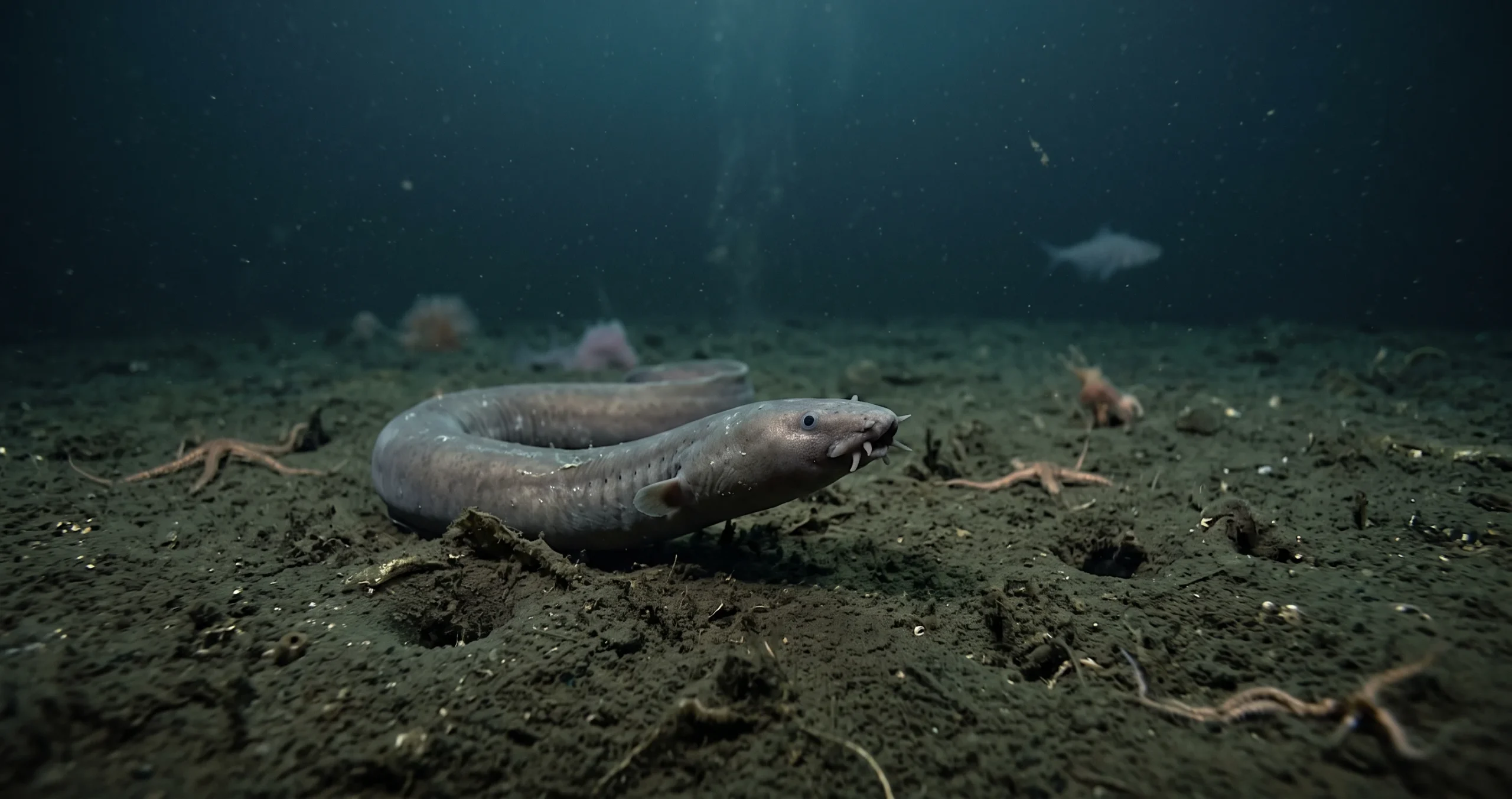
A shark closes its jaws around what looks like an easy meal: a soft-bodied, eel-shaped hagfish. Then, almost instantly, the predator’s mouth fills with a strange fibrous slime. The material spreads toward the gills, the shark releases its prey, and the hagfish swims away.
This extraordinary hagfish slime defense is not simply ordinary mucus produced in unusually large quantities. Hagfish possess specialized slime glands that release mucus-forming material and microscopic protein threads. When those ingredients contact seawater, they rapidly transform into an enormous volume of dilute, mechanically unusual slime capable of interfering with a predator’s gills.
The same biological material that saves hagfish from sharks is now inspiring scientists searching for new fibers and sustainable biomaterials.
Table of Contents
- What Is Hagfish Slime?
- How Hagfish Slime Glands Work
- How a Tiny Secretion Becomes a Huge Mass of Slime
- Hagfish Slime Defense Against Predators
- How the Slime Clogs Gills
- Why Hagfish Don’t Suffocate in Their Own Slime
- Slime Threads Are Remarkable Biological Fibers
- Could Hagfish Inspire Sustainable Materials?
- Hagfish Are Ancient Jawless Vertebrates
- How Hagfish Feed Without Jaws
- Hagfish and Their Role in Marine Ecosystems
- FAQ
- Conclusion
What Is Hagfish Slime?
Hagfish slime looks deceptively simple.
At first glance, it resembles a huge mass of mucus suspended in seawater. Under a microscope, however, researchers find a sophisticated composite material built primarily from two biological components: mucus and extremely fine protein threads.
Those ingredients interact with seawater to form the defensive slime.
A major scientific review in the Annual Review of Biochemistry describes hagfish slime exudate as containing secretory products from two specialized cell types: gland mucous cells and gland thread cells.
The resulting material is extraordinarily dilute.
Rather than producing liters of concentrated mucus inside its body, a hagfish carries comparatively small quantities of concentrated precursor material and uses the surrounding ocean to provide most of the final slime’s volume.
It is an ingenious solution for an animal that may need a massive defense in a fraction of a second.
How Hagfish Slime Glands Work
The machinery responsible for the hagfish slime defense runs along much of the animal’s body.
Depending on the species, hagfish possess numerous slime pores associated with specialized glands arranged along their sides. Research on hagfish predation describes roughly 90–200 slime pores in some hagfish, although anatomy varies among species.
Inside the glands are two particularly important cell types.
Gland Mucous Cells
These cells contain the components responsible for the mucus portion of the slime.
Once released into seawater, their contents help produce the mucus network that gives the slime exceptional water-trapping and clogging properties.
Gland Thread Cells
These are even stranger.
A gland thread cell manufactures an extraordinarily long protein fiber and packages it inside itself as a tightly organized bundle called a thread skein.
Research has found that individual slime threads can reach roughly 30 centimeters in length while measuring only around 1–3 micrometers in diameter.
That means a microscopic cell packages a fiber enormously longer than itself.
When the hagfish releases the gland material into seawater, those tightly packed fibers rapidly unravel.
The result is a microscopic web.
How a Tiny Secretion Becomes a Huge Mass of Slime
This is perhaps the most remarkable part of the entire process.
A hagfish does not have to store a body-sized mass of finished slime. Instead, its glands store concentrated ingredients.
When threatened, the animal ejects the glandular material through its slime pores.
Seawater then becomes part of the defense.
The mucous components hydrate while the microscopic thread skeins unravel. Together, they create a network capable of trapping an enormous quantity of seawater.
Research published in the Journal of Experimental Biology described the resulting structure as behaving more like a fine sieve than ordinary thick mucus, with seawater held within a network of mucin-coated threads.
The slime is therefore mostly water.
Yet because of its microscopic structure, an extremely small concentration of biological material can profoundly alter how that water flows.
That becomes disastrous for a predator attempting to breathe through gills.
Hagfish Slime Defense Against Predators
For years, scientists suspected that hagfish slime protected the animals from fish predators.
Then researchers captured the process on video in the wild.
In a landmark 2011 study published in Scientific Reports, underwater cameras recorded predators—including sharks and large bony fishes—attempting to eat hagfish. When a predator grabbed one, the hagfish released slime directly into the attacker’s mouth.
The reaction was dramatic.
Slime secretion occurred in less than 0.4 seconds in observed encounters. Predators released the hagfish and made vigorous movements apparently aimed at clearing material from their mouths and gill chambers.
Researchers documented 14 clear encounters in which attacking predators were repelled.
Remarkably, the targeted hagfish appeared unharmed and sometimes simply continued feeding after the predator retreated.
This is strong direct evidence that slime is not merely an unpleasant secretion.
It is a highly effective anti-predator system.
How the Slime Clogs Predator Gills
Fish need water to flow efficiently across their gills.
Hagfish slime interferes with that process.
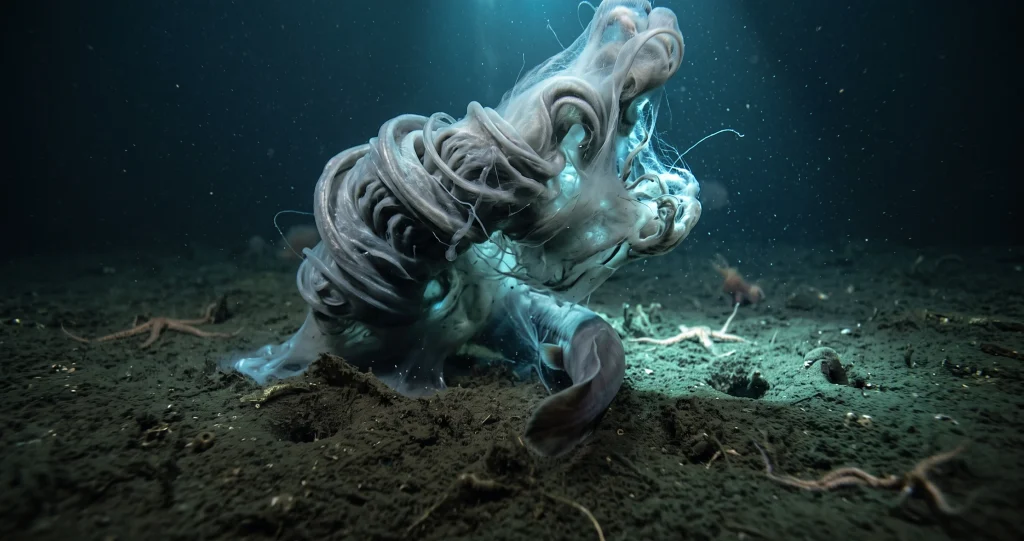
When a predator bites or attempts to swallow a hagfish, slime can enter its mouth and gill chamber. The fibrous mucus network creates resistance to water movement, forcing the predator to abandon its attack and clear its respiratory surfaces.
More recent experimental work has investigated exactly why such incredibly dilute slime is so effective.
A study examining the mechanics of gill clogging found that the mucus and threads perform different but complementary jobs. The mucus was particularly important for producing low permeability and effective clogging, while the protein threads added mechanical strength and helped the material retain its clogging ability.
Researchers estimated effective pore sizes in the slime network of only about 10–300 nanometers.
The slime therefore creates a remarkably fine barrier to water movement.
That is the secret behind the hagfish slime defense: it doesn’t need to poison the attacker.
It changes the physics of water around the predator’s respiratory system.
The Slime Changes Depending on How It Is Pulled
Hagfish slime becomes even stranger when scientists examine its flow properties.
Research published in Scientific Reports found evidence that the slime behaves differently under different mechanical forces.
Under elongational flow—the kind of stretching flow that can occur when a predator sucks prey toward its mouth—the mucus becomes more resistant to movement. This property could make it particularly effective at interfering with gill ventilation.
Under shear forces, however, the slime can become easier to remove.
That difference may help solve a major problem.
The hagfish needs slime that becomes troublesome inside a predator’s mouth but does not permanently trap the animal that produced it.
Why Hagfish Don’t Suffocate in Their Own Slime
The defense is dangerous enough that hagfish themselves must escape it.
They have another extraordinary behavior for doing exactly that.
A hagfish can literally tie its body into a knot.
The animal forms a loop, passes part of its body through it and moves the knot along its length. This behavior can help scrape slime from its body.
Experiments examining hagfish slime rheology suggest that shear forces generated during this knotting behavior help collapse or remove the slime network.
Knotting serves other purposes too.
Hagfish can use the mechanical leverage generated by a knot when feeding, helping them pull pieces from carcasses.
So one of the strangest body movements in the vertebrate world assists both feeding and survival.
Slime Threads Are Remarkable Biological Fibers
The slime’s microscopic threads have attracted attention far beyond marine biology.
They are made largely from proteins belonging to the intermediate filament family. Their mechanical properties have encouraged researchers to investigate whether similar protein fibers could be manufactured artificially.
The goal is not to harvest enormous quantities of slime from wild hagfish.
Instead, scientists want to understand how the animal constructs its fibers and reproduce useful aspects of that process.
Research published in Biomacromolecules demonstrated that solubilized hagfish slime-thread proteins could be processed into films and drawn into fibers. After additional drawing, some experimental fibers developed mechanical characteristics comparable in certain respects to regenerated silk fibers.
That discovery created interest in hagfish-inspired materials.
Could Hagfish Inspire Sustainable Materials?
Many modern synthetic fibers depend on petroleum-derived polymers and industrial manufacturing processes.
Protein-based fibers offer another possible route.
Researchers studying hagfish slime threads have investigated whether intermediate-filament proteins could eventually provide models for strong, lightweight, biologically derived materials. Potential concepts discussed around biomimetic protein fibers include textiles and other high-performance fiber applications.
But there is an important distinction between inspiration and commercialization.
Hagfish slime has not suddenly become a replacement for nylon or polyester. Producing protein fibers economically and at industrial scale remains a major engineering challenge.
The scientifically interesting idea is biomimicry.
Instead of manufacturing clothing by extracting slime from millions of hagfish, researchers can study how hagfish proteins assemble and then attempt to reproduce comparable materials through controlled biological or industrial processes.
The 2012 Biomacromolecules research specifically explored hagfish slime proteins as models for potentially high-performance, environmentally sustainable protein-based fibers.
For readers interested in other extraordinary natural materials, explore our wildlife and biological-adaptation stories at secretsofthegreengarden.com.
Hagfish Are Ancient Jawless Vertebrates
The slime would be remarkable coming from any animal.
Its owner makes the story even stranger.
Hagfish belong to an ancient lineage of jawless vertebrates. Together with lampreys, they represent surviving branches that diverged deep in vertebrate evolutionary history.
Calling a modern hagfish a “living fossil” can be misleading if it suggests that the animal has remained completely unchanged for hundreds of millions of years. Modern hagfish have continued evolving like every living lineage.
Their broader lineage, however, is genuinely ancient.
Research on hagfish ecology describes them as occupying a distinctive position near the base of vertebrate evolutionary history, and fossil evidence shows that hagfish-like animals have existed for hundreds of millions of years.
They lack the hinged jaws possessed by sharks, bony fishes, reptiles, birds and mammals.
They also lack paired fins and possess an elongated, flexible body that can superficially resemble an eel.
But an eel is a jawed bony fish.
A hagfish belongs to a radically different evolutionary branch.
How Hagfish Feed Without Jaws
Lacking jaws does not prevent hagfish from eating animal tissue.
Their mouths contain keratinous tooth-like structures mounted on movable dental plates. These structures can grip and tear flesh.
Hagfish are famous for scavenging carcasses that sink to the seafloor. They play an important role in consuming dead organisms and returning nutrients to marine food webs.
But the idea that hagfish are exclusively scavengers is outdated.
The same underwater research that documented the hagfish slime defense also captured hagfish actively attacking living prey.
Their feeding ecology is therefore more versatile than their reputation suggests.
Knotting can help here as well.
By forming a knot and bracing it against a carcass, a hagfish can create leverage while pulling tissue with its dental apparatus.
It is an unusual mechanical solution to life without jaws.
Hagfish and Their Role in Marine Ecosystems
Hagfish inhabit marine environments, with different species occurring at different depths and across oceans.
Many spend considerable time on or within soft seafloor sediments.
Their scavenging activities help break down carcasses and recycle organic material. Burrowing can also disturb and mix sediments, meaning hagfish influence the ecosystems around them rather than simply waiting for something dead to eat.
Their defense may even influence competition around food.
Field observations have shown slime accumulating around bait when multiple hagfish were feeding, sometimes discouraging other fishes from approaching.
A mechanism evolved primarily to stop a predator may therefore produce other ecological effects.
FAQ
What is hagfish slime made of?
Hagfish defensive slime consists primarily of seawater trapped within an extremely dilute network created from mucus and microscopic protein threads. Specialized gland cells produce the two major biological components.
How quickly can hagfish produce slime?
Wild observations have recorded defensive slime being released in less than 0.4 seconds after a predator attacked.
Does hagfish slime kill predators?
The main documented defensive mechanism is physical rather than toxic. The slime interferes with water flow through the mouth and gills, prompting fish predators to release the hagfish and clear their respiratory surfaces. Chemical analyses cited in field research did not identify toxins responsible for the observed defense.
How does hagfish slime expand?
Specialized gland material is released into seawater. Mucous components hydrate while tightly packed protein-thread skeins unravel, forming a huge, highly dilute network containing mostly seawater.
Why doesn’t a hagfish become trapped in its own slime?
Hagfish can tie their flexible bodies into sliding knots and move those knots along themselves. The resulting shear forces help remove slime from the body.
Are hagfish eels?
No. Although their long bodies resemble eels, hagfish are jawless vertebrates belonging to a much older evolutionary lineage. True eels are jawed bony fishes.
Can hagfish slime be used to make clothing?
Researchers have successfully produced experimental fibers from processed hagfish slime-thread proteins, demonstrating interesting biomaterial potential. That is different from having a commercially established hagfish-slime textile industry.
Why are scientists interested in hagfish slime?
It combines extraordinary expansion, water retention, gill-clogging performance and strong microscopic protein threads. Understanding those properties may inspire new biomaterials while also revealing how an unusual vertebrate defense evolved.
Conclusion
The hagfish slime defense sounds almost absurd until you see what it accomplishes.
A predator attacks. Specialized glands release a tiny amount of concentrated material. Protein threads unravel, mucus interacts with seawater, and within moments the attacker’s mouth and gill chamber can become overwhelmed by an enormous volume of dilute fibrous slime.
The predator lets go.
The hagfish escapes—and may even tie itself into a knot to clean away its own weapon.
Yet this defense is more than one of nature’s strangest escape tricks. Hagfish slime has become a model for studying mucus physics, biological fibers, high-water-content materials and biomimetic manufacturing.
All of this comes from an animal belonging to one of the deepest surviving branches of vertebrate evolution.
For hundreds of millions of years, the hagfish lineage has persisted without jaws, claws, armor or venom. Its most spectacular defense instead uses something far simpler: microscopic protein threads, mucus—and the seawater surrounding it.
External Sources:
1. Zintzen et al., Scientific Reports — “Hagfish predatory behaviour and slime defence mechanism.” Direct field observations demonstrated hagfish slime rapidly entering predators’ mouths and gill chambers and causing attacks to be abandoned.