
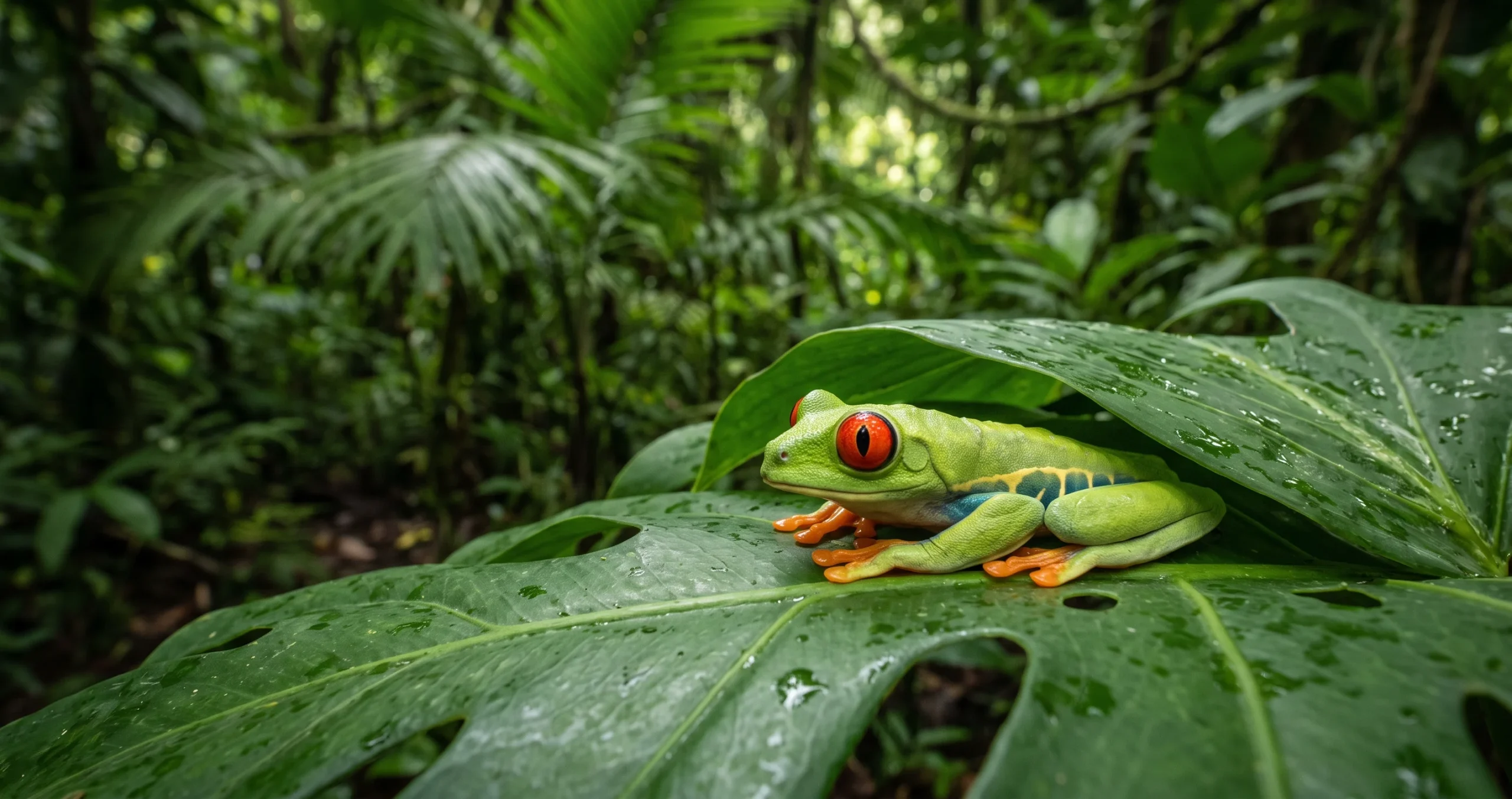
A red-eyed tree frog sleeping beneath a rainforest leaf hardly looks like one of nature’s most spectacularly colored amphibians. Its green body disappears against the foliage, its orange feet are tucked away, and its famous scarlet eyes remain concealed. But disturb the frog and the disguise can disappear instantly.
That sudden transformation is often described as red-eyed tree frog defense through “startle” or flash coloration. The frog opens its enormous red eyes and, as it moves, may expose brilliant orange feet and blue-and-yellow sides. For decades, biologists and natural-history sources have proposed that this abrupt burst of color could momentarily surprise a predator, buying the frog enough time to leap away.
Recent experimental research, however, adds an intriguing twist: the frog certainly flashes its eyes, but scientists are still testing whether startling predators is actually the reason those eyes evolved.
Table of Contents
- What Is the Red-Eyed Tree Frog Defense?
- How Flash Coloration Is Supposed to Work
- New Research Complicates the Startle Story
- Why Hide Bright Colors Until the Last Moment?
- Camouflage While the Frog Sleeps
- How Other Animals Use Flash Displays
- Red Eyes Are Only Part of the Display
- Life After Dark in the Rainforest
- A Defense Strategy That Begins Before Hatching
- Rainforest Habitat and Range
- Conservation Status and Threats
- FAQ
- Conclusion
What Is the Red-Eyed Tree Frog Defense?
The red-eyed tree frog (Agalychnis callidryas) looks almost artificially colorful when fully exposed.
Adults have a predominantly green back, vivid red eyes, orange or reddish feet and contrasting colors along their sides. Yet those conspicuous features can largely disappear when the frog adopts its daytime resting position.
The frog folds its legs close to its body, concealing much of the colorful flank and feet, and closes its eyes. Seen from above, what remains is primarily a smooth green surface resting against a green leaf.
Then something approaches.
The frog can suddenly open its eyes and prepare to jump. The abrupt transition from concealed green animal to red-eyed, multicolored frog has traditionally been interpreted as a form of flash coloration, potentially disrupting a predator’s attack.
National Geographic describes this proposed mechanism as startle coloration that may provide the frog with a crucial instant to escape.
But “may” is an important word.
How Flash Coloration Is Supposed to Work
Camouflage works best when an animal remains unnoticed. Once a predator has detected it, however, camouflage has partly failed.
Flash coloration offers a possible second line of defense.
Instead of remaining visually inconspicuous, an animal suddenly reveals a contrasting patch of color during an encounter. The unexpected stimulus could potentially cause hesitation, confusion or interruption in a predator’s attack.
Even a very brief interruption could matter.
For a small frog facing a bird, snake or other predator, survival may depend on getting enough time to launch a jump into surrounding vegetation.
The classic interpretation of red-eyed tree frog defense therefore involves two stages.
First comes concealment.
Then, after detection, comes sudden color and escape.
It is an elegant hypothesis—but researchers have recently put it to a more direct experimental test.
New Research Complicates the Startle Story
A 2025 study published in Ethology Ecology & Evolution examined whether the famous coloration of Agalychnis callidryas actually functions as a deimatic—or startling—anti-predator display.
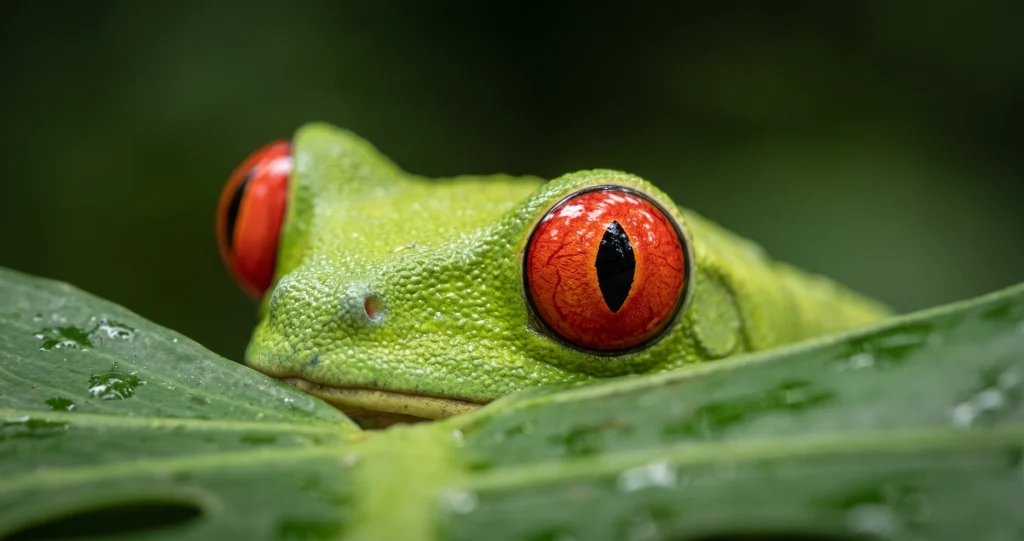
Researchers exposed wild-caught frogs to simulated predatory encounters. The frogs rapidly opened their eyes early in those encounters, confirming that exposing the bright eyes is a genuine behavioral response to disturbance.
Their colorful feet and flanks, however, were exposed much less frequently and generally in association with jumping away.
The researchers then conducted experiments involving domestic chickens and differently colored prey or frog models. Rather than demonstrating clear hesitation toward red eyes, the experiments failed to find the predicted aversion. Experienced chickens actually attacked models with red eyes more frequently and intensely under one experimental condition.
That does not prove that red eyes have no defensive value in nature.
Domestic chickens are not the complete community of wild predators that red-eyed tree frogs encounter in Central American forests. The authors specifically noted that interactions involving wild avian predators still need evaluation.
What the study changes is our level of certainty.
It is accurate to say that red-eyed tree frogs rapidly expose their eyes when disturbed and that startle coloration is a prominent hypothesis explaining their striking appearance. It is no longer wise to state as settled fact that the red eyes have been experimentally demonstrated to frighten predators.
That scientific uncertainty makes the red-eyed tree frog defense story more interesting, not less.
Why Hide Bright Colors Until the Last Moment?
Flash coloration depends on contrast.
A permanently visible red patch cannot produce the same sudden transition as one that disappears when the animal rests and reappears when it moves.
Red-eyed tree frogs are particularly well suited to this strategy because their resting posture conceals much of their conspicuous coloration.
During daylight, the frog may cling to the underside of vegetation. The legs are folded inward, colorful toes are tucked beneath the body, and the eyes are closed.
The green dorsal surface then dominates what an observer can see.
If the frog wakes and jumps, the visual picture changes dramatically. Red, orange, blue and yellow can appear almost simultaneously.
Whether those colors directly startle a predator or serve another function, the transition between concealment and exposure is remarkable.
Camouflage While the Frog Sleeps
Red-eyed tree frogs are nocturnal. Much of their activity occurs after darkness falls, while daytime is commonly spent resting on vegetation.
Their green dorsal coloration helps make them less conspicuous among leaves. Animal Diversity Web reports that adults are relatively small, measuring roughly 4–7 centimeters, with females generally larger than males.
Small size makes camouflage particularly effective.
A motionless green frog pressed against foliage can become surprisingly difficult to notice, especially when its most recognizable features are hidden.
Its eyes also possess a nictitating membrane. This protective structure is patterned and helps cover the conspicuous eye while the frog rests.
This combination creates an impressive visual trick: one of the world’s most recognizable frogs can become remarkably inconspicuous simply by folding itself up and staying still.
How Other Animals Use Flash Displays
Red-eyed tree frogs are far from the only animals to combine camouflage with suddenly exposed colors.
Many insects employ similar visual strategies.
Some moths possess relatively cryptic forewings but dramatically colored hindwings. While resting, the bright surfaces remain hidden. When disturbed, flight suddenly reveals them.
Certain grasshoppers follow a comparable pattern, keeping brightly colored hindwings concealed until they take flight.
The principle can extend beyond insects. Animals across different groups have evolved concealed markings that become visible during movement or defensive behavior.
Not all such displays perform exactly the same job.
In some species, sudden color may genuinely startle an attacker. In others, rapidly appearing and disappearing markings may interfere with tracking moving prey. Bright markings can also participate in warning displays, communication or mate selection.
That distinction matters when discussing the red-eyed tree frog defense.
Similar appearance does not necessarily mean identical evolutionary function.
Red Eyes Are Only Part of the Display
Photographs tend to emphasize the frog’s enormous scarlet eyes, but an active red-eyed tree frog exposes far more color.
Its sides can contain striking blue and yellow or cream markings, while its feet are orange to reddish.
When the animal is resting, much of this coloration can be concealed. Once it begins moving, several contrasting colors become visible.
That difference has led to an interesting possibility.
Perhaps the frog’s defensive effect, if there is one, comes not from red eyes alone but from the rapid transformation of the animal’s entire appearance during escape.
The 2025 experimental research nevertheless found that frogs exposed their bright flank and foot coloration relatively rarely except when jumping away.
That observation leaves researchers with several possible explanations to investigate.
The colors might assist escape once movement begins. They could perform additional functions unrelated to predator deterrence. Different predators may also respond differently to them.
Evolution rarely provides a simple answer merely because one explanation sounds convincing.
Life After Dark in the Rainforest
Once daylight fades, the red-eyed tree frog becomes active.
It is an arboreal carnivore, moving through tropical vegetation and feeding primarily on small animals such as insects. National Geographic lists crickets, flies and moths among its prey.
Large adhesive toe pads allow the frog to cling to vegetation, including leaf surfaces.
The rainy season is particularly important for reproduction. Males call to attract females, and breeding occurs around bodies of water.
Females typically attach gelatinous egg clutches to vegetation positioned above water.
That unusual choice creates another extraordinary anti-predator story.
A Defense Strategy That Begins Before Hatching
Red-eyed tree frog embryos do not simply wait passively for a predetermined hatching date.
Research associated with biologist Karen Warkentin has demonstrated that embryos can respond to environmental danger. When threatened by predators such as snakes or wasps attacking an egg clutch, sufficiently developed embryos can hatch prematurely and fall into the water below.
This phenomenon is called environmentally cued hatching.
It means that defensive behavior begins before the frog even becomes a free-swimming tadpole.
An adult may depend on concealment and rapid escape. An embryo has an entirely different option: abandon the egg early.
For another remarkable example of how animals change behavior to survive danger, readers can explore our other wildlife adaptations at secretsofthegreengarden.com.
Rainforest Habitat and Range
Agalychnis callidryas inhabits humid tropical environments in the Americas.
Its distribution extends from southern Mexico through Central America and into northwestern South America. The species is particularly associated with tropical lowland forests and vegetation near ponds and other aquatic breeding sites.
Rainfall connects almost every stage of its life.
Moist conditions help amphibians manage water balance. Seasonal rains create and replenish breeding pools, while dense vegetation provides resting, hunting and egg-laying sites.
The frog consequently depends on more than individual trees.
It needs functioning forest habitat that connects vegetation with suitable freshwater breeding environments.
Conservation Status and Threats
The red-eyed tree frog is currently widely described as Least Concern, rather than endangered, reflecting its relatively broad distribution. National Geographic also reports a decreasing population trend.
“Least Concern” should not be interpreted as “faces no threats.”
Habitat alteration and forest loss can remove the humid vegetation and breeding environments these frogs require. Amphibians worldwide are also affected by interacting pressures including emerging diseases and environmental changes.
The species’ famous appearance has made it an international symbol of rainforest biodiversity.
Protecting red-eyed tree frogs ultimately means protecting the ecological system surrounding them: forest vegetation, breeding ponds, rainfall patterns, insects, predators and the countless other organisms occupying the same habitat.
Red-Eyed Tree Frog Defense: A More Complicated Story Than It Looks
The red-eyed tree frog provides a useful lesson about how wildlife facts change as scientists test familiar explanations.
Natural-history descriptions have long proposed that the frog’s suddenly revealed red eyes and other bright colors startle predators. The behavior certainly looks as though it could work that way.
Yet appearance alone cannot establish evolutionary function.
The 2025 experimental study found that frogs rapidly opened their eyes when confronted with simulated predators, but its experiments did not support the prediction that red eye coloration deterred the tested avian predator.
Future experiments involving natural predators could produce a more complete picture.
For now, the strongest description is that sudden eye exposure is part of the frog’s response to disturbance, while startling predators remains a plausible but actively tested explanation for the conspicuous coloration.
FAQ
Why do red-eyed tree frogs have red eyes?
Startle coloration has traditionally been proposed as an anti-predator explanation. However, recent experimental research did not find clear evidence that flashing red eyes deterred the avian predator tested, so the exact evolutionary function remains open to further investigation.
Do red-eyed tree frogs actually flash their eyes?
Yes. Experimental observations found that disturbed frogs rapidly opened their eyes during simulated predator encounters.
Are red-eyed tree frogs poisonous?
Their conspicuous colors should not automatically be interpreted like the warning coloration of highly toxic frogs. Red-eyed tree frogs rely heavily on behavior, concealment and escape rather than the famous potent toxins associated with some other colorful amphibians.
How do red-eyed tree frogs camouflage themselves?
They rest with their green dorsal surface exposed while folding their brightly colored limbs against the body and closing their eyes. This reduces the amount of contrasting coloration visible against foliage.
What predators eat red-eyed tree frogs?
Potential predators include snakes, birds and other rainforest predators capable of capturing small arboreal frogs. Different life stages encounter different threats; even eggs can be attacked by predators.
Where do red-eyed tree frogs live?
They occur from southern Mexico through Central America and into northwestern South America, principally in humid tropical environments associated with vegetation and aquatic breeding sites.
Are red-eyed tree frogs endangered?
The species is classified as Least Concern in commonly cited conservation assessments, although habitat degradation and other pressures can affect populations locally. National Geographic reports the population trend as decreasing.
Conclusion
The red-eyed tree frog seems to perform one of nature’s simplest magic tricks.
Close the eyes, fold away the legs and remain motionless, and a spectacularly colored amphibian becomes a patch of green among thousands of rainforest leaves. Open those scarlet eyes and leap, and the disguise disappears in an explosion of contrasting color.
For years, this transformation has been presented as a textbook example of startle coloration—a sudden visual shock intended to interrupt a predator long enough for the frog to escape.
The behavior is real. The evolutionary explanation is still being tested.
Recent research reminds us that the most compelling wildlife stories are not always those with the simplest answers. The red-eyed tree frog defense may involve camouflage, sudden eye exposure, rapid escape and conspicuous colors whose precise functions scientists are still working to understand.
In the rainforest, surviving another night may depend on fractions of a second. Whether those extraordinary red eyes actually make a predator hesitate—or have a more complicated role—the frog has evolved an extraordinary combination of concealment, movement and color.
And sometimes the most scientifically accurate answer to one of nature’s strangest adaptations is also the most exciting: we are still discovering exactly how it works.