
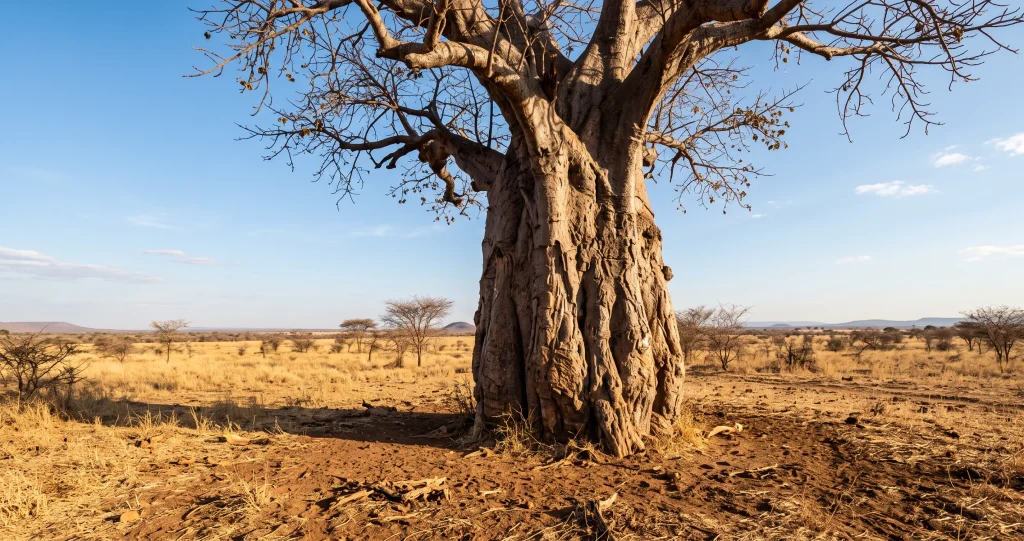
Across parts of Africa, the dry season can transform a green landscape into a dusty expanse of brittle grass and leafless vegetation. Yet rising above that parched scenery is one of the strangest silhouettes in the plant kingdom: the African baobab (Adansonia digitata), with a trunk so swollen that it can look more like a giant bottle than a conventional tree.
That extraordinary shape is closely connected to baobab tree water storage. Baobabs possess unusually water-rich, low-density tissues that allow their massive stems to act as biological reservoirs. But the viral claim that a baobab is simply a wooden tank containing tens of thousands of gallons of drinkable water misses the fascinating reality.
The water is largely held within living, fibrous tissues—and understanding how the tree stores and manages it reveals an extraordinary adaptation to seasonal drought.
Table of Contents
- The Baobab’s Giant Trunk Is More Than a Trunk
- How Much Water Can a Baobab Actually Store?
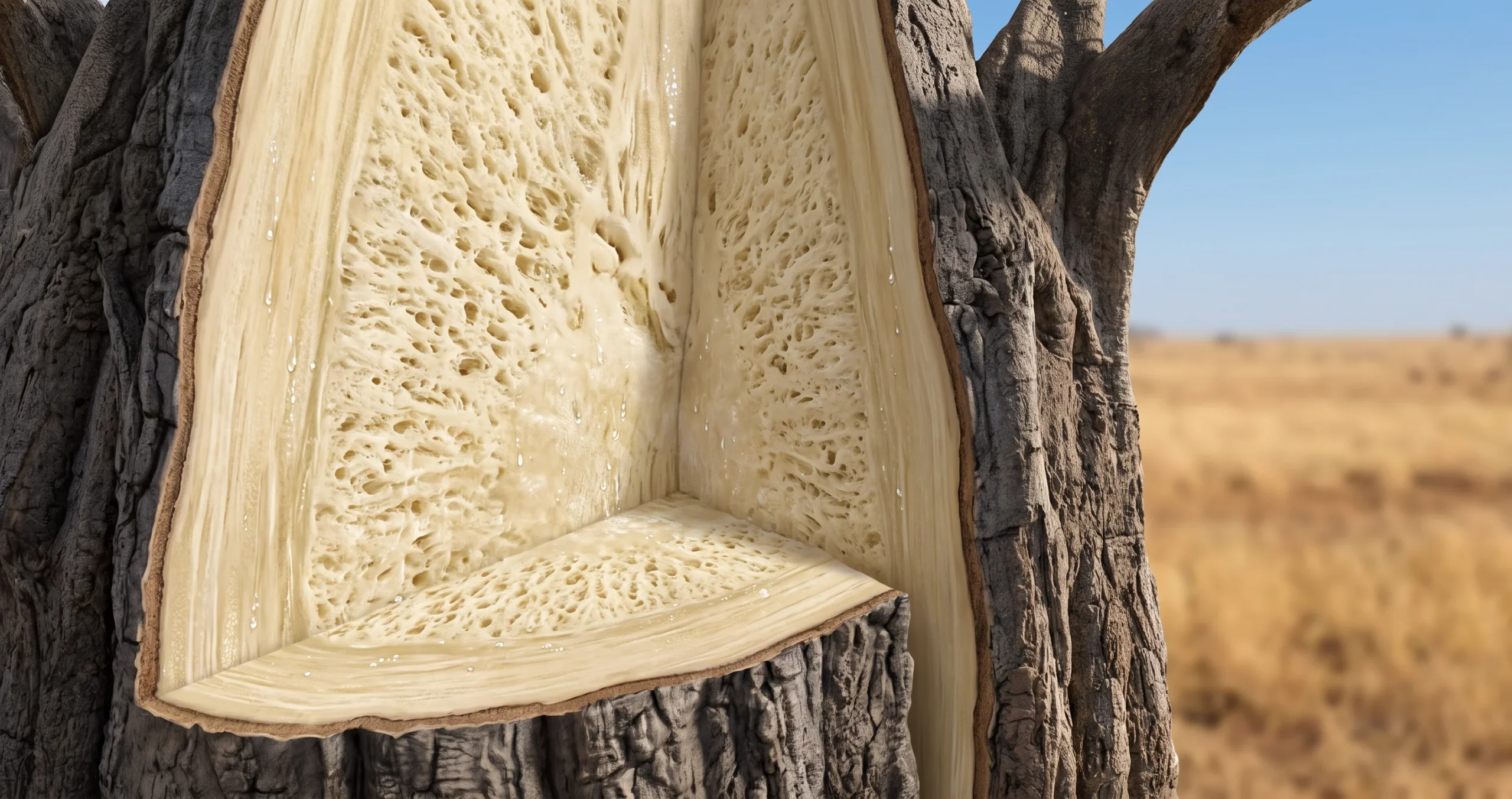
- The Sponge-Like Wood Inside a Baobab
- What Happens During the Dry Season?
- A Tree That Can Change Size
- Can People Really Drink Water From Baobab Trunks?
- Baobabs Can Live for More Than 1,000 Years
- Some Ancient Baobabs Have Suddenly Died
- The Baobab Is an Entire Ecosystem
- Baobab Myths vs. Facts
- FAQ
- Conclusion
The Baobab’s Giant Trunk Is More Than a Trunk
The African baobab is native across large areas of tropical and southern Africa and parts of the Arabian Peninsula, particularly in seasonally dry tropical environments. Kew describes Adansonia digitata as a massive deciduous tree capable of developing an immense trunk girth.
Unlike trees built primarily from dense, rigid wood, baobabs belong to a group often described as stem-succulent trees. Their enormous trunks contain relatively low-density tissues capable of holding exceptionally large amounts of water.
The trunk therefore performs several jobs simultaneously. It supports the crown, transports water and nutrients, stores carbohydrates, and maintains a substantial internal water reserve.
This is why the famous bottle-shaped profile is more than visual spectacle. It is part of the tree’s strategy for surviving an environment where rainfall may be highly seasonal.
How Much Water Can a Baobab Actually Store?
This is where internet descriptions of baobabs need some caution.
A frequently repeated claim says that a large baobab can store 120,000 liters—roughly 32,000 U.S. gallons—of water. The number appears widely in popular literature, but it should not be treated as though researchers have directly drained and measured that quantity from a typical Adansonia digitata.
Scientific physiological work gives us a more meaningful measurement: water concentration inside baobab tissues.
Research on Malagasy Adansonia species found outer sapwood containing approximately 71–75% water by volume. Expressed relative to dry weight, measured water contents reached approximately 500–800%, partly because baobab stems contain comparatively little solid material.
Kew similarly describes baobabs as behaving like giant succulents and notes that water can account for a very large proportion of trunk volume.
A gigantic baobab therefore unquestionably represents an enormous biological water store. But assigning one universal capacity in gallons is misleading because trees differ enormously in trunk dimensions, architecture, age, tissue condition, season, and species.
The scientifically safer description is spectacular enough: a mature baobab can contain thousands of liters of water-rich tissue, with exceptionally large individuals potentially containing vastly more.
The Sponge-Like Wood Inside a Baobab
Calling baobab wood “spongy” creates a reasonably useful mental picture—as long as we do not imagine squeezing the trunk like a household sponge.
Its wood is comparatively soft, fibrous, and low in density. Much of the water exists within and between these tissues rather than sloshing around inside a gigantic hollow chamber.
Research into baobab water relations has also revealed an important complication. Having large amounts of stored water does not necessarily mean the tree can instantly move all that water wherever it is needed.
Studies of Malagasy baobabs found that stem anatomy restricts movement between storage tissues and the tree’s conducting pathways. Researchers concluded that stored water is particularly suited to coping with longer-term seasonal water deficits, rather than simply supplying every short daytime shortage.
The trunk is therefore better understood as a living hydraulic storage system than a water tank.
What Happens During the Dry Season?
Baobabs are deciduous. Losing their leaves when conditions become dry dramatically reduces the surface area through which water can escape by transpiration.
The tree then spends much of the dry period conserving resources rather than attempting to maintain a lush canopy.
One of the most fascinating discoveries comes from studies of Malagasy baobabs preparing to produce new leaves before reliable rains arrive. Researchers found evidence that stored stem water could support this early leaf flushing.
In one study, outer sapwood water content was exceptionally high, and water movement indicated that expanding leaves were being supplied substantially by water stored in stems and branches rather than immediately from the soil.
Once rain arrives, roots absorb new water and gradually replenish the reserves.
This produces a seasonal cycle: store, conserve, use, refill.
Baobab tree water storage is therefore not merely about surviving a single rainless afternoon. It helps bridge much longer transitions between wet and dry conditions.
A Tree That Can Change Size
A wooden trunk feels permanent to us. A baobab trunk is surprisingly dynamic.
Researchers studying baobabs have measured changes in stem water content and trunk diameter as stored water is withdrawn and replenished.
In Adansonia za, for example, stems in one study shrank an average of approximately 2–3 centimeters during leaf flushing and later recovered during the rainy season. Another studied species showed changes in volumetric stem water content over the same seasonal transition.
These changes are subtle compared with the enormous diameter of a mature tree, but physiologically they are remarkable.
A baobab is not literally inflating and deflating like a balloon. Instead, its water-rich tissues expand and contract as their hydration changes.
The massive trunk that appears immovable from the outside is participating in an annual hydraulic rhythm.
Can People Really Drink Water From Baobab Trunks?
This popular story contains an important mixture of fact and misunderstanding.
There are documented traditions of using baobabs in water management. Kew records that baobab trunks in western Sudan were used as water containers.
South Africa’s PlantZAfrica database also describes cases where naturally hollow or deliberately hollowed baobabs were used as reservoirs. One recorded reservoir reportedly held 4,546 liters of water. Rainwater can also collect naturally in branch clefts and cavities.
But notice the crucial distinction.
Water collected in a hollow baobab cavity is not the same thing as the water biologically stored inside the tree’s living tissues.
Humans can use a hollow trunk as a cistern and fill or collect rainwater inside it. That does not mean chopping into an intact baobab reveals a cavern containing thousands of gallons of clean drinking water.
Ethnobotanical practices also vary enormously across Africa. It would be inaccurate to describe extracting drinking water from baobabs as a universal African tradition.
The real relationship between people, baobabs, and water is more diverse—and more interesting—than the viral version.
Baobabs Can Live for More Than 1,000 Years
Determining a baobab’s age presents another unusual scientific problem.
With many familiar trees, researchers can count annual growth rings or take a core toward a clearly defined center. Ancient baobabs often have much more complicated structures.
Very old specimens can consist of multiple stems that have grown together, sometimes enclosing large internal cavities. This makes identifying a simple chronological center extremely difficult.
Researchers have therefore used accelerator mass spectrometry radiocarbon dating on wood samples.
A famous example was Grootboom, a gigantic Namibian baobab that collapsed in 2004. Radiocarbon analysis produced a calibrated age of about 1,275 ± 50 years for its oldest sampled wood, while the tree’s structure indicated that it consisted of multiple fused stems belonging to the same individual.
Research has identified even older material in other monumental baobabs. Investigators studying the Panke baobab in Zimbabwe reported samples corresponding to an age of roughly 2,450 years, although interpreting a multi-stem tree’s exact total age is more complicated than simply assigning the oldest sample’s age to every part of the organism.
So the claim that some baobabs survive beyond a millennium is well supported.
Claims that ordinary baobabs routinely live 5,000 or 6,000 years deserve considerably more skepticism.
Some Ancient Baobabs Have Suddenly Died
Their extraordinary longevity does not make baobabs immortal.
A widely discussed 2018 study reported an unexpected pattern among monumental African baobabs. Researchers found that 9 of the 13 oldest and 5 of the 6 largest individuals they studied had died, or had their oldest stems collapse and die, during a 12-year period.
The authors suggested that changing climate conditions might have contributed, but they did not establish a definitive cause.
That distinction has become even more important since publication.
In 2024, researchers Sarah Venter and Ed Witkowski challenged aspects of the interpretation, noting that the original sample did not provide population-level demographic evidence sufficient to determine whether the observed mortality was truly exceptional. They also cautioned against drawing a strong causal connection with climate change from those observations alone.
The responsible conclusion is therefore narrower: several famous ancient baobabs did die or suffer major collapses within a relatively short period, but scientists have not established one definitive explanation for those deaths.
The Baobab Is an Entire Ecosystem
A giant baobab is more than an individual plant. After centuries in one place, it becomes habitat.
Its flowers provide nectar and pollen to nocturnal visitors. Interestingly, pollination differs geographically: recent research found fruit bats to be important flower visitors in parts of West and East Africa, while moths play a much greater role in southern African populations.
Hollows can provide nesting and shelter sites. African honey bees are known to establish colonies inside baobab cavities, while animals use the trees for food, shade, and refuge. Elephants may even gouge the water-rich trunks.
Humans have built equally deep relationships with the tree.
Baobab fruit pulp is eaten and made into drinks, leaves are consumed as vegetables in some regions, seeds have culinary uses, and bark fibers have traditionally been made into rope and other materials. Kew notes the species’ substantial social and economic importance to local communities.
A centuries-old baobab is consequently not just a survivor of its environment. It can become one of the structures around which a local ecological community develops.
Baobab Myths vs. Facts
Myth: Baobabs are hollow tanks filled with water.
Fact: Much of their stored water is held within water-rich living tissues. Some old trees develop cavities, but these are different from the physiological water-storage system.
Myth: Every giant baobab is thousands of years old.
Fact: Size alone cannot reliably establish age. Radiocarbon dating has confirmed ages exceeding 1,000 years in exceptional specimens, but individual trees vary enormously.
Myth: Cutting open a baobab releases a reservoir of drinking water.
Fact: An intact trunk does not normally contain a giant free-standing lake. Hollow baobabs have sometimes been used as rainwater reservoirs, which likely helped inspire the misconception.
Myth: Baobabs never die from drought.
Fact: Their anatomy and seasonal behavior provide impressive drought tolerance, not immortality.
Myth: Every African community traditionally extracts drinking water from baobabs.
Fact: Documented water-related practices exist in particular regions, but Africa contains enormous cultural and ecological diversity. Local practices should not be generalized across the continent.
FAQ
How does baobab tree water storage work?
Water is stored largely within the trunk’s highly hydrated, low-density tissues. The tree can draw on stored water over seasonal periods and replenish those reserves when water becomes available.
How much water can a baobab hold?
There is no single scientifically applicable number for every baobab. Popular claims of up to 120,000 liters circulate widely, but physiological studies more reliably demonstrate exceptionally high water content in baobab tissues rather than establishing that volume as a universal measured capacity.
Is baobab wood really spongy?
Relatively speaking, yes. Baobab stems contain soft, fibrous, low-density, highly water-rich tissues compared with the dense wood of many conventional trees.
How long can a baobab live?
Radiocarbon research confirms that exceptional African baobabs can survive for more than 1,000 years. Samples from some monumental specimens indicate considerably greater ages.
Why are baobabs so wide?
Their enormous stem architecture provides structural and physiological advantages, including space for extensive water-rich storage tissues. Old individuals may also comprise multiple stems fused into complex structures.
Can humans drink water directly from a baobab?
Baobab cavities and deliberately modified trunks have historically been used to collect or store water in some regions. This is different from simply cutting into living tissue and finding a tank of potable water.
Do baobabs lose their leaves during drought?
Yes. African baobabs are deciduous, and shedding leaves during the dry season greatly reduces water loss.
Conclusion: A Living Water-Management System
The familiar description of a baobab as a tree containing tens of thousands of gallons of water sounds extraordinary. The truth is even more interesting.
A baobab does not simply carry a hidden tank inside its trunk. Its entire massive stem is part of a sophisticated biological system in which water-rich tissues, seasonal leaf loss, controlled water movement, stem contraction and expansion, and replenishment after rainfall work together.
Some individuals repeat that cycle for more than a thousand years.
Standing leafless above a sun-baked landscape, the baobab may look almost dead. Inside its enormous trunk, however, an intricate water-management strategy is helping keep one of Earth’s most remarkable flowering trees alive.
That is the real wonder of baobab tree water storage: not a secret lake hidden inside a tree, but a living organism whose body itself has become a reservoir.
External Sources:
- Royal Botanic Gardens, Kew — Adansonia digitata: species distribution, traditional uses, ecology, longevity, and interactions with wildlife.
- Chapotin et al. — New Phytologist / Plant, Cell & Environment: experimental research on baobab stem water content, stored-water use, sap flow, and seasonal stem changes.
- Patrut et al. — Nature Plants: radiocarbon research and documented deaths/collapse of monumental African baobabs.