
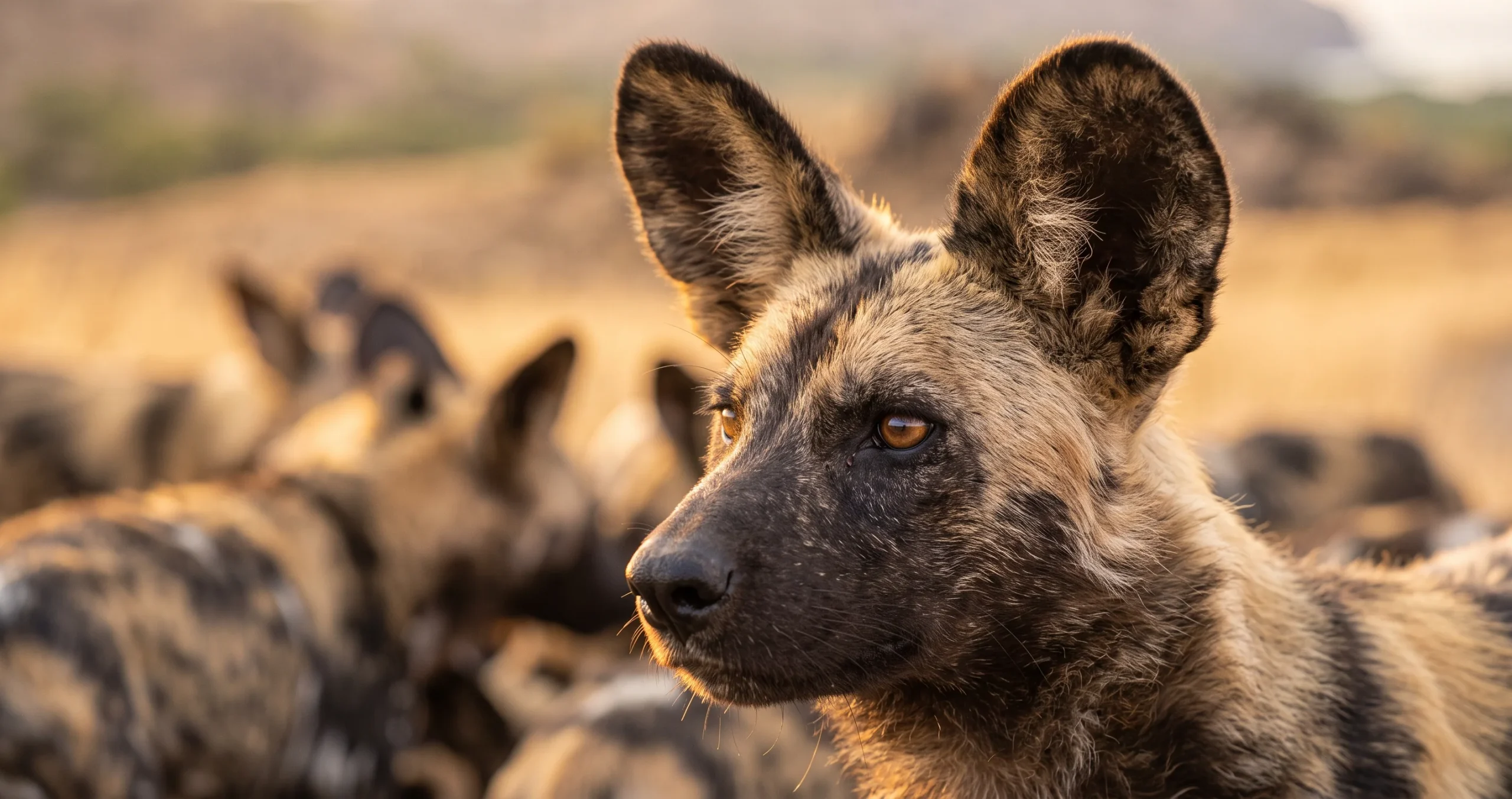
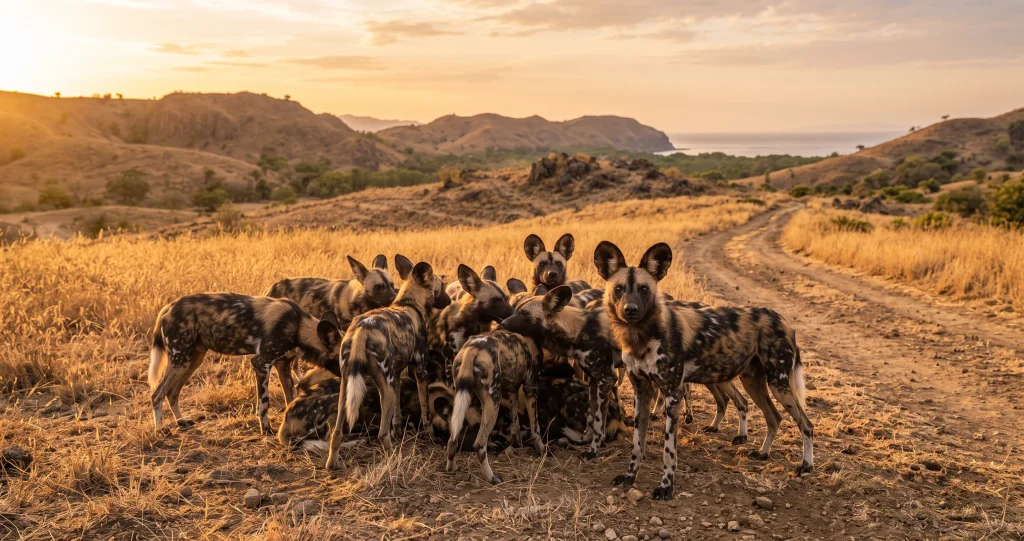
A pack of African wild dogs has been resting in the shade. Suddenly, the animals rise, crowd together, wag their tails, touch noses, and burst into an energetic social ceremony.
Then someone sneezes.
Another dog sneezes.
More sneezes follow.
And if enough accumulate, the entire pack may get up and move.
It sounds almost too strange to be true, but African wild dog sneeze voting is based on documented research. Scientists studying free-ranging packs in Botswana found that the number of rapid nasal exhalations—or “sneezes”—during these social gatherings predicted whether the dogs would leave together afterward.
Calling this behavior “voting” is convenient shorthand. The dogs are not holding a democratic election.
What researchers discovered is arguably more interesting: the sneezes appear to contribute to a quorum-like decision system, and the number required changes depending on which dogs are involved.
Table of Contents
- The Strange Rally Before a Hunt
- The Study Behind African Wild Dog Sneeze Voting
- What Scientists Actually Counted
- Why More Sneezes Can Mean “Let’s Go”
- Dominant Dogs Appear to Have More Influence
- The Pack Can Still Override the Dominant Pair
- Why Group Decisions Matter to Wild Dogs
- How Cooperative Hunting Works
- African Wild Dog Social Structure
- Why African Wild Dogs Are Endangered
- What Conservation Efforts Focus On
- Common Myths
- Frequently Asked Questions
- Conclusion
The Strange Rally Before a Hunt
African wild dogs (Lycaon pictus), also known as African painted dogs, are intensely social canids.
They live in packs and cooperate in activities ranging from hunting to pup care.
After resting, pack members sometimes participate in highly energetic social gatherings called rallies.
Dogs crowd together, greet one another, wag their tails, and become increasingly active.
These rallies often happen before the pack moves off collectively.
But researchers noticed something puzzling.
Not every rally ended with the pack leaving.
Some rallies appeared to build toward departure, while others fizzled out and the dogs returned to resting.
Why?
A surprisingly important clue seemed to be hiding in a sound researchers had previously paid little attention to.
The dogs were sneezing.
The Study Behind African Wild Dog Sneeze Voting
In 2017, researchers Reena H. Walker, Andrew J. King, J. Weldon McNutt, and Neil R. Jordan published a study in Proceedings of the Royal Society B investigating collective decision-making in free-ranging African wild dogs.
The research took place in Botswana’s Okavango Delta.
The scientists recorded 68 social rallies involving five wild dog packs.
They examined multiple aspects of each rally, including which dogs participated, whether dominant individuals were involved, how many sneezes occurred, and whether the pack eventually departed.
A clear relationship emerged.
The more sneezes that occurred during a rally, the greater the probability that the pack would subsequently move off.
The researchers described the sneezes as part of a variable quorum mechanism involved in collective decisions.
The original peer-reviewed study, “Sneeze to leave: African wild dogs use variable quorum thresholds facilitated by sneezes in collective decisions”, provides the full methods and statistical analysis.
The authors cautiously described the behavior as negotiation that works, in effect, like voting.
That wording is important.
The dogs are not consciously copying a human political system.
Instead, individual signals accumulate until the group’s behavior becomes more likely to change.
How African Wild Dog Sneeze Voting Works
Imagine a pack resting after a long period of activity.
Several animals become energetic.
A rally begins.
Dogs gather.
Sneezes occur.
If only a small number of sneezes is recorded, the rally may end without the pack going anywhere.
As the number increases, however, departure becomes increasingly likely.
The researchers interpreted this as evidence of a quorum.
A quorum occurs when a certain amount of signaling or participation must accumulate before a group changes behavior.
Social animals can benefit from systems like this because moving together requires coordination.
One animal running away from a resting site while everyone else remains asleep does not create an effective pack movement.
Enough members need to be ready.
The sneezes appear to provide information about that collective readiness.
Dominant Dogs Appear to Have More Influence
Here is where the story becomes even stranger.
If every sneeze counted identically, we could imagine a simple threshold: perhaps the pack leaves after a particular number of sneezes.
That is not what the researchers found.
The required threshold changed depending on who initiated the rally.
When dominant dogs were involved in initiating the rally, fewer sneezes were needed before departure became likely.
When dominant individuals were not involved, the pack required substantially more sneezing before moving.
Researchers reported that when the dominant male and female were engaged, only a few sneezes could be associated with departure. Without dominant involvement, the threshold was substantially higher—around 10 sneezes in the researchers’ description of the results.
In other words, the signals did not appear to carry equal influence in every social context.
Rank mattered.
The Pack Can Still Override the Dominant Pair
This could sound like the dominant dogs simply make the decision.
But that was not the result either.
Dominant involvement made successful departure more likely at a lower sneeze threshold, but it was not required.
A rally initiated without dominant participation could still succeed.
It simply needed more accumulated sneezes.
That led the researchers to a particularly fascinating interpretation.
A sufficiently strong group consensus could apparently overcome the absence of support from dominant animals.
So African wild dog decision-making seems to contain elements of both hierarchy and collective participation.
Dominant individuals have disproportionate influence.
But other pack members are not necessarily irrelevant.
That is why describing the system simply as either a dictatorship or a democracy misses the interesting biology.
It appears to be a negotiation process shaped by social rank and accumulated signaling.
Why Group Decisions Matter to Wild Dogs
For an African wild dog, leaving a resting site is not a trivial decision.
These animals hunt cooperatively and range across large landscapes.
Once a pack starts moving, its members benefit from remaining coordinated.
Hunting requires energy.
Travel requires energy.
Young animals may be present.
The pack also has to coordinate access to prey and eventually return food to dependent pups or other pack members.
A decision to leave therefore affects multiple animals at once.
Social species repeatedly face this problem.
Should the group rest longer?
Should it move?
Should it search for food?
Which direction should it travel?
If individuals constantly made incompatible choices, the advantages of group living could quickly disappear.
Quorum-like systems offer one way of coordinating behavior without requiring every individual to have identical preferences.
Cooperative Hunting Makes the Pack Powerful
African wild dogs are extraordinary cooperative hunters.
Rather than relying entirely on one large predator overpowering prey, several pack members can pursue and coordinate during hunts.
They often hunt medium-sized antelope, although prey varies with habitat, pack composition, and availability.
Cooperation allows them to pursue animals across considerable distances and exploit opportunities that might be difficult for a solitary hunter.
But cooperation does not stop when the chase ends.
Pack members maintain strong social relationships.
Adults can regurgitate food for pups and other pack members. Cooperative care of young is an important feature of their society.
The pack therefore functions as much more than a temporary hunting team.
Movement, feeding, reproduction, pup care, and survival are deeply connected to group life.
The sneeze behavior makes more sense when viewed within this broader system.
A coordinated predator needs coordinated departures.
African Wild Dog Social Structure
African wild dog packs have social hierarchies, typically centered around a dominant breeding pair.
Reproduction is often concentrated in this pair, although pack structure can vary.
Other adults participate extensively in the functioning of the group.
They hunt.
They help care for pups.
They defend pack members and maintain social relationships through greetings and other interactions.
Young dogs eventually face another important social transition.
Individuals may disperse from their natal packs and form new groups, which is important for reproduction and genetic connectivity among populations.
This makes fragmentation particularly dangerous.
A species whose social and reproductive system depends on packs and dispersal needs enough connected habitat for those behaviors to continue.
For another remarkable example of sophisticated animal communication, see our article on elephant infrasound communication, where elephants use very low-frequency calls to exchange information over long distances.
Why African Wild Dogs Are Endangered
The entertaining idea of sneezing dogs “voting” can easily overshadow a much more serious fact.
African wild dogs are endangered.
The 2025 IUCN Red List assessment classifies Lycaon pictus as Endangered, with the population trend decreasing.
The assessment estimates approximately 1,676 mature individuals and fewer than 700 packs globally.
Wild dogs now persist in only a small fraction of their historical range.
Habitat loss and fragmentation are central problems.
Wild dogs naturally occur at low densities and range across enormous areas. Even large protected areas may therefore struggle to contain a fully viable population.
When landscapes become divided by farms, settlements, roads, and other development, dogs moving between suitable habitats encounter additional dangers.
Roads, Snares, Conflict, and Disease
Habitat fragmentation creates more than a simple shortage of land.
It exposes wild dogs to other threats.
Roads can kill traveling animals.
Snares set for other wildlife can accidentally trap and seriously injure wild dogs.
Where wild dogs encounter livestock, conflict with farmers and ranchers can result in deliberate killing.
Disease is another major concern.
Rabies and canine distemper can cause severe mortality, and domestic dogs can contribute to disease transmission in some landscapes.
For a highly social species, disease outbreaks can be devastating because multiple members of a pack interact closely.
The current IUCN assessment also highlights the interaction between disease and fragmentation.
Historically, long-distance dispersal could help wild dogs recolonize areas after local populations disappeared. Fragmented landscapes make that recovery process more difficult.
Climate change adds another growing pressure, with high temperatures potentially affecting hunting opportunities, survival, and reproduction.
What Conservation Efforts Focus On
Protecting African wild dogs requires thinking at landscape scale.
A small isolated reserve may not be enough for animals that naturally travel across huge areas.
Conservation therefore focuses heavily on maintaining large wildlife-friendly landscapes and connectivity between populations.
Transfrontier conservation areas are especially important because wild dogs do not recognize national borders.
Anti-snaring programs are another priority.
Removing snares, reducing illegal hunting, supporting alternative livelihoods, and treating injured animals can all reduce mortality.
Disease management may include surveillance and, where appropriate, vaccination strategies involving domestic dogs in surrounding communities.
Conflict mitigation is equally important.
Long-term conservation depends on finding ways for people, livestock, and large carnivores to coexist across landscapes that are not exclusively protected wilderness.
Genetic connectivity matters too.
Isolated packs can lose the natural movement of individuals between populations, increasing conservation challenges.
In some fragmented systems, carefully planned translocations and reintroductions can help restore populations or connectivity.
There is no single solution.
Saving African wild dogs requires habitat protection, connectivity, disease management, anti-snaring work, monitoring, community participation, and international cooperation.
Common Myths About African Wild Dog Sneeze Voting
Myth 1: Wild Dogs Hold Democratic Elections
“Voting” is a metaphor.
The study found that accumulated sneezes predicted the probability of departure and behaved like a variable quorum system.
Researchers did not demonstrate that wild dogs understand voting as humans do.
Myth 2: Every Sneeze Counts Equally
The evidence suggests otherwise.
The sneeze threshold was lower when dominant individuals initiated rallies, indicating that social status influenced the decision process.
Myth 3: The Dominant Pair Always Decides
Also incorrect.
Dominant participation increased the probability of departure at lower sneeze numbers, but rallies could succeed without dominant involvement if enough sneezes accumulated.
Myth 4: Every Sneeze Means “Let’s Hunt”
Researchers studied sneezes occurring within specific social rallies.
A sneeze outside that behavioral context should not automatically be interpreted as a vote to hunt.
Myth 5: The Study Proved Every African Wild Dog Pack Uses Exactly the Same Threshold
The original research involved 68 rallies across five free-ranging packs in Botswana.
It provides strong evidence for the behavior in those studied animals, but it should not be transformed into a claim that every pack everywhere follows one identical numerical rule.
Frequently Asked Questions
Do African wild dogs really vote by sneezing?
In a functional sense, something resembling voting appears to occur.
Researchers found that sneezes accumulated during social rallies and that more sneezes increased the probability of the pack departing afterward. The authors described the process as negotiation that works “in effect” like voting.
What is African wild dog sneeze voting?
African wild dog sneeze voting refers to a quorum-like signaling process observed during pre-departure social rallies.
The number of sneezes helps predict whether the pack will collectively move off.
How many sneezes does it take before the pack moves?
There is not one universal number.
The threshold changed according to social context. When dominant dogs initiated rallies, fewer sneezes were required; without their involvement, researchers reported a substantially higher threshold.
Does the alpha dog’s sneeze count more?
It is more accurate to say dominant participation changes the quorum threshold.
The study did not simply assign a numerical value to each individual sneeze.
Why do African wild dogs rally?
Rallies are energetic social greeting ceremonies associated with collective movement.
They often occur after resting and before the pack moves away together.
Are African wild dogs endangered?
Yes.
The 2025 IUCN Red List assessment classifies the African wild dog as Endangered and reports a decreasing population trend.
What is the biggest threat to African wild dogs?
Habitat loss and fragmentation are overarching threats because wild dogs require exceptionally large areas.
They also face snares, road mortality, conflict with people, prey loss, infectious disease, and increasing climate-related pressures.
Are African wild dogs the same as domestic dogs?
No.
The African wild dog, Lycaon pictus, is a distinct wild canid species. It is not a feral breed of domestic dog.
Conclusion
A sneeze seems like one of the least meaningful sounds an animal could make.
Inside an African wild dog rally, it may carry much more information.
Researchers studying free-ranging packs in Botswana discovered that the probability of a group departure increased as sneezes accumulated.
But African wild dog sneeze voting is not simply “one dog, one vote.”
Dominant participation appears to lower the quorum needed for departure, giving high-ranking animals greater influence. Yet dominant approval is not essential: enough accumulated signaling from the group can still be associated with a successful departure.
That combination makes the behavior especially fascinating.
African wild dogs live in a society where hierarchy and cooperation operate simultaneously.
They hunt together.
They care for pups together.
They move across enormous landscapes together.
And before some of those collective movements begin, they appear to negotiate through a sound once dismissed as little more than clearing their noses.
Unfortunately, the species performing this remarkable behavior is disappearing.
Habitat fragmentation, snares, roads, disease, human-wildlife conflict, prey loss, and climate pressures continue to threaten remaining populations.
Understanding how African wild dogs communicate is therefore more than an entertaining glimpse into animal behavior.
It is another reminder of the complex social world conservationists are trying to preserve.
External Sources :