
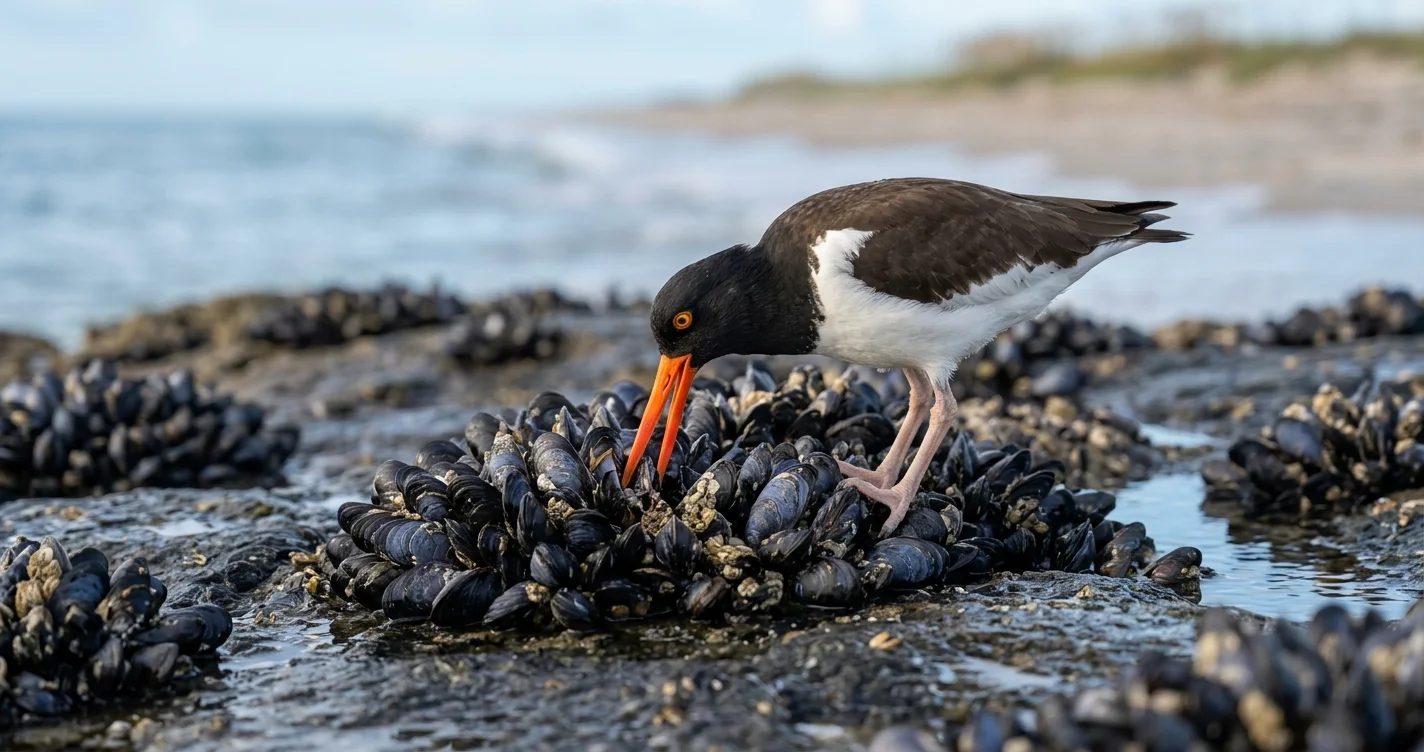
A bird walks across a muddy shoreline, stops beside a tightly closed oyster, and lowers its bright orange-red bill toward the shell. Moments later, it may slip that bill into a tiny opening and reach the soft animal hidden inside.
There is no hammer, no rock, and no powerful crushing jaw involved. Instead, the bird relies on timing, precision, and a specialized bill.
Meet the american oystercatcher bird (Haematopus palliatus), one of North America’s most recognizable coastal shorebirds. With its black head, brown back, white belly, pink legs, and striking yellow eyes surrounded by red orbital rings, it looks as unusual as its feeding behavior.
American Oystercatchers specialize in eating marine invertebrates, particularly bivalve mollusks such as oysters, mussels, and clams. Their ability to exploit shellfish that many other birds cannot easily open makes them fascinating examples of adaptation.
But their lives involve much more than clever feeding. These birds depend on healthy coastal habitats, carefully chosen nesting sites, and shorelines where human activity can sometimes create serious challenges.
Table of Contents
- What Is the American Oystercatcher?
- How to Identify an American Oystercatcher
- American Oystercatcher Bird: How It Opens Shellfish
- Why Its Bill Is So Specialized
- What American Oystercatchers Eat
- Where American Oystercatchers Live
- Courtship, Nesting, and Raising Chicks
- Migration and Seasonal Movements
- Threats Facing American Oystercatchers
- Why These Birds Matter to Coastal Ecosystems
- In Your Own Yard: Helping Coastal Wildlife
- Frequently Asked Questions
What Is the American Oystercatcher?
The American Oystercatcher is a large, sturdy shorebird belonging to the family Haematopodidae.
Its scientific name is Haematopus palliatus. The species occurs along coastal areas of the Americas, including the Atlantic and Gulf coasts of the United States.
Unlike many small sandpipers that race along the water’s edge probing for tiny prey, American Oystercatchers often move deliberately across exposed shellfish beds and tidal flats.
They are especially associated with coastal environments where mollusks are abundant.
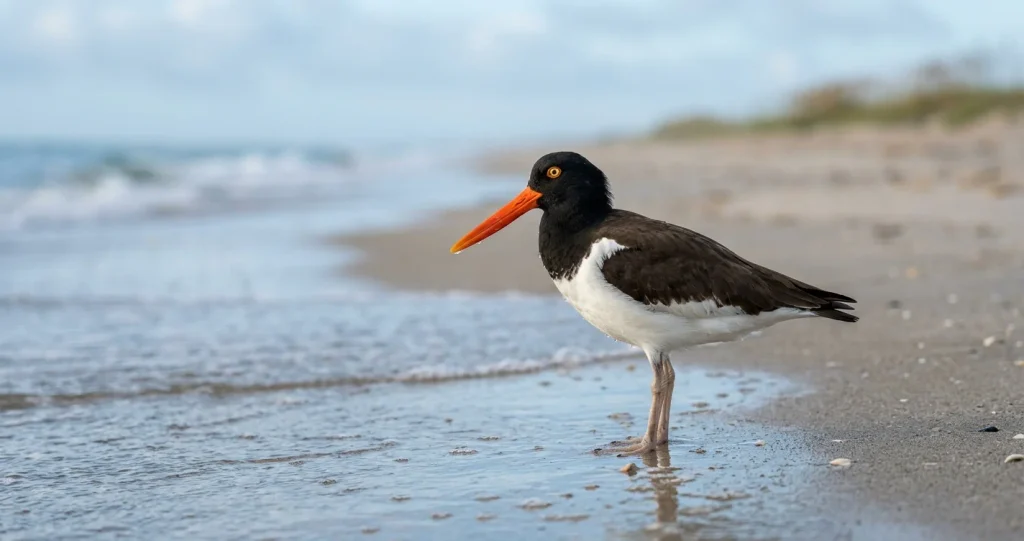
A bird built for the shoreline
American Oystercatchers have relatively long, sturdy legs that allow them to walk through shallow water and across uneven coastal surfaces.
Their long bills help them investigate shellfish and other invertebrates.
Their strong bodies and broad wings support flights between feeding areas, nesting sites, and seasonal habitats.
They are often encountered in pairs or small groups, although larger gatherings may occur outside the breeding season.
Why the name fits
The name oystercatcher refers to the bird’s ability to feed on oysters and other shellfish.
However, the name does not mean that every meal consists of oysters.
Depending on habitat and prey availability, American Oystercatchers may eat mussels, clams, marine worms, and other coastal invertebrates.
Their diet varies geographically and seasonally.
How to Identify an American Oystercatcher
Few North American shorebirds have such a distinctive combination of colors.
Black head and brown upperparts
Adult American Oystercatchers have a dark head and neck that contrast with their brown back and wings.
Their underside is largely white.
In flight, white wing markings become especially noticeable.
These contrasting colors can help birdwatchers identify the species even from a distance.
A bright orange-red bill
The bill is the bird’s most recognizable feature.
It is long, straight, and conspicuously orange-red.
The shape is particularly well suited to handling shellfish, although the precise form of the bill tip can vary with wear and feeding behavior.
Yellow eyes and pink legs
American Oystercatchers have yellow eyes surrounded by reddish orbital rings.
Their legs are pale pink to flesh-colored.
This combination makes adults easy to distinguish from many other coastal birds.
Loud, distinctive calls
These shorebirds are often heard before they are seen.
Their calls are loud, sharp, and piping.
During territorial encounters and courtship displays, birds may produce repeated vocalizations while moving together.
These sounds are a familiar part of the atmosphere on many Atlantic Coast beaches and marshes.
American Oystercatcher Bird: How It Opens Shellfish
The American Oystercatcher’s most extraordinary adaptation is its ability to feed on animals protected by hard shells.
Oysters and mussels present a difficult problem for predators.
Their two shells are joined by a hinge and held closed by powerful adductor muscles.
For many animals, reaching the soft tissues inside requires considerable force or specialized feeding equipment.
The American Oystercatcher often solves this challenge through precise handling rather than brute strength.
Step 1: Searching exposed shellfish beds
American Oystercatchers frequently forage during low tide, when oysters, mussels, and other marine invertebrates become accessible.
They walk across tidal flats, oyster reefs, and similar habitats, examining potential prey.
Some shellfish remain tightly closed, while others may open their valves slightly under suitable conditions.
A bird’s success can depend on recognizing opportunities to insert its bill.
Step 2: Finding an opening
A bivalve shell has two valves connected by a hinge.
When a live oyster or mussel opens slightly, the oystercatcher may attempt to slip its bill between the valves.
The timing matters.
If the shell closes before the bird gains access, the opportunity may disappear.
The bird’s bill is narrow enough to enter certain openings while remaining strong enough for controlled manipulation.
Step 3: Inserting the bill
Once the bird finds a suitable gap, it can insert the tip of its bill between the shells.
This requires accurate positioning.
The oystercatcher is not simply trying to smash the shell apart.
Instead, it uses the bill to reach the tissues that help keep the valves closed.
The exact technique varies with the prey species and the individual bird.
Step 4: Disabling the closing muscle
Oysters and other bivalves use adductor muscles to hold their shells together.
When an oystercatcher successfully reaches and damages the muscle responsible for closure, the shell may no longer remain tightly shut.
This allows the bird to access the soft tissues.
The technique is particularly associated with feeding on accessible, slightly open bivalves.
Not every attempt succeeds.
Shell size, shell position, prey behavior, and the bird’s experience can influence the outcome.
Step 5: Extracting the edible tissues
After gaining access, the oystercatcher uses its bill to remove the soft animal from the shell.
The bird may adjust its position and manipulate the prey repeatedly.
Handling time can vary depending on the shellfish species and the difficulty of opening it.
Step 6: Using alternative techniques
Not all oystercatchers feed in exactly the same way.
Some individuals use hammering or stabbing movements when handling particular types of bivalves.
Oystercatchers can also probe into sediment for buried prey.
Different techniques may be associated with prey availability, local habitat, experience, and individual specialization.
It is therefore misleading to describe shell-opening behavior as a single rigid sequence followed by every bird.
Why experience matters
Opening shellfish is a demanding skill.
Young oystercatchers may require time to become proficient at handling difficult prey.
As they develop, they can improve their ability to locate, manipulate, and consume suitable shellfish.
Research on oystercatchers has shown that feeding methods and bill characteristics can be linked to differences in prey handling.
However, findings from other oystercatcher species should not automatically be treated as identical to the American Oystercatcher.
Why Its Bill Is So Specialized
The American Oystercatcher’s bill is not designed like the beak of a seed-eating finch or a fish-catching heron.
Its shape reflects the demands of coastal foraging.
A long, straight tool
The bill allows the bird to reach into narrow spaces and manipulate prey close to the ground.
Its length is useful for investigating shellfish beds and probing suitable substrates.
The tip can experience wear from repeated contact with hard shells.
Precision instead of crushing power
Oystercatchers generally do not depend on crushing thick oyster shells with their jaws.
Their feeding strategy often involves finding access points and exploiting the anatomy of the prey.
This makes the bill an instrument of precision.
Bill wear and feeding behavior
The tips of oystercatcher bills can change through use.
Feeding on hard-shelled prey may produce different wear patterns from probing into softer sediment.
Studies of oystercatchers have examined relationships between bill shape, feeding methods, and individual behavior.
These patterns can vary by species and population.
The importance of suitable prey
Even a highly specialized bill cannot overcome every shell.
Very large, deeply embedded, or tightly closed shellfish may be difficult to exploit.
Oystercatchers often benefit from access to prey of manageable sizes and favorable positions.
Healthy, productive intertidal habitats are therefore essential to their feeding success.
What American Oystercatchers Eat
Although oysters are an important food source, the American Oystercatcher has a broader diet.
Oysters and mussels
These bivalves are among the prey most closely associated with the species.
Exposed shellfish beds can provide concentrated feeding opportunities.
Oystercatchers may revisit productive areas as tidal conditions change.
Clams
Clams are another potential food source.
Some species live buried in sand or mud, requiring different searching and handling techniques.
Prey availability depends on local conditions.
Marine worms
American Oystercatchers may also consume marine worms found in intertidal sediments.
These softer-bodied animals can be easier to handle than heavily armored shellfish.
Other invertebrates
Additional prey may include crustaceans and other small marine animals.
Diet composition varies with location, season, and habitat.
The species is best understood as a specialized coastal predator with some flexibility in prey selection.
Where American Oystercatchers Live
American Oystercatchers are strongly associated with coastal environments.
In the United States, they occur along the Atlantic and Gulf coasts, with seasonal distribution varying by region.
Sandy beaches
Open beaches can provide nesting habitat, particularly where disturbance is limited.
Oystercatchers often choose relatively exposed sites with good visibility.
However, beaches also attract people, vehicles, and pets, creating potential conflicts during the nesting season.
Oyster reefs
Oyster reefs are valuable feeding habitats.
Their complex surfaces support oysters and other marine organisms.
At suitable tides, oystercatchers can search these areas for accessible prey.
Salt marshes
Salt marshes provide feeding and nesting opportunities in some coastal regions.
Marsh edges, shell deposits, and nearby tidal flats may be particularly important.
Barrier islands
Barrier islands offer a combination of beaches, tidal flats, marshes, and shellfish habitats.
These dynamic coastal landscapes can support breeding and wintering birds.
Their suitability changes with storms, erosion, vegetation, and human activity.
Courtship, Nesting, and Raising Chicks
American Oystercatchers nest on the ground.
This makes their reproductive strategy both fascinating and vulnerable.
Pair bonds and territorial behavior
Breeding pairs defend nesting territories and suitable feeding areas.
Courtship may include vocal displays and coordinated movements.
Pairs can remain associated across breeding seasons, although individual circumstances vary.
A simple nest on the ground
The nest is usually a shallow scrape in sand, shell, or another suitable substrate.
It may contain small shell fragments or pebbles.
Unlike many songbirds, oystercatchers do not build elaborate elevated nests.
Their eggs are placed directly in a landscape where camouflage is important.
Camouflaged eggs
Eggs are generally buff-colored with darker markings.
This coloration helps them blend into sand, shell fragments, and other coastal materials.
A typical clutch often contains two or three eggs, although clutch size varies.
Chicks that move soon after hatching
American Oystercatcher chicks are precocial, meaning they hatch relatively well developed and can move around soon afterward.
However, they still depend heavily on their parents.
Adults provide protection and bring food to the young.
This parental care is particularly important because the chicks cannot immediately handle difficult shellfish on their own.
A vulnerable nesting period
Eggs and chicks are exposed to weather, predators, flooding, and human disturbance.
Repeated interruptions can reduce the time adults spend incubating or caring for young.
In heavily visited coastal areas, protective fencing and seasonal access restrictions may help improve nesting success.
Migration and Seasonal Movements
American Oystercatchers show a mixture of migratory and resident behavior.
Northern breeding populations
Birds breeding in more northern parts of the Atlantic Coast generally move southward as winter approaches.
Wintering areas include warmer coastal regions where food remains accessible.
Southern populations
Some birds in southern coastal regions may remain in the same general area throughout the year.
Movements can still occur in response to changing food availability and environmental conditions.
Winter gatherings
Outside the breeding season, American Oystercatchers may gather in flocks at suitable feeding and roosting sites.
These locations can be important for birds from multiple breeding areas.
Protecting winter habitats is therefore an important part of conservation.
Threats Facing American Oystercatchers
American Oystercatchers depend on coastal habitats that are constantly changing.
Natural processes shape these environments, but human activities can add pressure.
Coastal development
Development can reduce or fragment suitable nesting and feeding habitat.
Shoreline modifications may change sediment movement and the availability of natural coastal features.
Human disturbance
Beach recreation can disturb nesting birds.
People walking too close to nests may cause adults to leave temporarily.
Repeated disturbance can expose eggs or chicks to heat, cold, and predators.
Pets and vehicles
Unleashed dogs can disturb or chase shorebirds.
Vehicles operating in nesting areas may damage nests or threaten chicks.
Seasonal restrictions and responsible beach use can reduce these risks.
Predation
Eggs and chicks are vulnerable to several predators, including certain mammals and birds.
Predation pressure varies among nesting sites.
Human activities can sometimes influence predator abundance or behavior.
Storms and rising seas
Storm surges and unusually high tides can flood nests.
Sea-level rise may reduce suitable nesting habitat in some coastal regions, especially where shorelines cannot migrate inland.
The consequences depend on local geography and habitat management.
Changes in shellfish habitat
Oyster reef degradation and other changes to intertidal ecosystems can affect food availability.
Restoration of suitable coastal habitats may benefit oystercatchers alongside many other species.
Why These Birds Matter to Coastal Ecosystems
American Oystercatchers are part of the complex food webs of coastal environments.
Predators of marine invertebrates
By consuming shellfish and other invertebrates, they participate in the transfer of energy through coastal ecosystems.
Their feeding relationships connect tidal flats, oyster reefs, and higher levels of the food web.
Indicators of coastal habitat conditions
Because oystercatchers rely on specific nesting and feeding habitats, their population trends can provide useful information about coastal conservation challenges.
However, no single bird species can fully represent the condition of an entire ecosystem.
Connections to oyster reef conservation
Oyster reefs support diverse marine communities and provide valuable ecological functions.
Protecting these habitats can benefit numerous organisms, including shellfish-feeding birds.
Conservation strategies should consider the broader ecosystem rather than focusing on a single species.
In Your Own Yard: Helping Coastal Wildlife
Most American Oystercatchers will never visit an ordinary inland backyard.
However, people who live near beaches, tidal marshes, or coastal waterways can still make a meaningful difference.
Respect seasonal nesting areas
Observe posted signs and temporary fencing around nesting habitat.
These protections help reduce disturbance to eggs and chicks.
Keep dogs under control
Follow local leash requirements near shorebird habitat.
Even a friendly dog can frighten nesting birds or cause them to abandon a feeding area temporarily.
Watch birds from a distance
Use binoculars or a camera with a telephoto lens.
If a bird repeatedly calls, moves away, or changes its behavior because of your presence, increase your distance.
Support healthy coastal habitats
Participate in reputable beach cleanups or habitat restoration projects.
Avoid trampling sensitive dunes, marsh vegetation, and shellfish habitats.
Reduce litter and fishing-line hazards
Discarded fishing line and other debris can entangle wildlife.
Dispose of these materials in appropriate collection containers.
Report marked birds responsibly
Some American Oystercatchers carry identification bands used by researchers.
If you can read a band without disturbing the bird, report the observation through the relevant banding program.
Such records can help researchers understand movements and survival.
Frequently Asked Questions
1. Can American Oystercatchers really open live oysters?
Yes. American Oystercatchers can feed on live oysters and other bivalves. They often exploit small openings between shell valves and use their bills to reach tissues involved in keeping the shell closed. Their success depends on prey size, position, behavior, and the bird’s handling ability.
2. Do American Oystercatchers eat only oysters?
No. Their diet can include mussels, clams, marine worms, and other coastal invertebrates. The relative importance of different prey varies among locations and seasons.
3. Are American Oystercatchers endangered?
The American Oystercatcher is not currently classified as globally endangered by the IUCN. However, some regional populations face significant conservation challenges, including habitat loss, disturbance, predation, and flooding. Conservation priorities differ across its range.
Conclusion
Return to that quiet tidal flat where an orange-billed shorebird stands beside a closed oyster.
What first appears to be an impossible meal becomes manageable through specialized anatomy, careful timing, and practiced movements.
The american oystercatcher bird demonstrates how evolution can shape an animal around a challenging food source.
Its long bill is more than a colorful feature. It is a precise tool for reaching prey protected by hard shells.
Yet this remarkable feeding strategy depends on healthy shorelines, productive shellfish habitats, and safe places to raise young.
Protecting those environments helps preserve not only a distinctive coastal bird but also the complex ecosystems that make its unusual way of life possible.
The next time you see an American Oystercatcher walking across an exposed oyster bed, its bright bill may tell you something extraordinary about the hidden world beneath the shells.
External Sources
- American Oystercatcher — Life History: Explain how American Oystercatchers use their specialized orange-red bills to open oysters, mussels, and other shellfish. Supports the article’s sections on feeding techniques, diet, and habitat. Cornell Lab of Ornithology — All About Birds. https://www.allaboutbirds.org/guide/American_Oystercatcher/lifehistory
- American Oystercatcher: Provide reliable information about the bird’s identification, shellfish-feeding behavior, breeding habits, nesting sites, and coastal distribution. Supports the sections on behavior and reproduction. National Audubon Society — Field Guide. https://www.audubon.org/field-guide/bird/american-oystercatcher
- American Oystercatcher: Explain the bird’s physical adaptations, including its long bill, and how these characteristics help it obtain food in coastal environments. Supports the sections on anatomy, diet, and ecological adaptations. Smithsonian’s National Zoo & Conservation Biology Institute https://nationalzoo.si.edu/animals/american-oystercatcher