
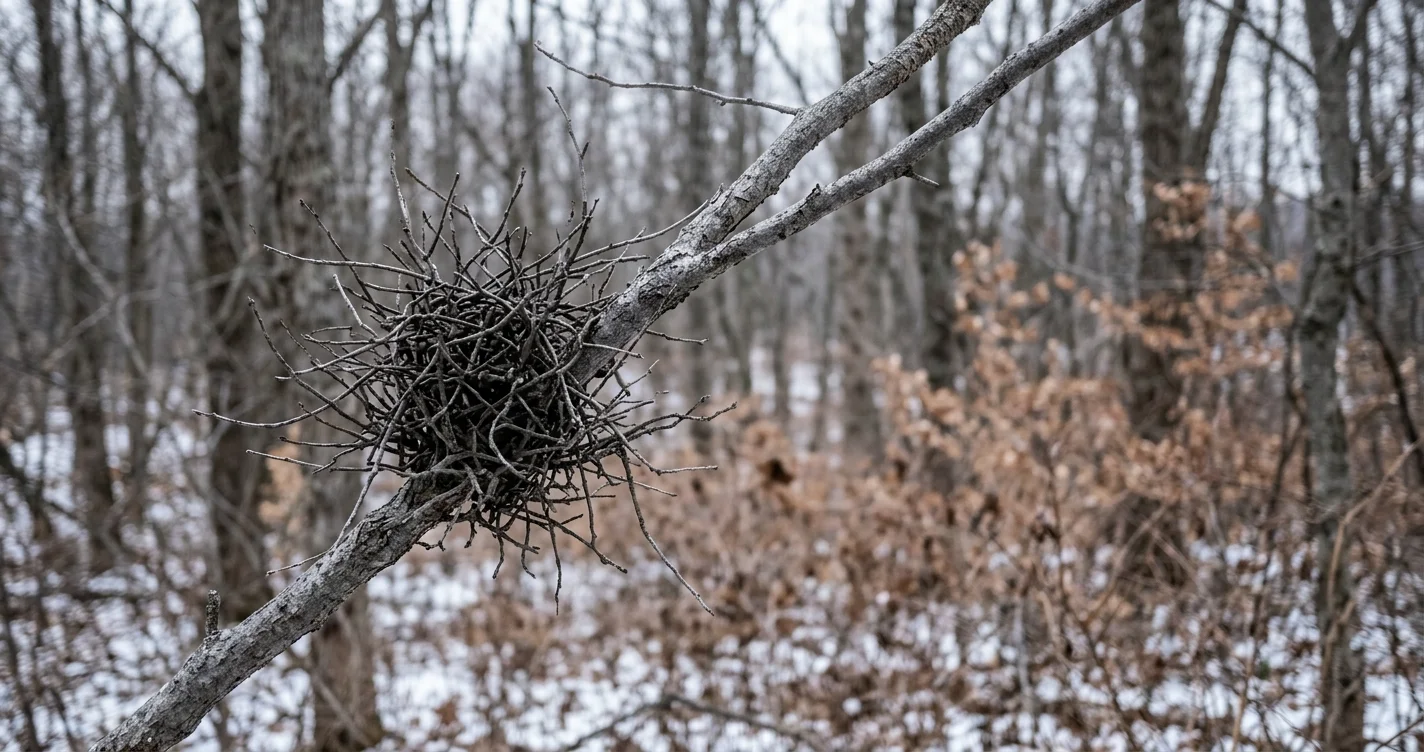
Imagine walking through a quiet woodland in late autumn when most of the leaves have fallen. High in the branches of an otherwise ordinary tree, you notice something strange: a dense, tangled ball of twigs, almost as though someone tucked an enormous bird’s nest into the canopy.
But it isn’t necessarily a nest.
It may be a witches broom tree growth, a remarkable plant abnormality that can develop when fungi, insects, mites, bacteria, or other factors interfere with the way branches grow.
Known as witches’ broom, this unusual formation has fascinated gardeners and naturalists for generations. Some brooms indicate an active disease, while others result from genetic changes or environmental stress. A few even become valuable sources of unusual ornamental plants.
Understanding the cause can help you decide whether a tree needs attention or whether the strange cluster can simply be left alone.
Table of Contents
- What Is Witches’ Broom?
- How to Recognize Witches’ Broom on Trees
- Witches Broom Tree: What Causes the Abnormal Growth?
- How Witches’ Broom Develops
- Which Trees Are Commonly Affected?
- Is Witches’ Broom Harmful to Trees?
- Witches’ Broom Versus Bird Nests and Mistletoe
- How to Manage Witches’ Broom
- When Pruning Is Necessary
- Why Some Witches’ Brooms Become Ornamental Plants
- In Your Own Yard: A Practical Inspection Guide
- Frequently Asked Questions
What Is Witches’ Broom?
Witches’ broom is a descriptive name for an abnormal concentration of shoots or twigs growing from a relatively small area of a plant.
Instead of forming a normal branching pattern, the affected section produces numerous closely spaced shoots. These may create a rounded, bushy, or broom-shaped cluster.
The appearance can vary dramatically.
Some formations resemble compact balls of twigs. Others look like tangled bundles of thin branches or unusually dense tufts of foliage.
Why the name sounds mysterious
The traditional name comes from the resemblance between certain twig clusters and old-fashioned brooms made from bundled branches.
Before plant diseases and growth abnormalities were well understood, these unusual structures attracted folklore and speculation.
Today, botanists and plant pathologists recognize witches’ broom as a growth symptom rather than a single disease.
The same general appearance can result from several unrelated causes.
Not every witches’ broom is the same
A witches’ broom on a conifer may have a completely different origin from one on a hardwood tree.
For example, some conifer brooms develop in association with rust fungi, while certain deciduous-tree brooms are linked to fungi, phytoplasmas, or insect activity.
Others arise through spontaneous changes in plant growth.
This distinction matters because the appropriate response depends on the underlying cause.
How to Recognize Witches’ Broom on Trees
Witches’ broom is often most noticeable during winter, when deciduous trees have lost their leaves.
Without foliage hiding the branches, dense clusters stand out against the sky.
Unusually crowded branches
The most recognizable sign is a concentrated mass of small branches emerging from a limited area.
The twigs may be shorter, thinner, or more numerous than those on the surrounding tree.
The cluster often has a noticeably different growth pattern from the rest of the canopy.
A rounded or broom-shaped outline
Some brooms form nearly spherical masses.
Others spread outward like a fan or resemble a loose bundle of sticks.
Their shape depends on the host tree, the cause, and how long the abnormal growth has been developing.
Differences in leaf growth
During the growing season, affected shoots may produce leaves that are smaller, distorted, crowded, or differently colored.
In some cases, the foliage appears earlier or later than leaves on unaffected branches.
However, these symptoms are not universal.
Certain genetic brooms can produce foliage that looks relatively normal apart from its compact arrangement.
Changes over several seasons
Some witches’ brooms remain small for years.
Others gradually expand or appear in multiple locations.
A sudden increase in abnormal growth, particularly when accompanied by branch dieback or other symptoms, deserves closer attention.
Witches Broom Tree: What Causes the Abnormal Growth?
The central mystery of witches’ broom lies in how normal branch development becomes disrupted.
Trees produce new shoots from growing points called meristems. Their branching patterns are regulated by genetic instructions, plant hormones, environmental conditions, and interactions with other organisms.
When those regulatory systems are altered, many shoots may develop where only a few would normally grow.
Several biological processes can produce this effect.
1. Fungal infections
Certain fungi can cause witches’ broom by altering the growth of infected plant tissues.
One well-known example involves fungi in the genus Taphrina.
Some Taphrina species cause abnormal shoot proliferation on particular hardwood hosts.
The infected branches may produce dense clusters that differ in growth and appearance from healthy branches.
The fungus-host relationship is specific. A fungus affecting one tree species should not automatically be assumed to infect another.
Rust fungi on conifers
Some conifer witches’ brooms are associated with rust fungi.
For example, certain rust diseases of firs can produce conspicuous clusters of abnormal branches.
Depending on the pathogen, the broom may show changes in needle color, branch density, and seasonal appearance.
Some rust fungi require more than one host species to complete their life cycles.
Identifying the pathogen may therefore require examining both the affected tree and the surrounding vegetation.
2. Phytoplasma infections
Phytoplasmas are specialized bacteria that live in plant tissues, particularly the phloem.
They are associated with several plant diseases that cause excessive shoot production.
Phytoplasmas can interfere with normal plant development, sometimes producing symptoms such as witches’ broom, shortened internodes, and abnormal branching.
These pathogens are often transmitted by sap-feeding insects.
However, not every witches’ broom is caused by a phytoplasma, and a visual inspection alone usually cannot confirm one.
Laboratory testing may be necessary for reliable identification.
3. Mites and other arthropods
Certain mites and insects can stimulate abnormal plant growth.
Their feeding activity may affect developing buds or plant tissues, sometimes resulting in unusual shoot clusters.
Some gall-forming organisms produce structures that resemble witches’ brooms.
The exact mechanism depends on the species involved.
In many cases, careful examination of buds, leaves, or affected twigs is needed to identify the responsible organism.
4. Genetic mutations
Not every witches’ broom is associated with an infection or pest.
Some develop because of spontaneous changes in the genetic regulation of shoot growth.
These brooms may produce unusually compact branching patterns without an active disease process.
Such growth forms can be especially interesting to horticulturists.
If a stable mutation can be propagated successfully, it may produce a dwarf or compact ornamental cultivar.
5. Environmental stress and injury
Physical damage, chemical injury, or environmental stress can sometimes stimulate abnormal shoot development.
When the normal growing tip is damaged, dormant buds may begin growing.
This can produce clusters of shoots that resemble witches’ broom.
However, vigorous sprouting after pruning or injury is not necessarily a true witches’ broom.
The distinction depends on the growth pattern and underlying cause.
How growth regulation becomes disrupted
Normal branching is influenced by plant hormones, including auxins and cytokinins.
Auxin produced near growing shoot tips helps regulate the activity of lateral buds, while cytokinins are involved in promoting cell division and shoot development.
Other hormones and signaling pathways also contribute.
Some pathogens can alter these systems, causing unusual shoot proliferation.
The exact molecular mechanisms differ among diseases, and researchers continue to investigate how particular organisms manipulate plant growth.
The visible broom is therefore the final result of changes occurring within the tree’s growth-regulation system.
How Witches’ Broom Develops
Although causes vary, many witches’ brooms follow a recognizable progression.
Stage 1: Normal branch development changes
A growing point, bud, or small section of tissue begins behaving differently.
This may follow infection, mutation, or another disturbance.
Instead of producing a normal branching arrangement, the affected region develops additional shoots.
Stage 2: Multiple buds begin growing
New shoots emerge close together.
The spacing between nodes may be reduced, or unusually large numbers of buds may become active.
The resulting growth appears denser than the surrounding branches.
Stage 3: A compact cluster forms
As the shoots continue developing, they create a visible tuft or tangled mass.
Some shoots may remain short, while others extend outward.
The cluster becomes increasingly noticeable as it contrasts with the tree’s normal structure.
Stage 4: The broom persists or changes
Depending on the cause, the broom may survive for several years, enlarge, decline, or die.
Some pathogen-associated brooms produce repeated abnormal growth.
Others remain relatively stable.
The development of a witches’ broom is therefore not identical across all trees.
Which Trees Are Commonly Affected?
Witches’ broom has been documented on numerous tree and shrub species.
Its appearance and significance vary with the host.
Birch trees
Birches can develop dense clusters of abnormal twigs associated with certain fungal infections, including species of Taphrina.
The brooms may become especially visible after leaf fall.
Some infected shoots show altered leaf development or premature decline.
Fir trees
Several fir species can develop witches’ brooms associated with rust fungi.
These may form conspicuous clusters of short branches.
The needles on affected growth can differ in appearance from those on healthy branches.
Spruce trees
Spruces sometimes produce witches’ brooms associated with genetic changes or particular disease processes.
Compact, mutation-derived brooms have attracted attention from ornamental plant growers.
Not every dense branch cluster on spruce indicates a contagious disease.
Pine trees
Pines can develop unusual compact branching patterns from various causes, including genetic abnormalities and certain diseases.
Some dwarf ornamental pines have originated from selected witches’ broom growth.
Other hardwoods
Witches’ broom-like symptoms occur on a variety of hardwoods, including some willows, cherries, and other broadleaf species.
Because the potential causes differ, host identification is essential before making a diagnosis.
Is Witches’ Broom Harmful to Trees?
A witches’ broom is not automatically a sign that a tree is dying.
Its significance depends on the cause, extent, and condition of the host.
When the effect is mostly cosmetic
A small, stable broom on an otherwise healthy tree may cause little noticeable harm.
This is particularly true when the abnormal growth results from a noninfectious mutation.
In such cases, removal may be unnecessary.
When disease is involved
Some pathogen-associated brooms can weaken branches or contribute to localized dieback.
Severe infections may reduce growth or affect the tree’s overall health.
The consequences depend on the specific pathogen and host.
A few scattered brooms do not necessarily indicate serious damage, but widespread symptoms warrant investigation.
When structural concerns arise
Large, dense clusters may add weight to individual branches.
If the affected branch is already weak, damaged, or positioned over a frequently used area, a structural assessment may be appropriate.
The broom itself is not necessarily the main hazard.
Branch condition, attachment strength, decay, and overall tree structure matter more.
When professional evaluation helps
Consider consulting a certified arborist or local Cooperative Extension service when abnormal growth appears alongside significant dieback, cankers, extensive discoloration, or other signs of decline.
A professional can help distinguish a harmless growth abnormality from a disease requiring management.
Witches’ Broom Versus Bird Nests and Mistletoe
Dense masses in tree branches are not always witches’ brooms.
Several other structures can look similar from the ground.
Bird nests
Bird nests are built from materials such as twigs, grasses, leaves, and fibers.
They are separate structures resting among branches.
A witches’ broom, by contrast, consists of abnormal shoots growing directly from the tree.
During winter, the difference may be visible with binoculars.
Mistletoe
Mistletoe is a parasitic flowering plant that grows attached to host trees.
Some mistletoes form rounded green masses that resemble dense twig clusters.
However, mistletoe has its own stems and leaves, and it obtains resources through specialized attachments to the host.
A true witches’ broom is formed from the host tree’s own shoots.
Squirrel dreys
Tree squirrels build nests called dreys, often using leaves and twigs.
These structures may appear as compact balls in tree canopies.
Unlike witches’ brooms, dreys are assembled from collected materials rather than produced by abnormal branch growth.
Epicormic shoots
Trees sometimes produce clusters of shoots from dormant buds along trunks or branches.
These are known as epicormic shoots.
They may develop after pruning, stress, or increased exposure to light.
Although they can resemble witches’ broom, epicormic growth is often a normal response to changing conditions.
How to Manage Witches’ Broom
Management begins with identifying the tree and evaluating the abnormal growth.
There is no single treatment suitable for every witches’ broom.
Identify the host tree
Start by determining the tree species.
Different hosts are associated with different diseases and growth abnormalities.
Knowing whether the tree is a birch, fir, pine, spruce, or another species can narrow the possible causes.
Examine the surrounding branches
Look for symptoms beyond the broom itself.
These may include dead twigs, cankers, unusual needle discoloration, leaf distortion, or abnormal growth elsewhere in the canopy.
A single compact broom on a healthy conifer may have a different explanation from numerous brooms accompanied by decline.
Monitor stable formations
If the broom is small and the tree otherwise appears healthy, observation may be appropriate.
Photograph it from the same location each year.
This provides a simple record of whether it is expanding, remaining stable, or declining.
Seek a diagnosis before treatment
Avoid assuming that every witches’ broom requires fungicide or insecticide.
Many causes cannot be corrected with these products.
A laboratory diagnosis or specialist assessment may be needed when the cause is uncertain.
Avoid unnecessary chemical applications
Spraying an unidentified broom rarely addresses the underlying problem.
Even when a pathogen is involved, an effective treatment may not be available or appropriate.
Use only products labeled for the specific host and disease, and follow local Extension recommendations.
When Pruning Is Necessary
Pruning can be useful in certain cases, particularly when an affected branch is dead, declining, or interfering with tree structure.
However, the correct approach depends on the diagnosis.
Remove affected branches when recommended
For some localized diseases, removing affected branches may reduce symptoms or eliminate infected tissue.
In other cases, pruning will not remove the underlying pathogen.
Before cutting, confirm that pruning is recommended for the specific tree and suspected cause.
Make proper pruning cuts
When removing a branch, cut just outside the branch collar.
The branch collar is the slightly swollen area near the branch’s attachment to the trunk or a larger limb.
Preserving this tissue helps the tree compartmentalize the wound.
Avoid flush cuts that remove the collar and avoid leaving unnecessarily long stubs.
Choose the right season
The best pruning time varies by tree species and disease.
Dormant-season pruning is suitable for many trees, but certain pathogens and regional conditions require different timing.
For example, pruning recommendations for some tree diseases are designed to avoid periods when insect vectors or pathogens are most active.
Local Cooperative Extension guidance is especially valuable.
Keep tools clean
Use sharp, properly maintained pruning tools.
When dealing with a suspected infectious disease, follow disease-specific recommendations for cleaning tools between cuts or trees.
Routine disinfection is not equally necessary for every pruning situation.
Leave high branches to professionals
Large branches and brooms located high in the canopy should not be approached with an ordinary ladder and handheld pruning tools.
A certified arborist can assess the risk and determine whether removal is needed.
Why Some Witches’ Brooms Become Ornamental Plants
One of the most surprising aspects of witches’ broom is its role in ornamental horticulture.
Some compact conifers sold in nurseries originated from unusual branch growth discovered on otherwise normal trees.
Naturally compact growth
A mutation-derived witches’ broom may produce shorter internodes and densely packed branches.
These characteristics can create a miniature version of the original tree.
Such plants may appeal to gardeners with limited space.
Propagation by grafting
Horticulturists sometimes collect suitable material from stable brooms and graft it onto compatible rootstock.
If the compact growth habit remains stable, the resulting plant may be evaluated as a potential cultivar.
Not every broom can be propagated successfully.
Disease-associated brooms should not be treated as desirable propagation material.
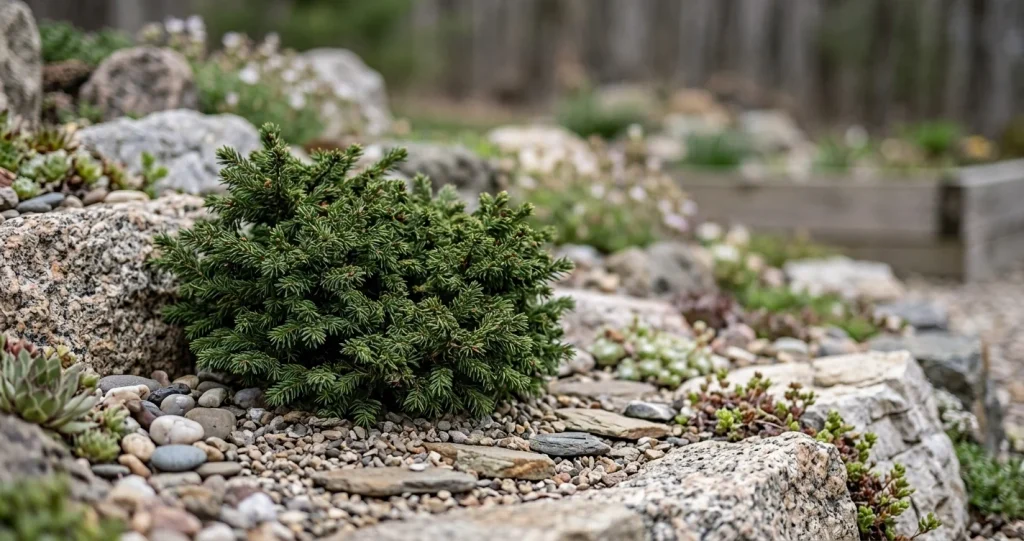
Dwarf conifers in garden design
Compact conifers are valued for rock gardens, containers, and small landscapes.
Some have rounded, cushion-shaped, or irregular forms.
Their unusual shapes can trace back to spontaneous mutations that changed how branches developed.
This is a striking example of how a botanical abnormality can sometimes become a horticultural feature.
In Your Own Yard: A Practical Inspection Guide
Discovering a witches’ broom can be an opportunity to learn more about the trees around your home.
A careful inspection often provides useful clues without requiring immediate intervention.
Step 1: Observe the entire tree
Stand far enough away to see the full canopy.
Notice whether the tree has one broom or several.
Look for dead branches, thinning foliage, or other unusual growth patterns.
Step 2: Identify the species
Examine leaves, needles, bark, buds, and branching patterns.
A tree identification guide or local Extension resource can help.
Correct host identification makes further investigation much easier.
Step 3: Photograph the abnormal growth
Take a photograph showing the broom’s location within the tree.
If it is safe to do so from the ground, take a closer image of the affected shoots.
Avoid climbing or breaking branches simply to obtain a better view.
Step 4: Look for signs of disease
Inspect accessible portions of the tree for discoloration, cankers, damaged bark, or unusual foliage.
These observations can help a specialist determine whether the broom is associated with a pathogen.
Step 5: Decide whether action is needed
A small, stable broom may be left in place.
A broom accompanied by extensive decline or located on a hazardous branch may justify professional evaluation.
Avoid pruning solely because the growth looks unusual.
Step 6: Monitor changes over time
Repeat your observations each season.
Late autumn and winter are particularly useful for examining the branching structure of deciduous trees.
Comparing photographs can reveal changes that are difficult to notice during a single visit.
Frequently Asked Questions
1. Does witches’ broom mean a tree is diseased?
Not necessarily. Witches’ broom is a growth symptom that can result from fungal or phytoplasma infections, certain insects or mites, genetic mutations, or other disturbances. Some formations are relatively harmless, while others indicate a disease. Identifying the tree and associated symptoms helps determine the cause.
2. Should I cut witches’ broom off my tree?
Removal depends on the cause and condition of the tree. A stable broom on an otherwise healthy tree may not require pruning. If the affected branch is dead, declining, structurally weak, or associated with a disease for which pruning is recommended, removal may be appropriate. Seek professional advice for large or high branches.
3. Can witches’ broom spread to other trees?
Some witches’ brooms result from infectious organisms that may spread under suitable conditions. Others arise from noninfectious genetic changes and cannot spread between trees. The risk depends on the underlying cause, host species, and pathogen biology.
Conclusion
Return to that tangled ball of twigs high in a nearly bare autumn tree.
At first glance, it resembles an abandoned nest or a bundle of branches caught in the canopy. But a closer look reveals that the twigs may be growing directly from the tree itself.
The witches broom tree phenomenon demonstrates how sensitive plant growth can be to changes in genetics, hormones, pathogens, and environmental conditions.
Some brooms are signs of disease. Others are harmless abnormalities, and a few become the starting point for unusual ornamental cultivars.
For gardeners, the most useful response is careful observation, accurate identification, and selective management rather than immediate removal.
For anyone fascinated by nature, witches’ broom offers a reminder that even a familiar tree can develop something extraordinary.
Sometimes the most interesting discoveries in a woodland are hiding in plain sight, among the branches overhead.
External Sources
1. Utah State University Extension — Witches’ Broom
Covers identification, common host trees, fungal diseases, phytoplasmas, dwarf mistletoe, and management recommendations. USU
2. University of Minnesota Extension — Spruce Needle Rust
Explains how rust fungi can cause witches’ brooms on spruce trees, their seasonal life cycles, and when pruning is appropriate. UMN Extens