
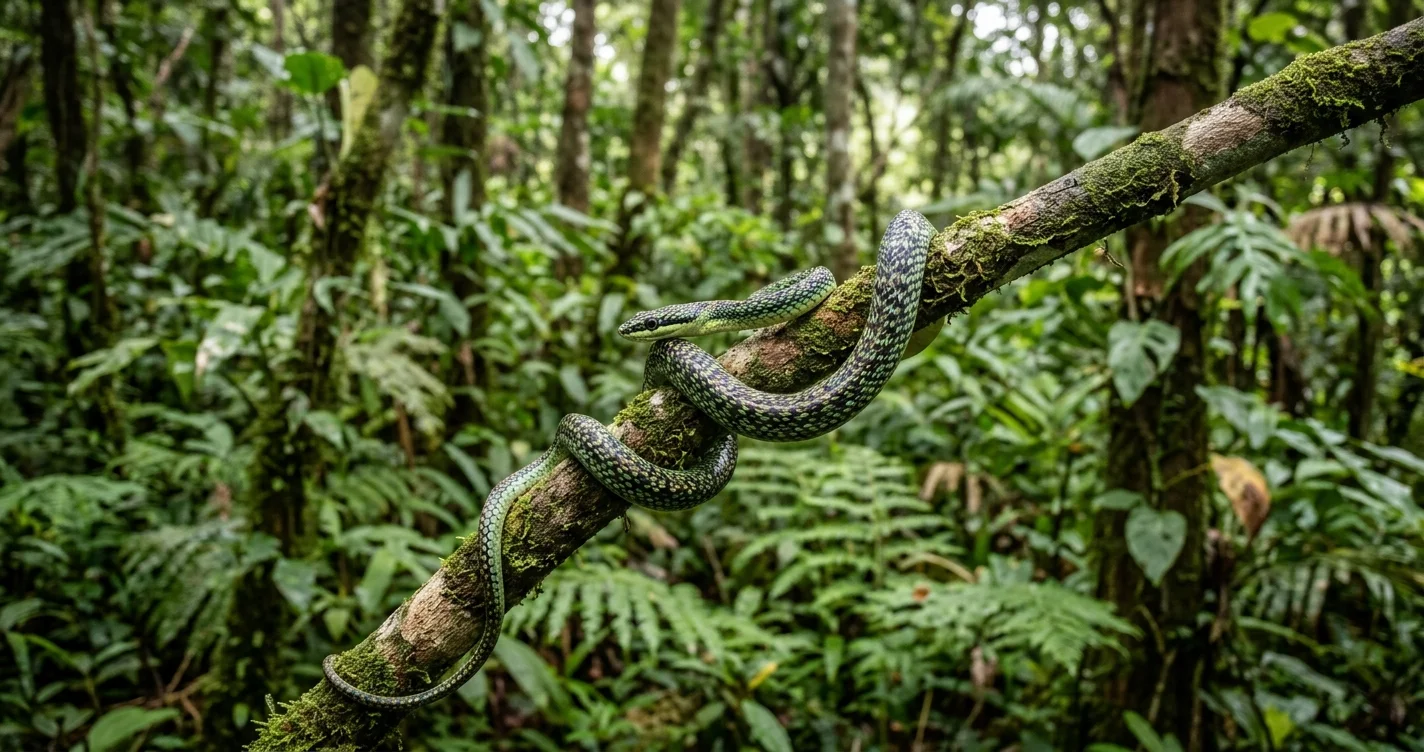
A snake launches itself from a tree branch, spreads its ribs, and sails through the air. It has no wings, feathers, or gliding membrane. Yet instead of dropping straight to the forest floor, it travels sideways through the air, bending its body as though it were swimming through an invisible river.
This remarkable behavior is known as flying snake gliding, and the paradise tree snake (Chrysopelea paradisi) is one of its most impressive performers.
Found in Southeast Asia, this slender, tree-dwelling reptile has evolved an extraordinary way to move between elevated locations. Its secret involves a flattened body, carefully coordinated movements, and aerodynamic forces that scientists are still investigating.
The result is one of nature’s most surprising examples of flight without wings.
Table of Contents
- Meet the Paradise Tree Snake
- Flying Snake Gliding: How a Snake Stays Airborne
- The Remarkable Body Shape That Makes Gliding Possible
- Why Flying Snakes Move Through the Air
- Where Paradise Tree Snakes Live
- What Flying Snakes Eat
- How Scientists Study Flying Snakes
- Flying Snakes and Other Gliding Animals
- In Your Own Yard: Understanding Gliding Wildlife
- Common Misconceptions About Flying Snakes
- Frequently Asked Questions
Meet the Paradise Tree Snake
The paradise tree snake, scientifically known as Chrysopelea paradisi, belongs to a small group of snakes capable of controlled aerial gliding.
Members of the genus Chrysopelea occur in parts of South and Southeast Asia, although individual species have different geographic ranges.
The paradise tree snake is particularly associated with tropical Southeast Asia, including forested habitats where trees provide opportunities for climbing, hunting, and aerial movement.
A colorful snake built for life above the ground
The paradise tree snake is relatively slender, with a long body and a narrow head.
Its coloration often includes black-edged scales arranged in greenish or yellowish patterns. Some individuals display striking reddish or orange markings along the back.
These patterns can be especially attractive when the snake is photographed against green tropical foliage.
Like other snakes, it has no limbs. However, its body is remarkably flexible, and its specialized rib movements allow it to change shape during a glide.
That ability is central to its aerial performance.
A snake that spends much of its time climbing
Paradise tree snakes are strongly arboreal, meaning they spend considerable time in trees and other elevated structures.
They can move through branches, climb vertical surfaces, and navigate complex vegetation.
Their slender build helps them travel through narrow spaces and across branches.
Gliding adds another way to move through this three-dimensional environment.
Rather than relying entirely on climbing down one tree and up another, a flying snake can sometimes cross an open gap through the air.
Flying Snake Gliding: How a Snake Stays Airborne
The most extraordinary part of flying snake gliding is that the animal uses its entire body as an aerodynamic surface.
Unlike birds, bats, or flying squirrels, the paradise tree snake does not have wings or a membrane stretched between its limbs.
Instead, it transforms the shape of its body during the glide.
Researchers have examined this process using high-speed video, aerodynamic experiments, and mathematical models.
Their findings reveal several interacting mechanisms.
Step 1: The snake prepares to launch
Before gliding, a paradise tree snake moves toward an elevated launching point.
It may extend the front of its body outward from a branch while maintaining contact with the support behind it.
The snake then propels itself into the air.
Some observed launches involve a characteristic body posture that helps the animal generate momentum and establish its initial trajectory.
The height of the launching point and the snake’s initial movement influence the glide that follows.
Step 2: The ribs spread and the body flattens
Once airborne, the snake changes the cross-sectional shape of its body.
Muscles associated with the ribs help spread the body laterally.
The underside becomes broader, producing a flattened, somewhat concave shape.
This transformation increases the surface available to interact with moving air.
The resulting shape is unlike the rounded cross-section of a snake resting on a branch.
It is an important part of the animal’s aerodynamic adaptation.
Step 3: Airflow produces aerodynamic forces
As the snake moves through the air, airflow around its flattened body generates aerodynamic forces.
These include lift, which acts partly against gravity, and drag, which resists motion through the air.
A gliding snake does not create continuous powered flight like a bird flapping its wings.
Instead, it converts gravitational potential energy into forward and downward movement while using its body shape to influence the descent.
The snake still loses altitude, but its trajectory can carry it a substantial horizontal distance.
Step 4: The snake undulates in midair
One of the most recognizable features of flying snake gliding is its side-to-side movement.
The snake bends its body into traveling waves, producing an aerial motion that resembles swimming.
This is not simply random wriggling.
Research suggests that aerial undulation contributes to the stability and control of the glide.
The snake coordinates different parts of its body while moving through the air.
This allows its flexible body to function as a dynamic aerodynamic system.
Step 5: The snake controls its trajectory
A flying snake can adjust its body posture during descent.
Changes in orientation, body curvature, and movement may influence its path.
Researchers have documented controlled gliding rather than a simple uncontrolled fall.
The animal can travel horizontally while descending, and its movements help maintain a useful orientation before landing.
The exact performance varies with species, body size, launch conditions, and environmental factors.
Step 6: The snake lands
Eventually, the snake reaches another tree, vegetation, or the ground.
It may contact branches or other surfaces as it completes the glide.
Its flexible body helps it respond to landing forces.
Not every glide ends at a precisely selected branch, and gliding performance depends on the available habitat.
Nevertheless, the ability to cross gaps through the air gives these snakes an unusual form of mobility.
The Remarkable Body Shape That Makes Gliding Possible
The paradise tree snake’s anatomy is central to its aerial abilities.
A flexible rib cage
Snakes possess numerous vertebrae and ribs along much of their bodies.
In flying snakes, muscular control allows the ribs to contribute to substantial changes in body shape.
During a glide, the snake can broaden its body and create an aerodynamic cross-section.
This is a temporary transformation rather than a permanently flattened body.
A surprisingly effective aerodynamic profile
Researchers studying flying snakes have tested models of their flattened cross-sectional shape in wind tunnels.
These experiments found that the shape can generate substantial lift under certain airflow conditions.
The geometry includes a relatively broad upper surface and a concave underside.
The precise aerodynamic behavior depends on the angle of attack and other conditions.
This research helps explain how a limbless animal can generate useful lift without conventional wings.
The entire body contributes
A flying snake is not a rigid aircraft.
Its shape changes continuously during flight.
Different sections of the body may experience different aerodynamic forces as the snake undulates.
This makes its movement especially interesting to scientists studying flexible structures and animal locomotion.
The body simultaneously acts as the aerodynamic surface and the mechanism for adjusting that surface.
Why Flying Snakes Move Through the Air
Gliding is impressive, but evolution does not produce unusual adaptations simply for spectacle.
In many animals, movement abilities develop because they improve access to resources, reduce travel costs, or help individuals survive.
Moving between trees
A major potential advantage of gliding is the ability to cross gaps in the forest canopy.
An arboreal snake that can glide may avoid some trips to the ground.
This could reduce the time and effort required to move between elevated locations.
However, the exact ecological benefits of gliding are difficult to measure in wild populations.
Escaping danger
Gliding may also provide a way to leave a dangerous location rapidly.
A snake threatened in a tree could potentially launch into the air rather than remain on the branch.
This is a plausible advantage, although the frequency with which wild paradise tree snakes use gliding specifically to escape predators is not fully established.
Reaching new hunting areas
Moving between trees may help snakes reach locations where prey is available.
This could be especially useful in complex forest habitats.
Still, it is important to distinguish likely ecological benefits from behaviors that have been directly documented.
Scientists continue to investigate how flying snakes use gliding in natural environments.
Where Paradise Tree Snakes Live
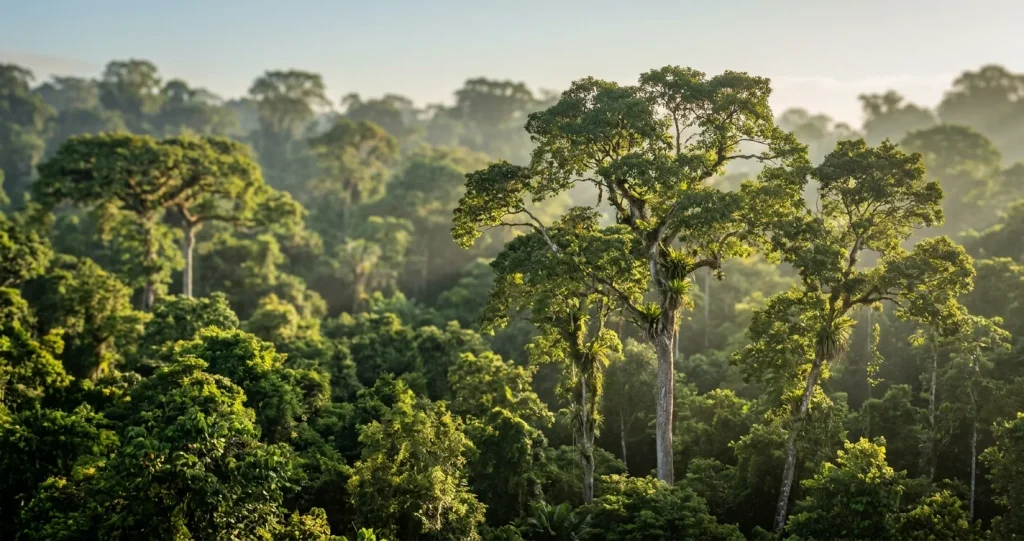
Paradise tree snakes occur in parts of Southeast Asia, including tropical forest environments.
Their distribution includes areas of the Malay Peninsula and several Southeast Asian islands.
They are associated with trees, vegetation, and other structures that provide climbing opportunities.
Tropical forests
Forested habitats offer branches, trunks, and vegetation that support arboreal movement.
The vertical complexity of these environments creates opportunities for gliding between elevated positions.
Forest edges and modified habitats
Some flying snakes can also occur near forest edges or in environments influenced by human activity.
Their presence depends on local habitat suitability, prey availability, and species distribution.
Not every tropical location supports the paradise tree snake, and the species is not native to the United States.
Why habitat structure matters
Gliding requires suitable launch points and landing areas.
A landscape with trees separated by manageable gaps may provide opportunities for aerial movement.
Habitat fragmentation can alter these conditions, although its specific effects on paradise tree snake populations require careful study.
What Flying Snakes Eat
Paradise tree snakes are predators.
Their diet includes small vertebrates, particularly animals encountered in trees and other elevated habitats.
Lizards
Lizards are important prey for several flying snake species.
Tree-dwelling lizards can be encountered on branches, trunks, and foliage.
The snake captures prey using its jaws and teeth.
Other small animals
Depending on species, location, and prey availability, flying snakes may consume other small vertebrates.
Published natural-history accounts describe prey such as frogs and small birds among members of the genus.
Diet should not be assumed to be identical across every flying snake species.
Mild venom and prey capture
Paradise tree snakes are rear-fanged and possess venom associated with prey capture.
They are generally considered to pose a relatively low risk to humans compared with medically significant venomous snakes.
However, they should not be handled casually.
Bites and individual reactions can vary, and unfamiliar wild snakes should always be observed from a safe distance.
How Scientists Study Flying Snakes
Understanding flying snake gliding requires more than watching a snake leap from a branch.
Researchers use several complementary methods to examine the movement.
High-speed video
High-speed cameras record rapid body movements that are difficult to see with the naked eye.
By tracking points along a snake’s body, researchers can reconstruct its posture and trajectory during a glide.
These observations reveal how the animal changes shape and undulates in the air.
Three-dimensional motion analysis
Scientists can use multiple camera views to reconstruct the snake’s movement in three dimensions.
This helps distinguish horizontal travel, vertical descent, and changes in body orientation.
The resulting data provide a more complete picture of aerial control.
Wind-tunnel experiments
Researchers have also investigated models based on the cross-sectional shape of flying snakes.
Wind-tunnel tests measure aerodynamic forces under controlled airflow conditions.
These experiments help explain why the snake’s flattened body can generate lift.
However, a stationary model cannot reproduce every aspect of a living snake’s flexible movement.
Computer modeling
Mathematical models allow scientists to explore how body undulation influences flight stability.
A 2020 study published in Nature Physics examined the role of aerial undulation in the gliding performance of flying snakes.
The researchers found that these movements contribute to stability, providing evidence that the snake’s side-to-side motion has an important aerodynamic function.
The findings also demonstrate why flying snake movement cannot be fully explained by body flattening alone.
Flying Snakes and Other Gliding Animals
Flying snakes are part of a broader group of animals that move through the air without powered flight.
Flying squirrels
Flying squirrels use a membrane of skin stretched between their limbs.
This structure increases their aerodynamic surface area.
Unlike flying snakes, they rely on a distinct gliding membrane.
Gliding lizards
Lizards of the genus Draco possess elongated ribs that support winglike membranes.
These structures allow them to glide between trees.
Their aerodynamic design is very different from the flattened body of a flying snake.
Gliding frogs
Some tree frogs have enlarged webbing between their toes and other body adaptations that can help slow descent or support controlled aerial movement.
Their gliding performance varies by species.
What makes flying snakes different
Flying snakes have no limbs or external gliding membrane.
They use a temporary change in body cross-section combined with coordinated aerial undulation.
That combination makes them especially unusual among vertebrate gliders.
In Your Own Yard: Understanding Gliding Wildlife
Paradise tree snakes do not naturally occur in American gardens.
However, the principles behind their movement connect to wildlife that may be found in the United States.
Watch for flying squirrels
In suitable wooded regions, flying squirrels may live in mature trees.
These nocturnal mammals use gliding membranes to move between trunks and branches.
Observing them requires patience and respect for their natural behavior.
Notice how animals use vertical habitat
Trees provide more than shade.
Their branches, bark, cavities, and leaves create a three-dimensional habitat for birds, mammals, reptiles, and insects.
Different animals have evolved specialized ways to navigate these spaces.
Support native trees and habitat connections
Planting appropriate native trees can provide food and shelter for local wildlife.
Where space allows, maintaining connected tree cover may benefit species that travel through wooded habitats.
Choose trees suited to your region, soil, and available growing space.
Observe reptiles without disturbing them
If you encounter a snake in your yard, give it space.
Most snakes play useful ecological roles as predators.
Avoid attempting to capture, relocate, or identify an unfamiliar snake by handling it.
For species-specific guidance, consult local wildlife agencies or qualified professionals.
Explore the physics of gliding
A simple paper glider can demonstrate how shape affects movement through the air.
Try comparing different paper shapes and observing how they descend.
Although a paper model cannot reproduce a flying snake’s flexible anatomy, it can introduce the relationship between surface shape, airflow, and stability.
Common Misconceptions About Flying Snakes
Flying snakes can fly like birds
Flying snakes do not perform sustained powered flight.
They glide by using aerodynamic forces while descending from elevated locations.
They cannot remain airborne indefinitely or climb upward through the air like a bird using powered flight.
Flying snakes have invisible wings
They have no wings.
Their flattened bodies create aerodynamic surfaces that generate lift.
The mechanism depends on anatomy and movement rather than hidden appendages.
Flying snakes are always dangerous to humans
The dramatic name can make these animals sound more threatening than they are.
Paradise tree snakes possess venom used in prey capture, but they are not generally regarded as a major medical threat to humans.
Nevertheless, bites should be avoided, and wild snakes should not be handled.
All snakes can glide
Only a small group of snakes in the genus Chrysopelea is known for this specialized aerial behavior.
Most snakes lack the combination of anatomical and behavioral adaptations required for controlled gliding.
Frequently Asked Questions
1. How far can a paradise tree snake glide?
Flying snake gliding distances depend on the species, launching height, body size, and environmental conditions. Under favorable circumstances, flying snakes can travel considerable horizontal distances while descending. Some published observations and experiments describe glides spanning many meters, but there is no single distance that applies to every glide.
2. Do paradise tree snakes use their ribs to glide?
Yes. Flying snakes can move their ribs to flatten and broaden their bodies during a glide. This altered cross-sectional shape helps generate aerodynamic forces. Their side-to-side aerial movements also contribute to stability and control.
3. Are flying snakes found in the United States?
Paradise tree snakes are native to parts of Southeast Asia, not the United States. Americans may encounter other gliding animals, such as flying squirrels, but flying snakes are not part of the native U.S. reptile fauna.
Conclusion
Return to that extraordinary moment in the tropical forest.
A slender snake leaves a branch, spreads its ribs, flattens its body, and begins moving through the air.
What looks like an impossible leap is actually a carefully coordinated interaction between anatomy, movement, gravity, and airflow.
The science of flying snake gliding reveals how evolution can produce remarkable solutions to the challenges of moving through complex habitats.
The paradise tree snake does not need wings to glide. Its body becomes the aerodynamic surface, and its undulating movements help stabilize the journey.
For scientists, it is a fascinating subject in biomechanics and aerodynamics. For nature enthusiasts, it is a reminder that some of the most astonishing adaptations are found in animals that appear, at first glance, to lack the equipment needed for the task.
In the forests of Southeast Asia, a snake can leave a tree and travel through the air—not by defying gravity, but by making remarkable use of it.
External Sources
1. Socha (2002), Nature. Gliding Flight in the Paradise Tree Snake. Research documenting the gliding performance of Chrysopelea paradisi.
2. Holden et al. (2014), Journal of Experimental Biology. Aerodynamics of the Flying Snake Chrysopelea paradisi: How a Snake Cross-Section Generates Lift. Experimental investigation of the aerodynamic forces produced by the snake’s flattened body.